30 June 2016 by Ben Howard
 “Have you been comparing?” ask Rodgers and Hart in their 1932 ballad “You Are Too Beautiful.” I suspect that most of us, if we are being honest and sufficiently self-aware, would have to answer in the affirmative.
“Comparison,” observed Mark Twain, whose vein of dark wisdom ran as deep as his humor, “is the death of joy.” Yet on we go, comparing whatever is at hand, be it brands of dental floss or newly listed homes or presidential candidates. A product of our education and social conditioning, the mental habit of comparison is as ingrained as it is necessary for survival. Regrettably, however, if left unexamined that habit can also rob us of happiness and hinder us from appreciating our present lives. Continue Reading »
Posted in 1 | Tagged comparison, faith-mind sutra, Japanese tea ceremony, Krishnamurti, Rodgers and Hart, Seng-Ts'an, William Scott Wilson, You Are Too Beautiful, zen meditation | Leave a Comment »
20 April 2016 by Ben Howard
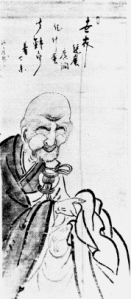
Ummon Bun’en
Drawing by Hakuin Ekaku
Among the cryptic sayings associated with the Zen tradition, none is better known than that of Ummon Bun’en (862-949), who famously declared that “every day is a good day.” Yeah, right, the weary, seasoned mind replies. Tell that to the commuter caught in gridlock or the stressed-out parent nursing a sick child. Superficially construed, Ummon’s remark sounds both naive and culpably aloof.
Yet, if examined in the light of Zen teachings, this adage is neither foolish nor untrue. The key component of Case 6 of the Blue Cliff Record, a classic collection of Zen koans, Ummon’s pronouncement is a fiction that points to an underlying reality, a construct that discloses a deeper truth. If we wish to probe that truth, we can consult the host of commentaries Case 6 has accrued, beginning with that of Hakuin Ekaku (1686-1768), compiler of Zen koans, who called this particular koan “cold,” meaning austere and challenging to contemplate. But if we wish to explore Ummon’s saying in a warmer light, we can begin by reflecting on how we know, or think we know, the things of this world, and how we determine whether a given day is good or bad. Continue Reading »
Posted in 1 | Tagged fuchsia, hakuin, ichigo ichie, Katsuki Sekida, Ummon | 2 Comments »
30 March 2016 by Ben Howard
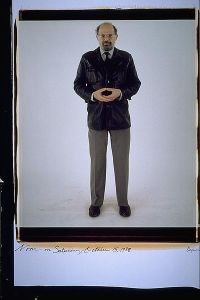
Allen Ginsberg, 1988
When the student is ready, the teacher will appear. So goes the Zen proverb, and for many it may be true. In my case, however, I was neither ready nor expectant. And my first guide on the path of meditation was an unlikely candidate for the position.
Allen Ginsberg visited Alfred University in October 1978. It was a relatively tranquil time, especially when contrasted with our present era. A few weeks earlier, the Camp David Accords had been signed under the watchful eye of President Jimmy Carter. In Western New York the fall colors were at their peak. Continue Reading »
Posted in 1, meditation, Zen | Tagged "Howl", 1970s, Alfred University, Allen Ginsberg, Cambridge, Dai Bosatsu Zendo, Elsa Dorfman, England, octagonal houses, Peter Orlovsky, thich nhat hanh | Leave a Comment »
16 March 2016 by Ben Howard

Zoketsu Norman Fischer
“Why do we like being Irish?” asks the Irish poet Louis MacNeice (1907-1963) in his poem Autumn Journal (1939). In subsequent lines, he answers his own question:
Partly because
It gives us a hold on the sentimental English
As members of a world that never was,
Baptized with fairy water;
And partly because Ireland is small enough
To be still thought of with a family feeling,
And because the waves are rough
That split her from a more commercial culture;
And because one feels that here at least one can
Do local work which is not at the world’s mercy
And that on this tiny stage with luck a man
Might see the end of one particular action.
Because Ireland is a relatively small country, and because in MacNeice’s time families tended to stay put for as long as economic conditions allowed, Irish people could reasonably hope to see the “end”–the consequences as well as the completion–of any particular action. Continue Reading »
Posted in 1, neuroscience, Zen | Tagged Autumn Journal, Belfast, Benjamin Libet, karma, louis macneice, norman fischer, Northern Ireland, peace, quarter-second, Susan Moon, Yeats | 2 Comments »
3 March 2016 by Ben Howard
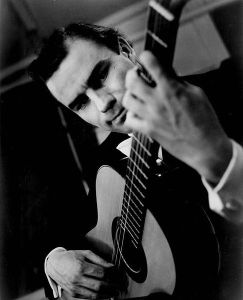
Julian Bream, 1964
On this snowy winter evening I’ve been listening to Benjamin Britten’s Nocturnal After John Dowland (1963), a twenty-minute piece for solo guitar composed for the English lutenist and guitarist Julian Bream (b. 1933). By turns dreamy and martial, restless and serene, this masterpiece of the modern guitar repertoire can be heard on Bream’s 1967 album 20th Century Guitar, one of forty CD’s in my newly-acquired Julian Bream: The Complete RCA Album Collection (2013). Released in conjunction with Bream’s eightieth birthday, this handsome boxed set is both a treasure trove of music for classical guitar and a tribute to a great musician’s lifetime achievement. And for this listener, the collection also evokes an enduring memory. Continue Reading »
Posted in 1, Zen | Tagged Benjamin Britten, Come Heavy Sleep, Django Reinhardt, John Dowland, Julian Bream, Letting Go, Nocturnal | Leave a Comment »
17 February 2016 by Ben Howard
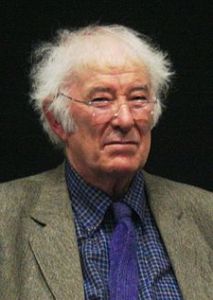
Seamus Heaney
In an interview many years ago, a journalist asked the Irish poet Seamus Heaney (1939-2013) for his thoughts on aging. At the time, Heaney must have been in his late fifties or early sixties. With his usual precision of language, leavened by a wryly ironic smile, Heaney remarked that growing older had brought “the inevitable attenuations.” He did not elaborate, but anyone of a certain age could readily fill in the blanks. And more important than the words or the missing details was the attitude behind them, an attitude at once rare and profoundly liberating.
Like forty million other men and women over the age of fifty, I belong to the AARP, formerly known as the American Association of Retired Persons. As a privilege of membership I receive two bimonthly publications: the AARP Magazine, which is printed on glossy paper and vaguely resembles People magazine; and the AARP Bulletin, which is printed on newsprint and resembles a tabloid. The Magazine endeavors to entertain, educate, and inspire me, while perhaps selling an Acorn Chairlift or a life-insurance policy along the way. By contrast, the Bulletin aspires to keep me informed and alert me to financial and health-related hazards threatening older people. Together these complementary organs of our consumer culture purport to enhance my so-called golden years and help me feel more secure. All too often, however, their effect is quite the opposite. Continue Reading »
Posted in 1 | Tagged AARP, aging, attenuation, Burt Reynolds, Diane Keaton, elbow outward, seamus heaney, zen | 1 Comment »
3 February 2016 by Ben Howard
 One bright morning several weeks ago, I received a friendly e-mail message from Amazon. “Benjamin W. Howard,” it read, “Based on your recent activity, we thought you might be interested in this:” Below these words, a handsome new book was displayed: “Firewood and Ashes: New and Selected Poems, by Ben Howard.”
To be fair to Amazon, I was indeed interested in the product described, and my interest was indubitably based on my recent activity. And, all things considered, I was heartened to see Amazon actively marketing my book and targeting a plausible customer. More power to them, I might have said, and may their project flourish.
At the same time, Amazon’s little slip-up highlighted something fundamental and unnerving about life in the digital era. Like other denizens of the twenty-first century, I am aware of the ways by which mega-conglomerates monitor our purchasing histories and manipulate our predilections. Nonetheless, had the book being promoted not been my own, I might have dozily surmised that someone at Amazon was looking out for me, as old-fashioned booksellers used to do, and that the message I had just received embodied an actual human presence. Continue Reading »
Posted in 1 | Tagged algorithm, Amazon, Laurence Scott, natural presence, presence, Tara Brach, virtual reality | Leave a Comment »
13 January 2016 by Ben Howard
 Last month the holiday season brought three small grandchildren to our home. Jack is six, Isla three, and Allegra two. Three may well be a crowd, but apart from an upset or two, this trio of tots played harmoniously together, and their brief presence brightened our lives.
A few days after the children and their parents had departed, I retired to my study to read a book I had bought just before the holidays: The Essential Brendan Kennelly, a richly varied selection of the Irish poet’s work, published on the occasion of his 75th birthday. I had left the book on a low table next to my reading chair. When I opened it, I found to my surprise a waxy red scribble on the title page. Someone had left me a souvenir.
Although I am not one to condone the defacing of books, I was amused by this discovery, and I suspect that Brendan Kennelly would be as well. One of Kennelly’s best-known poems, “Poem from a Three Year Old,” speaks in the voice of a child. Its exuberant verses dramatize the spirit of play, the incessant questioning, and the moments of wonder intrinsic to childhood. “The first moment of wonder,” Kennelly has remarked, “is an amazing moment, as if for the first time something is happening. And that is the moment on which poetry depends.” There is a “strange thing” in us, Kennelly asserts, that is destroyed by familiarity and experience. But through the successive acts of attention that constitute an authentic poem, the familiar can again become strange and the sense of wonder restored. “And I think that’s what poetry is about–a kind of permanent beginning.” Continue Reading »
Posted in 1 | Tagged begin again, Brendan Kennelly, ichhigo ichie, ichigo ichie | 2 Comments »
16 December 2015 by Ben Howard
 Last week two Army helicopters flew over the village of Alfred, New York. Their thunder, my wife confided, unnerved her as never before.
In the wake of the mass shootings in Paris, Colorado Springs, and San Bernadino, fear has become a focus of national attention. In his address to the nation on December 6, President Obama sought to reassure us. “Freedom,” he asserted, “is more powerful than fear.” Perhaps it is in the long run, but for the time being, how can we best address the growing presence of fear in our daily lives? And how can the practice of meditation help us in that effort? Continue Reading »
Posted in 1 | Tagged dharma rain, fear, jack kornfield, Michele McDonald, non-fear, RAIN, thich nhat hanh, Zenkei Blanche Hartman | 1 Comment »
2 December 2015 by Ben Howard
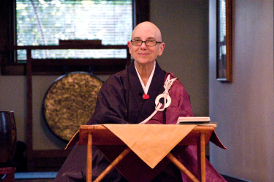
Shinge Roko Sherry Chayat Roshi, Abbot,
Dai Bosatsu Zendo and the Zen Center of Syracuse
The practice of Zen contemplation, Zen teachings tell us, is the “action of non-action,” grounded in silent awareness. At the same time, the “non-action” of Zen is best described in active verbs. In her essay “What is Zen?” Shinge Roko Sherry Chayat Roshi offers this description:
What is Zen? Stop now. Stop trying to get an intellectual lock on something that is vast and boundless, far more than the rational mind can grasp. Just breathe in with full awareness. Taste the breath. Appreciate it fully. Now breathe out, slowly, with equal appreciation. Give it all away; hold onto nothing. Breathe in with gratitude; breathe out with love. Receiving and offering–this is what we are doing each time we inhale and exhale. To do so with conscious awareness, on a regular basis, is the transformative practice we call Zen.
It would be difficult to find a more lucid or concrete description of Zen practice. Follow Shinge Roshi’s instructions, and you will not go wrong. Yet, for all its clarity, this description is at one point ambiguous. “Hold onto nothing,” Shinge Roshi advises. “Give it all away.” But what is the antecedent, a grammarian might inquire, of the pronoun “it”? What, besides our breath, are we giving away? Continue Reading »
Posted in 1, meditation, Zen | Tagged Blanche Hartman, emptiness, interdependence, Milarepa, norman fischer, Shinge roko sherry chayat roshi, Shinge Roshi, Shunryu Suzuki Roshi | Leave a Comment »
« Newer Posts - Older Posts »

