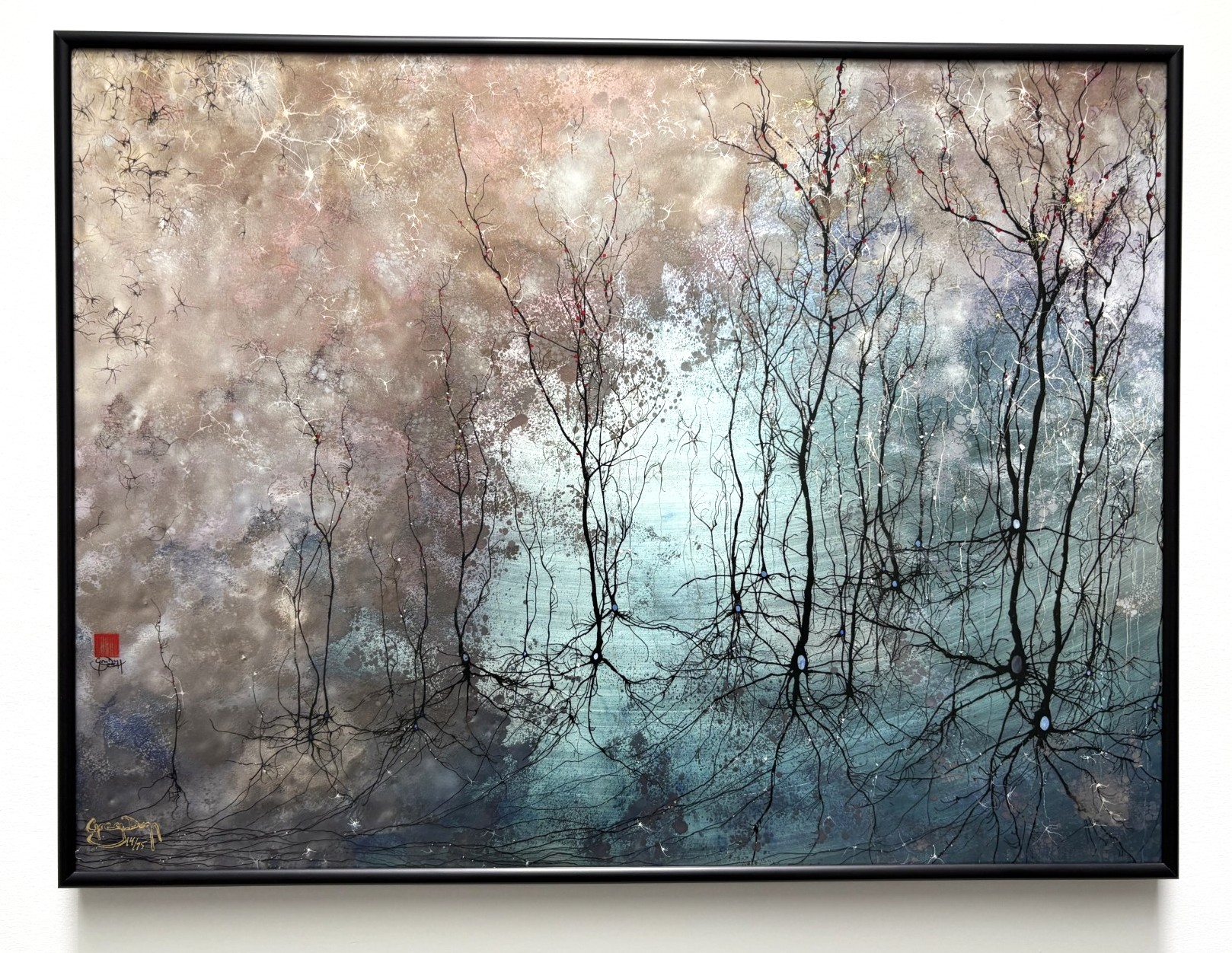
Recently I hung a giclée print by the contemporary American artist Greg Dunn on the wall of my meditation room. Viewing the print casually, you might first think it depicts an underwater scene: its center is a wavy, luminous blue. But it might also be a forest with a pond in the background. Its dominant components are the black limbs that branch upward in a blue mist. Look more closely, and you may notice red points on the limbs, resembling fairy lights. The atmosphere is mysterious and alluring. The mood is at once tranquil and dynamic.
The print is titled Blue and Silver Cortex. And what you are contemplating, in all its complex beauty, is not a forest or an underwater seascape but the cerebral cortex of the human brain. Greg Dunn is a neuroscientist as well as a visual artist. He holds a doctorate in neuroscience from the University of Pennsylvania. And what he creates in his studio and exhibits worldwide is “neuro art”: prints, ink paintings, micro-etchings, gold-leaf works, scrolls, murals, and large installations, all based on slices of the human brain. His images sometimes call to mind cross-sections of broccoli or squash, but most resemble living trees. Although his works have a decidedly Asian feel, reflecting the artist’s affinity for Asian art, what they represent are not ancient Chinese landscapes but the neuronal pathways of our own, homegrown brains. Those miniature, finger-like limbs at the ends of branches are nerve endings. Those fairy lights are dendrites: the branched protoplasmic extensions where nerve cells exchange information.
In his book In Trees, the journalist and arborist Robert Moor, who has traveled to the ends of the earth to study woody plants and has climbed to the crowns of the Great Sequoias, contends that we suffering human beings have much to learn from the “wisdom of trees.” Most centrally, we can study and emulate those natural processes by which trees heal themselves and live long lives: “branching, pruning, and gnarling.” By these stratagems, trees manage to heal their injuries, continue to grow even as they die inside, and sometimes, as in the case of the sequoias, live for millennia.
In his discussion of branching, which takes place in both the limbs and the root systems of trees, Moor draws direct parallels to human growth, physical in part but primarily intellectual, emotional, and spiritual. Like trees in good health, we can branch outward and upward all our lives, even as we anchor ourselves in wide, deep roots. Or as happens all too often, we can let our mental limbs and branches wither for lack of challenge, nourishment, or care.
As a prime example of such decline, Moor cites the poet William Wordsworth, who wrote his canonical poems, most notably The Prelude, before he was thirty-four. Although he continued to write verse and prose throughout his eighty years, he never equaled his early achievements. When a young Ralph Waldo Emerson journeyed to the Lake District to meet the venerable poet, he encountered an elderly man with green shades to protect his eyes and a mind drastically narrowed. Once the radical and visionary, who had composed some of the most ambitious and groundbreaking poems in the English language, he had grown rigidly conservative and far less open to the changing world.
Fortunately, such decline is not inevitable. Moor offers many counterexamples, including a spirited Japanese bonzai master and the British broadcaster David Attenborough, who recently turned 100 but is still creating acclaimed documentaries about the wild natural world. Among his historical models, Moor singles out Leo Tolstoy, a temperament expansive and boundlessly energetic even by Russian standards, whom Stefan Zweig described as an oak tree “spreading its branches wide . . . firmly rooted in the earth from which it springs.” Elaborating Zweig’s point, Moor notes that Tolstoy’s “arborescent mind” continued to expand throughout his life: “He taught himself to ride a bicycle at the age of sixty-five, and even into his eighties, he was still playing ferocious games of tennis, swinging a scythe alongside peasants on his estate, and swimming in the icy sea.”
Roshi Joan Halifax, the 84-year-old abbot of the Upaya Zen Center, has defined zazen (seated meditation) as a practice of being “radically open to things just as they are, not grasping or rejecting phenomena, but simply being present with moment-to-moment uncertainty and groundlessness.” The Zen teacher Christian Dillo urges the cultivation of “uncorrected [i.e. uncensored] mind,” which allows all manner of thoughts to arise, stay for a while, and depart. And the meditation teacher Gaylon Ferguson admonishes us to “welcome beginner’s mind.”
What these seasoned practitioners are gesturing toward is a state of continuing freshness, curiosity, and non-attachment much to be desired but not easily sustained. I sometimes recall that ideal as I pause to contemplate the branching limbs in Blue and Silver Cortex, each of them representing a neural path taken, a feeling or thought experienced, a possibility explored.
To learn more about Greg Dunn’s neuro art visit https://www.gregadunn.com/.


Leave a Reply