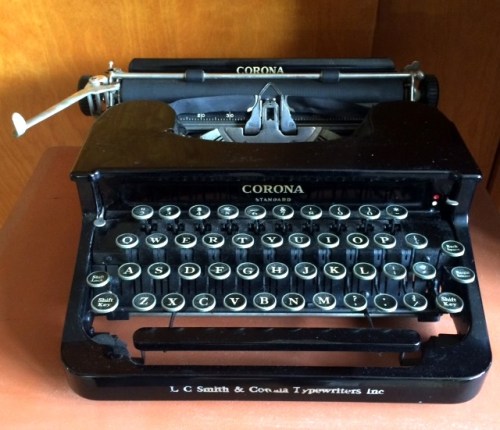
 Twelve years ago, my son gave me a vintage manual typewriter for my birthday. Black, sleek, and compact, it was manufactured in the 1930s by L.C. Smith and Corona Typewriters, Inc., of Syracuse, New York. All of its forty-seven keys are still intact, including its Shift Key, Shift Lock, Back Space, and Margin Release. Fitted out with a new black ribbon, it can still produce a faint but legible line: The quick brown fox jumps over the lazy dog.
Although I have never used this machine, it occupies a place of honor in my study, a symbol of my vocation and a reminder of family continuity and change. Half a century ago, I wrote my doctoral exams and my doctoral dissertation on my late father’s Royal Empress typewriter. Two decades later, when my son was soon to enter high school, I presented him with my own IBM Selectric, which even then was becoming obsolete. All too soon, that nimble machine gave way to his first personal computer. He is now a journalist by profession and does much of his work on a laptop or mobile device.
My Corona Standard is what Zen teachings call a composite thing. It consists of a multitude of moving parts, nearly all of them visible to the naked eye. Lifting its cover, I can inspect its type bars, type heads, springs, and twin ribbon spools. Turning it over, I can examine its gears, rods, cords, escapement, and walnut-sized bell. Equipped with the appropriate skills and tools, I could dismantle the entire mechanism, part by part. And at some point in the process, this complex, functioning machine would no longer be recognizable or identifiable as a typewriter, a term of convenience for a configuration of component parts. It would be revealed as the temporary aggregate it always was. Continue Reading »