 Consider, if you will, the peculiar status of the word special. Whether employed as adjective or noun, the word means distinctive, uncommon, out-of-the-ordinary. Yet the word itself could hardly be more common. On what seems like a weekly basis, retailers announce their Special Offers and Special Sales. For breakfast, some of us eat Special K, which presumably is superior to Regular K. When we go out to dinner to celebrate a special occasion, we are likely to hear at length about that evening’s specials. In some contexts, as in “special needs,” “special effects,” and Special Counsel, the word’s function is chiefly descriptive, but more often it serves to praise, sell, or persuade. If someone calls you a “very special person,” you can safely take it as a compliment. With rare exceptions, both the literal meaning and the connotations of special are reliably, if vaguely, laudatory. Continue Reading »
Posted in 1, meditation, Zen | Tagged charlotte joko beck, Robert Wright, Robert Zajonc, Seng-Ts'an, Shunryu Suzuki Roshi, zen | Leave a Comment »
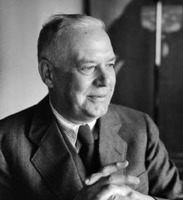
Wallace Stevens 1879-1955
In his poem “Sunday Morning,” the modern American poet Wallace Stevens depicts a leisured woman enjoying her late-morning coffee in a sun-drenched room. “She dreams a little,” the narrator notes; and in her reverie she revisits moments of heightened emotional intensity:
Passions of rain, or moods in falling snow;
Grievings in loneliness, or unsubdued
Elations when the forest blooms; gusty
Emotions on wet roads on autumn nights;
All pleasures and all pains, remembering
The bough of summer and the winter branch.
I first read those lines as an undergraduate, some fifty years ago. They have stayed with me over the decades, partly because of their formal beauty but also because they exemplify what the English poet and philosopher Samuel Taylor Coleridge (1772-1834) viewed as a principal aim of the poetic imagination: the “balance or reconciliation of opposite or discordant qualities.” In this instance, the qualities being reconciled are the disparate emotional states associated with spring and fall, summer and winter. Passion and its absence, grief and elation, loneliness and excitement, pleasure and pain—all are held in balance in one harmonious whole. Continue Reading »
Posted in 1 | Tagged contemplation, dualistic thinking, Father Richard Rohr, haiku, Wallace Stevens, Yosa Buson, zen | 2 Comments »
 All conditioned things, Zen teachings tell us, are impermanent. A conditioned thing is a phenomenon that arises from contingent causes and conditions. A pickup truck, a million-dollar home in California, a relationship, thought, or state of mind—all arise from particular causes and conditions; all are subject to what Zen calls the “law of impermanence.” Continue Reading »
Posted in 1 | Leave a Comment »
 In the spring of 1998, at a meditative retreat in Burlington, Vermont, Zen master Thich Nhat Hanh offered some basic instructions for seated meditation. “Just sit there,” he said. “Don’t try to become someone else.”
A year later, in Brownsville, Vermont, I attended a subsequent retreat conducted by Thich Nhat Hanh. On an August afternoon, I sat outdoors with “Thay,” as we called him, and a dozen others, drinking herbal tea. A gentle monk in his early seventies, he wore the earth-brown robes of his Vietnamese order. Now and then, he lifted his cup with both hands and took a sip of tea. At that time, Thich Nhat Hanh was already a figure of international renown. Describing him as an “apostle of peace and non-violence,” Dr. Martin Luther King had nominated him, in 1967, for the Nobel Peace Prize. Yet, on that August afternoon, his silent presence seemed as humble as it was peaceful. Well established in the present moment, he was the very embodiment of his own advice. He showed no sign of wanting to be anywhere or anyone else. Continue Reading »
Posted in 1 | Tagged aimlessness, apranihita, Buddhism, Martin Luther King, Maud Gonne, norman fischer, peace, thich nhat hanh, Three Doors of Liberation, W.B. Yeats, wishlessness, zen | Leave a Comment »
 Last month I read a book I hadn’t intended to read. Entitled The Camera Does the Rest, it is an illustrated history of the Polaroid camera. Its author, Peter Buse, chronicles the creation, the triumphant success, and the sad demise of the Polaroid phenomenon in twentieth-century American culture. More broadly, he assesses the impact of Edwin Land’s brilliant if rather bulky invention, once considered near-miraculous, in the history of photography. There had been nothing quite like it before, and though it foretold the digital era, its unique properties have yet to be fully replicated by digital technology. Continue Reading »
Posted in 1 | 2 Comments »
 I once had a neighbor who rarely stopped complaining, chiefly about his ailments. On one day it was his allergies, on another his asthma. On rare occasions, when his body was being relatively compliant, his monologues might briefly turn to other matters, but sooner rather than later they came back to his maladies. He seemed incapable of changing the subject.
However pronounced, my neighbor’s habit of mind was not all that unusual. The activity of complaining is as embedded in human nature as the verb describing it is in the English language. Complain derives from the Latin plangere, which means “to lament or bewail.” From the same root come plaintive, plangent, and of course complaint. If you are of a certain age, you may recall that physical afflictions and disorders, which are now euphemistically called “issues,” were once known as complaints. There were back complaints, neck complaints, stomach complaints, and many more. Some were real, others imagined. All caused the sufferer to complain, which is say, lament, often to no avail. Continue Reading »
Posted in 1 | Tagged complaint, gratitude, mindfulness, pain, thich nhat hanh, w.s. merwin, zen meditation | 2 Comments »
 The British poet Sir Geoffrey Hill (1932-2016) once described words as repositories of meanings. Those meanings may be social, historical, or political. They may also be hidden or manifest, dormant or active. The word silly, for example, once meant “innocent,” as in “the silly sheep,” but that meaning is no longer current. By contrast, the original meanings of other words may be extant in one culture but not in another, though the two share a common language.
Nature is one such word. In ordinary usage, nature refers to a physical world apart—or seemingly apart—from the human: the world of stars and planets, mountains and rivers, flora and fauna. But as recently as the mid-nineteenth century, the word nature could also refer to a quality altogether human: one’s “natural feeling and affection” (O.E.D.). Thus, in 1841, the English cleric Charles Henry Hartshorne could observe that “There’s often more nature in people of that sort than in their betters.” Commoners, in other words, often expressed more natural feeling than did the lords and ladies. By the end of the nineteenth century, lexicographers had deemed that older meaning archaic, at least in England. But in Ireland, it has persisted into the present century. In Brendan Behan’s play The Quare Fellow (1954), a prison guard who has just learned that a fellow guard has done him a favor responds by saying, “I’m more than grateful to you. But sure I’d expect no less from you. You’re all nature.” Continue Reading »
Posted in 1 | Tagged Buddha-nature, ireland, nature, Richard Tillinghast, thich nhat hanh | Leave a Comment »
That day she put our heads together,
Fate had her imagination about her,
Your head so much concerned with outer,
Mine with inner, weather.
— Robert Frost, “Tree at My Window”
If you pay attention to your inner life, you may have noticed how your experience of the world around you conditions your states of mind. Sitting with friends on a summer afternoon, you feel happy and relaxed. Watching the evening news, you feel tense and depressed. What may have escaped your notice, however, is the degree to which your mental states condition your experience of the world. “I feel different now,” my granddaughter remarked, having fallen and broken a front tooth, “and the world feels different, too.” In ways less dramatic and often less apparent, that is true for us grown-ups as well.
In Buddhist psychology, the part of our makeup that causes us to feel one way or another is known as a “mental formation.” According to traditional Buddhist teachings, the so-called self consists of five components, known as “form” (physical body), “feelings” (sensations), “thought” (perceptions), “mental formations,” and “consciousness.” Like the other components, mental formations are constantly in flux. They pass through our minds like changing weather. But while a particular mental formation is present, it mediates between our raw sensory impressions and our awareness of the world. It influences and may determine how we think, speak, and act. If, for example, the mental formation craving is present, we are likely to grasp, or try to grasp, the manifold things we encounter. By contrast, if the formation mindfulness is present, we are likely to see those objects clearly and allow them to remain as they are.
Mental formations might be likened to filters, through which we screen the evidence of our senses. At any given moment, what we call the world is in reality an immediate sensory impression—the bark of a dog, the smell of gas, a roseate evening sky—perceived through the medium of whatever mental formation might be present. In a microsecond, what began as a pure impression becomes a complex of thought and feeling, as we superimpose on that impression our personal and cultural memories, our moral concepts, and our fixed opinions. Together this multilayered amalgam becomes what we call our experience. Continue Reading »
Posted in 1 | Leave a Comment »
 A few months ago, our bathroom wall clock ticked its last. Shopping online for a replacement, I settled on a contemporary Hito analog clock, with a stark white face, plain Arabic numerals, and a stainless-steel rim. The size and shape of a pie plate, our new timepiece incorporates a thermometer and hygrometer, both of them reliably inaccurate. But it also possesses two additional features, which together make its presence distinctive, compelling, and curiously unsettling.
Nowadays, most wall clocks tick. The tick may be as soft as a heartbeat—or loud enough to keep a light sleeper awake. By contrast, the Hito makes no sound at all. Advertised as a “silent, non-ticking” clock, it lives up to that description. If you wish to be aware of time’s winged chariot hurrying near, you must employ your eyes rather than your ears.
Should you do so, you will discover the Hito’s other distinguishing feature: a needle-thin second hand that never stops. Moving smoothly and continuously above the two main hands, it brings to mind the flow of sand through a nineteenth-century hourglass. Combined with the eerie silence of its movement, this concrete reminder of time passing leaves an impression of time itself as objective, inexorable, and unnervingly swift. And by so doing, it evokes three realities that Zen teachings admonish us to remember, lest we live in ignorance and delusion. Continue Reading »
Posted in 1 | Tagged Ben Howard, Eihei Dogen, Genjokoan, Hito, Shohaku Okumura, thich nhat hanh | Leave a Comment »
 Imagine, if you will, that you are standing in the Dental Needs aisle of your local supermarket, shopping for floss. Fifty varieties, in bright, colorful packages, tempt you with their charms. Your options include Top Care Reach, Oral-B Glide, Listerine Cool Mint, Oral-B Essential, Listerine Gentle Gum Care Woven, and, not least, Tom’s of Maine Natural Anti-plaque Floss. You don’t have all day; you must choose. How will you do so? And of your many mental faculties, which will you employ? Continue Reading »
Posted in 1 | Leave a Comment »

