Feeds:
Posts
Comments

Posts Tagged ‘norman fischer’

Many years ago, when I was still an undergraduate, I traveled from eastern Iowa to the North of England to study English literature at the University of Leeds, a so-called “redbrick” university in West Yorkshire. There I lived for a year in a village on the outskirts of that soot-laden city in a hall of residence built in 1865 from Yorkshire gritstone. Most of my fellow residents were English, but others hailed from such faraway countries as Ghana, South Africa, Iceland, and Rhodesia.

Sometimes in the evenings I would walk down the hall to have a chat with my friend Asmundur (“Asi”) Jonsson, a husky, deep-voiced, older student from Keflavik. Asi smoked an ornate Meerschaum pipe. Sometimes, after I’d offered up a fresh opinion—or, no less likely, a callow misperception—he would sit back in his chair and patiently puff on his pipe as he formulated his response. “I should have thought,” he would finally say, and proceed to address whatever I’d said. More than once, his views differed from mine. I have long since forgotten our opinions, but I recall his opening phrase as vividly as I do the sweet fragrance of his tobacco. I had never heard it before and have rarely heard it since.

“I should have thought” is a verbal phrase cast in what grammarians call the conditional past tense. It places the action, in this case having a thought, in a time prior to the present, before a subsequent event has occurred. In this instance, the subsequent event is the voicing of a different or contrary opinion. For example, were Geoffrey to observe that “I’ve heard that it’s better to brush your teeth first, then floss afterward,” Nigel might reply, “I should have thought it was the other way around.” As this innocuous exchange illustrates, “I should have thought” provides a vehicle for polite disagreement. But even when engaged in more charged conversations, especially those concerning politics and religion, this now rare usage can serve to open the conversational space, establish an appropriate distance between conversationalists, and set a distinctive tone.

In contemporary American life, we have grown accustomed to living in cramped conversational spaces, where there is often little room for a variety of perspectives or a divergence of views. If one participant says something the other finds erroneous, ill-informed, or otherwise objectionable, the conversation may soon be abruptly over. Or worse, it might escalate into an angry confrontation.

By contrast, “I should have thought” expands the conversational arena to accommodate multiple, differing, and opposing views. And it opens the possibility of a “both/and” rather than a “right/wrong” or “either/or” resolution. Even views that stood in polar opposition at the beginning of the conversation may, by its end, prove compatible and even complementary.

By the same token, “I should have thought” widens the emotional distance between the participants in a conversation. It establishes an appropriate space between them. As the Zen teacher Norman Fischer has observed, in any relationship between two people, two components are ever present: their connection and their essential solitude. The two participants may be intimately connected by such bonds as family, friendship, country, or affiliation. At the same time, each has a private inner life that the other has no way of knowing. In the Japanese martial arts, an appropriate combative distance (known as ma-ai) is strictly maintained. Analogously, an appropriate distance in conversation honors both the speakers’ interconnection and their respective solitudes. And, as Fischer puts it, it also creates “[a] space charged with openness, silence, and mystery.”

And that is not all. In its very formality, “I should have thought” forges a link between contemporary usage, which tends to be casual and all too often careless, and the long history of the English language. Asi’s first language was Icelandic. He learned English in a school, where the old rule regarding “should” rather than “would” was still taught and enforced. According to that rule, “should” must be used when speaking in the first person. However archaic, Asi’s locution conjured a linguistic universe in which the observance of such fine distinctions imparted precision to ordinary speech. By extension, it also heightened the beauty and dignity of a conversation.

Today, no one I know would say “I should have thought,” except perhaps ironically or in a role-playing context. The phrase would come across as a pretentious affectation. But might there not be other ways by which the space, distance, and tone once created by that turn of phrase could be re-imagined, if only as a welcome alternative to the rude interruptions and abrupt dismissals, the in-your-face confrontations, and the unnecessary misunderstandings that afflict contemporary American discourse? I should have thought so.

Read Full Post »

In the summer of the year 2000, I had the good fortune to be spending the month of June in Ireland, where I was teaching Irish literature to American students at Trinity College, Dublin. One sunny afternoon, as I was walking down Nassau Street in central Dublin, I stopped to browse at a sidewalk bookstall.

Enclosed in wooden trays were dozens of used books, including hefty, well-worn volumes on Irish history, culture, literature, and topography; slim, tattered collections by obscure Irish poets; dated anthologies of Irish drama, short stories, and essays; and biographies of such luminaries as Michael Davitt, Michael Collins, and Éamon de Valera. Finding many books of interest but none I cared to buy, I was about to leave, when another book caught my eye. Lo and behold, it was a book of my own: my verse novella, Midcentury, which my Irish publisher, Salmon Poetry, had released three years earlier.

Midcentury is a book-length, blank-verse meditation, narrated by a middle-aged American lexicographer living alone in Ireland in the nineteen-forties. Down on his luck and overly fond of Irish whiskey, he is seeking solace in the Irish landscape and Ireland’s wartime neutrality. His dominant themes, interwoven through six, interrelated sections in the manner of a string quartet, include impermanence, dispossession, forgiveness, the roots of language, Ireland’s tragic history, and his own spiritual deracination and renewal.

I began the  the first section, “The Word from Dublin, 1944,” while in residence at Yaddo, the writers’ retreat in Saratoga Springs, New York. The remaining sections were written in multiple venues over the next three years. I completed the book in 1995 while staying at the Tyrone Guthrie Centre (Annaghmakerrig), the Irish writers’ retreat in Co. Monaghan. Before I had even begun this project, I might add, months of historical research into mid-twentieth-century Irish history and culture had laid its foundation. And there it was, my magnum opus, for sale on a Dublin sidewalk for less than a pint of Guinness.

“All conditioned things,” the Buddha is reported to have said, “are of the nature of vanishing.” Where books are concerned, those conditions include the vagaries of publishing, marketing, aesthetic fashion, critical opinion, and time itself, which can be cruel to unprotected ink and paper. With obvious exceptions, most authors should not be surprised to see their books vanish or be forgotten in due time—and often sooner rather than later. (With Midcentury I’ve had better luck: according to WorldCat, the worldwide library database, the book is currently in 89 libraries, here and abroad). No matter how many hours went into the making of a book, it can disappear quickly and with scarcely a trace, taking with it whatever ephemeral acclaim it might have accrued. In his poem “Provide, Provide!” Robert Frost puts the matter succinctly: “No memory of having starred / Atones for later disregard.”

What I am speaking of, of course, is the reality of impermanence, which the Zen teacher Norman Fischer has called the “cornerstone of Buddhist teachings and practice.” For Frost, the remedy was to “make the whole stock exchange your own,” which might increase the chances of having interested parties at one’s bedside as the end draws near. “Better to go down dignified,” he advised, “With boughten friendship at your side / Than none at all.” From the perspective of Zen teachings, however, the issue is neither so materialistically defined nor so easily resolved. Nor is impermanence something we can deal with later. It is immanent, if not always apparent, in things as they appear to us in the here and now. And, as Fischer puts it, “to understand impermanence at the deepest level, and to merge with it fully, is the whole of the Buddhist path.” Mindfulness, the central practice of Zen meditation, is “not a way to cope with or overcome impermanence. It is the way to fully appreciate and live it.”

That is more easily said than done. A lifetime of Western conditioning militates against it. But having practiced Zen for more than three decades, I can report that eventually one can get the hang of living within, rather than outside, the reality of impermanence. And should that happen, you may find yourself experiencing an unexpected lightness of being. As the Vietnamese master Thich Nhat Hanh often noted, we suffer not because things are impermanent but because we expect them to be permanent when they are not. Truly releasing that expectation can lift a self-inflicted burden, offer a fresh way of seeing, and open a gate to the next new experience. And for Zen practitioners who are also creative artists, living in alignment with impermanence rather than habitually resisting it can both facilitate the process of artistic creation and make it far more enjoyable. “Long live impermanence!” Thich Nhat Hanh, a poet and the author of more than a hundred books, delighted in saying, with only the gentlest irony in his tone.


Norman Fischer, When You Greet Me I Bow (Shambhala, 2022), 99, 102.

Photo: “At the Bookstall,” by garryknight (Creative Commons)


Read Full Post »

North StarLast month, an Alfred State College student, who was working on a project concerning “spiritual life in the Alfred area,” contacted me to request an interview. Although I am hardly an authority on such matters, I agreed to speak with him. His questions, submitted in advance, struck me as serious and provocative. Foremost among them was the question, “Why do you think it is important for students to explore spirituality while in college?”
However well formulated, that question contains a debatable premise and an ambiguous abstraction. As it happens, I would concur with the underlying assumption: that exploring “spirituality” while in college is important. But I would note, first, that the abstract concept “spirituality” may or may not be linked to organized religion. Non-competitive swimming, for example, can be experienced as a meditative activity. Likewise cooking, writing, drawing, gardening, and other human pursuits. Second, I would suggest that “exploring spirituality” will be of limited value if it only involves adopting a set of beliefs but doesn’t integrate a regular practice into the practitioner’s daily round. With those qualifications in mind, I reinterpreted the question as, “What might be the benefits of exploring a spiritual practice during a student’s college years?” To that re-framed question, I offered three responses.

A Refuge

During my years of teaching at Alfred University, I was often aware of the pressures, emotional and intellectual, to which conscientious students were being regularly subjected. Most obvious were the academic pressures, especially on those whose scholarships were based on maintaining a high grade-point average. Many of those same students were working part-time jobs; most were juggling academic demands with social obligations and extra-curricular activities. Beyond that, all were navigating a path toward a promising but uncertain future. Along the way, they were responding to the multiple and sometimes conflicting expectations of their parents, their peers, their professors, and their fluid personal relationships. Little wonder that many suffered from chronic anxiety.

From all such pressures, a spiritual practice can provide a welcome refuge. In times of crisis, it can afford solace and support. And even on ordinary days, it can provide a young person with a “home from home,” as the Irish say, and a way of reconnecting with his or her inner life. Beyond personal restoration, a daily practice can also introduce the practitioner to the silence, the stillness, and the mystery at the heart of being. And over time, it can acquaint the dedicated practitioner with what the Zen priest Norman Fischer has called “that which is beyond [ourselves] and holds [us] in its embrace.”

A Path to Maturity

It is sometimes assumed that as we grow older, we become more mature. Comforting though it is, that assumption is not always borne out by experience. In most spiritual traditions, including Zen, it is understood that the qualities of a mature person do not magically manifest of their own accord. They must be cultivated. Among the most salient of those qualities are the strength to face difficult and sometimes painful realities; the courage to accept responsibility for one’s words, deeds, and even thoughts; the realism to acknowledge one’s personal, physical, and temperamental limitations; the empathy to temper egocentric desires with regard for other people’s feelings and needs; and the discipline to restrain hedonistic impulses in the service of the common good. These and other qualities of a mature person can be developed through regular, systematic spiritual practice. Attaining full maturity—becoming fully human—is a continuing challenge at any stage of life. To undertake a spiritual practice during one’s undergraduate years not only nourishes the practitioner’s evolving maturity. It can also provide a sound basis for future development.

A North Star

It is fair to say that American college students come from a wide variety of moral backgrounds. Their ethical training may have been narrow, strict, and rigid, on the one hand, or vague, lax, and virtually non-existent, on the other. A daily spiritual practice, if conducted in a spirit of openness and flexibility, can provide a moral compass somewhere between those extremes. Zen master Thich Nhat Hanh placed great importance on the ethical framework of Zen practice, which he often likened to a North Star. Rather than view the “precepts,” as they are called in Zen, as an inflexible code of conduct or a set of moral absolutes, he saw them as an ethical destination. By keeping the precepts firmly in mind as we speak, act, and make crucial decisions, we can stay on course toward that distant destination.

All the great spiritual traditions rest on moral foundations. By studying, absorbing, and thoughtfully interpreting those foundations, students can learn to respond to each new situation in a manner consistent with both the particulars of that situation and their deepest moral intentions. That, alone, is reason enough to “explore spirituality” during one’s college years, when life-decisions are being made, and untried graduates are poised to enter the wider world.

_______

Norman Fischer, Taking Our Places: The Buddhist Path to Truly Growing Up (Harper/SanFrancisco, 2003), 121.

Image: Polaris, by steviep87 CC

Read Full Post »

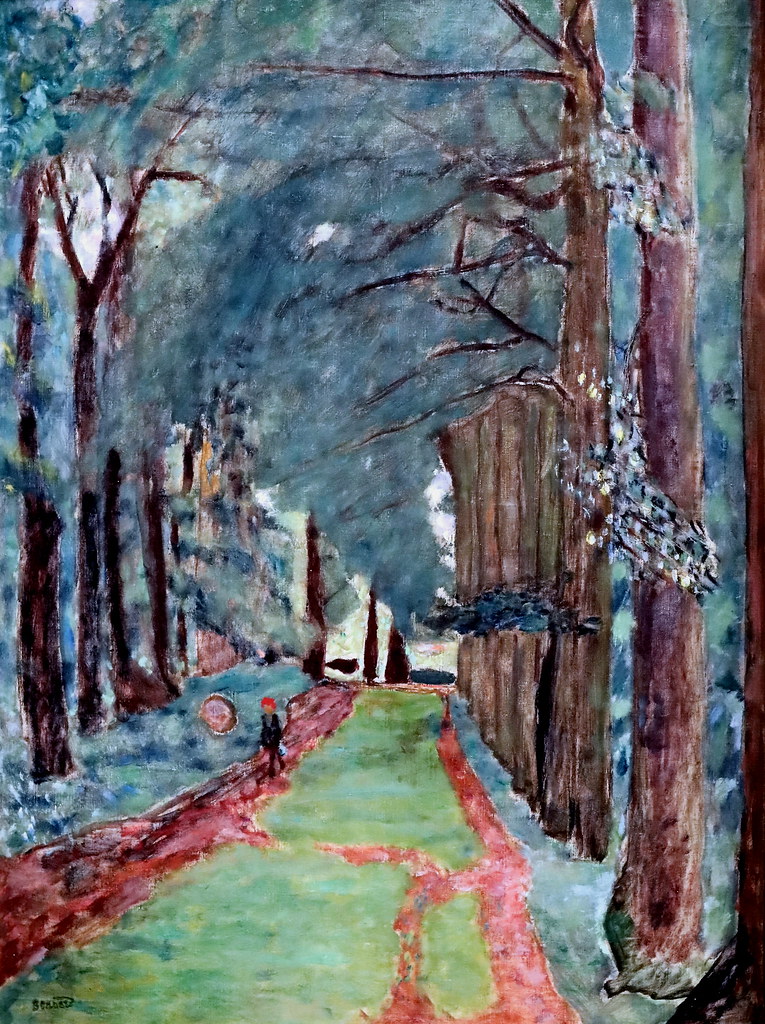
Bonnard Tree Alley“We rarely contact this simple moment,” wrote the Zen-trained teacher Toni Packer (1927-2013). “So used to constant input and excitement, we lack fine-tuning into all the subtleties of this instant, the ability to register a quiet aliveness without the stirring of expectation.”

In this otherwise straightforward reflection on the place of meditative practice—or “contemplative inquiry,” as Packer preferred to call it—in contemporary Western culture, the word aliveness may give us pause. What, exactly, is “aliveness,” and what has it to do with meditation, a practice conventionally associated with quietude and calm?

In his book The Path of Aliveness: A Contemporary Zen Approach to Awakening Body and Mind, the Zen teacher Christian Dillo employs two striking metaphors to characterize his primary subject. “Aliveness,” he asserts, “is the buzz that can be felt from head to toe,” the “buzz of basic aliveness.” It is “the feeling of the body being filled with a liquid continuously releasing champagne bubbles.” More prosaically, he defines aliveness as “the always-present background”—what elsewhere he calls the “field of mind”—to any and all sensations,” the “here now through which everything appears.” In Dillo’s view, to become consciously aware of the aliveness of one’s body and mind, and to cultivate that awareness, is a central objective of meditative practice.

In his book Taking Our Places: The Buddhist Path to Truly Growing Up, Zoketsu Norman Fischer Roshi offers a perspective congruent with Dillo’s, but he places emphasis less on cultivating the quality of aliveness than on appreciating its abiding presence in our bodies and minds. In his discussion of zazen, or seated meditation, Fischer notes that in Japan this practice “is called ‘just sitting’—in other words, simply being present with the fact of being alive, breathing, in the body. It is such a simple thing, yet so profound, to appreciate directly that we are living, breathing bodies. Mostly we take this for granted and occupy ourselves with what seem like more significant concerns. But, in fact, there is nothing more significant than being our bodies.” Through the daily practice of zazen, we can become more cognizant and far more appreciative of our breathing, physical presence. And as our practice matures, this fundamental recognition can lead to a deeper awakening, as we come to see that “we are not atomized individuals separate from and opposed to the world.” By becoming acutely aware of our living bodies, we also become aware of “that which is larger than [ourselves], which holds [us] in its embrace.”

Yet another view of aliveness animates the Zen teacher Susan Moon’s collection of essays Alive Until You’re Dead: Notes on the Home Stretch. In her essay “Knowing How to Be Satisfied,” Moon recounts the harrowing experience she had while riding on the BART (Bay Area Rapid Transit) from Berkeley to the San Francisco airport. Upon reaching her destination, Moon discovered that her carry-on bag, which contained her IDs, credit cards, cash, address book, appointment calendar, and teaching notes, had been stolen. Shocked and disoriented, she felt “stripped of everything.” Barred from boarding her flight without an ID, but still in possession of her round-trip train ticket, Moon took the BART back to Berkeley. And on the way home, she had a startling revelation. Whatever else had been taken from her, she suddenly realized, she still had her life, her body, her family, and her friends. “I touched my own knees in amazement,” she recalls. “I wanted to jump up and down in the train, shouting, `I’m alive! I’m alive!’ The theft was a strange kind of gift. I lost some objects, yes, and I gained a sense of gratitude for my life that is still with me. I often forget how amazing it is to be alive, but if I concentrate, I can open a drawer in my mind and find the memory of that BART train ride: I’m alive! I’m alive!” By periodically reliving that pivotal experience, Moon can also rekindle her sense of aliveness, restoring it to its rightful place in her hierarchy of values.

It bears noting that in Toni Packer’s formulation, it is not only the “constant input and excitement” of contemporary life that prevent us from registering our “quiet aliveness.” It is also the “stirring of expectation,” with its attendant speculation, anxiety, and sometimes dire scenarios. But, as Fischer reminds us, the daily discipline of seated meditation, in which we contact “this simple moment” in all its plenitude, can prompt us to appreciate our living, breathing bodies and to recognize once again the precious gift that we’ve been given.  And over time, this renewed awareness can awaken our infinite gratitude.  

______

Christian Dillo, The Path of Aliveness (Shambhala, 2022), 54, 122, 218.

Norman Fischer, Taking Our Places  (Harper, 2003), 119.

Susan Moon, Alive Until You’re Dead (Shambhala, 2022), 122.

Image: Pierre Bonnard, L’allee d’arbres. (The Tree Alley)


Read Full Post »


Hermit Thrush JulioM

When thoughts form an endless procession

            I vow with all beings

to notice the spaces between them

and give the thrushes a chance.

Robert Aitken, Zen Vows for Daily Life

The lines above describe a familiar experience. “Non-stop thinking,” Thich Nhat Hanh called it. Given the pace and volume of our thoughts, how are we to “notice the spaces between them”? How are we to stop—or at least put on pause—our non-stop thinking?

In his book The Path of Aliveness, the Zen teacher Christian Dillo identifies two dimensions of the human mind. The first he calls “content of mind,” by which he means the perceptions, memories, images, and other mental phenomena that traverse our consciousness. The other is the “field of mind,” by which he means our awareness of those mental phenomena. The mind’s contents, he notes, are by nature reactive. Entertaining a memory, a thought, a future scenario, we tend to react to it, whether with desire, aversion, or indifference. By contrast, the “field of mind” is non-reactive. Ever-present and immovable, even when we are agitated, it merely observes what is occurring. When we are having a thought, it knows we are having a thought. And when our thought reflects our uncertainty or fear, our joy or sorrow or elation, it knows that as well.

To “notice the spaces between” our thoughts is to take a break from conceptual thinking and open a portal to the field of mind. Unfortunately, that portal can close, and usually does, almost as soon as it opens. Robert Aitken Roshi (1917-2012) was an American Zen master, with decades of meditative experience. That he would frame the noticing of spaces between thoughts as an aspiration rather than a fruit of the practice is very telling. The endless procession of thoughts of which he speaks is the means by which we discriminate between self and other, fact and fantasy, truth and propaganda. It is the faculty with which we analyze and navigate the world. However much we may wish to disengage from “ordinary mind,” as it is called in Zen, and to rest in open awareness, we are unlikely to do so without making a conscious effort.

One way to do that is to stop whatever we are doing and take three conscious breaths. Almost any available sight or sound can serve as a prompt: a red light at an intersection, the call of a mourning dove, the wail of the village siren. Having stopped in our tracks, we can then give full attention to our breathing, noticing such subtleties as the difference in length between breaths, the coolness of the inhalation and the warmth of the exhalation, the tactile experience of tension and release. Thich Nhat Hanh, who taught this technique at his retreats, recommended it as both as a stratagem for reducing stress and a practice for fostering peace within and around us. Based on the Sutra on the Full Awareness of Breathing, a foundational Zen text, this classic method can also provide us access, however brief, to the “field of mind.”

For those who might wish to prolong that access, other, more advanced methods are available. In his book The World Could Be Otherwise, the Zen priest Zoketsu Norman Fischer Roshi offers these instructions:

Sit down and pay attention to body and breath. Become aware of thoughts, images, memories, whatever arises in your mind. Now become aware of the awareness itself that is the container or background for the content of your mind. Little by little (using your exhale to ease your way into it), shift your attention from the foreground (thoughts, etc.) to the background (awareness itself). Feel the awareness itself as boundless. Feel its infinite generosity.

As both Dillo and Fischer acknowledge, the shift of attention to which these instructions refer requires practice. It will not be accomplished in a single sitting. But in my experience, such a shift is not only possible but practicable in a variety of settings, including walking meditation. And in two important ways, its benefits can reward the commitment involved.

First, by shifting our attention from the “foreground” to the “background” of our minds, we allow ourselves the space and time to reflect on whatever is arising. We train ourselves to respond, appropriately and wisely, rather than impulsively react. And second, by releasing us from the grip of our thoughts, we open ourselves to those sensorial impressions that “non-stop thinking” impedes. Paradoxically, by learning to migrate from the foreground to the background of our minds, we engender greater intimacy between ourselves and our environs. We give the thrushes a chance to be heard and ourselves the freedom to listen.

___

Robert Aitken, Zen Vows for Daily Life (Wisdom, 2018).

Christian Dillo, The Path of Aliveness (Shambhala, 2022).

Norman Fischer, The World Could Be Otherwise (Shambhala, 2019), 50.

Photo: Hermit Thrush, by JulioM

Read Full Post »

Sarasota Zen Center

In the summer of 1965, shortly after my twenty-first birthday, I booked passage from London to New York on the Castel Felice, a storied old Sitmar liner with rock-bottom fares. For the previous nine months I had been an American student at the University of Leeds in West Yorkshire, England. Now I was coming home.

Midway through the ten-day voyage, something quietly momentous occurred. Winston Churchill once remarked that America and England are two nations separated by a common language. And during my time in England, although I shared a common tongue with my British hosts, I seldom forgot that I was a foreigner: a guest, as it were, of the British nation. But somewhere in the mid-Atlantic, I began to feel myself on native ground again. I began to feel like a host. And the British subjects on board, with whom I had many conversations about American culture, began to feel like my guests. Although it was never openly acknowledged, this reversal of roles could be felt in our language, our attitudes, even our demeanor. And the closer we came to the Statue of Liberty, the stronger the feeling grew.

Something analogous has been happening in American Zen. Recently Shohaku Okumura Roshi, an esteemed Zen master and abbot of the Sanshin Zen Community in Bloomington, Indiana, abandoned the lotus position, the traditional, cross-legged posture of Japanese Zen. He now sits in a chair. Likewise Susan Moon, an American writer and longtime Zen practitioner, has traded her traditional zafu (meditation cushion) for a straight-backed chair. In both instances, these decisions were driven by physical considerations. But in their broader cultural import, they might well be seen as symbolic.

For the past fifty years, American Zen has played guest to its foreign host, whose postures, forms, language, and liturgy it has struggled mightily to emulate and adopt. We Western practitioners have worn our hipparis and rakusus, our robes and tabi. We have chanted the Heart Sutra in Sino-Japanese. But slowly and sometimes painfully, American Zen has been coming into its own. Such unconventional practices as sitting zazen in a chair or chanting the sutras in English translation have been introduced in many Zen centers and widely, if sometimes reluctantly, accepted. Such adaptions are now no longer seen, as least by the more liberal-minded proponents of the practice, as concessions to comfort or as inauthentic, Western replicas of the real thing.

Looking back on my own essays on Zen practice, I see that they, too, reflect this tectonic shift. The Vietnamese Zen master Thich Nhat Hanh, to whom I have so often referred, went out of his way in his talks and writings to make the Asian practice of Zen palatable and accessible to interested Westerners. The word Zen was never mentioned; he spoke rather of “mindfulness” and the “energy of mindfulness.” Zazen became “seated meditation,” kinhin became “walking meditation,” and prostrations—that most foreign of Buddhist practices—became “touching the earth.” In this way “Thay,” as we called him, not only repackaged the practice. He also contributed, in no small measure, to its naturalization in the Western Hemisphere.

By and large, most of the leading Western teachers and writers on Zen—Zoketsu Norman Fischer, Roshi Joan Halifax, Charlotte Joko Beck, Edward Espe Brown, Zenkei Blanche Hartman, James Ishmael Ford, to name a few—have done the same. Their teachings and writings are deeply rooted in the traditional Asian teachings, particularly the seminal writings of Eihei Dogen (1200-1253), founder of the Soto tradition of Japanese Zen. But all of these teachers grew up in the United States and were conditioned by the mores, values, and language of mainstream Western culture. And in their talks and writings, they too have made an effort not only to translate the teachings into Western terms but to make this ennobling practice relevant and understandable to people living in our present place and time. Such terms as “ordinary Zen” and “everyday Zen” reinforce the image of a practice that originated in the East but has found a home and a nurturing environment in Western society.

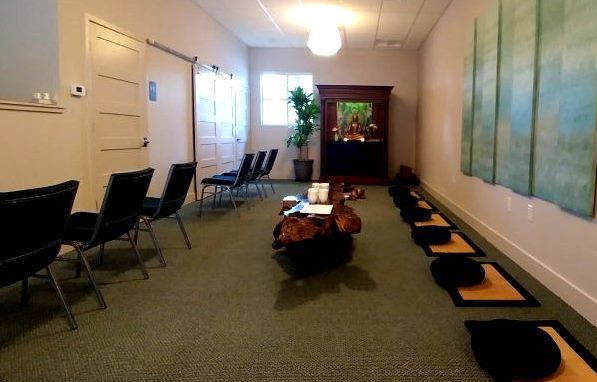
To be sure, not every Zen practitioner is comfortable with this development. Those who assert that the full lotus is the only truly authentic Zen posture are unlikely to be at ease in such venues as the Ordinary Zen Sangha in Sarasota, Florida, which features on its website a photo of airport-style chairs lined up next to a wall on one side of its meditation hall and a row of zafus on tatami mats next to the facing wall. This image of an accommodating cultural change might also be read as a symptom of a deepening cultural divide: the innovators on the one side, the traditionalists on the other. Will that image prove to be a symbol of a broadening, inclusive practice—or a harbinger of a splintering spiritual community?  I for one would hope that a strict and formal Eastern practice whose motto is “include everything” will find ample room for the West and its often informal ways.

______

Photo: The zendo of the Ordinary Zen Sangha, Sarasota, Florida. https://ordinaryzensangha.org/.


Read Full Post »

In her book Ordinary Wonder, the Zen teacher Charlotte Joko Beck (1917-2011) recounts the experience of one of her students, a heart surgeon on the verge of burnout. A nervous wreck at work, he came home exhausted in the evenings. To relieve his stress, he adopted a simple but effective practice. Whenever he was walking down the halls of the hospital, he focused on his feet. Rather than think about the operation just performed or the one in prospect, he shifted his attention to the feeling of his soles pressing against the floor. To his amazement, he found himself less anxious at work and less tired at the end of the day.

 As food for thought, the sensation of one’s feet doing their customary work may seem like meager fare indeed. How much better to be musing about enlightenment—or dreaming of the clear blue waters of the Caribbean. But underlying the surgeon’s humble intervention was an essential principle of Zen practice. Ubiquitous in Zen teachings, that principle has three distinct but interrelated aspects.

(more…)

Read Full Post »

In his book The World Could Be Otherwise (Shambhala, 2019) the Zen priest Zoketsu Norman Fischer Roshi makes an arresting remark, as notable for its subtlety as for its bold assertion. “When I am sick at a retreat,” he writes, “I don’t try to perform as if I weren’t sick . . . I try not to waste time wishing for another condition. I just live within the condition I have.” (My italics)

Norman Fischer is a poet as well as a longtime Zen practitioner. He chooses his words with care. Had he written with rather than within—“I just live with my condition”—his statement would have been unremarkable, even banal. But instead he wrote within, a word that means, among other things, “in the interior of.” And between those two prepositions, so common in speech and prose but so wide-ranging in their implications, there is a significant and telling difference. (more…)

Read Full Post »

During this period of mandatory confinement, when  our normal activities have been curtailed and our public spaces have fallen silent, commentators in the media have suggested numerous ways to fill the void: movies we might watch, books we might read, things we might make or do. Some of those suggestions have been helpful. But the reduction of sound and activity in our external environment might also prompt us to consult its inner counterpart: the silent, abiding dimension of our minds, which often goes undetected and unacknowledged. A well-spring of intuitive knowledge, it is also a source of compassionate wisdom.

In Buddhist teachings this dimension is known by various names. In the Theravadan tradition, it is sometimes called “natural awareness,” or, more lyrically, “the one who knows.” Shunryu Suzuki Roshi called it “Big Mind” (as distinguished from ordinary, voluble, ego-centered mind). More obliquely, an old Zen koan refers to it as “the one who is not busy.” Thich Nhat Hanh calls it “the mind of non-discrimination,” the act of discriminating being the busywork of ordinary mind. And Zoketsu Norman Fischer Roshi has called it “the silent mind,” the term I prefer and have enlisted here. (more…)

Read Full Post »

Robert Frost
1874-1963

On the eve of the Second World War and during a period of acute personal distress, Robert Frost composed “The Silken Tent,” a lyric poem widely regarded as one of the finest sonnets written in English in the twentieth century. A love poem in the tradition of Shakespeare’s sonnets, it is also a hymn in praise of personal composure:

            She is as in a field a silken tent

            At midday when a sunny summer breeze

            Has dried the dew and all its ropes relent,

            So that in guys it gently sways at ease,

            And its supporting central cedar pole

            That is its pinnacle to heavenward

            And signifies the sureness of the soul,

            Seems to owe naught to any single cord,

            But strictly held by none, is loosely bound

            By countless silken ties of love and thought

            To everything on earth the compass round,

            And only by one’s going slightly taut

            In the capriciousness of summer air

            Is of the slightest bondage made aware.

In these eloquent lines, cast in the strict rhymed form of the English sonnet, Frost elaborates a single complex sentence and a single unifying metaphor. Likening an unidentified woman to a silken tent, he compares her strength of character to a cedar pole, her interdependent relationships to guy lines, and her bonds of affection to the “cords” that tether her to the earth. Contrasting the connotations of bound and bondage—the former suggestive of obligations, the latter of enslavement—he portrays a person grounded in real life but also flexible, buoyant, and untrammeled. In the midst of social pressures and ever-shifting conditions, she remains balanced and resilient—qualities of heart and mind that the narrator much admires. (more…)

Read Full Post »

Older Posts »