In his poem “Fly,” the American poet W.S. Merwin (1927-2019) describes himself as one who has “always believed too much in words.”
That statement would be remarkable coming from almost anyone, but it is particularly striking coming from an acclaimed poet and translator, then in his forties, whose distinguished career had been largely based on words. Profound and far-reaching, Merwin’s declaration can be understood in multiple contexts, most notably the personal, the environmental, and the metaphysical.
“Fly” appeared in The Lice (1972), Merwin’s sixth collection of poems, three years after the moon landing and concurrent with the dawn of the environmental movement. A lyric poem with a prominent narrative component, it recounts the narrator’s effort to compel an old, unhealthy, and “filthy” pigeon, whom the narrator has been keeping in a dovecote, to rally its energies and take flight:
Fly I said throwing him into the air
But he would drop and run back expecting to be fed
I said it again and again throwing him up
As he got worse
As foolish as they were futile, the narrator’s actions eventually result in the pigeon’s death. Finding him “in the dovecote dead / Of the needless efforts,” he contemplates the dead bird’s eye, “that could not / Conceive that I was a creature to run from.”
In the general scheme of human misdeeds, Merwin’s might seem minor, but to him it occasions introspection and harsh self-judgment. “So that is what I am,” he concludes, isolating that line for maximum impact. Having been presumptuous and obtuse in expecting the pigeon to obey his spoken command, he views himself as an agent of human cruelty, who has abused his dominion over beasts and fowls and caused the unnecessary death of a fellow creature.
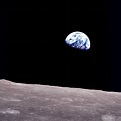
Beyond its personal context, the narrator’s actions and his subsequent remorse reflect a broader, cultural sense of culpability. When the astronauts viewed the planet Earth from the vantage point of the moon, they were awed by its beauty, humbled by its magnificence, and made newly aware of its vulnerability. Michael Collins (Apollo 11) likened the planet to a precious jewel. James Irwin (Apollo 15) described it as so delicate that if “you touched it with a finger it would fall apart.” Those feelings were shared by many who viewed William Anders’ celebrated “Earthrise” photo, which the nature photographer Galen Rowell called the “most influential environmental photograph ever taken.” Within that cultural milieu, the episode depicted in “Fly” epitomizes the greed, arrogance, and ignorance that by the 1960s had accelerated the extinction of floral and fauna and grievously plundered the Earth’s natural resources. And Merwin’s personal epiphany represents, in small, the cultural awakening that would engender the Whole Earth Movement (c.1970), the establishment of the EPA (1970), and, in the next decades, stringent environmental regulation.
Yet, if Merwin’s poem is in part a personal confession and in part a cultural avatar, it is also the mature work of a seasoned poet who, as a steward of the English language, has come to recognize his medium’s limitations. The word the narrator has believed in is “fly,” cast in the imperative mode. Not only does its inefficacy reveal the incapacity of human speech to control wild nature. It also points toward the limited ability of language in general to represent reality. To be sure, an abiding belief in words is necessary to navigate and survive everyday life. “Stop” means “stop,” and we’d better believe it. But excessive belief in language, whether as a measure of personal importance, a defining agent of social identity, or a mirror of things as they are, can foster delusion and inflict incalculable suffering. Witness theories of a master race or false historical ideologies justifying territorial invasion.
No spiritual tradition is more aware of the frailties of language than Zen Buddhism, which from its beginnings has declared itself “not dependent on words and letters” and regarded words as “fingers pointing toward the moon,” not to be mistaken for the moon itself. Like many poets and writers of his generation, Merwin was interested in Zen, and in 1976 he moved to Hawaii to study with the Zen master Robert Aitken Roshi. Just as “Fly” anticipates Merwin’s later environmental conservationism and his founding of the Merwin Conservancy, so does his poem adumbrate his wholehearted embrace of Zen teachings, which by and large view concepts and their linguistic vehicles, namely words, as filters and impediments between our minds and concrete reality. Even honest, well-intentioned words are not to be naively trusted, insofar as they reify interdependent, dynamic nexuses into separate, static “things.” From that perspective, a skeptical attitude toward words, however beautiful or inspiring, potent or inciteful they may be, is of itself a necessary, wise, and salutary practice.
Read “Fly” in its entirety at https://merwinconservancy.org/poems/fly-by-w-s-merwin/. .

 One Time, One Meeting