Feeds:
Posts
Comments

Posts Tagged ‘poems’

In his poem “Fly,” the American poet W.S. Merwin (1927-2019) describes himself as one who has “always believed too much in words.”

That statement would be remarkable coming from almost anyone, but it is particularly striking coming from an acclaimed poet and translator, then in his forties, whose distinguished career had been largely based on words. Profound and far-reaching, Merwin’s declaration can be understood in multiple contexts, most notably the personal, the environmental, and the metaphysical.

“Fly” appeared in The Lice (1972), Merwin’s sixth collection of poems, three years after the moon landing and concurrent with the dawn of the environmental movement. A lyric poem with a prominent narrative component, it recounts the narrator’s effort to compel an old, unhealthy, and “filthy” pigeon, whom the narrator has been keeping in a dovecote, to rally its energies and take flight:

            Fly I said throwing him into the air

            But he would drop and run back expecting to be fed

            I said it again and again throwing him up

            As he got worse

As foolish as they were futile, the narrator’s actions eventually result in the pigeon’s death. Finding him “in the dovecote dead / Of the needless efforts,” he contemplates the dead bird’s eye, “that could not / Conceive that I was a creature to run from.”

In the general scheme of human misdeeds, Merwin’s might seem minor, but to him it occasions introspection and harsh self-judgment. “So that is what I am,” he concludes, isolating that line for maximum impact. Having been presumptuous and obtuse in expecting the pigeon to obey his spoken command, he views himself as an agent of human cruelty, who has abused his dominion over beasts and fowls and caused the unnecessary death of a fellow creature.

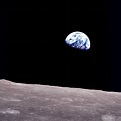
Beyond its personal context, the narrator’s actions and his subsequent remorse reflect a broader, cultural sense of culpability. When the astronauts viewed the planet Earth from the vantage point of the moon, they were awed by its beauty, humbled by its magnificence, and made newly aware of its vulnerability. Michael Collins (Apollo 11) likened the planet to a precious jewel. James Irwin (Apollo 15) described it as so delicate that if “you touched it with a finger it would fall apart.” Those feelings were shared by many who viewed William Anders’ celebrated “Earthrise” photo, which the nature photographer Galen Rowell called the “most influential environmental photograph ever taken.” Within that cultural milieu, the episode depicted in “Fly” epitomizes the greed, arrogance, and ignorance that by the 1960s had accelerated the extinction of floral and fauna and grievously plundered the Earth’s natural resources. And Merwin’s personal epiphany represents, in small, the cultural awakening that would engender the Whole Earth Movement (c.1970), the establishment of the EPA (1970), and, in the next decades, stringent environmental regulation.

Yet, if Merwin’s poem is in part a personal confession and in part a cultural avatar, it is also the mature work of a seasoned poet who, as a steward of the English language, has come to recognize his medium’s limitations. The word the narrator has believed in is “fly,” cast in the imperative mode. Not only does its inefficacy reveal the incapacity of human speech to control wild nature. It also points toward the limited ability of language in general to represent reality. To be sure, an abiding belief in words is necessary to navigate and survive everyday life. “Stop” means “stop,” and we’d better believe it. But excessive belief in language, whether as a measure of personal importance, a defining agent of social identity, or a mirror of things as they are, can foster delusion and inflict incalculable suffering. Witness theories of a master race or false historical ideologies justifying territorial invasion.

No spiritual tradition is more aware of the frailties of language than Zen Buddhism, which from its beginnings has declared itself “not dependent on words and letters” and regarded words as “fingers pointing toward the moon,” not to be mistaken for the moon itself. Like many poets and writers of his generation, Merwin was interested in Zen, and in 1976 he moved to Hawaii to study with the Zen master Robert Aitken Roshi. Just as “Fly” anticipates Merwin’s later environmental conservationism and his founding of the Merwin Conservancy, so does his poem adumbrate his wholehearted embrace of Zen teachings, which by and large view concepts and their linguistic vehicles, namely words, as filters and impediments between our minds and concrete reality. Even honest, well-intentioned words are not to be naively trusted, insofar as they reify interdependent, dynamic nexuses into separate, static “things.” From that perspective, a skeptical attitude toward words, however beautiful or inspiring, potent or inciteful they may be, is of itself a necessary, wise, and salutary practice.

Read “Fly” in its entirety at https://merwinconservancy.org/poems/fly-by-w-s-merwin/. .

Read Full Post »

One afternoon not long ago, as I was walking in a local gym, I watched a student shooting hoops in an unusual way. On the fingertips of his right hand, he held a basketball. In the palm of his left, he held a cell phone. After taking a single-handed shot, and before the ball had even hit the backboard, he turned his attention to his cell phone. Repeated over and over, his toggling had a rhythm of its own. But it also divided his attention, which could not have been good for his game. And, unwittingly, he was repeatedly flouting a cardinal principle of Zen practice.

In Japanese Zen, that principle is known as ichigyo zammai, which means “doing one thing at a time.” As Zen masters ancient and modern have often reminded us, by giving full attention to whatever we might be doing we not only develop our powers of concentration. We also cultivate the grounded, peaceful state of samadhi: an equanimous, non-reactive, and natural alignment with the flow of reality. “Combust yourself entirely,” a familiar Zen saying, encapsulates this root tenet of the practice.

In classical Japanese poetry, the practice of ichigyo zammai undergirds that most familiar of Japanese poetic forms, the haiku:

A solitary

crow on a bare branch—

autumn evening.

— Basho

In this miniature word-painting, the duality of subject and object dissolves in the meeting of poet and crow. Rather than utilize the crow as a metaphor or symbol, Basho amplifies the bird’s singular presence. What might have been an act of ego-centered observation becomes a moment of life-centered, selfless contemplation.

In Western poetry, which tends to regard encounters with the natural world as occasions for moral, metaphysical, or psychological reflection (“I wandered lonely as a cloud”), there is no exact equivalent of the Japanese haiku. But a parallel may be seen in a sub-genre of lyric poetry known in German as the dinggedicht and in English as the “thing-poem.” As those labels suggest, poems of this kind concentrate on a single thing. And often the poet establishes, in Martin Buber’s famous formulation, an “I-Thou” rather than an “I-It” relationship with the object at hand.

In Rainer Maria Rilke’s “The Panther,” for example, the narrator’s consciousness merges with that of a panther confined to its cage. In Elizabeth Bishop’s poem “The Fish,” the narrator’s sporting, anthrocentric frame of mind morphs into one of reverence and awe. And in the poems of such Zen-trained American poets as Gary Snyder, W.S. Merwin, and Jane Hirshfield, the narrators typically treat their objects of attention with deep respect and disinterested regard.

Such is the case in Hirshfield’s poem “A Chair in Snow,” where the narrator contemplates a snow-covered chair, focusing on the quiddity, or “whatness,” of her subject. After observing that a chair covered with snow ought to be like any other object “whited / & rounded,” she distinguishes it from all other snow-covered objects primarily by virtue of its function:

more than a bed

more than a hat or house

 a chair is shaped for just one thing


 to hold

 a soul its quick and few bendable

 hours


 perhaps a king


 not to hold snow

 not to hold flowers

For Hirshfield, there is something melancholy in this scene. “[A] chair in snow,” she notes, “is always sad.” Presumably, this sadness stems from the chair being isolated and out of place in an alien environment. But the chair’s stark displacement is also an essential component of its singularity.

As a young woman, Jane Hirshfield spent eight years in Zen training, first at the Tassajara Zen Mountain Center in California’s Ventana Wilderness and subsequently at the San Francisco Zen Center and Green Gulch Farm. In 1979 she received lay ordination in Soto Zen. Reflecting on those early, intensive experiences, Hirshfield, now in her seventies, has remarked that they have influenced her life and work ever since. In its concentration, its intimacy with its subject, and its spirit of inquiry, “A Chair in Snow” vividly confirms that claim.

Beyond that, Hirshfield’s poem represents a quality of sustained, one-pointed attention that is growing increasingly rare in our culture, where millions of people experience their smart phones as vital appendages and frequent scrolling-and-swiping as a necessary, if not obsessive, activity. As Chris Hayes, in his book The Siren’s Call (Penguin, 2025), has noted, attention has become a commodity, which the titans of social media compete to manipulate and otherwise control. And the fragmentation of attention is fast becoming the norm.

To those pernicious social trends, the daily practice of ichigyo zammai offers a potent antidote. By their very nature, the twin disciplines of doing one thing and concentrating on one object at a time settle the restless mind and calm the anxious heart. And for those young people I have observed jaywalking across busy streets, their heads bowed and their eyes fixed on their cell phones, this venerable practice might prove as life-preserving as it is timely.

To read the full text of “A Chair in Snow,” see

http://www.poetryfoundation.org/poetrymagazine/poems/56174/a-chair-in-snow.  

Read Full Post »

And yet, and yet

ISSA 2

In 1973, the writer and Zen practitioner Peter Matthiessen and the field biologist George Schaller undertook an expedition to the High Himalayas in hopes of sighting the elusive snow leopard. Before departing for the Tibetan Plateau, Matthiessen consulted with his Zen teacher, Eido Shimano Roshi, at Dai Bosatsu Zendo. Drawing upon a fundamental Zen teaching, Eido Roshi advised his student to “expect nothing.” By adopting that attitude, Matthiessen would enable himself to be open and attentive to whatever he encountered. Rather than regard his expedition as a means to an end, he might treat the experience as an end in itself.

Eido Roshi’s advice may well have been sound, given Matthiessen’s slim chances of sighting so rare a creature as the snow leopard. As a guideline for living, however, “expect nothing” might best be viewed as a wise maxim to bear in mind rather than a practical motto to live by. We human beings, it’s fair to say, are hardwired not only to expect but also to hope for and fear specific outcomes. Should we attempt to banish our expectations, we are more than likely to fail. As a realistic alternative, however, we can resolve to take note of our expectations as they arise, acknowledging both their presence and their largely speculative nature. And we can endeavor to remain cognizant, moment by moment, of the ongoing tension between the time-honored wisdom of Zen and the recalcitrant realities of human nature.

Nowhere is that tension more concisely expressed than in this haiku by the Japanese poet and Buddhist priest Kobayashi Issa (1763-1828):

             tsuyu no yo wa

             tsuyu no yo nagara

             sari nagara

                        –

            The world of dew

            is only the world of dew –

            and yet, and yet

The first two lines of this haiku allude to a central tenet of the Buddhist tradition, articulated in these verses from the Diamond Sutra:

            Think in this way of all this fleeting world:

            As a star at dawn, a bubble in a stream,

            A dewdrop, a flash of lightning in a summer cloud,

            A flickering lamp, a phantom, and a dream.

Through a concentration of metaphors, these verses remind us that all conditioned things are subject to change. All are impermanent. What we may conventionally view as solid and lasting is no more permanent than morning dew. The image of a “world of dew” evokes this foundational premise of the tradition in which the poet-priest Issa was trained.

“The world of dew” also reflects a cardinal principle of Japanese art and poetry.  According to this principle, known as mono no aware, the transience of the things of this world is both a locus of their pathos and a source of their beauty, whether those transient things be cherry blossoms, bubbles in a stream, or our own brief existence on this planet. Beautiful, ephemeral things are moving and beautiful because they are transient. A visual artist as well as a poet, Issa was steeped in Japanese cultural traditions, and as his haiku demonstrates, his aesthetic was deeply aligned with the convention of mono no aware.

But Issa was also a husband and father who had experienced profound losses in his life, including the deaths of his first wife, several of his children, and, shortly before writing the present haiku, the loss of his two-and-a-half-year-old daughter to smallpox. Introducing his haiku in his travel journal The Springtime of My Life, he recounts that devastating experience:

Her mother clutched her cold body and wailed. I knew her heartbreak but also knew that tears were useless, that water under the bridge never returns, that scattered flowers are gone forever. And yet nothing I could do would cut the bonds of human love.

In popular iconography, Japanese Zen is sometimes viewed as a meditative version of samurai culture: a practice marked by “detachment” and the stoic repression of feeling. Contrary to that popular conception, authentic Buddhist practice—and the Zen-based practice of haiku—foster direct engagement with external realities, particularly the realities of impermanence and death. Rather than turn away, practitioners are admonished to make those realities objects of contemplation. At the same time, the practice also encourages continuous awareness of (and non-attachment to) one’s changing moods and feelings, however pleasant or painful they may be.

Hence the last line of Issa’s haiku. Occurring just after the “turning” characteristic of the haiku form, the repeated phrase “and yet” acknowledges the emotional dimension of his present experience: the upwelling of grief triggered by the death of a child. And though it leaves much unsaid, this repeated phrase leaves little doubt as to its meaning.

“The deepest feeling,” wrote the American poet Marianne Moore, “always shows itself in silence; / not in silence but restraint.” As silent and restrained as a poem can be, Issa’s haiku is all the more piercing for its reticence and all the more affecting for its restraint. If you would live wisely, it seems to say, expect nothing. And yet, and yet.

    —–

Image: Kobayashi Issa

Her mother clutched her body: Sam Hamill & J.P. Seaton, The Poetry of Zen (Shambhala, 2004), 172-3.

Marianne Moore,  “Silence,” in The Complete Poems of Marianne Moore (Macmillan, 1972), 91.

Read Full Post »