3 March 2016 by Ben Howard
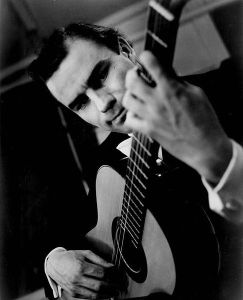
Julian Bream, 1964
On this snowy winter evening I’ve been listening to Benjamin Britten’s Nocturnal After John Dowland (1963), a twenty-minute piece for solo guitar composed for the English lutenist and guitarist Julian Bream (b. 1933). By turns dreamy and martial, restless and serene, this masterpiece of the modern guitar repertoire can be heard on Bream’s 1967 album 20th Century Guitar, one of forty CD’s in my newly-acquired Julian Bream: The Complete RCA Album Collection (2013). Released in conjunction with Bream’s eightieth birthday, this handsome boxed set is both a treasure trove of music for classical guitar and a tribute to a great musician’s lifetime achievement. And for this listener, the collection also evokes an enduring memory. Continue Reading »
Posted in 1, Zen | Tagged Benjamin Britten, Come Heavy Sleep, Django Reinhardt, John Dowland, Julian Bream, Letting Go, Nocturnal | Leave a Comment »
17 February 2016 by Ben Howard
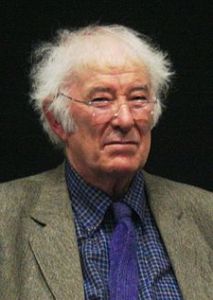
Seamus Heaney
In an interview many years ago, a journalist asked the Irish poet Seamus Heaney (1939-2013) for his thoughts on aging. At the time, Heaney must have been in his late fifties or early sixties. With his usual precision of language, leavened by a wryly ironic smile, Heaney remarked that growing older had brought “the inevitable attenuations.” He did not elaborate, but anyone of a certain age could readily fill in the blanks. And more important than the words or the missing details was the attitude behind them, an attitude at once rare and profoundly liberating.
Like forty million other men and women over the age of fifty, I belong to the AARP, formerly known as the American Association of Retired Persons. As a privilege of membership I receive two bimonthly publications: the AARP Magazine, which is printed on glossy paper and vaguely resembles People magazine; and the AARP Bulletin, which is printed on newsprint and resembles a tabloid. The Magazine endeavors to entertain, educate, and inspire me, while perhaps selling an Acorn Chairlift or a life-insurance policy along the way. By contrast, the Bulletin aspires to keep me informed and alert me to financial and health-related hazards threatening older people. Together these complementary organs of our consumer culture purport to enhance my so-called golden years and help me feel more secure. All too often, however, their effect is quite the opposite. Continue Reading »
Posted in 1 | Tagged AARP, aging, attenuation, Burt Reynolds, Diane Keaton, elbow outward, seamus heaney, zen | 1 Comment »
3 February 2016 by Ben Howard
 One bright morning several weeks ago, I received a friendly e-mail message from Amazon. “Benjamin W. Howard,” it read, “Based on your recent activity, we thought you might be interested in this:” Below these words, a handsome new book was displayed: “Firewood and Ashes: New and Selected Poems, by Ben Howard.”
To be fair to Amazon, I was indeed interested in the product described, and my interest was indubitably based on my recent activity. And, all things considered, I was heartened to see Amazon actively marketing my book and targeting a plausible customer. More power to them, I might have said, and may their project flourish.
At the same time, Amazon’s little slip-up highlighted something fundamental and unnerving about life in the digital era. Like other denizens of the twenty-first century, I am aware of the ways by which mega-conglomerates monitor our purchasing histories and manipulate our predilections. Nonetheless, had the book being promoted not been my own, I might have dozily surmised that someone at Amazon was looking out for me, as old-fashioned booksellers used to do, and that the message I had just received embodied an actual human presence. Continue Reading »
Posted in 1 | Tagged algorithm, Amazon, Laurence Scott, natural presence, presence, Tara Brach, virtual reality | Leave a Comment »
13 January 2016 by Ben Howard
 Last month the holiday season brought three small grandchildren to our home. Jack is six, Isla three, and Allegra two. Three may well be a crowd, but apart from an upset or two, this trio of tots played harmoniously together, and their brief presence brightened our lives.
A few days after the children and their parents had departed, I retired to my study to read a book I had bought just before the holidays: The Essential Brendan Kennelly, a richly varied selection of the Irish poet’s work, published on the occasion of his 75th birthday. I had left the book on a low table next to my reading chair. When I opened it, I found to my surprise a waxy red scribble on the title page. Someone had left me a souvenir.
Although I am not one to condone the defacing of books, I was amused by this discovery, and I suspect that Brendan Kennelly would be as well. One of Kennelly’s best-known poems, “Poem from a Three Year Old,” speaks in the voice of a child. Its exuberant verses dramatize the spirit of play, the incessant questioning, and the moments of wonder intrinsic to childhood. “The first moment of wonder,” Kennelly has remarked, “is an amazing moment, as if for the first time something is happening. And that is the moment on which poetry depends.” There is a “strange thing” in us, Kennelly asserts, that is destroyed by familiarity and experience. But through the successive acts of attention that constitute an authentic poem, the familiar can again become strange and the sense of wonder restored. “And I think that’s what poetry is about–a kind of permanent beginning.” Continue Reading »
Posted in 1 | Tagged begin again, Brendan Kennelly, ichhigo ichie, ichigo ichie | 2 Comments »
16 December 2015 by Ben Howard
 Last week two Army helicopters flew over the village of Alfred, New York. Their thunder, my wife confided, unnerved her as never before.
In the wake of the mass shootings in Paris, Colorado Springs, and San Bernadino, fear has become a focus of national attention. In his address to the nation on December 6, President Obama sought to reassure us. “Freedom,” he asserted, “is more powerful than fear.” Perhaps it is in the long run, but for the time being, how can we best address the growing presence of fear in our daily lives? And how can the practice of meditation help us in that effort? Continue Reading »
Posted in 1 | Tagged dharma rain, fear, jack kornfield, Michele McDonald, non-fear, RAIN, thich nhat hanh, Zenkei Blanche Hartman | 1 Comment »
2 December 2015 by Ben Howard
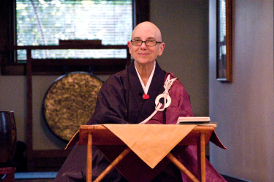
Shinge Roko Sherry Chayat Roshi, Abbot,
Dai Bosatsu Zendo and the Zen Center of Syracuse
The practice of Zen contemplation, Zen teachings tell us, is the “action of non-action,” grounded in silent awareness. At the same time, the “non-action” of Zen is best described in active verbs. In her essay “What is Zen?” Shinge Roko Sherry Chayat Roshi offers this description:
What is Zen? Stop now. Stop trying to get an intellectual lock on something that is vast and boundless, far more than the rational mind can grasp. Just breathe in with full awareness. Taste the breath. Appreciate it fully. Now breathe out, slowly, with equal appreciation. Give it all away; hold onto nothing. Breathe in with gratitude; breathe out with love. Receiving and offering–this is what we are doing each time we inhale and exhale. To do so with conscious awareness, on a regular basis, is the transformative practice we call Zen.
It would be difficult to find a more lucid or concrete description of Zen practice. Follow Shinge Roshi’s instructions, and you will not go wrong. Yet, for all its clarity, this description is at one point ambiguous. “Hold onto nothing,” Shinge Roshi advises. “Give it all away.” But what is the antecedent, a grammarian might inquire, of the pronoun “it”? What, besides our breath, are we giving away? Continue Reading »
Posted in 1, meditation, Zen | Tagged Blanche Hartman, emptiness, interdependence, Milarepa, norman fischer, Shinge roko sherry chayat roshi, Shinge Roshi, Shunryu Suzuki Roshi | Leave a Comment »
11 November 2015 by Ben Howard
 As a boy growing up in eastern Iowa, I savored the word dwell, which I heard on many a Sunday morning. I will dwell in the house of the Lord forever, I intoned with the rest of the congregation, not quite understanding the context but reassured by the general idea. The word was pleasant to pronounce. It made a pleasing sound.
Only later did I learn that dwell bears a negative connotation. “Don’t dwell on it,” I was advised, in the aftermath of some abrasive encounter. “She didn’t mean to hurt your feelings.” Used in that fashion, dwell meant to brood, to worry, to concentrate unhealthily on some slight or insult or perceived injustice. Nowadays, for good or ill, many people use the verb obsess to describe the same habit of mind. “Don’t obsess about it,” we might advise a person who can’t stop talking about a personal dilemma, or can’t let go of a painful experience, as though that person had a choice, or our well-intentioned counsel might be helpful. Continue Reading »
Posted in 1 | Tagged Diamond Sutra, insight meditation, Iowa, Psalm 23, Theravadan Buddhism, thich nhat hanh, vipassana | Leave a Comment »
21 October 2015 by Ben Howard
 Zen has been called the study of silence. “We need silence,” writes Zen master Thich Nhat Hanh, “just as much as we need air, just as much as plants need light.” But how, exactly, are we to study silence? By what means can we cultivate its nourishing presence?
Just be quiet, one is tempted to suggest. Just be still. But in a world rife with noise and distraction, that choice may no longer seem plausible–or even very desirable. In her book Reclaiming Conversation, the sociologist Sherry Turkle reports that many of the people she has interviewed, particularly young people, have an aversion to silence, finding it merely boring. They would rather go online. And as Thich Nhat Hanh observes in his book Silence, many of us are afraid to sit quietly, doing nothing. By keeping ourselves ever-busy and ever-connected, we avoid such negative feelings as loneliness, restlessness, and sadness, which can become all too present when we are silent and alone. If we wish to study and cultivate silence, it would seem, we have first to overcome our resistance, whether it be grounded in aversion or fear. Continue Reading »
Posted in 1 | Tagged Fr. Richard Rohr, George Prochnik, sherry turkle, Shizuteru Ueda, silence, thich nhat hanh, Zen Buddhism | 2 Comments »
1 October 2015 by Ben Howard
 One afternoon a few summers ago, I decided to practice the guitar on our backyard deck. It was a sunny day, the temperature in the mid-seventies. At the time, I was revisiting the Prelude from J.S. Bach’s Prelude, Fugue, and Allegro (BWV 998), a piece I had played for years and knew by heart. Normally, I practice indoors, my eyes fixed on the score. If I’ve memorized the piece, I tend to stare at the fingerboard, as classical guitarists are prone to do. That afternoon, however, I looked out at our spacious and secluded backyard, where the natural world was vividly in motion. Blue jays were foraging in the grass. Leaves quivered in a light wind. High in a tall pine, a dark bird flew in, perched for a moment, and flew out. As I played the first few bars of the Prelude–a lyrical but technically challenging piece–my eyes came to rest on our Curly Willow tree in the middle distance. At the same time, I remained keenly aware of all the peripheral movement. And as I proceeded into the Prelude, I gradually realized that my playing had become more fluent and relaxed. To my surprise, it had also become more accurate, expressive, and rhythmically precise.
That experience was new to me, but it was hardly my invention. Without knowledge or systematic training, I had stumbled upon a technique known to equestrians, martial artists, and other highly skilled performers as “soft eyes.” “Do you know what you need at a crime scene?” asks Detective Bunk Moreland in The Wire. “Rubber gloves?” ventures Detective Kima Greggs. “Soft eyes,” Moreland replies. “You got soft eyes, you see the whole thing.” In essence an integration of peripheral and foeval (central, line-of-sight) vision, the technique of soft eyes is used in fields as diverse as tracking, performance driving, interior decorating, teaching, yoga, and Akido. The personal and social benefits of this technique can be significant, if not transformative. It can permit us at any moment to see “the whole thing.” Yet in obvious ways, the practice of soft eyes runs counter to the prevalence of “hard eyes”–the type of vision we habitually employ when chopping a carrot or threading a needle or working at a computer. To learn to look with soft eyes may require conscious effort. Continue Reading »
Posted in 1, meditation, neuroscience, Zen | Tagged Akido, Bunk Moreland, BWV 998, centered riding, Denny Emerson, Donna Farhi, foeval vision, JS Bach, Sally Swift, soft eyes, The Wire, zen | 1 Comment »
10 September 2015 by Ben Howard
 “As everyone knows,” declares Ishmael, the narrator of Herman Melville’s novel Moby-Dick (1851), “meditation and water are wedded forever.”
Melville’s schoolmaster-turned-sailor makes this remark in the opening pages of Moby-Dick, as he reflects on the lure of water, especially to those of a contemplative disposition, who are naturally drawn to ponds, lakes, rivers, and the sea. Ishmael is not a meditative practitioner in any formal sense, and as Daniel Herman, a Melville scholar and Zen practitioner, notes, “Melville almost certainly never in his life heard the word ‘Zen’.” Yet Ishmael’s remark is relevant to the discipline of Zen meditation, insofar as that remark calls attention to two salient elements of the practice. By its nature, water visibly embodies the quality of impermanence, one of the primary objects of Zen contemplation. At the same time, water also embodies the quality of constancy, which Zen teachings urge us to contemplate. “How can I enter Zen?” a student asked a master. “Can you hear the murmuring of the mountain stream?” the master replied. “Enter there.” Continue Reading »
Posted in 1 | Tagged Charles Tomlinson, Daniel Herman, dhammapada, elizabeth bishop, Herman Melville, Ishmael, John Constable, Moby Dick, seamus heaney, thich nhat hanh, William Wordsworth, zen meditation | 1 Comment »
« Newer Posts - Older Posts »



 One Time, One Meeting