Feeds:
Posts
Comments

Archive for the ‘1’ Category

Charlotte Joko Beck

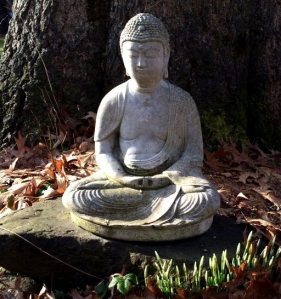
In the popular imagination, Zen practice consists of sitting cross-legged, preferably on a mountain or within the confines of a monastery, in a state of perfect calm. His hands positioned in the “cosmic mudra” and a beatific smile on his face, the Zen Buddhist practitioner sits at a comfortable remove from the petty conflicts and mundane concerns of ordinary life. In a word, he is detached. He has transcended the human fray.

This stereotypical image of Buddhist practice has widespread currency, even among the intellectual elite. A recent manifestation may be found in the Swedish philosopher Martin Hägglund’s book This Life: Secular Life and Spiritual Freedom (Pantheon, 2019), where the author defines the general aim of Buddhism as “a detachment from everything that is finite.” Reviewing this book in The New Yorker (May 13, 2019), staff writer James Wood endorses Hägglund’s view, alluding vaguely to “those doctrinal aspects of Buddhism which insist on detachment.” “Everything that is finite,” one might note, is a very large category. Not only does it include buildings and boulevards, mountains and rivers, rocks and trees. It also includes one’s family, friends, and loved ones generally. Why on earth would anyone wish to be so detached? If that is what Zen is about, one might conclude, so much the worse for Zen. (more…)

Read Full Post »

The poet William Butler Yeats (1865-1939) hated being old. In his late poem “Sailing to Byzantium,” written when Yeats was in his early sixties, he described an “aged man” as “but a paltry thing, / A tattered coat upon a stick . . .” And in “The Tower,” a poem of the same vintage, he likened the “absurdity” of “decrepit age” to a battered kettle tied to a dog’s tail. Invoking the traditional duality of body and soul, Yeats contrasted his “passionate, fantastical / Imagination” with the humiliations of physical decline. By common consent, Yeats’s late poems are among his finest, but the agon they so memorably dramatize is that of an aging artist resisting with all his imaginative might those inevitable changes that happen to us all.

Zen teachings also address those changes, but they offer a very different perspective. Nowhere is that perspective more concretely articulated or more forcefully asserted than in the litany of home truths known as the Five Remembrances. Here is Thich Nhat Hanh’s translation: (more…)

Read Full Post »

Shinge Sherry Chayat Roshi

“It’s so not like that.”

Such was the response of Shinge Sherry Chayat Roshi, Abbot of the Zen Center of Syracuse, to a comment I’d made a moment earlier. At the time, we were midway through a private interview—one of the face-to-face encounters between student and teacher that are a staple of Zen training. It was the third day of an extended retreat at the Zen Center of Syracuse, and I was one of more than thirty practitioners in attendance. In keeping with Zen custom, Shinge Roshi, then in her sixties, was giving dokusan, as it is called, to each of us in succession. She was also overseeing the retreat, conducting formal services, and offering erudite talks on Zen topics. Remembering my own experience as an academic advisor, in which I sometimes met with six or more students in a two-hour period, I remarked that she must be tired, if not exhausted. “It’s so not like that,” she replied, going on to explain that she loved what she was doing, and, far from exhausting her, the work replenished her reserves.

In her conspicuous resilience, as in her seemingly limitless energy, Shinge Roshi exemplified a quality of heart and mind essential to Zen practice. At once a precondition and a benefit of long-term practice, that quality is known in Zen circles as virya paramita, the fourth of the Six Perfections of Wisdom. Virya paramita is commonly translated as “energy” or “effort,” but the full meaning of this Sanskrit term is more nuanced than those conventional translations might imply. The multidimensional nature of virya can be seen in the contrasting perspectives of three influential Zen teachers of our time. Each gives the word and its referent a distinctively different coloration. (more…)

Read Full Post »

800px-Sweden._Doll_02One afternoon not long ago, my five-year-old granddaughter taught the basics of sitting meditation to her red-haired doll, Pippi Longstocking. Being a rag doll, Pippi is not very good at sitting upright, so after repeated attempts, Allegra allowed her to lie down. “I know you can do this,” she explained to Pippi, “but since this is your first day, I want you to be a little comfortable with what it feels like instead of what it looks like.” With Pippi lying flat on her back, Allegra proceeded with her lesson. “You just have to listen to your breathing,” she advised.

If you are familiar with the stories of Pippi Longstocking, you might agree that Astrid Lindgren’s rambunctious nine-year-old heroine, who is physically strong but conspicuously lacking in tact, could use a bit of meditation in her life. But in addition to teaching Pippi how to meditate, Allegra was also demonstrating by example a quality much prized in the Zen tradition. Known by its Sanskrit name of kshanti paramita (pron. kuh-SHAWN-ti pear-uh-ME-tuh), it is the Third Perfection of Wisdom to which serious Zen practitioners aspire. At once conceptually complex and emotionally challenging, it comprises three principal dimensions, each of them integral to the whole. (more…)

Read Full Post »

“Ray of Hope” impatiens

On this cold morning in February, I’m remembering my last conversation with my father. At the time, he was sixty-five years old. He had retired early the year before, having received a diagnosis of metastatic cancer. Now he lay in a hospital bed, his once-sturdy body reduced by chemotherapy. Although he did not know for certain that he was dying—no one had definitively told him so—he knew that he wasn’t getting any better. Much of our conversation centered on the past: on our shared experiences, our conflicting political views, his wish that he could have better provided for his family. But when our focus turned to the future, and the word hope arose, I remarked without much thought that he might be “hoping for the wrong things.” My remark unsettled him. “I just hoped to enjoy my retirement and my grandchildren,” he replied. “What’s wrong with that?”

Over the ensuing decades I have often regretted my remark. At the very least, it was less than wise. At worst, it was insensitive and unintentionally unkind. Who was I, at the untried age of twenty-six, to be advising my father? To be suggesting what, if anything, he should or shouldn’t hope for? Now that I am well beyond his age at the time, I am far less certain of what any of us should hope for, if hope we must, especially in later life. Turning to Zen teachings for guidance, I find contrasting perspectives, some of them more useful than others. (more…)

Read Full Post »

Bill Bryson

Of the many American brand names that have infiltrated the English language—kleenex, aspirin, q-tips, to name a few—none has enjoyed greater success than the word Kodak. Properly capitalized, Kodak originated as the trade name of an inexpensive camera invented by George Eastman of Rochester, New York. As Eastman’s revolutionary invention burgeoned in popularity, kodak became a common noun and a generic term for camera. Yet, for all its eventual currency, Kodak had the least auspicious of origins. The word was coined by Eastman and his mother in 1888 with the aid of an anagram set and three guiding principles. First, the word had to be short. Second, it had to be easily pronounced. And third, it should not resemble any other word or be associated with anything other than the Eastman family business. Kodak, in other words, was conjured out of thin air and meant precisely nothing. (more…)

Read Full Post »

If you enjoy cooking, as I do, and if you devote much time to that activity, you probably play favorites. You have your favorite recipes and your favorite ingredients. High in my own hierarchy would be certain meats (chicken,  pork tenderloin), fish (haddock, cod, sole), vegetables (yams, carrots, bell peppers, broccoli), and seasonings (turmeric, coriander, ginger, fenugreek). Much lower on the ladder would be salt, processed meats, and sugar (New York State maple syrup excepted). Beyond these personal preferences, there is the relative cost of any one ingredient. Fresh sea scallops at $19.99 / lb., it’s fair to say, receive greater respect than a common parsnip or humble clove of garlic.

Nothing unusual there, you might conclude, especially for an amateur chef aiming to create simple, frugal, and nutritious meals for his family and friends. But in a classic text of the Soto Zen tradition, Eihei Dogen’s Instructions for the Zen Cook (Tenzo Kyōkun; 1237), the founder of that tradition challenges the assumptions and the value system such conventional thinking represents. “When making a soup with ordinary greens,” Dogen advises, “do not be carried away by feelings of dislike towards them nor regard them lightly; neither jump for joy simply because you have been given ingredients of superior quality to make a special dish. . . . Do not be negligent and careless just because the materials seem plain . . . Your attitude toward things should not be contingent upon their quality.”

As might be surmised from the last of those admonitions, Dogen has more than cooking in mind. The Tenzo Kyōkun is in part a practical manual for the head cook, or tenzo, of a Japanese Zen monastery. But in its broader, metaphoric dimension, it is also a guide for living, in which a medieval Zen master advocates a general attitude toward the conduct of everyday life. That attitude has multiple aspects, but three in particular stand out. (more…)

Read Full Post »

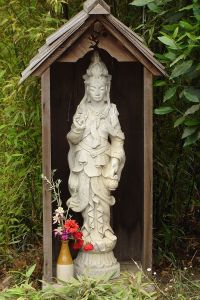
Kwan Yin, Bodhisattva of compassion, Green Gulch Farm Zen Center, San Francisco

Every era has its blind spots: subjects that go largely unexamined, though their presence can be felt and their importance intuited at every turn. In our own time, one conspicuous instance is the subject of maturity, which receives scant notice in the media, much less sustained attention. Even AARP The Magazine, which used to be called Modern Maturity, now avoids both the word and the concept it designates, focusing instead on ways of staying hip and feeling younger. Yet, in my experience, few qualities of mind and heart are more conducive to health and well-being than emotional, intellectual, and spiritual maturity. In its absence, individuals, families, and whole societies suffer. In its presence, harmonious relations between classes, races, political parties, and other competing interests become possible. Reason enough, one would have thought, to give the subject serious consideration. (more…)

Read Full Post »

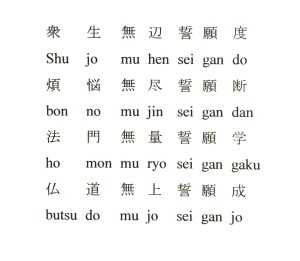
The Four Great Bodhisattva Vows, Rinzai Zen version

If you are a connoisseur of proverbial wisdom, you know which road is paved with good intentions. And if you’ve ever bestowed a well-intentioned gift, only to find it unwanted and unappreciated, you may be forgiven for suspecting that good intentions, especially those that ignore actual conditions and circumstances, may be as unavailing as last year’s New Year’s resolutions.

In the popular imagination, Zen is sometimes viewed as a philosophy of “going with the flow.” Rather than impose our narrow intentions on things as they are, we should relax and let events unfold of their own accord. Such a view is not without a basis in Zen teachings. No less an authority than Shunryu Suzuki Roshi, in his classic Zen Mind, Beginner’s Mind, asserts that “the true purpose” of Zen is “to see things as they are, to observe things as they are, and to let everything go as it goes.” But in the foundational teachings of the Buddhist tradition, of which Zen is a late flowering, the issue of intentionality plays a pivotal role. “The thought becomes an intention,” the Buddha is reported to have said, “the intention manifests as an action, the action develops into habit, and habit hardens into character. Therefore watch closely the thought and let it spring from concern for all beings.” Far from being extraneous or antithetical, intentions and their manifestation in action, habit, and character lie close to the heart of Zen practice. (more…)

Read Full Post »

Shortly after her fifth birthday, my granddaughter and I had one of our quiet conversations. We talked about her preschool activities, her best friends, her latest drawings. When we had exhausted those subjects, she paused for a bit, sat back regally in my leather chair, and made a request:

“Grandpa, tell me about the Buddha.”

Her request took me by surprise. During my tenure at Alfred University, I often taught an Honors course entitled The Art of Meditation, in which I introduced undergraduates to the basics of Buddhist meditation. Since retiring, I have given informal talks on the Four Noble Truths, the Four Foundations of Mindfulness, and other aspects of the Buddhist tradition to classes and audiences large and small. But until then, I had not attempted to expound Buddhist teachings to a very young child, let alone my granddaughter. What should I tell her? What should I not tell her? What did I wish for her to remember? (more…)

Read Full Post »

« Newer Posts - Older Posts »