Feeds:
Posts
Comments

Archive for the ‘1’ Category

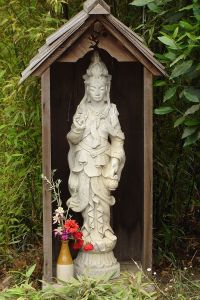
Kwan Yin, Bodhisattva of compassion, Green Gulch Farm Zen Center, San Francisco

Every era has its blind spots: subjects that go largely unexamined, though their presence can be felt and their importance intuited at every turn. In our own time, one conspicuous instance is the subject of maturity, which receives scant notice in the media, much less sustained attention. Even AARP The Magazine, which used to be called Modern Maturity, now avoids both the word and the concept it designates, focusing instead on ways of staying hip and feeling younger. Yet, in my experience, few qualities of mind and heart are more conducive to health and well-being than emotional, intellectual, and spiritual maturity. In its absence, individuals, families, and whole societies suffer. In its presence, harmonious relations between classes, races, political parties, and other competing interests become possible. Reason enough, one would have thought, to give the subject serious consideration. (more…)

Read Full Post »

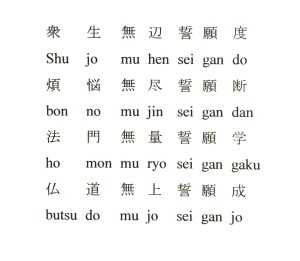
The Four Great Bodhisattva Vows, Rinzai Zen version

If you are a connoisseur of proverbial wisdom, you know which road is paved with good intentions. And if you’ve ever bestowed a well-intentioned gift, only to find it unwanted and unappreciated, you may be forgiven for suspecting that good intentions, especially those that ignore actual conditions and circumstances, may be as unavailing as last year’s New Year’s resolutions.

In the popular imagination, Zen is sometimes viewed as a philosophy of “going with the flow.” Rather than impose our narrow intentions on things as they are, we should relax and let events unfold of their own accord. Such a view is not without a basis in Zen teachings. No less an authority than Shunryu Suzuki Roshi, in his classic Zen Mind, Beginner’s Mind, asserts that “the true purpose” of Zen is “to see things as they are, to observe things as they are, and to let everything go as it goes.” But in the foundational teachings of the Buddhist tradition, of which Zen is a late flowering, the issue of intentionality plays a pivotal role. “The thought becomes an intention,” the Buddha is reported to have said, “the intention manifests as an action, the action develops into habit, and habit hardens into character. Therefore watch closely the thought and let it spring from concern for all beings.” Far from being extraneous or antithetical, intentions and their manifestation in action, habit, and character lie close to the heart of Zen practice. (more…)

Read Full Post »

Shortly after her fifth birthday, my granddaughter and I had one of our quiet conversations. We talked about her preschool activities, her best friends, her latest drawings. When we had exhausted those subjects, she paused for a bit, sat back regally in my leather chair, and made a request:

“Grandpa, tell me about the Buddha.”

Her request took me by surprise. During my tenure at Alfred University, I often taught an Honors course entitled The Art of Meditation, in which I introduced undergraduates to the basics of Buddhist meditation. Since retiring, I have given informal talks on the Four Noble Truths, the Four Foundations of Mindfulness, and other aspects of the Buddhist tradition to classes and audiences large and small. But until then, I had not attempted to expound Buddhist teachings to a very young child, let alone my granddaughter. What should I tell her? What should I not tell her? What did I wish for her to remember? (more…)

Read Full Post »

One Sunday morning, a lifetime ago, I sat with my family in the First Methodist Church in Clinton, Iowa. The pew was hard, as if designed to punish us for our sins. Our black-frocked minister was well into his latest long-winded sermon, but I wasn’t listening. My attention was riveted on the elderly man in the pew ahead of me.

On the nape of his leathery neck, deep creases had etched an elongated “X.” Whenever he bowed his head, the creases would recede. When he looked up again, they would re-emerge. As the service continued, these marks of age and experience exhibited various degrees of depth and prominence. During the responsive readings, they nearly vanished. During the singing of the Doxology, which he probably knew by heart, they stood out boldly, like furrows in a freshly plowed field. (more…)

Read Full Post »

202. The beautiful secret

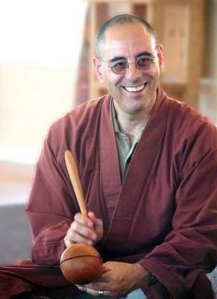
Zoketsu Norman Fischer Roshi

In his e-book Suffering and Possibility, the Zen teacher Norman Fischer discloses what he calls “the great and beautiful secret” of meditative practice. Elementary in nature but far-reaching in significance, the realization to which he refers has the capacity to transform both our outlook and our experience of everyday life.

Fischer’s general subject is the human condition, of which human suffering, broadly defined, is an inescapable part. Like other teachers in the Zen tradition, Fischer distinguishes between necessary and unnecessary suffering. The former arises from external conditions over which we have little or no control: war, famine, disease, aging, natural disasters, and the like. The latter is created by our own minds, specifically by our conditioned and often unskillful responses to the troubles we incur. Yet, whether human suffering, known as dukkha in Buddhist teachings, be deemed necessary or self-inflicted, it is an integral and unavoidable aspect of human experience.

(more…)

Read Full Post »

Matthew Arnold
1822-1888

In his sonnet “To a Friend” (1849), the Victorian poet Matthew Arnold offers “special thanks” to the tragic dramatist Sophocles, whose “even-balanced soul . . . / Business could not make dull, nor Passion wild.” The “mellow glory of the Attic stage,” the author of Antigone and Oedipus Rex “saw life steadily, and saw it whole.”

To see life steadily, which is to say, to remain continuously present for the present moment, is a fundamental aim of Zen practice. Toward that end, a  variety of means are available to the serious practitioner, most prominently sitting meditation, conscious breathing, and mindful attention to everyday life. With proper instruction and sufficient diligence, all of these methods can eventually be mastered. Being fully present can become a dominant mental habit, replacing older habits of inattention and distraction.

Seeing life whole is another matter. What, exactly, Arnold meant by that phrase is open to question, but whatever else his words might imply, they suggest a balanced and comprehensive vision of the human condition. Such a vision would, as Zen teachers put it, “include everything”: illness as well as health, sorrow as well as joy, death as well as life. To attain to so equable and inclusive a view is a noble objective, but many practical obstacles stand in the way. Three in particular come to mind. (more…)

Read Full Post »

Roshi Joan Halifax

Altruism. Empathy. Integrity. Respect. Those abstract words enjoy an exalted status in contemporary discourse, perhaps because the qualities they designate often seem in short supply.  Those who embody them earn our admiration, both for their courage and their moral example. In many spiritual traditions, Zen included, the manifestation of such qualities is both an aim and a fruit of dedicated practice.

Yet even the noblest human qualities have their shadow sides. Practiced unskillfully, they can harm both the practitioner and those whom he or she purports to serve. In her new book Standing at the Edge (Flatiron Books, 2018), Roshi Joan Halifax, founder and Abbot of the Upaya Zen Center, takes a hard look at five such qualities, examining their nature, their agency in the world, and their capacity to relieve human suffering. At the same time, she acknowledges the emotional damage that even such commendable qualities as empathy and compassion, practiced without sufficient knowledge or wisdom, can inflict on oneself or others. As a longtime caregiver for the dying, a volunteer in maximum-security prisons, and the director of clinics and service projects in Tibet and elsewhere, Halifax knows whereof she speaks. Grounded in her practical experience and her scholarly training in the social sciences, her book is at once a manual for caregivers and an illuminating collection of cautionary tales, detailing the hazards and the fulfillments attendant to a life of selfless service. (more…)

Read Full Post »

Jane Hirshfield 2009

Shizen ichimi, an old Zen saying asserts: “Poetry and Zen are one.” And in the poems of Jane Hirshfield (b. 1953), a leading American poet and longtime Zen practitioner, that adage is borne out in concrete images and recurrent themes. Such is the case in this elegant poem, which hangs on a wall in our home:

                        A CEDARY FRAGRANCE

                       Even now,

                       decades after,

                       I wash my face with cold water –


                       Not for discipline,

                       nor memory,

                       nor the icy, awakening slap,


                       but to practice

                        choosing

                        to make the unwanted wanted.

 In these lines Hirshfield examines a daily ritual: splashing cold water on her face in the early-morning hours. In so doing, she also articulates several core principles of Zen practice. (more…)

Read Full Post »

Michael Longley (b. 1939) is the foremost living poet of Northern Ireland. Born and reared in Belfast, he was educated at Trinity College, Dublin, where he studied classics. Although he has traveled widely, he has lived in his native city all his life, and some of his most admired poems address what he has called the “Years of Disgrace”—the thirty-year period of sectarian warfare in twentieth-century Ulster. But Longley’s poetic imagination is most at home in the townland of Carrigskeewaun in Co. Mayo, where he and his wife, the distinguished literary critic Edna Longley, have owned a cottage since 1970. Over the decades, they have regularly returned to their remote retreat, and many of Longley’s most compelling poems are exquisite miniatures, set in the Mayo landscape. Many feature birds and flowers.

Longley’s most recent collection, Angel Hill, includes a poem as remarkable for its diction as for its concentration: (more…)

Read Full Post »

Consider, if you will, the peculiar status of the word special. Whether employed as adjective or noun, the word means distinctive, uncommon, out-of-the-ordinary. Yet the word itself could hardly be more common. On what seems like a weekly basis, retailers announce their Special Offers and Special Sales. For breakfast, some of us eat Special K, which presumably is superior to Regular K. When we go out to dinner to celebrate a special occasion, we are likely to hear at length about that evening’s specials. In some contexts, as in “special needs,” “special effects,” and Special Counsel, the word’s function is chiefly descriptive, but more often it serves to praise, sell, or persuade. If someone calls you a “very special person,” you can safely take it as a compliment. With rare exceptions, both the literal meaning and the connotations of special are reliably, if vaguely, laudatory. (more…)

Read Full Post »

« Newer Posts - Older Posts »