Every era has its blind spots: subjects that go largely unexamined, though their presence can be felt and their importance intuited at every turn. In our own time, one conspicuous instance is the subject of maturity, which receives scant notice in the media, much less sustained attention. Even AARP The Magazine, which used to be called Modern Maturity, now avoids both the word and the concept it designates, focusing instead on ways of staying hip and feeling younger. Yet, in my experience, few qualities of mind and heart are more conducive to health and well-being than emotional, intellectual, and spiritual maturity. In its absence, individuals, families, and whole societies suffer. In its presence, harmonious relations between classes, races, political parties, and other competing interests become possible. Reason enough, one would have thought, to give the subject serious consideration. (more…)
Posts Tagged ‘norman fischer’
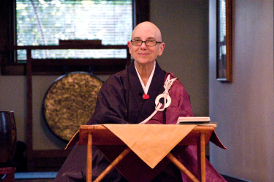
206. True adulthood
Posted in 1, tagged adulthood, bodhisattva, kosho uchiyama, maturity, norman fischer, zen on 5 December 2018| Leave a Comment »
193. The practice of aimlessness
Posted in 1, tagged aimlessness, apranihita, Buddhism, Martin Luther King, Maud Gonne, norman fischer, peace, thich nhat hanh, Three Doors of Liberation, W.B. Yeats, wishlessness, zen on 2 November 2017| Leave a Comment »
In the spring of 1998, at a meditative retreat in Burlington, Vermont, Zen master Thich Nhat Hanh offered some basic instructions for seated meditation. “Just sit there,” he said. “Don’t try to become someone else.”
A year later, in Brownsville, Vermont, I attended a subsequent retreat conducted by Thich Nhat Hanh. On an August afternoon, I sat outdoors with “Thay,” as we called him, and a dozen others, drinking herbal tea. A gentle monk in his early seventies, he wore the earth-brown robes of his Vietnamese order. Now and then, he lifted his cup with both hands and took a sip of tea. At that time, Thich Nhat Hanh was already a figure of international renown. Describing him as an “apostle of peace and non-violence,” Dr. Martin Luther King had nominated him, in 1967, for the Nobel Peace Prize. Yet, on that August afternoon, his silent presence seemed as humble as it was peaceful. Well established in the present moment, he was the very embodiment of his own advice. He showed no sign of wanting to be anywhere or anyone else. (more…)
182. The practice of not-knowing
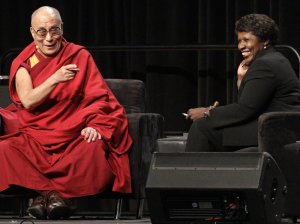
Posted in 1, tagged Gwen Ifill, Nan-in, norman fischer, not-knowing, zen on 8 December 2016| Leave a Comment »
“My job as a reporter,” the late Gwen Ifill once remarked, “is not to know what I think.” Humble in spirit but incisive in content, that remark calls to mind two essential stories from the Zen tradition.
In the first, a learned university professor pays a visit to Nan-in, a renowned Zen master of the Meiji period (1868-1912), with the intention of learning more about Zen. The two men meet for tea.
Eager to impress his host, the professor holds forth at great length, demonstrating his extensive knowledge of Buddhism and expounding his personal views. Meanwhile, Nan-in pours tea into the professor’s cup. When he has filled it to the brim, he continues to pour, spilling tea all over the table.
For a time the professor ignores this distraction, but when he can bear it no longer, he exclaims, “The cup is overfull! No more will go in!”
“Like this cup,” Nan-in replies, “you are full of your opinions and speculations. How can I show you Zen unless you first empty your cup?” (more…)
173. One particular action
Posted in 1, neuroscience, Zen, tagged Autumn Journal, Belfast, Benjamin Libet, karma, louis macneice, norman fischer, Northern Ireland, peace, quarter-second, Susan Moon, Yeats on 16 March 2016| 2 Comments »

Zoketsu Norman Fischer
“Why do we like being Irish?” asks the Irish poet Louis MacNeice (1907-1963) in his poem Autumn Journal (1939). In subsequent lines, he answers his own question:
Partly because
It gives us a hold on the sentimental English
As members of a world that never was,
Baptized with fairy water;
And partly because Ireland is small enough
To be still thought of with a family feeling,
And because the waves are rough
That split her from a more commercial culture;
And because one feels that here at least one can
Do local work which is not at the world’s mercy
And that on this tiny stage with luck a man
Might see the end of one particular action.
Because Ireland is a relatively small country, and because in MacNeice’s time families tended to stay put for as long as economic conditions allowed, Irish people could reasonably hope to see the “end”–the consequences as well as the completion–of any particular action. (more…)
167. Give it all away
Posted in 1, meditation, Zen, tagged Blanche Hartman, emptiness, interdependence, Milarepa, norman fischer, Shinge roko sherry chayat roshi, Shinge Roshi, Shunryu Suzuki Roshi on 2 December 2015| Leave a Comment »
The practice of Zen contemplation, Zen teachings tell us, is the “action of non-action,” grounded in silent awareness. At the same time, the “non-action” of Zen is best described in active verbs. In her essay “What is Zen?” Shinge Roko Sherry Chayat Roshi offers this description:
What is Zen? Stop now. Stop trying to get an intellectual lock on something that is vast and boundless, far more than the rational mind can grasp. Just breathe in with full awareness. Taste the breath. Appreciate it fully. Now breathe out, slowly, with equal appreciation. Give it all away; hold onto nothing. Breathe in with gratitude; breathe out with love. Receiving and offering–this is what we are doing each time we inhale and exhale. To do so with conscious awareness, on a regular basis, is the transformative practice we call Zen.
It would be difficult to find a more lucid or concrete description of Zen practice. Follow Shinge Roshi’s instructions, and you will not go wrong. Yet, for all its clarity, this description is at one point ambiguous. “Hold onto nothing,” Shinge Roshi advises. “Give it all away.” But what is the antecedent, a grammarian might inquire, of the pronoun “it”? What, besides our breath, are we giving away? (more…)
156. The Book of Janet
Posted in 1, tagged impermanence, interdependence, Martin Luther King, network of mutuality, norman fischer, self, zen on 4 February 2015| 3 Comments »
I have a friend by the name of Janet, who regularly consults what I call the Book of Janet, especially when she’s feeling blue or vexed or insecure. If she makes some trivial error, like misplacing her car keys, the Book of Janet reminds her that she is not well-organized. If she enters a competition and receives a letter of rejection, the Book of Janet informs her that her work is not all that good. And if she’s feeling less than beautiful on any given morning, the Book of Janet confirms her worst fears. On all three counts, the Book of Janet is wide of the mark. It is out of touch with the present reality. Unfortunately, that makes little difference to Janet, who swears by her Book as if it were her Bible. (more…)
150. Let’s not go there
Posted in 1, tagged Amish clothing, habits, ichigo ichie, James Silas Rogers, jukai precepts, norman fischer, rakusu, zen meditation, Zen practice on 13 August 2014| 2 Comments »
In his poignant essay “The Old Order,” the Irish-American writer James Silas Rogers recalls his conversation on an Amtrak train with a young Amish man named Johann, who was crossing Wisconsin with his extended family. Curious about Amish faith and belief, Rogers inquired as to the significance of Johann’s distinctive attire: his plain shirt, suspenders, and broadfall trousers. “People ask us,” Johann replied, “if we think that wearing these clothes will get us into heaven. We absolutely do not. . . . But I do know that if I wear these clothes, it will keep me out of places where I should not go.”*
Reading Johann’s explanation, I was reminded of formal Zen practice, which also employs special clothes to remind practitioners of their moral commitments. In Japanese Zen, one of the most conspicuous of those clothes is the rakusu, a bib-like garment worn (and often hand-sewn) by those who have “taken the precepts,” which is to say, have publicly affirmed a set of ethical guidelines. Known as the “jukai precepts,” those guidelines differ from sect to sect, but in essence they enjoin the Zen disciple to refrain from harmful behaviors, particularly killing, stealing, engaging in false or injurious speech, using sexuality in hurtful ways, and abusing intoxicants. The unadorned rakusu, viewed as a miniature monastic robe and inscribed on the back with its wearer’s “dharma name,” signifies a commitment to that fundamental code of conduct. (more…)
132. This precious human birth
Posted in Uncategorized, tagged ichigo ichie, lojong, loren eiseley, norman fischer, this precious human birth, Tibetan slogans on 26 June 2013| 8 Comments »
On Friday, June 14, my granddaughter, Allegra Rose Howard, arrived in the world, weighing eight pounds and twelve ounces. As I reflect on that glad event, I am reminded of a phrase from Tibetan Buddhist teachings.
The phrase is this precious human birth. Its source is the Chiggala Sutra, where the Buddha speaks of the chances of being born a human being. Those chances, he observes, are infinitesimally small. They are analogous to those of a blind tortoise swimming in an ocean as large as the planet, where an ox’s yoke is afloat on the waves. Every one hundred years, the tortoise surfaces. The chances of being born human are no better than those of the tortoise surfacing with his head in the yoke. Human birth is extremely rare and therefore most precious.
In the lojong system of mind training practiced by Tibetan Buddhists, phrases such as this precious human birth are known as “slogans.” Contemplated and absorbed during sitting meditation, they are subsequently applied to everyday life. As the Zen teacher Norman Fischer explains, the best way to work with a lojong slogan is to develop it “as an almost physical object, a feeling in your belly or heart.” Once the slogan has embedded itself, you can work with it throughout the day, until it becomes “part of your mind—your own thought, a theme for daily living.”* (more…)
113. True Equanimity
Posted in Uncategorized, tagged bhikkhu bodhi, BOSU Ball, equanimity, Four Immeasurables, ichigo ichie, norman fischer, pema chodron, thich nhat hanh, upeksha on 5 September 2012| 2 Comments »

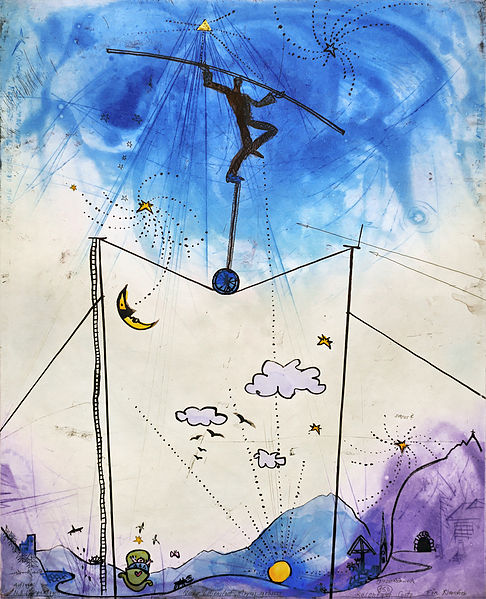
Adi Holzer, “CV” (1997)
One morning earlier this summer, I found myself standing atop an unstable blue object known as a BOSU Ball. Invented by David Weck in 1999, the BOSU Balance Trainer is an inflatable rubber hemisphere attached to a rigid platform. The central component of a “mindful approach to exercise,”[1] the BOSU Ball is designed to improve the body’s sense of balance while strengthening its stabilizing muscles. I was standing on the BOSU Ball because I’d been having knee pain, and our family doctor had recommended physical therapy. In turn, the affable but exacting physical therapist with whom I was working had prescribed the BOSU Ball. “Don’t fall off,” he cheerfully warned, having just assigned me thirty squats. Miraculously, I managed to comply.
In a manner analogous to that of the BOSU Ball, Zen practice also aims to strengthen our sense of balance, physical and emotional. In Zen teachings, the capacity to maintain one’s equilibrium, especially under stressful, uncertain, and unstable conditions, is known as equanimity, a translation of the Sanskrit word upeksha. The traditional posture of sitting meditation—knees down, back erect, head balanced on the spine—supports the cultivation of upeksha, as does the practice of walking meditation, which trains the practitioner to walk with dignity and steady awareness. But these forms and practices, however essential to Zen discipline, are but the outward expressions of an inner poise. And at the heart of that inner poise is a balanced, inclusive way of experiencing the world. (more…)