Feeds:
Posts
Comments

Posts Tagged ‘Dogen’

Yamada Koun

“The practice of Zen,” declared Yamada Koun Roshi (1907-1989), “is the perfection of character.” To those accustomed to thinking of Zen as a means of “living in the present” or relieving stress, that stark pronouncement may come as a surprise. In any event, it merits and rewards a closer look.

To begin with, Yamada Roshi was speaking of a process, not a fait accompli. Specifically, he was referring to what are known in Zen as the paramitas, or the Perfections of Wisdom: a set of virtues that are both a focus of daily practice and an essential foundation for its long-term aims. In Zen parlance, the paramitas are the vessels that “carry” practitioners to the “other shore” of full awakening. In the Rinzai Zen tradition in which I was trained, there are six such Perfections: generosity, ethical conduct, patience, joyful effort, meditation, and wisdom. Together with other qualities of heart and mind, including compassion, sympathetic joy, and equanimity, the Perfections comprise the ethical infrastructure on which Zen practice is based.

But how, exactly, can the central practice of Zen, namely zazen (seated meditation), contribute to the perfection of character? How can sitting quietly while following one’s breath, watching and releasing thoughts, or contemplating a koan further the development of character? And how can the “non-action” of zazen, as distinguished from virtuous actions in the world, foster the perfection of character? Of the many ways in which this can occur, I would single out three for special attention.

The backward step

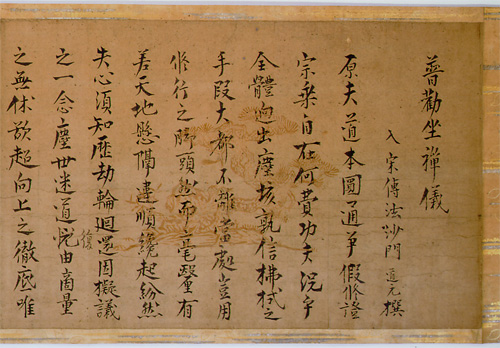
In a classic text of the Soto Zen tradition (the Fukanzazengi  or Principles of Seated Meditation), Eihei Dogen (1200-1253), founder of that tradition, characterizes the practice of zazen as taking “the backward step” that “turns the light inward.” What that light illuminates, among other things, is the ever-changing states of our bodies, minds, and hearts. Our physical sensations, especially those to do with respiration; our present state of mind, whether agitated or tranquil, angry or at ease; our heart’s intentions, whether malicious or benevolent; our thoughts, however fleeting or obsessive—all are revealed to the mindful observer. Where before there were only sensations, thoughts, and feelings, now there is also awareness of those phenomena. Awareness of this kind can transform our character, insofar as it reveals what was hidden, even from ourselves. In this respect, zazen resembles the practice of prayer, in which petitioners humbly articulate their needs, longings, regrets, gratitude, and more, while seeking to atone for past misdeeds. And like the practice of prayer, zazen can nourish and advance the development of character.

Response rather than reaction

In many situations in everyday life, such as driving a car or riding a bike, it is imperative that we react instantaneously to whatever has suddenly arisen. Seeing an unaccompanied child crossing the street, we hit the brakes without hesitation. But in many other situations, such as a parent-child conflict or a domestic argument, even a moment of reflection prior to speaking or acting can make the difference between a destructive reaction and a constructive response.

By its very nature, zazen fosters the latter. The practice of sitting still and not reacting to internal or external stimuli strengthens a precious mental faculty, namely the ability to respond to unwelcome circumstances in a spirit consistent with the paramitas. By not reflexively reacting but wisely responding to such challenging affronts as insults, inflammatory remarks, and false accusations, we create opportunities to align our responses with our deepest values. We actively cultivate kshanti paramita (patience). And over time, this measured, disciplined response to adversity can deepen and fortify character.

Humility

Although Zen meditation is sometimes misconstrued as a self-centered practice, its net effect is to heighten practitioners’ sensitivity to what Paula Arai, in The Little Book of Zen Healing (Shambhala, 2023), calls “the extensive matrix of connections we all share.” That heightened sensitivity enables us to interact “with present conditions from a perspective that moves in rhythm with the circling of stars, seas, life, bones, stones, stars.” In other words, the practice of zazen reminds us not only of the interdependence of the human family but also of non-human forces larger than our ordinary selves. As Arai notes, that broadened awareness can bring relief from anxieties, insecurities, and suffering generally. And for some practitioners, it can feel like being embraced by a higher power, over which the personal self has little or no control. By so doing, zazen can reinforce our sense of humility, one of the essential components of what we in the West call character.

To be sure, Zen meditation is not for everyone. Nor is it common in our fast-paced contemporary culture. As the Zen teacher Nelson Foster observes, “Sitting silently for long hours, reciting old Asian texts, studying koans—these are hardly common behaviors in the West.” More’s the pity, I might submit, if so simple, accessible, and enjoyable a practice can indeed equate with the gradual perfection of character.


Paula Arai, The Little Book of Zen Healing: Japanese Rituals for Beauty, Harmony, and Love (Shambhala, 2023), 88, 106.

Nelson Foster, Storehouse of Treasures: Recovering the Riches of Chan & Zen (Shambhala, 2024), 31.

Photo: Yamada Koun Roshi
Read Full Post »

grandmother-1_custom-9fc121820404197bbae50a16e9363940e4a7e6a3-s800-c85

One night at the dinner table I posed three questions to our granddaughter, who has now entered fourth grade.

“What is something,” I asked, “that children are interested in but grown-ups are not?”

“Pokemon,” she replied, not skipping a beat.

“What is something that grown-ups are interested in but children are not?”

“Economics,” she replied, a knowing look in her eyes.

“And what is something that both children and grown-ups are interested in?

“Food!” she answered.

Perhaps it was time to eat.

The subject of food—and of late, food insecurity—is indeed of universal interest. Its importance transcends nations and cultures as well as generations. In Zen teachings, food is regarded as one of the four essential gifts for which we should be grateful, the other three being clothing, medicine, and shelter. Yet, though food is fundamental to our existence, regardless of who we are or where we live, it’s fair to say that there are as many customs, strictures, and prohibitions regarding the preparation and consumption of food as there are societies, ethnicities, and varieties of religious experience.

Zen is no exception, though in Western Zen, especially among lay practitioners, there are few hard and fast rules. According to the “Five Contemplations” chanted before meals in Zen monasteries, we are to consume “only those foods which nourish us and prevent illness.” (Fritos are out of the question). Moreover, we are to “eat mindfully, so as to be worthy” to receive our food. By so doing, we will “realize the path of understanding and love.” If you spend time in a Western Zen center, as in its Asian counterpart, you are more than likely to be served—and often to assist in the preparation—of vegetarian meals. But what, exactly, you will eat is on the whole of less consequence than the attitude to be cultivated in preparing and consuming it.

If you would like a taste, as it were, of that attitude, I would recommend exploring the many Zen-inflected cookbooks currently available to the Western reader. A good place to start would be Edward Espe Brown’s Tassajara Bread Book (1974), the bread-making bible of the “whole-earth” movement, and his memoir No Recipe: Cooking as Spiritual Practice (Sounds True, 2018). In the latter book, Brown, a celebrated chef as well as a Zen priest, embraces an intuitive, improvisatory approach to the art of cooking. Also of interest is 3 Bowls: Recipes from an American Zen Buddhist Monastery (Harvest, 2000), by Seppo Edward Farrey and Nancy O’Hara, which offers innovative, hybrid recipes not found elsewhere. My own well-thumbed favorite is A Taste of Heaven and Earth (Morrow, 1993) by Bettina Vitell. Like Farrey, Vitell is a former tenzo (head cook) at Dai Bosatsu Zendo. Emphasizing the sensory dimension of cooking and eating, her wide-ranging book integrates perspectives from the Zen tradition with simple but delicious vegetarian recipes.

Underlying all of these modern examples, however, is Eihei Dogen’s thirteenth-century classic Instructions for the Zen Cook (1237), in which the founder of the Soto Zen tradition articulates the basic principles of Zen cooking. Foremost among them is an attitude of wholeheartedness—or, in today’s parlance, of being “all in,” however menial the task at hand. Concomitant to this is the principle of equality: we are to treat the lowliest turnip with the same respect as we would the most exotic rice. Most striking, at least to the modern Western reader accustomed to hastily prepared food, is Dogen’s explanation of robai-shin, commonly translated as “parental mind.” Cultivating robai-shin, we train ourselves to treat both the food we are preparing and the utensils we are using as if they were our children, affording them infinite care.

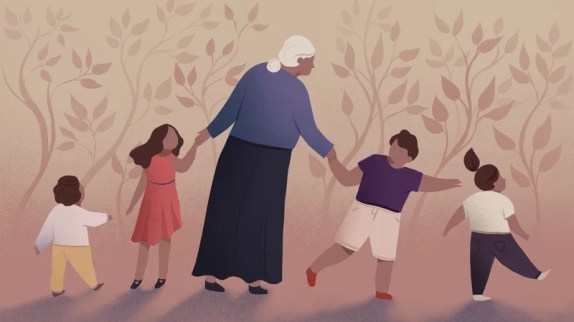
Robai-shin is sometimes translated as “grandmother mind.” And in her book Alive Until You’re Dead (Shambhala, 2022), the Zen teacher Susan Moon, herself a devoted grandmother, opts for this alternative translation. “Grandmother mind” deepens the concept of parental mind to include the qualities of warmth, empathy, wisdom, and compassionate understanding, tempered by grandmotherly sternness when required.

This attitude need not be limited to cooking. Nor is it the exclusive province of literal grandmothers. In the true spirt of Zen, Moon widens the concept to encompass anyone engaged in the interactions of everyday life. “If a young male monk can develop grandmother mind,” she writes, “then a person of any age, gender, and social status can develop it. You don’t have to be a grandmother to give your coat to someone shivering in the cold. A particular nod of recognition is due to all the grandfathers who are devoted to their grandchildren. Grandmother mind is simply a figure of speech. Even grandfathers can have grandmother mind.” Moreover, she notes in her conclusion, “Since we will become ancestors after we die, whether we like it or not, we might as well practice now by loving the beings we meet with grandmother mind, even if we aren’t grandmothers and even if they aren’t children.”

_______

Susan Moon, Alive Until You’re Dead: Notes on the Home Stretch (Shambhala, 2022), 57, 62.

Illustration by Nicole Xu.

 \

Read Full Post »

Sarasota Zen Center

In the summer of 1965, shortly after my twenty-first birthday, I booked passage from London to New York on the Castel Felice, a storied old Sitmar liner with rock-bottom fares. For the previous nine months I had been an American student at the University of Leeds in West Yorkshire, England. Now I was coming home.

Midway through the ten-day voyage, something quietly momentous occurred. Winston Churchill once remarked that America and England are two nations separated by a common language. And during my time in England, although I shared a common tongue with my British hosts, I seldom forgot that I was a foreigner: a guest, as it were, of the British nation. But somewhere in the mid-Atlantic, I began to feel myself on native ground again. I began to feel like a host. And the British subjects on board, with whom I had many conversations about American culture, began to feel like my guests. Although it was never openly acknowledged, this reversal of roles could be felt in our language, our attitudes, even our demeanor. And the closer we came to the Statue of Liberty, the stronger the feeling grew.

Something analogous has been happening in American Zen. Recently Shohaku Okumura Roshi, an esteemed Zen master and abbot of the Sanshin Zen Community in Bloomington, Indiana, abandoned the lotus position, the traditional, cross-legged posture of Japanese Zen. He now sits in a chair. Likewise Susan Moon, an American writer and longtime Zen practitioner, has traded her traditional zafu (meditation cushion) for a straight-backed chair. In both instances, these decisions were driven by physical considerations. But in their broader cultural import, they might well be seen as symbolic.

For the past fifty years, American Zen has played guest to its foreign host, whose postures, forms, language, and liturgy it has struggled mightily to emulate and adopt. We Western practitioners have worn our hipparis and rakusus, our robes and tabi. We have chanted the Heart Sutra in Sino-Japanese. But slowly and sometimes painfully, American Zen has been coming into its own. Such unconventional practices as sitting zazen in a chair or chanting the sutras in English translation have been introduced in many Zen centers and widely, if sometimes reluctantly, accepted. Such adaptions are now no longer seen, as least by the more liberal-minded proponents of the practice, as concessions to comfort or as inauthentic, Western replicas of the real thing.

Looking back on my own essays on Zen practice, I see that they, too, reflect this tectonic shift. The Vietnamese Zen master Thich Nhat Hanh, to whom I have so often referred, went out of his way in his talks and writings to make the Asian practice of Zen palatable and accessible to interested Westerners. The word Zen was never mentioned; he spoke rather of “mindfulness” and the “energy of mindfulness.” Zazen became “seated meditation,” kinhin became “walking meditation,” and prostrations—that most foreign of Buddhist practices—became “touching the earth.” In this way “Thay,” as we called him, not only repackaged the practice. He also contributed, in no small measure, to its naturalization in the Western Hemisphere.

By and large, most of the leading Western teachers and writers on Zen—Zoketsu Norman Fischer, Roshi Joan Halifax, Charlotte Joko Beck, Edward Espe Brown, Zenkei Blanche Hartman, James Ishmael Ford, to name a few—have done the same. Their teachings and writings are deeply rooted in the traditional Asian teachings, particularly the seminal writings of Eihei Dogen (1200-1253), founder of the Soto tradition of Japanese Zen. But all of these teachers grew up in the United States and were conditioned by the mores, values, and language of mainstream Western culture. And in their talks and writings, they too have made an effort not only to translate the teachings into Western terms but to make this ennobling practice relevant and understandable to people living in our present place and time. Such terms as “ordinary Zen” and “everyday Zen” reinforce the image of a practice that originated in the East but has found a home and a nurturing environment in Western society.

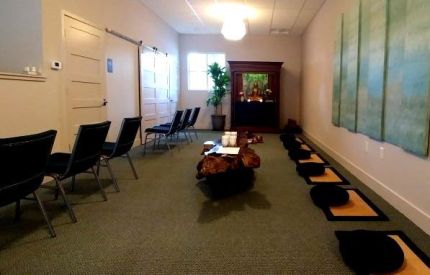
To be sure, not every Zen practitioner is comfortable with this development. Those who assert that the full lotus is the only truly authentic Zen posture are unlikely to be at ease in such venues as the Ordinary Zen Sangha in Sarasota, Florida, which features on its website a photo of airport-style chairs lined up next to a wall on one side of its meditation hall and a row of zafus on tatami mats next to the facing wall. This image of an accommodating cultural change might also be read as a symptom of a deepening cultural divide: the innovators on the one side, the traditionalists on the other. Will that image prove to be a symbol of a broadening, inclusive practice—or a harbinger of a splintering spiritual community?  I for one would hope that a strict and formal Eastern practice whose motto is “include everything” will find ample room for the West and its often informal ways.

______

Photo: The zendo of the Ordinary Zen Sangha, Sarasota, Florida. https://ordinaryzensangha.org/.


Read Full Post »

Ted Kooser

Ted Kooser

______

In Zen practice,” writes the Zen teacher Sobun Katherine Thanas, “we give attention to the details of our lives.” By paying close, sustained attention to the most ordinary details in our daily round, we train ourselves to abide in the present moment. Rather than sacrifice our present experience to a past that is already gone, a future that has not yet come, or abstract thoughts that may or may not reflect reality, we attend to the details of the matter at hand: the level of green tea in our measuring spoon, the temperature and volume of water to be added, the specific brewing time for that particular tea. By so doing, we fully engage in relative, historical time, even as we touch the timeless, absolute dimension of our experience.

No one understands this paradox more fully or articulates it with greater skill than the Midwestern poet Ted Kooser (b. 1939), who won the Pulitzer Prize for Poetry for his book Delights & Shadows in 2005 and served as US Poet Laureate from 2004-2006. Kooser is not a Zen practitioner, so far as I know, but by attending to the details of quotidian life, no matter how mundane, he returns the reader, time and again, to the immediacy of the present moment. And in their acute awareness of impermanence and interdependence, as revealed by such common or discarded objects as curtain rods, enameled pans, and Depression glass, his poems often embody the essence, if not the customary forms and rituals, of Zen practice.

A vivid example may be seen in the title poem of Kooser’s collection Splitting an Order (2014). In this gentle poem, set in a diner, the narrator observes an old man cutting his cold sandwich into two equal parts. It pleases the narrator to watch him

                                  keeping his shaky hands steady

by placing his forearms firm on the edge of the table

and using both hands, the left to hold the sandwich in place,

and the right to cut it surely, corner to corner,

observing his progress through glasses that moments before

he wiped with his napkin, and then to see him lift half

onto the extra plate that he asked the server to bring,

and then to wait, offering the plate to his wife

while she slowly unrolls her napkin and places her spoon,

her knife, and her fork in their proper places,

then smooths the starched white napkin over her knees

and meets his eyes and holds out both old hands to him.

A more ordinary situation it would be difficult to imagine: an elderly married couple having lunch in a diner. Yet Kooser endows this everyday situation with the glow of heightened attention, both on the part of the husband and wife and on that of the observant narrator.

The couple are splitting a plain roast-beef sandwich, perhaps to economize or because neither needs to eat a whole one. To accomplish this division, the husband must steady his shaky hands, a challenge he readily overcomes. By dividing the sandwich “surely” and diagonally, he ensures that the resulting portions will be exactly equal. Meanwhile, his wife carefully unrolls the napkin enclosing her knife, fork, and spoon. These, too, become objects of meticulous attention.

Even as the husband and wife are taking their time and paying attention to the details of their humble repast, the narrator is doing the same. His unswerving observation, recorded in a single complex but graceful sentence, not only mirrors that of his subjects toward the actions they are performing. It also establishes a tone of caring, even for common, unexceptional things, and implicitly bestows moral and aesthetic value on a scene that might otherwise have been dismissed as banal. The true significance of the scene becomes apparent in the poem’s closing lines, where the husband’s offering his wife her half of their sandwich completes his act of fairness, solicitude, and kindness. She in turn exhibits an attitude of openness and gratitude.

Shizen ichimi, an old Zen saying reminds us: “Poetry and Zen are one.” Although the former depends on fresh language, the latter on silent contemplation, both rely on wholehearted attention to concrete, particular detail. By stopping and looking deeply, both reveal the hidden dimension of human experience, the currents of interdependence and impermanence that underlie the most commonplace of human interactions. And, though they do so in very different ways, both, in the words of the poet Patrick Kavanagh, “snatch out of time the passionate transitory.”

_____________

Sobun Katherine Thanas, The Truth of This Life: Essays on Learning to Love This World (Shambhala, 2018), 69.

Ted Kooser, Splitting an Order (Copper Canyon, 2014), 9.

Patrick Kavanagh, “The Hospital,” Collected Poems (Norton, 1964), 153.

Photo: Ted Kooser

Read Full Post »

Wind bell PS

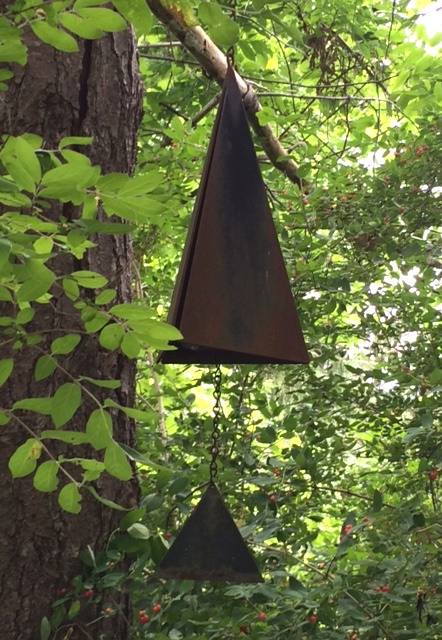
As a wedding gift eighteen years ago, two of our friends gave my wife and me a wind bell. Tall, pyramidical, and unadorned, it has hung from the branch of a spruce tree for nearly two decades. Its three steel sides and the triangular plate suspended from its clapper are rusted now, and the tree has long since died. But whenever the wind comes up with sufficient force, we are summoned by a distant, resonant clang, clang, clang—a reminder at once of continuity and change.

Wind bells have been around for millennia. In the late twelfth century Tendō Nyojō, a revered Zen master and the teacher of Eihei Dōgen, wrote a poem about his own: (more…)

Read Full Post »

One Sunday morning, a lifetime ago, I sat with my family in the First Methodist Church in Clinton, Iowa. The pew was hard, as if designed to punish us for our sins. Our black-frocked minister was well into his latest long-winded sermon, but I wasn’t listening. My attention was riveted on the elderly man in the pew ahead of me.

On the nape of his leathery neck, deep creases had etched an elongated “X.” Whenever he bowed his head, the creases would recede. When he looked up again, they would re-emerge. As the service continued, these marks of age and experience exhibited various degrees of depth and prominence. During the responsive readings, they nearly vanished. During the singing of the Doxology, which he probably knew by heart, they stood out boldly, like furrows in a freshly plowed field. (more…)

Read Full Post »

return_to_innocence-2

“Grandpa,” my granddaughter asked me over the holidays, “why do you have hair in your nose?”

At the time, Allegra had tucked herself snugly into my lap, and I was reading her a story. She is now three-and-a-half, the age of unending and sometimes unanswerable questions. On an earlier occasion, she had asked me why the sky is blue, and I replied as best I could. But this question was of another order.

As I looked down at her open, eager face, I remembered George Orwell’s observation that small children, being small, view adults from the least flattering angle. More happily, I also recalled the explanation a longtime friend provided when his grandchild asked him a similar question. Putting on his best poker face, he explained that when we have reached a certain age, our hair can no longer make it to the tops of our heads, so it comes out our ears and noses.

I considered offering this explanation to Allegra but thought better of it, knowing that my son, who once asked such questions himself, might not appreciate my filling his daughter’s head with misinformation.  So I offered the rather lame explanation that as people get older they have hair in their noses. Fortunately my son, overhearing our conversation, judiciously noted that all of us have hair in our noses. With that, the matter was laid to rest. (more…)

Read Full Post »

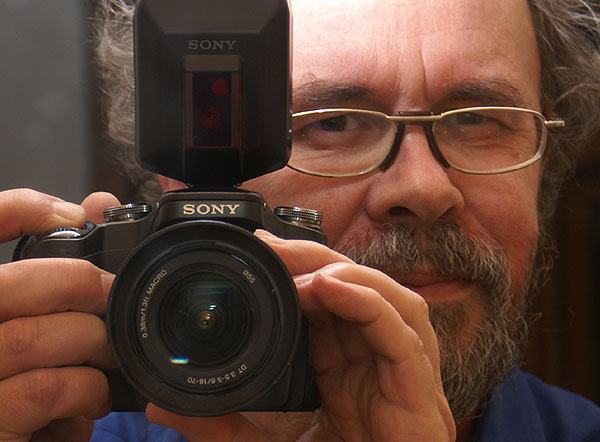
SelfieOver the past few years the digital self-portrait has come into its own. Decried by some as a symptom of narcissism, celebrated by others as a vehicle of self-empowerment, the so-called “selfie” has assumed center stage, not only in social media but in the media at large. Ellen DeGeneres’ “group selfie,” spontaneously snapped at the Oscars, may well be the world’s most widely viewed example, but it is literally one among millions.

In another decade or two, we may find out whether the selfie was a fad, a portent of a cultural shift, or something else entirely. But from the vantage point of Zen teachings, the ubiquitous selfie, shot in a mirror or from an outstretched hand, offers what is known as a “dharma gate”: a point of entry into a deeper truth. “To study the way,” wrote the thirteenth-century Zen master Eihei Dogen, “is to study the self.” And the phenomenon of the selfie, however superficial it may seem, provides an opportunity to do just that. (more…)

Read Full Post »

Eihei Dogen, Fukanzazengi (1233)

“It’s time for Congress to step up to its job,” writes Chris Dunn on his blog Collegiate Times. “It’s time for the Lakers to step up,” writes Darius Soriano on the Forum Blue and Gold. “It is time for webOS to step up,” writes Derek Kessler on precentral.net, if Hewlett-Packard is to compete with the iPad.  And “it is time to step up and be found faithful to God and his work,” writes Pastor Joe on the website of the Oakdale Baptist Church.

Surveying these pronouncements, one might conclude that it is time for American bloggers—and American popular culture—to find a new figure of speech. But cliches often reflect common beliefs, and behind this particular cliche lies a widely held belief that whatever the problem might be, it can best be addressed by someone stepping up. Whether the field of endeavor be politics, sports, business, or religion, this belief is so familiar as to be mistaken for empirical fact. And though the contexts in which it functions are most often practical, it also carries its share of moral weight. Those who have stepped up are to be commended. Those who have not would do well to get with the program. (more…)

Read Full Post »

If you have lived in a northern climate for any length of time, the chances are good that you have slipped and fallen on an icy sidewalk. Or that you will, no matter how careful you are.

Such was the case a few weeks back, as I was walking down the sidewalk in Alfred, New York, wearing shoes more suitable to spring than winter. Coming upon a puddle in the middle of the sidewalk, I stepped onto a mound of ice to avoid the water. Down I went, face forward, landing on my knee.

Thanks, I suspect, to my daily practice of T’ai Chi, I was back on my feet a moment later, suffering no worse injury than a scraped knee. But as the day wore on, and as I felt the lasting effects of my fall, I considered what to call it. Was it a mishap—something, as they used to say in Ireland, that could happen to a bishop? Or was it an avoidable mistake? Although those two small words share a common prefix, their meanings differ widely, as do their implications. (more…)

Read Full Post »

Older Posts »