Feeds:
Posts
Comments

97. Fresh listening


“Can there be fresh speaking and fresh listening right now,” asks the Zen-trained teacher Toni Packer, “undisturbed by what is known?”*
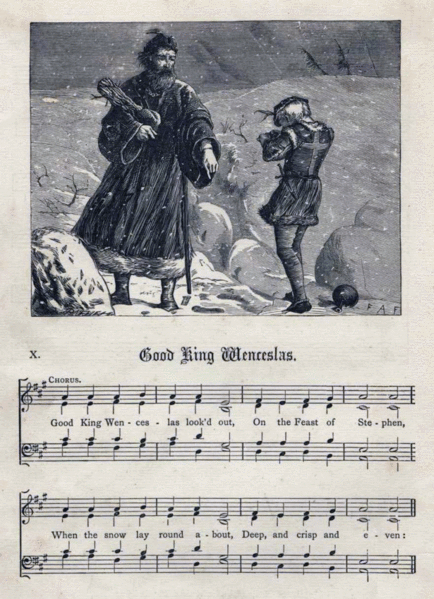
Packer’s question would be pertinent in any season, but it is especially so in the present season, when the usual holiday tunes are in the air, and what we are hearing is so well-known as to seem banal. Like it or not, here comes The Little Drummer Boy again—he and his drum. Given the familiarity of the old songs, is “fresh listening” possible? And if so, how shall we go about it? Continue Reading »

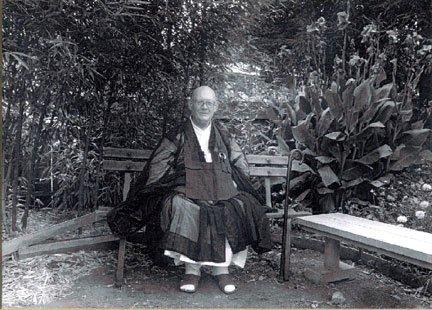
Zenshin Philip Whalen

“The elbow,” Zen teachings tell us, “does not bend outward.” As a longtime Zen practitioner, I have heard that saying more than once, but in recent years it has come to seem ever more germane.

That might have something to do with my growing older. On certain mornings, the elbow is not the only bodily component that doesn’t want to bend outward—or inward, for that matter. But a reminder that elbows do not bend outward can be of benefit to all of us, regardless of age, not least because it returns our hyperactive minds to a physical reality. Beyond that, the saying might also provide a countervailing motto for the twenty-first century, particularly as it pertains to the tempo of our activities, the volume of our consumption, and the realism of our view of life. Continue Reading »

Cloisters of Lisbon Cathedral

“There is this cave / In the air behind my body / That nobody is going to touch: / A cloister, a silence / Closing around a blossom of fire.”* So wrote the American poet James Wright (1927-1980) in his poem “The Jewel.” Wright’s images are enigmatic, in the way dreams are, but their import is clear. They evoke a place in the self that is silent, luminous, and inviolate. Continue Reading »

Autumn in Kyoto, Japan

In his essay “Reading Oneself,” the writer and teacher Sven Birkerts describes the experience of encountering a long-forgotten page of his own prose. As Birkerts tells the story, he agreed to read the book manuscript of a student whom he had taught many years before. When his former student arrived at their meeting, she brought both her manuscript and Birkerts’ written evaluation of her work, which she had saved from her days in his course. Typed on the Selectric II he was using at the time, Birkerts’ prose seemed foreign to its author:

And suddenly there’s this feeling, I’ve had it before—more and more in recent years. I am reading something I’ve written and I not only don’t recognize the sentences—they’ve gone from me—I also don’t quite map to the mind that produced them. It’s very much like catching your shopwindow reflection for a split second before you realize it’s you. Almost always, the shock is negative. I look like that? With these sentences it’s the opposite. My eyes catch sight of what my hand did. Reading, I actually admire the images, the figures of speech, the confidence of the rhythm. Not the rhythm I would write in now. But I feel it as distinct.

For Birkerts this encounter with his younger self was comparable to contemplating an old photograph. “The looking,” he observes, “is mainly about taking in the differences.”* Continue Reading »

93. Dramatis personae


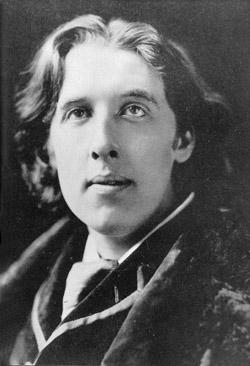
“Man is least himself,” wrote Oscar Wilde in The Critic as Artist,* “when he talks in his own person. Give him a mask, and he will tell you the truth.”

Wilde was speaking of Shakespeare, who, in Wilde’s view, revealed more of himself in his plays than he did in his sonnets. Over the years I have often recalled Wilde’s maxim, and I have had occasion to test it against my experience, both as a teacher of imaginative writing and as the author of poems, essays, and a verse novella. And by and large I have found Wilde’s notion to be true, though perhaps not in the way he intended. Continue Reading »

Rowan berries by Moor Lane

Now that the leaves are falling, and the hills are splashed with color, I’m reminded of an autumnal poem by the twelfth-century Japanese poet Saigyo:

INSECTS ON AN EVENING ROAD

On the road with not a soul

to keep me company,

as evening falls

katydids lift their voices

and cheer me along

Uchigusuru

hito naki michi no

yusare wa

koe nite okuru

kutsuwamushi kana Continue Reading »

91. In the waiting room

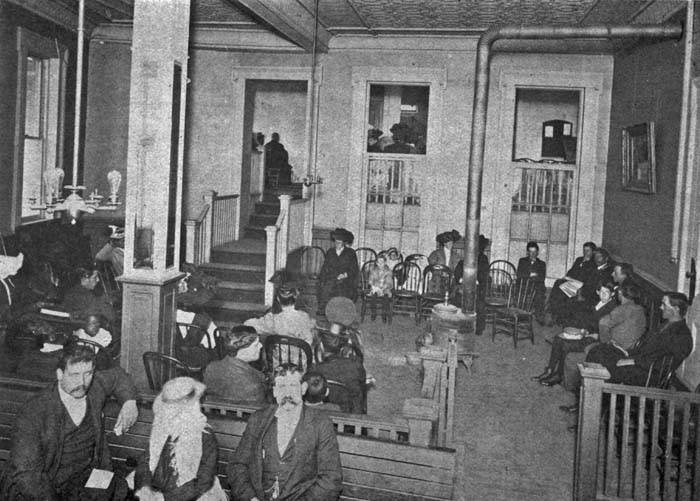
Waiting room in the Eye, Ear, Nose, & Throat Hospital, New Orleans, 1907

Imagine, if you will, that you have just arrived at your local hospital for a routine test. Anticipating a wait, you have brought a book. After checking in at the reception desk, you seat yourself in a plastic chair and open your book.

Very soon, however, you discover that you are unable to concentrate, because you are being bombarded by the sounds of daytime TV. Muzak you could handle, but not the dialogue of a soap opera, which is keeping you from reading the words on the page. You can’t enjoy your book, but you can’t leave either. For a while you contain your frustration, but when it becomes intolerable, you go to the reception desk to complain. There you learn that the hospital keeps the TV on because most patients want it on. A survey indicated as much. So you return to your seat, humbled and disgruntled. Continue Reading »

90. Being positive

When Ernest Hemingway was a cub reporter for the Kansas City Star, he learned four simple rules for writing well:

             1. Use short sentences.

            2. Use short first paragraphs.

            3. Use vigorous language.

            4. Be positive, not negative.

“Those were the best rules I ever learned for the business of writing,” Hemingway later declared. “I’ve never forgotten them. No man with any talent, who feels and writes truly about the thing he is trying to say, can fail to write well if he abides with them.” Continue Reading »

89. A life’s work

Path of stone over water, Nanjing, South of China

If you have ever sung in a choir, you know that certain disciplines apply. You must sit up straight at the edge of your chair. You must breathe from the diaphragm. And you must open your mouth more widely than you otherwise would—widely enough to accommodate three fingers. Although these principles are simple, it is easy to forget them, especially if your mind is elsewhere.

Such was the case one morning in 1961, when I and other members of the Clinton High School A Cappella Choir sat upright at the edge of our chairs, rehearsing Michael Pretorius’s beautiful carol “Lo, How a Rose E’er Blooming.” Leading us was our director, John De Haan, a tall, ruggedly-built man with a gentle but commanding presence. Glancing in my direction, he noticed my half-open mouth. “Open your mouth, Ben,” he said, quietly but firmly, in his deep bass voice. “This is my life’s work.” Continue Reading »

88. Inhabiting Zen

Peace Pagoda, Providence Zen Center

To live in a place is one thing, to inhabit it another. The word inhabit derives from the Latin inhabitare, which originally meant to dwell. “They shall build houses,” prophesied Isaiah, “and inhabit them; and they shall plant vineyards, and eat the fruit of them” (Isaiah 65:21). To eat the fruit of your vineyards, you cannot be flitting from one locality to another. You must dwell in one place for a while.

What is true of grape farming is also true of the practice of Zen.  “Authentic Zen,” writes Dr. James H. Austin, a neurologist and longtime Zen practitioner, “has always meant inhabiting each present moment in the most natural, direct, and spontaneous way.”[i} And in his book Being Upright, the Zen priest Tenshin Reb Anderson employs the same verb to describe the practice of zazen:

For a sentient being to practice the ultimate good means not to move. How do you realize not moving? By fully settling into all aspects of your experience: your feelings and your perceptions. Not moving means to be fully congruent with yourself. You go down to the bottom of your experience, as all buddha ancestors have done, and enter the proverbial green dragon’s cave. Graciously and gently, you encourage yourself to fully inhabit your body, speech, and thought. You may even command yourself to be obedient to yourself, and to come all the way in and sit down.[ii]l

 “Although no one issues the invitation,” Anderson further explains, we “invite the self into the self.” As both “host and guest of the self,” we fully inhabit our experience. Continue Reading »