2 April 2014 by Ben Howard
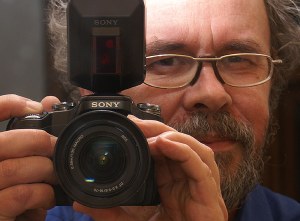 Over the past few years the digital self-portrait has come into its own. Decried by some as a symptom of narcissism, celebrated by others as a vehicle of self-empowerment, the so-called “selfie” has assumed center stage, not only in social media but in the media at large. Ellen DeGeneres’ “group selfie,” spontaneously snapped at the Oscars, may well be the world’s most widely viewed example, but it is literally one among millions.
In another decade or two, we may find out whether the selfie was a fad, a portent of a cultural shift, or something else entirely. But from the vantage point of Zen teachings, the ubiquitous selfie, shot in a mirror or from an outstretched hand, offers what is known as a “dharma gate”: a point of entry into a deeper truth. “To study the way,” wrote the thirteenth-century Zen master Eihei Dogen, “is to study the self.” And the phenomenon of the selfie, however superficial it may seem, provides an opportunity to do just that. Continue Reading »
Posted in 1 | Tagged digital self-portrait, Dogen, ichigo ichie, Joseph Goldstein, selfie, Shohaku Okumura, social media, thich nhat hanh, Zen master Eihei Dogen | 2 Comments »
19 March 2014 by Ben Howard

The Crown Bar
Belfast, Northern Ireland
“For Ben Howard, well met in Belfast, July, 2004.”
So wrote a gentlemanly Irish poet, whose work I had long admired, in the flyleaf of his most recent book. At the time, he and I were having lunch in the upstairs dining room of the Crown Liquor Saloon, a storied old pub in the heart of Belfast, Northern Ireland. I had come up on the train from Dublin to meet him.
Of the many inscriptions I have acquired over the years, few have proved as memorable as the one above, partly because the poet’s chosen phrase, faintly archaic but resonantly apt, sorted well with the Crown’s Victorian decor–its ornate tin ceilings, stained-glass windows, and dark-paneled “snugs.” Regrettably, “well-met” is no longer current in North America, either as a description or a greeting. Once the equivalent of “Nice to have met you,” that old-fashioned phrase evokes a singular event: two people meeting, in the fullness of human relationship, at a particular place and time. Continue Reading »
Posted in 1 | Tagged Belfast, ichigo ichie, Martin Buber, Mary Rose O'Reilley, norman fischer, Northern Ireland, radical presence, the Crown Bar | 1 Comment »
26 February 2014 by Ben Howard
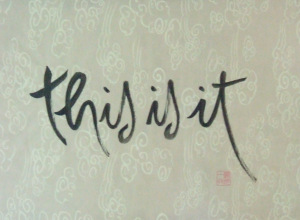
Original calligraphy by the Ven. Thich Nhat Hanh
“Support for NPR,” announced National Public Radio’s Sabrina Farhi during the holiday season, “comes from Pajamagram, makers of matching holiday pajamas for the whole family, including dogs and cats.” After listing several other sponsors, Ms. Farhi concluded with a single declarative sentence: “This . . . (pause),” said she, “is NPR.” She might have been delivering a dramatic monologue, so pronounced was her emphasis on this and so protracted the ensuing pause.
Ms. Farhi has since abandoned that mannerism, but its temporary recurrence on Morning Edition, morning after morning, brought to mind the prominence of the word this, similarly isolated, in the Zen tradition. Generally speaking, in Zen practice this refers to undifferentiated reality, prior to the imposition of conceptual thought. “Just this,” a phrase familiar to Zen students, is what we experience when we penetrate the filter created by dualistic concepts, particularly such ego-centered dualities as “self/other,” “I/they,” and “mine/not mine.” To remain in continuous contact with this, while also questioning its nature, is central to Zen practice. And to lose touch with or misconstrue the nature of this is likely to bring suffering upon oneself and others. Continue Reading »
Posted in 1 | Tagged Bassui Tokusho, ichigo ichie, mindfulness, Morning Edition, NPR, thich nhat hanh, what is this | 2 Comments »
5 February 2014 by Ben Howard
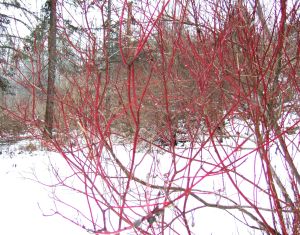 Twelve years ago, my wife and I planted a row of Red Twig Dogwoods on the western border of our back yard. They are now more than twelve feet tall. As I look out on this cold winter morning, I notice again how the dogwoods’ deep-red branches contrast with the prevailing whites, grays, and browns. Against a dormant and seemingly lifeless landscape, they remind us of the life force.
The poet Gerard Manley Hopkins called that force “the dearest freshness deep down things.” Dylan Thomas called it “the force that through the green fuse drives the flower.” More simply, the Zen teacher Shohaku Okumura, in his book Living by Vow,* calls it the “natural universal life force,” which appears most vividly in nature but is common to the natural and human worlds alike. “The force that drives the water through the rock,” Thomas went on to say, “drives my red blood.” “We are all connected,” writes Okumura, “one universal life force.” Continue Reading »
Posted in 1 | Tagged Bann River, County Derry, Dylan Thomas, gerard manley hopkins, ichigo ichie, Irish poetry, Living by Vow, perch, seamus heaney, Shohaku Okumura, Zen poetry | 3 Comments »
18 December 2013 by Ben Howard

Scott Chapel
Drake University
Four weeks ago, in anticipation of the fiftieth anniversary of John F. Kennedy’s assassination, we of a certain age were asked to recall where we were when the president was shot. As it happened, I was then a sophomore at Drake University in Des Moines, Iowa, and I listened to the announcement of the president’s death in the lobby of Goodwin-Kirk Residence Hall, where a few of us had gathered around a portable radio. In retrospect, however, the question of where I was seems less important than where I went, having just received that sad and shocking news.
Continue Reading »
Posted in 1 | Tagged contemplation, Drake University, Eero Saarinen, ichigo ichie, JFK assassination, meditation, Oreon E Scott Memorial Chapel, Scott ChapelDrake University, Thomas Merton, zen | 4 Comments »
4 December 2013 by Ben Howard
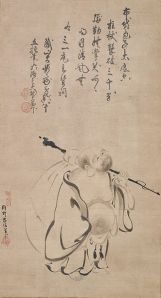
Hotei
Kano Takanobu, 1616
Last month my infant granddaughter Allegra uttered her first belly laugh. At the time she was sitting upright in her father’s lap, firmly supported by his two strong hands. Meanwhile my wife, Robin, was exuberantly entertaining Allegra, smiling broadly, blowing raspberries on her belly, and singing “I’m going to get you” as she tickled her toes. Without warning, up when Allegra’s arms, as though she were conducting an orchestra, and from her whole little being came gleeful, protracted laughter.
Luckily I had my camera handy, and I was able to capture the moment. When I later sent the photo to a few friends, one described Allegra as a laughing Buddha. Another expressed the wish that Allegra might keep laughing all her life. Continue Reading »
Posted in 1 | Tagged Eihei Dogen, Hotei, ichigo ichie, Jon Stewart, moment of Zen, Philip Woollcott, the backward step, zen meditation | 2 Comments »
20 November 2013 by Ben Howard
 One day last summer I decided to go for a swim. It was a hot afternoon, and I needed both the exercise and relief from the heat.
Upon arriving at the university’s spacious pool, I observed that most of the lanes were still open. I chose lane one. As I prepared to enter the water, I noticed a pair of tiny pink flip-flops at the poolside. Someone’s little girl had apparently left them behind.
The water was chilly but refreshing. Pushing off, I swam a leisurely lap, breast stroke up, crawl stroke back. I hadn’t been swimming in quite a while, and I’d forgotten how pleasant the experience could be.
Upon surfacing, however, I was greeted by a little girl in a pink bathing suit. She was sitting on the edge of the pool, dangling her legs in the water. She wore a frown and looked perturbed. Continue Reading »
Posted in 1 | Tagged gratitude, Hotei, ichigo ichie, John Daido Loori, Thank You, Thanksgiving gatha, thich nhat hanh | 10 Comments »
6 November 2013 by Ben Howard

Dai Bosatsu Zendo
Meditation Hall
If your waking hours are anything like mine, many if not most are spent in attending to ordinary things. Although you might wish to be contemplating the meaning of life or encountering something out of the ordinary, groceries need to be bought and e-mails answered. Bills need to be paid. Whatever your spiritual aspirations, ordinary life assumes the foreground.
At first glance, Zen practice might seem a welcome escape from the daily round. At its deeper levels, Zen is indeed concerned with the alleviation of suffering, the cultivation of compassionate wisdom, and the “Great Matter” of life and death. Cloistered in their mountain monasteries or secluded in their urban centers, Zen masters and their disciples may appear to have risen above the quotidian fray and to have transcended the concerns of everyday life. Continue Reading »
Posted in 1 | Tagged Dai Bosatsu Zendo, ichigo ichie, jane hirshfield, Layman P'ang, Rinzai Zen, Zen teachings | 4 Comments »
23 October 2013 by Ben Howard

Thomas Brackett Reed
January 2, 1894
“I would rather be right than president,” declared William McKendree Springer, Democrat from Illinois, on the floor of the House.
“The gentleman needn’t worry,” replied Thomas Brackett Reed (1839-1902), Republican from Maine and Speaker of the House. “He will never be either.”
That famous exchange took place in the late nineteenth century, but the sentiment expressed by Congressman Springer may well be timeless in human affairs. Whether the venue be public or domestic, the context political or personal, many of us attach inordinate value to being right. We would rather be right than president–or fair, or peaceful, or humane. Continue Reading »
Posted in 1 | Tagged ichigo ichie, jane hirshfield, Right View, Sean O'Faolain, The Human Thing, thich nhat hanh, Thomas Brackett Reed, zen meditation | 3 Comments »
9 October 2013 by Ben Howard
 Exert yourself. Whether conscious or unrecognized, that imperative underlies our everyday experience. Our livelihoods and indeed our survival depend upon our exertions. If we are to compete, achieve, and contribute to the common good, we must exert ourselves. Even the pursuit of happiness, as it is called, requires exertion. No rest for the weary, and no mercy for the slacker.
Yet even the highest achievers need their rest. The great pianist Vladimir Horowitz was once asked how he managed to play so many notes so quickly. “I relax between notes,” he cheerfully replied. As Horowitz well understood, rest and relaxation are essential, both before and during performance. They make strenuous exertion possible.
Quite often, people in need of rest and relaxation find their way to Zen practice. Viewed from a distance, the practice offers the prospect of unruffled calm. Yet, as newcomers soon find out, it is not always easy to rest or relax, even in a meditative setting. For those accustomed to multi-tasking, hyperconnectivity, and busyness generally, the simple act of stopping and resting can be as challenging as the most demanding activity. Admonished to sit still, the body rebels. A shoulder aches; a knee hurts; a foot wants to fidget. Efforts to correct one’s posture or relieve one’s unease often result only in new forms of discomfort. Wedded to incessant movement, the body wants to do, not merely to be. Continue Reading »
Posted in 1 | Tagged Dogen Zenji, Eihei Dogen, Francis Dojun Cook, gujin, ichigo ichie, Vladimir Horowitz, Zen practice | 4 Comments »
« Newer Posts - Older Posts »
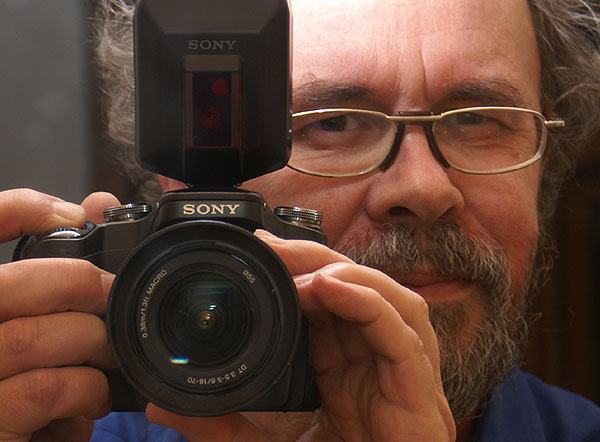 Over the past few years the digital self-portrait has come into its own. Decried by some as a symptom of narcissism, celebrated by others as a vehicle of self-empowerment, the so-called “selfie” has assumed center stage, not only in social media but in the media at large. Ellen DeGeneres’ “group selfie,” spontaneously snapped at the Oscars, may well be the world’s most widely viewed example, but it is literally one among millions.