Feeds:
Posts
Comments

Posts Tagged ‘thich nhat hanh’

Thomas Brackett Reed       January 2, 1894

Thomas Brackett Reed
January 2, 1894

“I would rather be right than president,” declared William McKendree Springer, Democrat from Illinois, on the floor of the House.

“The gentleman needn’t worry,” replied Thomas Brackett Reed (1839-1902), Republican from Maine and Speaker of the House. “He will never be either.”

That famous exchange took place in the late nineteenth century, but the sentiment expressed by Congressman Springer may well be timeless in human affairs. Whether the venue be public or domestic, the context political or personal, many of us attach inordinate value to being right. We would rather be right than president–or fair, or peaceful, or humane. (more…)

Read Full Post »

The weir on the river Chew in Pensford

The weir on the river Chew in Pensford

It has often been observed that time seems to go faster as we grow older. Our birthdays arrive with increasing rapidity. Shortly after my fortieth birthday, I began to feel as if I were taking the garbage cans out to the curb every other morning. And with each ensuing decade this subjective sense of accelerating time, which a number of my older friends have also noted, has grown ever more prominent. It is as if we were afloat on a swiftly moving river, and each of those “important” birthdays, the ones that mark the decades of our lives, were another waterfall, whose drop and velocity have yet to be experienced.

Yet, from the vantage point of Zen teachings, neither birthdays nor waterfalls are quite what they appear to be. They are at once real and illusory. In his book Living by Vow the Soto Zen priest Shohaku Okumura has this to say about waterfalls:

A river flows past a place where there is a change of height, and a waterfall is formed. Yet there is no such thing as a waterfall, only a continuous flow of water. A waterfall is not a thing but rather a name for a process of happening. . . . We cannot distinguish where the waterfall starts and ends because it is a continuous process.*

(more…)

Read Full Post »

131. True realism

In a recent column Paul Krugman spoke of “fantasy posing as hardheaded realism.”* As might be expected, Krugman’s subject was economic, his theme political. But his well-wrought phrase has resonance beyond the spheres of politics and economics.

To begin with, it evokes the stereotype of the hardheaded realist—the seasoned, no-nonsense person who lives in the real world. At the same time, it suggests that realism may be little more than a pose. If, as Krugman implies, realism can be false, the opposite must also be the case. What is true realism, we might inquire, and what are its salient traits? Is it by nature hardheaded—and hardhearted as well? (more…)

Read Full Post »

124. Cooked carrots

800px-Sliced_carrotsBeing retired now, I cook most of the meals in our home. And of late I have become a connoisseur of my wife’s responses, spoken and unspoken, to what I put on our table.

Let us say that tonight’s menu is Rotini with Lemon-Asparagus Sauce, a side of cooked carrots, and a Martha’s Vineyard salad. After a few bites, Robin may comment on what she has just eaten, or she may not. If she is silent for very long, I begin to get curious. “How do you like it?” I venture to inquire. (more…)

Read Full Post »

Dennis O' DriscollPhoto by Kim Haughton

Dennis O’ Driscoll
Photo by Kim Haughton

“He gave the art a good name,” remarked the Nobel laureate Seamus Heaney of the Irish poet Dennis O ’Driscoll, who died suddenly on Christmas Eve at the age of fifty-eight. Dennis was the author of nine collections of graceful, civilized verse and one of the most respected voices in contemporary Irish letters. I am saddened by his early death, as are many of his fellow writers, Irish and American, who remember him as a true gentleman and a generous friend. (more…)

Read Full Post »

2012-03-11 002 2012-03-11 012Dr. Friederike Boissevain is a German oncologist and seasoned Zen practitioner. By her own admission, her meditative practice is imperfect—or “crooked,” as she describes it. Rather than remain focused and fully aware of the present moment, she finds herself wandering off into the “land of dreams and worries.” But, crooked though it be, her practice has supported her daily work with the sick and the dying. “The most important thing I ever did,” she reflects, “was to sit down once.” That act set “something in motion that cannot be stopped. This is not because of trust in something but because of experience. . . The snow of dharma covers everything, whether we see it or not.” (more…)

Read Full Post »

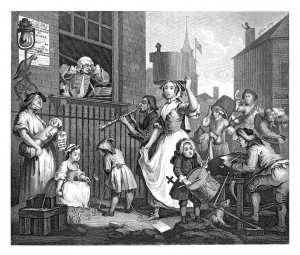
William Hogarth, The Enraged Musician

William Hogarth, The Enraged Musician

According to a recent report on the NBC Nightly News, American police have been running stop signs and causing serious accidents, so distracted have they become by the computers in their cars. To address the problem, the Fort Wayne, Indiana police department has installed devices that freeze the computer’s keys whenever the patrol car’s speed exceeds fifteen miles per hour.

This situation may be uniquely ironic, but the underlying problem is hardly peculiar to the police. On the contrary, in the age of the Internet and ubiquitous mobile devices, distraction has become endemic. With so many objects summoning our attention, where shall we direct it? On what objects should we place our minds? (more…)

Read Full Post »

During the last few days of October, when Hurricane Sandy was threatening Western New York, state and local officials advised us as to the important documents we should take with us in the event of an evacuation: deeds, home-insurance policies, birth certificates, passports, and the like. In preparation, we should assemble those documents and place them in a waterproof envelope.

Sound advice, to be sure. But as I read that official list, I thought of a less than official item I would add to it: the file of documents I have kept for years under my father’s well-worn Bible. Contained in that file are notes, letters, and cards from friends and family, including letters from my deceased mother; birthday cards from my wife; holiday cards from my daughter-in-law; and a variety of notes from my son, some of them dating from his early childhood. Unlike the policies and passports, those documents are irreplaceable. And all were written by hand, which makes them all the more valuable.

That value, I might point out, is more than sentimental. It is historical and spiritual. The novelist Philip Hensher, author of The Missing Ink (Macmillan, 2012), has argued, with ample corroboration, that “we are at a moment when handwriting seems to be about to vanish from our lives,”* having been supplanted by the printed—and now the digital—word. If Hensher is right, we would do well to cherish whatever handwritten documents remain extant, irrespective of their author or content.  But even if we believe that handwriting, having survived for 5000 years, will always be with us, the act of writing by hand is worthy of renewed attention, if not of veneration. For in the handwritten word, it might be said, the authentic human self is concretely embodied. And the handwritten note or letter, however rough or polished, affords a depth of intimacy between writer and reader that print can only approximate. Little wonder that the world’s great spiritual traditions, Zen included, have accorded the handwritten word—or character—a place of honor, whether the handwritten text be the Torah, the Quran, the Heart Sutra, or the Book of Kells. (more…)

Read Full Post »

“Where did this bread come from?” asked a guest at our dinner table. “It’s delicious.” To that question, there is a very short answer. But there is also a longer answer that goes to the heart of Buddhist meditative practice.

The short answer is that the Deli-Style Rye we were enjoying came from Sisters Kneading Dough, a home bakery in Almond, New York. Every Friday afternoon, the sisters Beth and Jayne arrive at Quest Farm with their trays of bread and muffins, still warm from the oven. On that particular Friday, my wife, Robin, and I also arrived, and we came home with the Deli-Style Rye, along with a loaf of Robin’s favorite, Cinnamon Swirl. That, in short, is where the bread on our table came from.

The longer answer is that the bread came from sources too numerous to mention. Deli-Style Rye is made from organic bread flour (wheat and barley), whole wheat flour, water, whole rye flour, caraway seeds, honey, yeast, and canola oil. And each of these ingredients has a history of its own. Without the work of the bees and their keepers, there would have been no honey. Without sunlight, water, earth, and the labors of the farmers, distributors, truckers, and the rest, there would have been no flour, yeast, or canola oil. Without our driving to Quest Farm on a Friday afternoon, the Deli-style Rye would never have reached our home. Like anything else that we might conventionally regard as a single thing, the bread on our table was an aggregate of countless, interconnected things, without which it could not have come into being. And as its quick disappearance demonstrated, it was not really a solid object but a transitory node in the web of life, an event in a never-ending process. (more…)

Read Full Post »

One morning earlier this summer, I found myself standing atop an unstable blue object known as a BOSU Ball. Invented by David Weck in 1999, the BOSU Balance Trainer is an inflatable rubber hemisphere attached to a rigid platform. The central component of a “mindful approach to exercise,”[1] the BOSU Ball is designed to improve the body’s  sense of balance while strengthening its stabilizing muscles. I was standing on the BOSU Ball because I’d been having knee pain, and our family doctor had recommended physical therapy. In turn, the affable but exacting physical therapist with whom I was working had prescribed the BOSU Ball. “Don’t fall off,” he cheerfully warned, having just assigned me thirty squats. Miraculously, I managed to comply.

In a manner analogous to that of the BOSU Ball, Zen practice also aims to strengthen our sense of balance, physical and emotional. In Zen teachings, the capacity to maintain one’s equilibrium, especially under stressful, uncertain, and unstable conditions, is known as equanimity, a translation of the Sanskrit word upeksha. The traditional posture of sitting meditation—knees down, back erect, head balanced on the spine—supports the cultivation of upeksha, as does the practice of walking meditation, which trains the practitioner to walk with dignity and steady awareness. But these forms and practices, however essential to Zen discipline, are but the outward expressions of an inner poise. And at the heart of that inner poise is a balanced, inclusive way of experiencing the world. (more…)

Read Full Post »

« Newer Posts - Older Posts »