Feeds:
Posts
Comments

Rowan berries by Moor Lane

Now that the leaves are falling, and the hills are splashed with color, I’m reminded of an autumnal poem by the twelfth-century Japanese poet Saigyo:

INSECTS ON AN EVENING ROAD

On the road with not a soul

to keep me company,

as evening falls

katydids lift their voices

and cheer me along

Uchigusuru

hito naki michi no

yusare wa

koe nite okuru

kutsuwamushi kana Continue Reading »

91. In the waiting room

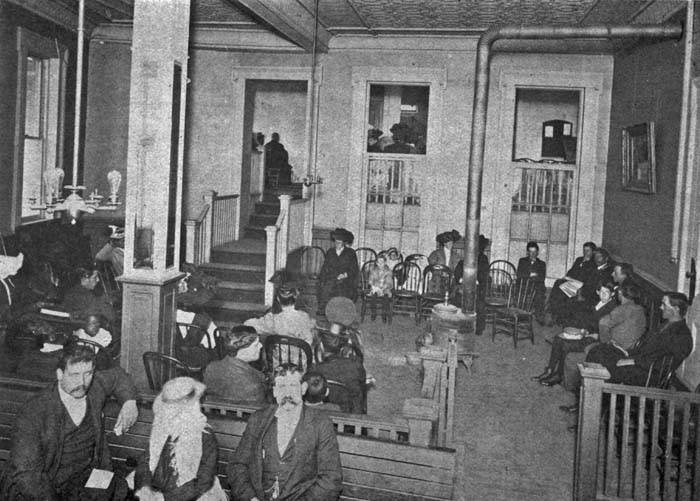
Waiting room in the Eye, Ear, Nose, & Throat Hospital, New Orleans, 1907

Imagine, if you will, that you have just arrived at your local hospital for a routine test. Anticipating a wait, you have brought a book. After checking in at the reception desk, you seat yourself in a plastic chair and open your book.

Very soon, however, you discover that you are unable to concentrate, because you are being bombarded by the sounds of daytime TV. Muzak you could handle, but not the dialogue of a soap opera, which is keeping you from reading the words on the page. You can’t enjoy your book, but you can’t leave either. For a while you contain your frustration, but when it becomes intolerable, you go to the reception desk to complain. There you learn that the hospital keeps the TV on because most patients want it on. A survey indicated as much. So you return to your seat, humbled and disgruntled. Continue Reading »

90. Being positive

When Ernest Hemingway was a cub reporter for the Kansas City Star, he learned four simple rules for writing well:

             1. Use short sentences.

            2. Use short first paragraphs.

            3. Use vigorous language.

            4. Be positive, not negative.

“Those were the best rules I ever learned for the business of writing,” Hemingway later declared. “I’ve never forgotten them. No man with any talent, who feels and writes truly about the thing he is trying to say, can fail to write well if he abides with them.” Continue Reading »

89. A life’s work

Path of stone over water, Nanjing, South of China

If you have ever sung in a choir, you know that certain disciplines apply. You must sit up straight at the edge of your chair. You must breathe from the diaphragm. And you must open your mouth more widely than you otherwise would—widely enough to accommodate three fingers. Although these principles are simple, it is easy to forget them, especially if your mind is elsewhere.

Such was the case one morning in 1961, when I and other members of the Clinton High School A Cappella Choir sat upright at the edge of our chairs, rehearsing Michael Pretorius’s beautiful carol “Lo, How a Rose E’er Blooming.” Leading us was our director, John De Haan, a tall, ruggedly-built man with a gentle but commanding presence. Glancing in my direction, he noticed my half-open mouth. “Open your mouth, Ben,” he said, quietly but firmly, in his deep bass voice. “This is my life’s work.” Continue Reading »

88. Inhabiting Zen

Peace Pagoda, Providence Zen Center

To live in a place is one thing, to inhabit it another. The word inhabit derives from the Latin inhabitare, which originally meant to dwell. “They shall build houses,” prophesied Isaiah, “and inhabit them; and they shall plant vineyards, and eat the fruit of them” (Isaiah 65:21). To eat the fruit of your vineyards, you cannot be flitting from one locality to another. You must dwell in one place for a while.

What is true of grape farming is also true of the practice of Zen.  “Authentic Zen,” writes Dr. James H. Austin, a neurologist and longtime Zen practitioner, “has always meant inhabiting each present moment in the most natural, direct, and spontaneous way.”[i} And in his book Being Upright, the Zen priest Tenshin Reb Anderson employs the same verb to describe the practice of zazen:

For a sentient being to practice the ultimate good means not to move. How do you realize not moving? By fully settling into all aspects of your experience: your feelings and your perceptions. Not moving means to be fully congruent with yourself. You go down to the bottom of your experience, as all buddha ancestors have done, and enter the proverbial green dragon’s cave. Graciously and gently, you encourage yourself to fully inhabit your body, speech, and thought. You may even command yourself to be obedient to yourself, and to come all the way in and sit down.[ii]l

 “Although no one issues the invitation,” Anderson further explains, we “invite the self into the self.” As both “host and guest of the self,” we fully inhabit our experience. Continue Reading »
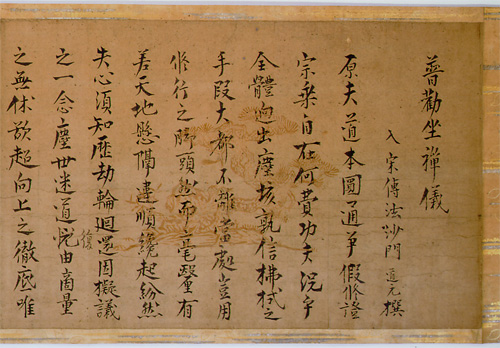
Eihei Dogen, Fukanzazengi (1233)

“It’s time for Congress to step up to its job,” writes Chris Dunn on his blog Collegiate Times. “It’s time for the Lakers to step up,” writes Darius Soriano on the Forum Blue and Gold. “It is time for webOS to step up,” writes Derek Kessler on precentral.net, if Hewlett-Packard is to compete with the iPad.  And “it is time to step up and be found faithful to God and his work,” writes Pastor Joe on the website of the Oakdale Baptist Church.

Surveying these pronouncements, one might conclude that it is time for American bloggers—and American popular culture—to find a new figure of speech. But cliches often reflect common beliefs, and behind this particular cliche lies a widely held belief that whatever the problem might be, it can best be addressed by someone stepping up. Whether the field of endeavor be politics, sports, business, or religion, this belief is so familiar as to be mistaken for empirical fact. And though the contexts in which it functions are most often practical, it also carries its share of moral weight. Those who have stepped up are to be commended. Those who have not would do well to get with the program. Continue Reading »

In 1968 the Vietnamese Zen master Thich Nhat Hanh, then a young Buddhist monk, visited the United States. Meeting with church groups, students, and others, he sought to promote peace and reconciliation. Throughout his tour, the gentle monk was well-received, but when he spoke one evening at a wealthy church in St. Louis, he found himself confronted by an angry detractor, who stood up to challenge him. “If you care so much about your people,” demanded the man, “why are you here? If you care so much for the people who are wounded, why don’t you spend your time with them?” Taken by surprise, Thich Nhat Hanh had no choice but to respond. But what could he say? What might be an appropriate response? Continue Reading »

85. Contenders

“I coulda been a contender,” laments the boxer Terry Malloy (Marlon Brando) in On the Waterfront (1954). “I coulda been somebody instead of a bum . . .” If those lines are among the most famous in American film, it is perhaps because they express a familiar human desire. Which of us would not wish to be a “contender”?  To be “somebody” in others’ eyes?

Yet, as Shunryu Suzuki Roshi observes in his essay “Calmness of Mind,”* the desire to be “somebody” is costly to the human psyche. It steers us into trouble. And as Suzuki also observes, the desire to be somebody bears an intimate connection to the process of breathing, specifically inhalation. “[W]hen you are more interested in inhaling than in exhaling,” he notes, “you easily become quite angry. You are always trying to be alive.” When we are inhaling, we are “trying to be active and special and to accomplish something.” And when, in meditation, we make our inhalations the main focus of our attention, we may only add to our anxiety. In Suzuki’s view, conscious inhalation, striving, and the drive to be somebody are of a piece, and all conduce to suffering. Continue Reading »

“Whoops!” wrote a friend the other day, having just sent me an e-mail message intended for someone else. Studying that word on my screen, I was reminded of an experience that occurred some fifty years ago.

At the time, I was splayed face-down on a sweat-scented wrestling mat. Straddling me was Grant Wilke, a tough competitor whose strength and wrestling skills far surpassed my own. With my belly squashed against the mat and Grant’s weight pressing firmly into my lower back, I attempted what high-school wrestlers call an “escape.” Rising like a cobra and twisting backward, I inadvertently gave Grant a sharp elbow in the ribs.

“Oops!” said I. Continue Reading »

Whatever else it has come to mean, at its root the word meditation means “mental cultivation.”* To meditate is to cultivate the mind. In contemporary practice, meditation is often a form of awareness training, in which we learn to calm the body, quiet the mind, and bring relaxed attention to the present moment. But Buddhist meditation is also a practice of cultivating certain qualities of mind and heart. At any given moment, the teachings tell us, we are cultivating one thing or another. What we are cultivating may be loving-kindness, compassion, or other “wholesome” states of mind. But it may also be such “unwholesome” states as fear, rage, and the impulse toward destruction. Continue Reading »