 I have a friend by the name of Janet, who regularly consults what I call the Book of Janet, especially when she’s feeling blue or vexed or insecure. If she makes some trivial error, like misplacing her car keys, the Book of Janet reminds her that she is not well-organized. If she enters a competition and receives a letter of rejection, the Book of Janet informs her that her work is not all that good. And if she’s feeling less than beautiful on any given morning, the Book of Janet confirms her worst fears. On all three counts, the Book of Janet is wide of the mark. It is out of touch with the present reality. Unfortunately, that makes little difference to Janet, who swears by her Book as if it were her Bible. (more…)
Archive for the ‘1’ Category
156. The Book of Janet
Posted in 1, tagged impermanence, interdependence, Martin Luther King, network of mutuality, norman fischer, self, zen on 4 February 2015| 3 Comments »
154. Immovable awareness
Posted in 1, tagged atta dipa, awareness, enlightened mind, falling leaf sangha, jon kabat-zinn, Katsuki Sekida, kosho uchiyama, Sixth Patriarch, thich nhat hanh on 3 December 2014| 4 Comments »
 Here in the village of Alfred, New York, those of us who like to walk can often be found on the Alfred State College track. Situated on a high elevation , the track affords a panoramic view of the surrounding wooded hills. Designed though it was for athletic competition, the track is also an excellent venue for walking meditation.
On a windy day last summer, I took a walk on that firm but forgiving track. Above the line of trees, the blades of the college’s wind turbine were revolving briskly. And on the tall flagpole near the entrance, the American flag was flapping audibly. I was reminded of an old Zen story, which features a pair of quarrelsome monks and the enlightened master Eno, the Sixth Patriarch of Zen. (more…)
153. Not two, not one
Posted in 1, tagged Eihei Dogen, Non-duality, stephanie kaza, thich nhat hanh, whole earth, zen, Zen teachings on 5 November 2014| Leave a Comment »
 “Up!” implores my granddaughter, looking up at me and raising her arms. Allegra is fifteen months old. Up was one of her first words.
I gladly pick Allegra up, and for the next few minutes I take her for a walk on my shoulder, making rhythmic noises in her ear. This seems to please her, but eventually she decides that she has indulged her grandfather long enough. “Down,” says she, and I reluctantly comply.
Up and down, down and up. Over the next year and beyond, Allegra will learn other pairs of words and other dualities: left and right, inside and outside, high and low. Through the medium of language she will learn not only to speak but also to think in dualistic terms. Soon enough, I suspect, she will enlist the duality yours and mine, with a pronounced emphasis on the latter.
As do we grown-ups, every day of the year. Dualistic thinking is so familiar and so necessary for navigating the world, it goes unnoticed and unexamined much of the time. Yet, as the Zen master Thich Nhat Hanh observes, our familiar dualities are relative in nature and impede our apprehension of reality: (more…)
152. Put it in neutral
Posted in 1, tagged 1950 Chevy, ichigo ichie, jan chozen bays, mindfulness, neutral center, neutral spine, neutral state, neutrality, posture of meditation, zazen, zen meditation on 8 October 2014| Leave a Comment »
 “Put it in neutral, Bud,” my father said, quietly but firmly. It was the summer of 1958, and I was learning to drive. The car was a 1950 Chevrolet sedan with a three-speed transmission and the gearshift lever on the steering column. “Three on the Tree,” it was called. Learning to put the lever and the Chevy itself into neutral was my first lesson.
It might also be the first lesson for the Zen practitioner. Wherever else it might lead, the practice of Zen meditation begins with finding, establishing, and maintaining a neutral center, both for the body and the mind. Neutrality may well be the body-mind’s most natural condition, but for many people it is far from habitual. In a culture as competitive as ours, neutrality is often not an option, much less a state to be cultivated and explored. To do so requires training and sustained attention (more…)
151. Yeah, whatever
Posted in 1, tagged cynical distrust, cynicism, senile dementia, thich nhat hanh, three poisons on 10 September 2014| 1 Comment »

Luca Giordano, A Cynic Philosopher
“I think most people would lie to get ahead.”
“It is safer to trust nobody.”
“Most people will use somewhat unfair reasons to gain profit or an advantage rather than lose it.”
If you would tend to agree with those statements, your outlook on life and human nature might fairly be described as one of cynical distrust. And while you might be well established in that outlook–and even take pride in being a curmudgeon–a recent Finnish study might give you pause. (more…)
150. Let’s not go there
Posted in 1, tagged Amish clothing, habits, ichigo ichie, James Silas Rogers, jukai precepts, norman fischer, rakusu, zen meditation, Zen practice on 13 August 2014| 2 Comments »
 In his poignant essay “The Old Order,” the Irish-American writer James Silas Rogers recalls his conversation on an Amtrak train with a young Amish man named Johann, who was crossing Wisconsin with his extended family. Curious about Amish faith and belief, Rogers inquired as to the significance of Johann’s distinctive attire: his plain shirt, suspenders, and broadfall trousers. “People ask us,” Johann replied, “if we think that wearing these clothes will get us into heaven. We absolutely do not. . . . But I do know that if I wear these clothes, it will keep me out of places where I should not go.”*
Reading Johann’s explanation, I was reminded of formal Zen practice, which also employs special clothes to remind practitioners of their moral commitments. In Japanese Zen, one of the most conspicuous of those clothes is the rakusu, a bib-like garment worn (and often hand-sewn) by those who have “taken the precepts,” which is to say, have publicly affirmed a set of ethical guidelines. Known as the “jukai precepts,” those guidelines differ from sect to sect, but in essence they enjoin the Zen disciple to refrain from harmful behaviors, particularly killing, stealing, engaging in false or injurious speech, using sexuality in hurtful ways, and abusing intoxicants. The unadorned rakusu, viewed as a miniature monastic robe and inscribed on the back with its wearer’s “dharma name,” signifies a commitment to that fundamental code of conduct. (more…)
149. Anything can happen anytime
Posted in 1, tagged chance, ichigo ichie, insight meditation, Joseph Goldstein, mantra, sunyata, vipassana on 2 July 2014| Leave a Comment »
 For more than four decades Joseph Goldstein, an internationally known teacher of Buddhist meditation, has practiced mindfulness of the body and mind. First as a monk in the Thai forest tradition and later as a Western practitioner, he has trained himself to be aware of what is occurring, within and without, in any given moment. Yet one afternoon, while walking along a river in northern New Mexico, Goldstein slipped on a wet rock and hyper-extended his knee. At the time, he was conducting a retreat, and later on that day, after giving a talk in the cross-legged position, he found himself unable to stand or walk. For the next few hours he berated himself and worried that he would not be able to complete the retreat. But in the midst of his anguish, he reports, a “sort of mantra” arose in his mind: Anything can happen anytime. To his surprise, that “mantra” provided a great sense of relief. Since then, he has found it “amazingly helpful in accepting change with a deepening and easeful equanimity.”* (more…)
148. Making whole
Posted in 1, tagged healing, ichigo ichie, Most Intimate, Pat Enkyo O'Hara, recovery, Roshi O'Hara, Roshi Pat Enkyo O'Hara, Sister Dang Nghiem on 4 June 2014| Leave a Comment »

Roshi Pat Enkyo O’Hara
“Do not lose yourself in the future,” Buddhist teachings advise. “Look deeply at life as it is in this very moment.” Under most circumstances that is sound advice, but it can also be devilishly difficult to follow. It is human nature to dwell on the future, especially when the future is replete with uncertainties.
So it was not long ago, when I learned that I needed minor surgery, and I met with my surgeon for a pre-op consultation. A seasoned professional in his sixties, he explained the nature of the procedure, including its history and technical details, and outlined the stages of recovery. During the first week, I would be laid up and managing pain, but by the second I would probably be feeling “fifty percent better.” By the end of the third, I might well be free of pain, though patients sometimes report “nuisance discomfort.” Six to eight weeks out, I would probably be able to resume my customary activities.
That forecast was reassuring, but by their nature forecasts focus on the future, and they leave open the question of what the patient, his eyes on the horizon, should be doing in the meantime. In a recent article (Prevention, January, 2014), Sister Dang Nghiem, MD, a Western-trained physician and a Buddhist nun, offers this prescription: (more…)
147. Call it a notion
Posted in 1, tagged ichigo ichie, ireland, Joseph Goldstein, Koshu Uchiyama, notion, notions, Sayada U Tejaniya, Sogyal Rinpoche, thich nhat hanh, zen, Zen master Thich Nhat Hanh on 7 May 2014| Leave a Comment »
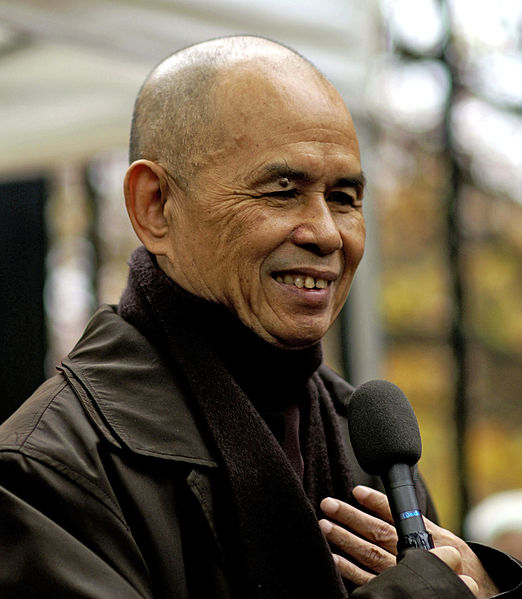
Thich Nhat Hanh
We can throw away a soiled tissue. We can throw away Q-tips, outdated appliances, and countless other items in our everyday lives. But can we also discard our ill-founded thoughts and one-sided perceptions? Our cherished notions?
According to classical Buddhist teachings, many if not most of our perceptions are erroneous, and erroneous perceptions cause suffering. “Looking deeply into the wrong perceptions, ideas, and notions that are at the base of our suffering,” writes Zen master Thich Nhat Hanh, “is the most important practice in Buddhist meditation.” And correspondingly, “the practice of throwing away your notions and views is so important. Liberation will not be possible without this throwing away.” Yet, as Thich Nhat Hanh goes on to say, “it takes insight and courage to throw away an idea.” Views we have held for decades–or perhaps for a lifetime–are not so easily disposed of, especially when they appear to have served us well. (more…)
146. Lessons of the selfie
Posted in 1, tagged digital self-portrait, Dogen, ichigo ichie, Joseph Goldstein, selfie, Shohaku Okumura, social media, thich nhat hanh, Zen master Eihei Dogen on 2 April 2014| 2 Comments »
 Over the past few years the digital self-portrait has come into its own. Decried by some as a symptom of narcissism, celebrated by others as a vehicle of self-empowerment, the so-called “selfie” has assumed center stage, not only in social media but in the media at large. Ellen DeGeneres’ “group selfie,” spontaneously snapped at the Oscars, may well be the world’s most widely viewed example, but it is literally one among millions.
In another decade or two, we may find out whether the selfie was a fad, a portent of a cultural shift, or something else entirely. But from the vantage point of Zen teachings, the ubiquitous selfie, shot in a mirror or from an outstretched hand, offers what is known as a “dharma gate”: a point of entry into a deeper truth. “To study the way,” wrote the thirteenth-century Zen master Eihei Dogen, “is to study the self.” And the phenomenon of the selfie, however superficial it may seem, provides an opportunity to do just that. (more…)

