Feeds:
Posts
Comments

Posts Tagged ‘zen’

Inside_Looking_Out_-_geograph.org.uk_-_767556“Up!” implores my granddaughter, looking up at me and raising her arms. Allegra is fifteen months old. Up was one of her first words.

I gladly pick Allegra up, and for the next few minutes I take her for a walk on my shoulder, making rhythmic noises in her ear. This seems to please her, but eventually she decides that she has indulged her grandfather long enough. “Down,” says she, and I reluctantly comply.

Up and down, down and up. Over the next year and beyond, Allegra will learn other pairs of words and other dualities: left and right, inside and outside, high and low. Through the medium of language she will learn not only to speak but also to think in dualistic terms. Soon enough, I suspect, she will enlist the duality yours and mine, with a pronounced emphasis on the latter.

As do we grown-ups, every day of the year. Dualistic thinking is so familiar and so necessary for navigating the world, it goes unnoticed and unexamined much of the time. Yet, as the Zen master Thich Nhat Hanh observes, our familiar dualities are relative in nature and impede our apprehension of reality: (more…)
Read Full Post »

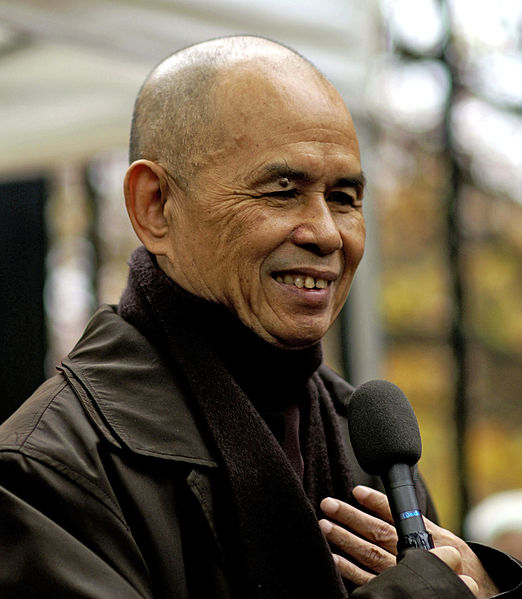
Thich Nhat Hanh

Thich Nhat Hanh

We can throw away a soiled tissue. We can throw away Q-tips, outdated appliances, and countless other items in our everyday lives. But can we also discard our ill-founded thoughts and one-sided perceptions? Our cherished notions?

According to classical Buddhist teachings, many if not most of our perceptions are erroneous, and erroneous perceptions cause suffering. “Looking deeply into the wrong perceptions, ideas, and notions that are at the base of our suffering,” writes Zen master Thich Nhat Hanh, “is the most important practice in Buddhist meditation.” And correspondingly, “the practice of throwing away your notions and views is so important. Liberation will not be possible without this throwing away.” Yet, as Thich Nhat Hanh goes on to say, “it takes insight and courage to throw away an idea.” Views we have held for decades–or perhaps for a lifetime–are not so easily disposed of, especially when they appear to have served us well. (more…)

Read Full Post »

       Scott Chapel    Drake University

Scott Chapel
Drake University

Four weeks ago, in anticipation of the fiftieth anniversary of John F. Kennedy’s assassination, we of a certain age were asked to recall where we were when the president was shot. As it happened, I was then a sophomore at Drake University in Des Moines, Iowa, and I listened to the announcement of the president’s death in the lobby of Goodwin-Kirk Residence Hall, where a few of us had gathered around a portable radio. In retrospect, however, the question of where I was seems less important than where I went, having just received that sad and shocking news.

(more…)

Read Full Post »

Bexley,_pond_at_Danson_Park_-_geograph_org_uk_-_972263Here in the village of Alfred, New York, many of us subscribe to our community newspaper, the Alfred Sun. And some us have discovered that the Alfred Sun, accompanied by a few well-placed squirts of Windex, can make short work of washing windows. The Sun is compact, maneuverable, and eco-friendly. Two full pages will suffice to wash a standard casement window. You can wash as many as three with a single issue.

A few weeks ago, I was engaged in that very task, but the work was not going well. Although I’d liberally applied the Windex and energetically rubbed it off, thick streaks remained. Repeated efforts produced the same result. Newsprint is effective for cleaning glass, I recalled, because the oil in printer’s ink repels the dirty water. Could someone have quietly switched inks? Should I try the Times Literary Supplement instead? (more…)

Read Full Post »

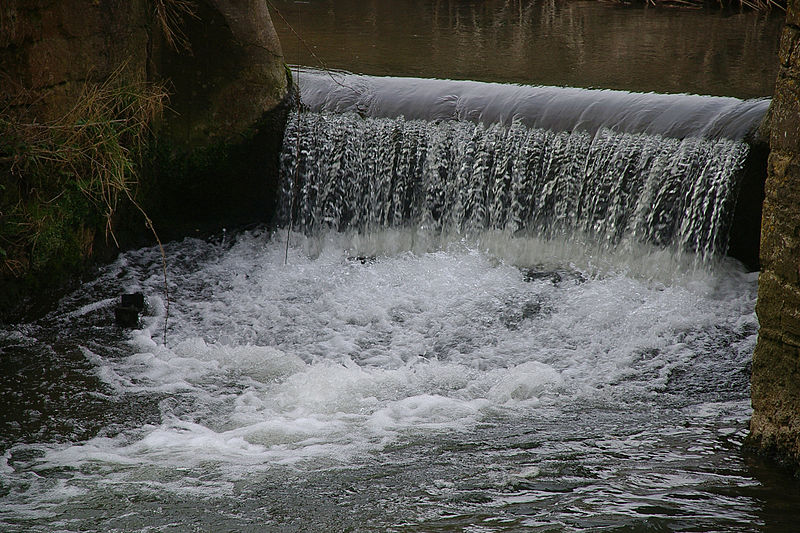
The weir on the river Chew in Pensford

The weir on the river Chew in Pensford

It has often been observed that time seems to go faster as we grow older. Our birthdays arrive with increasing rapidity. Shortly after my fortieth birthday, I began to feel as if I were taking the garbage cans out to the curb every other morning. And with each ensuing decade this subjective sense of accelerating time, which a number of my older friends have also noted, has grown ever more prominent. It is as if we were afloat on a swiftly moving river, and each of those “important” birthdays, the ones that mark the decades of our lives, were another waterfall, whose drop and velocity have yet to be experienced.

Yet, from the vantage point of Zen teachings, neither birthdays nor waterfalls are quite what they appear to be. They are at once real and illusory. In his book Living by Vow the Soto Zen priest Shohaku Okumura has this to say about waterfalls:

A river flows past a place where there is a change of height, and a waterfall is formed. Yet there is no such thing as a waterfall, only a continuous flow of water. A waterfall is not a thing but rather a name for a process of happening. . . . We cannot distinguish where the waterfall starts and ends because it is a continuous process.*

(more…)

Read Full Post »

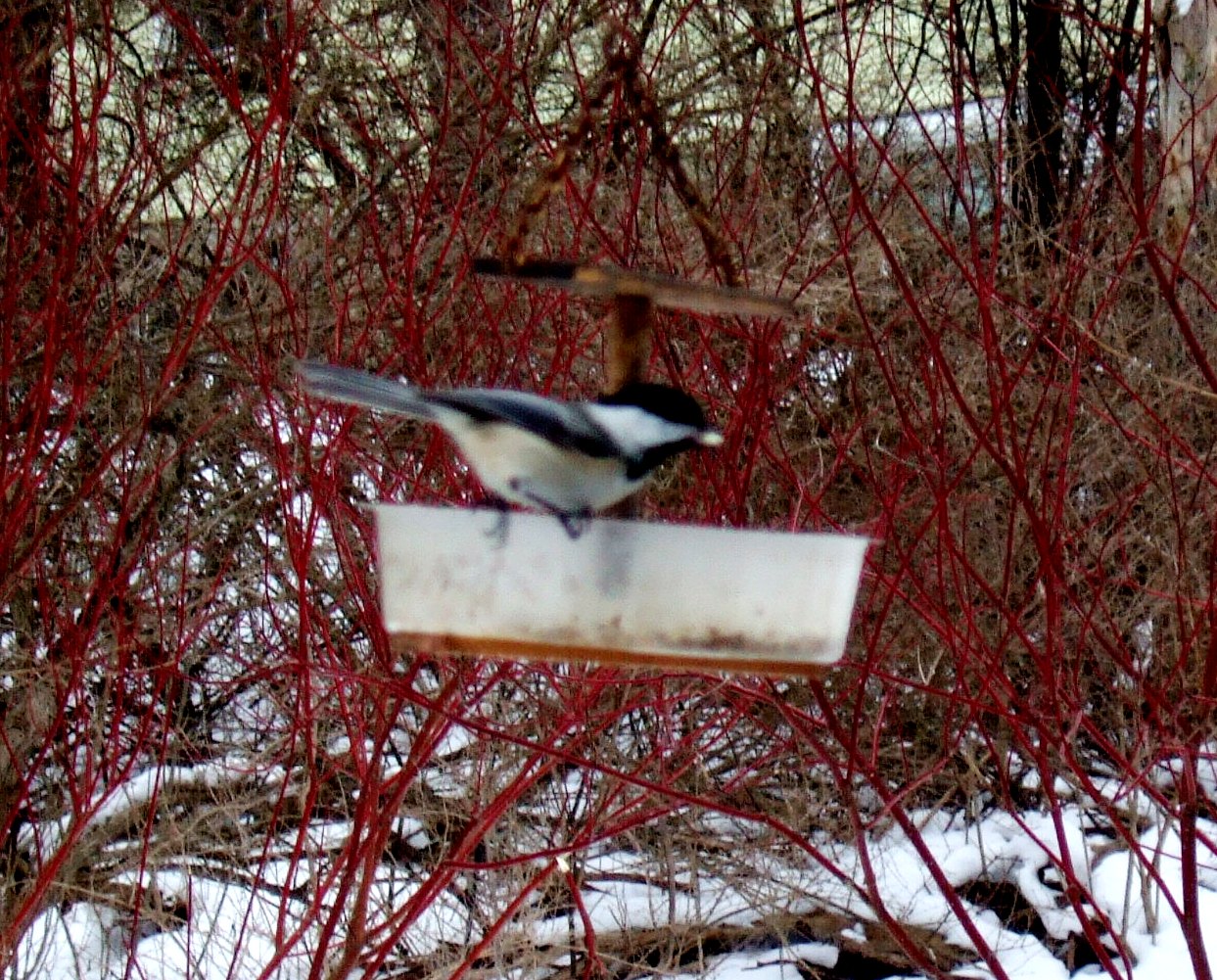
Chickadee feeder 2012-06-25 005One spring morning five years ago, as I was watching chickadees flit around our backyard feeder, it occurred to me that those nimble little birds might appreciate having a trapeze on which to perch. When my son was a child I built him a trapeze, and he enjoyed it. Perhaps the chickadees would as well.

Construction was simple. Rummaging in the garage, I found a remnant of 3/4” flat screen molding. From this I cut two six-inch pieces for the top and bottom bars. These I connected with a central, four-inch dowel. Using wire-cloth staples, I fastened two three-inch lengths of cuckoo-clock chain to the ends of the top bar, joining them at the middle with a handsome brass S-hook. My trapeze thus completed, I hung it from a branch of our pin oak tree. Ready for occupancy, it swung invitingly in the wind. (more…)

Read Full Post »

Pruitt Taylor Vince(Rub Squeers in Nobody's Fool)

Pruitt Taylor Vince

If you have a good memory for movies, you may remember Nobody’s Fool (1994). Set in a declining town in upstate New York and based loosely on Richard Russo’s comedic novel, Nobody’s Fool stars Paul Newman as Donald “Sully” Sullivan, a feckless, sixty-year-old handyman who, in Russo’s words, has “led a life of studied unpreparedness.“ Although he is blessed with humane instincts and a generous heart, Sully’s devil-may-care attitude and his boyish penchant for mischief have too often sabotaged his better nature.

Sully’s sidekick and fellow bungler of odd jobs is a garbage collector named Rub Squeers, who plays a role in Sully’s adventures comparable to that of Sancho Panza in Don Quixote’s. Rub is just over five feet tall. His large head sits “like a medicine ball precariously balanced on his thick shoulders.” For most of his life Rub has seldom paid attention to much of anything. He finds attentiveness “hateful and exhausting,” and he considers inattention “normal human behavior.”

What Rub does do is wish, habitually and frequently. During a lull, when he and Sully are out of work, Rub wishes that “we’d just start up again like before.” Later, when they do find work, Rub wishes “we were all through with this job and sitting in The Horse eating a big ole cheeseburger.”* Wherever Rub might be, he wishes he were elsewhere. (more…)

Read Full Post »

Path of stone over water, Nanjing, South of China

If you have ever sung in a choir, you know that certain disciplines apply. You must sit up straight at the edge of your chair. You must breathe from the diaphragm. And you must open your mouth more widely than you otherwise would—widely enough to accommodate three fingers. Although these principles are simple, it is easy to forget them, especially if your mind is elsewhere.

Such was the case one morning in 1961, when I and other members of the Clinton High School A Cappella Choir sat upright at the edge of our chairs, rehearsing Michael Pretorius’s beautiful carol “Lo, How a Rose E’er Blooming.” Leading us was our director, John De Haan, a tall, ruggedly-built man with a gentle but commanding presence. Glancing in my direction, he noticed my half-open mouth. “Open your mouth, Ben,” he said, quietly but firmly, in his deep bass voice. “This is my life’s work.” (more…)

Read Full Post »

One thing at a time, Bud, my father used to say. For centuries, Zen teachers have said the same. Whatever you are doing, give that one thing your full attention. When you walk, just walk.

That is sound advice, but in our present culture it stands little chance of being heeded. A recent New Yorker cartoon depicts an urban couple at an intersection of trails in a state park. While the man studies the printed guide, his companion turns to a passing hiker for help. “Which trail,” she asks, “has the best cell-phone reception?” When you walk, just walk, our culture seems to be saying, but keep your cell phone on. Within this prevailing social ethos, the admonition to do one thing at a time, and to give that one thing sustained attention, comes to look like a quaintly archaic notion. (more…)

Read Full Post »


Moises Guevara & Ben Howard

“The song of the piano,” wrote the Catalan poet Eugenio d’Ors, “is a discourse. The song of the cello is an elegy. The song of the guitar . . . is a song.”

Those well-known lines, which please guitarists but tend to annoy pianists and cellists, suggest that the song of the guitar is as natural as that of one’s favorite bird. The Carolina Wren, perhaps, or the Hermit Thrush. That may well be true, but the production of the guitar’s seemingly natural song requires the mastery of two basic right-hand strokes, known to classical guitarists as apoyando and tirando. These two strokes produce two, very different timbres. And they also exemplify two different ways of paying attention. (more…)

Read Full Post »

« Newer Posts - Older Posts »