As the world knows, Zen Buddhism is a practice of stillness and silence. Its iconic image is a figure sitting cross-legged in meditation. But Zen is also a practice of active questioning. And no question is more central to the practice than one a child might ask: “What is this?” Zen teachings enjoin practitioners to ask this question over and again, not only in formal meditation but throughout the day. Whether the immediate focus of attention be an orange, an iPhone, a transitory feeling, a state of mind, or what is commonly called the self, to practice Zen is to inquire deeply into whatever we encounter: to penetrate beneath its illusory surface to its “true nature.”
Yet one need not be a Zen practitioner to benefit from asking Zen’s central question. Radical inquiry is basic to pursuits as diverse as science, medicine, law, philosophy, and the visual arts. And it is also fundamental to Western meditative poetry, as in Wordsworth’s Prelude or T.S. Eliot’s Four Quartets, where the aim, as in Zen, is both to understand the essential nature of the object under scrutiny and to reignite an Edenic sense of awe and wonder.
Few Western poems better illustrate this process than Robert Frost’s “Mending Wall” (1913), one of the most celebrated, widely anthologized, and enduring poems of the 20th century. At first glance, this readily accessible poem is a folksy, anecdotal account of a conversation between two neighboring farmers in rural New Hampshire. But on closer inspection, it reveals itself to be a profound inquiry into the nature, origins, and purpose of man-made walls. More broadly, it is an examination of the sources of division, enclosure, and territorial conflict in Western culture and the role that fixed, traditional ideas play in such conflicts.
In “Mending Wall,” two owners of adjoining farms are engaging in the annual springtime ritual of repairing a drystone wall that separates their properties. Even as they work together, the narrator (who has initiated this chore by getting in touch with his neighbor) is inwardly questioning its worth and meaning. “Something there is that doesn’t love a wall,” he confides to the reader. Whatever that unspecified “something” may be, it has both human and natural agents: the hunters who break through the wall in pursuit of prey and the winter groundswell, which topples the carefully balanced stones. And just as these physical forces undermine the established wall, so the narrator subverts its very existence by questioning its reason for being. As he notes, there is no practical need to separate his apple orchard from his neighbor’s pine forest. Neither is harming the other. Nor are there cows to enclose. Why erect a wall at all?
In response to this mischievous but searching question, the neighbor offers a platitude, most likely derived from a 19th-century Farmer’s Almanac: “Good fences make good neighbors.” Recognizing this argument as proverbial rather than original, expedient rather than persuasive, the narrator characterizes it as his neighbor’s “father’s saying,” which the man has neither the inclination nor the imagination to call into question. And toward the end of the poem, the two neighbors merely restate their opposing positions: “Something there is that doesn’t love a wall” and “Good fences make good neighbors.” Whether the author is siding with one or the other remains unknown. And the question itself remains unresolved.
“Mending Wall” has sometimes been read—or misread—as a didactic poem with a simple message: “Tear down all walls.” But, given the even balance of opposing perspectives, supported by the author’s own impartiality, the poem might better be understood as a concrete demonstration of an ongoing inquiry. That the issue remains far from resolved after more than a hundred years may be seen in an episode of the TV drama Yellowstone (Season 1, Episode 7), where the cattle baron John Dutton (Kevin Costner) directs the Asian tourists who are trespassing on his property (and photographing a nearby grizzly bear) to take note of his fences and get off his land. When one of the tourists objects, asserting that the earth belongs to everyone, Dutton dismisses his argument with a memorable line: “This is America. We don’t share land here!”
In Zen practice, “What is this?” is both a question and a koan, whose purpose is not so much to produce definitive answers as to lift the veils of prejudicial concepts, freshen our perceptions, and reveal the impermanent, selfless, and interdependent nature of things we usually take for granted. Likewise, Robert Frost, at once a social conservative and a radical explorer, offers a koan of his own, inviting us to look more deeply into the nature of walls and boundaries, literal and figurative, and to ask what place and meaning such fabrications have in our daily lives.
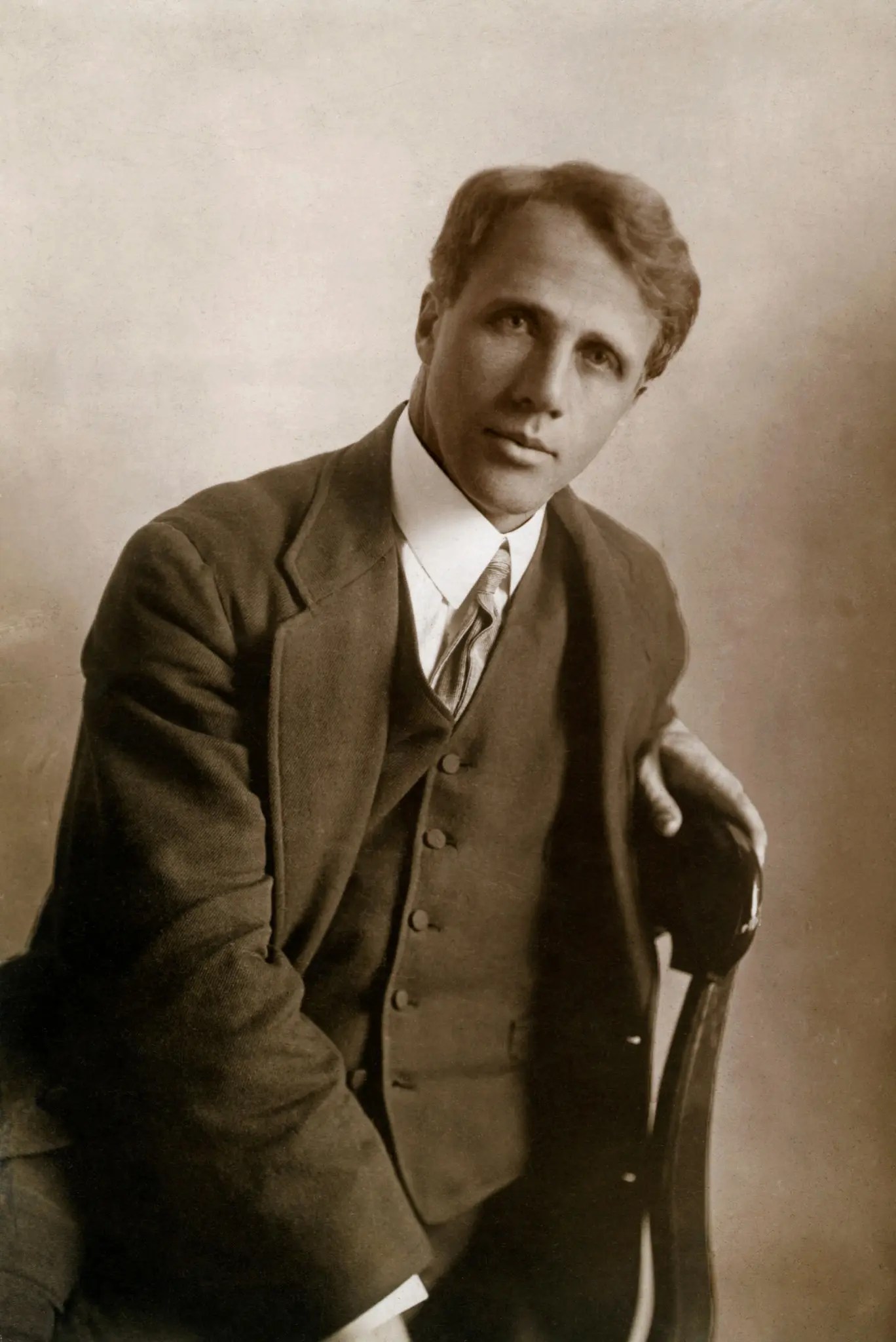
Photo: Robert Frost
To read “Mending Wall” go to https://www.poetryfoundation.org/poems/44266/mending-wall


 “Receive a guest,” advised the Zen master Soyen Shaku (1860-1919), “with the same attitude you have when alone. When alone, maintain the same attitude you have in receiving guests.”

 One Time, One Meeting