
In the summer of the year 2000, I had the good fortune to be spending the month of June in Ireland, where I was teaching Irish literature to American students at Trinity College, Dublin. One sunny afternoon, as I was walking down Nassau Street in central Dublin, I stopped to browse at a sidewalk bookstall.
Enclosed in wooden trays were dozens of used books, including hefty, well-worn volumes on Irish history, culture, literature, and topography; slim, tattered collections by obscure Irish poets; dated anthologies of Irish drama, short stories, and essays; and biographies of such luminaries as Michael Davitt, Michael Collins, and Éamon de Valera. Finding many books of interest but none I cared to buy, I was about to leave, when another book caught my eye. Lo and behold, it was a book of my own: my verse novella, Midcentury, which my Irish publisher, Salmon Poetry, had released three years earlier.
Midcentury is a book-length, blank-verse meditation, narrated by a middle-aged American lexicographer living alone in Ireland in the nineteen-forties. Down on his luck and overly fond of Irish whiskey, he is seeking solace in the Irish landscape and Ireland’s wartime neutrality. His dominant themes, interwoven through six, interrelated sections in the manner of a string quartet, include impermanence, dispossession, forgiveness, the roots of language, Ireland’s tragic history, and his own spiritual deracination and renewal.
I began the the first section, “The Word from Dublin, 1944,” while in residence at Yaddo, the writers’ retreat in Saratoga Springs, New York. The remaining sections were written in multiple venues over the next three years. I completed the book in 1995 while staying at the Tyrone Guthrie Centre (Annaghmakerrig), the Irish writers’ retreat in Co. Monaghan. Before I had even begun this project, I might add, months of historical research into mid-twentieth-century Irish history and culture had laid its foundation. And there it was, my magnum opus, for sale on a Dublin sidewalk for less than a pint of Guinness.
“All conditioned things,” the Buddha is reported to have said, “are of the nature of vanishing.” Where books are concerned, those conditions include the vagaries of publishing, marketing, aesthetic fashion, critical opinion, and time itself, which can be cruel to unprotected ink and paper. With obvious exceptions, most authors should not be surprised to see their books vanish or be forgotten in due time—and often sooner rather than later. (With Midcentury I’ve had better luck: according to WorldCat, the worldwide library database, the book is currently in 89 libraries, here and abroad). No matter how many hours went into the making of a book, it can disappear quickly and with scarcely a trace, taking with it whatever ephemeral acclaim it might have accrued. In his poem “Provide, Provide!” Robert Frost puts the matter succinctly: “No memory of having starred / Atones for later disregard.”
What I am speaking of, of course, is the reality of impermanence, which the Zen teacher Norman Fischer has called the “cornerstone of Buddhist teachings and practice.” For Frost, the remedy was to “make the whole stock exchange your own,” which might increase the chances of having interested parties at one’s bedside as the end draws near. “Better to go down dignified,” he advised, “With boughten friendship at your side / Than none at all.” From the perspective of Zen teachings, however, the issue is neither so materialistically defined nor so easily resolved. Nor is impermanence something we can deal with later. It is immanent, if not always apparent, in things as they appear to us in the here and now. And, as Fischer puts it, “to understand impermanence at the deepest level, and to merge with it fully, is the whole of the Buddhist path.” Mindfulness, the central practice of Zen meditation, is “not a way to cope with or overcome impermanence. It is the way to fully appreciate and live it.”
That is more easily said than done. A lifetime of Western conditioning militates against it. But having practiced Zen for more than three decades, I can report that eventually one can get the hang of living within, rather than outside, the reality of impermanence. And should that happen, you may find yourself experiencing an unexpected lightness of being. As the Vietnamese master Thich Nhat Hanh often noted, we suffer not because things are impermanent but because we expect them to be permanent when they are not. Truly releasing that expectation can lift a self-inflicted burden, offer a fresh way of seeing, and open a gate to the next new experience. And for Zen practitioners who are also creative artists, living in alignment with impermanence rather than habitually resisting it can both facilitate the process of artistic creation and make it far more enjoyable. “Long live impermanence!” Thich Nhat Hanh, a poet and the author of more than a hundred books, delighted in saying, with only the gentlest irony in his tone.
Norman Fischer, When You Greet Me I Bow (Shambhala, 2022), 99, 102.
Photo: “At the Bookstall,” by garryknight (Creative Commons)
 The British poet Sir Geoffrey Hill (1932-2016) once described words as repositories of meanings. Those meanings may be social, historical, or political. They may also be hidden or manifest, dormant or active. The word silly, for example, once meant “innocent,” as in “the silly sheep,” but that meaning is no longer current. By contrast, the original meanings of other words may be extant in one culture but not in another, though the two share a common language.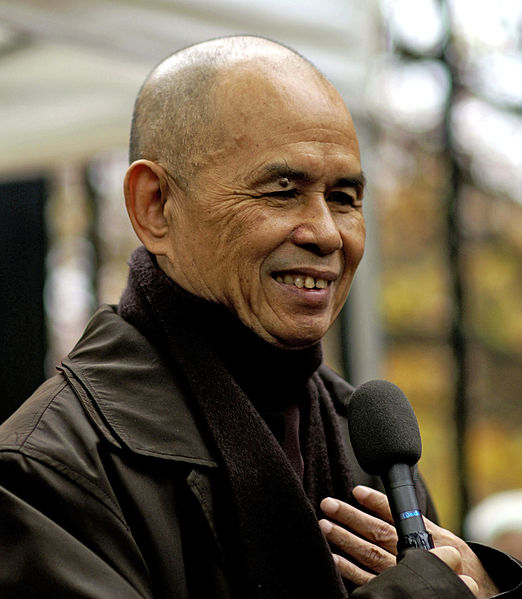


 One Time, One Meeting