Feeds:
Posts
Comments

Posts Tagged ‘ichigo ichie’

Allegra Rose Howard, three days oldOn Friday, June 14, my granddaughter, Allegra Rose Howard, arrived in the world, weighing eight pounds and twelve ounces. As I reflect on that glad event, I am reminded of a phrase from Tibetan Buddhist teachings.

The phrase is this precious human birth. Its source is the Chiggala Sutra, where the Buddha speaks of the chances of being born a human being. Those chances, he observes, are infinitesimally small. They are analogous to those of a blind tortoise swimming in an ocean as large as the planet, where an ox’s yoke is afloat on the waves. Every one hundred years, the tortoise surfaces. The chances of being born human are no better than those of the tortoise surfacing with his head in the yoke. Human birth is extremely rare and therefore most precious.

In the lojong system of mind training practiced by Tibetan Buddhists, phrases such as this precious human birth are known as “slogans.” Contemplated and absorbed during sitting meditation, they are subsequently applied to everyday life. As the Zen teacher Norman Fischer explains, the best way to work with a lojong slogan is to develop it “as an almost physical object, a feeling in your belly or heart.” Once the slogan has embedded itself, you can work with it throughout the day, until it becomes “part of your mind—your own thought, a theme for daily living.”* (more…)


Read Full Post »

131. True realism

In a recent column Paul Krugman spoke of “fantasy posing as hardheaded realism.”* As might be expected, Krugman’s subject was economic, his theme political. But his well-wrought phrase has resonance beyond the spheres of politics and economics.

To begin with, it evokes the stereotype of the hardheaded realist—the seasoned, no-nonsense person who lives in the real world. At the same time, it suggests that realism may be little more than a pose. If, as Krugman implies, realism can be false, the opposite must also be the case. What is true realism, we might inquire, and what are its salient traits? Is it by nature hardheaded—and hardhearted as well? (more…)

Read Full Post »

Purple Finch

Purple Finch

There may be no such thing as a free lunch, but one morning not long ago I called my wife to offer that very thing. I could pick her up at her office at noon, I proposed, and we could go to the Jet for a bite to eat. After checking her schedule, Robin readily agreed.

As it happened, however, Robin was called out of her office at 11:45. Not wanting to leave her husband in limbo, she asked Kevin, her work-study student, to inform me that she would be back shortly.

“What does he look like?” Kevin asked.

“He’s gray and slightly built.”

An hour later, over my egg-salad sandwich, I noted that there were other adjectives Robin might have chosen. “In aspect marvelous, in form divine” came to mind, but it lacked specificity. Perhaps “lean of limb and stern in mien”? Or, in the interests of concision, “compact and professorial”?

“But you are gray and slightly built,” Robin insisted.  At which point I rested my case. (more…)

Read Full Post »


Manjusri

Manjusri

One afternoon many years ago, when my son and I were playing chess at our dining-room table, our conversation turned to a woman I’d recently met.

“She seems honest,” I cautiously observed.

“I would have said ‘straightforward,’ Dad,” Alexander replied, taking my rook with his knight. Although he was only thirteen at the time, he was even then a stickler for definitions.

As it happened, however, father and son were both close to the mark. The word straightforward is a relative newcomer to the English language. The first usage cited by the Oxford English Dictionary dates from 1806. Originally, the meaning of straightforward was primarily descriptive. The word meant “directly in front of or onwards; in direct order.” But by the end of the nineteenth century, straightforward had acquired a moral aura, as in the Rev. Griffith John’s characterization of one Mr. Wei as a “plain, honest, straightforward-looking man” (1875). If not quite synonyms, honest and straightforward had come to occupy the same moral universe. (more…)

Read Full Post »

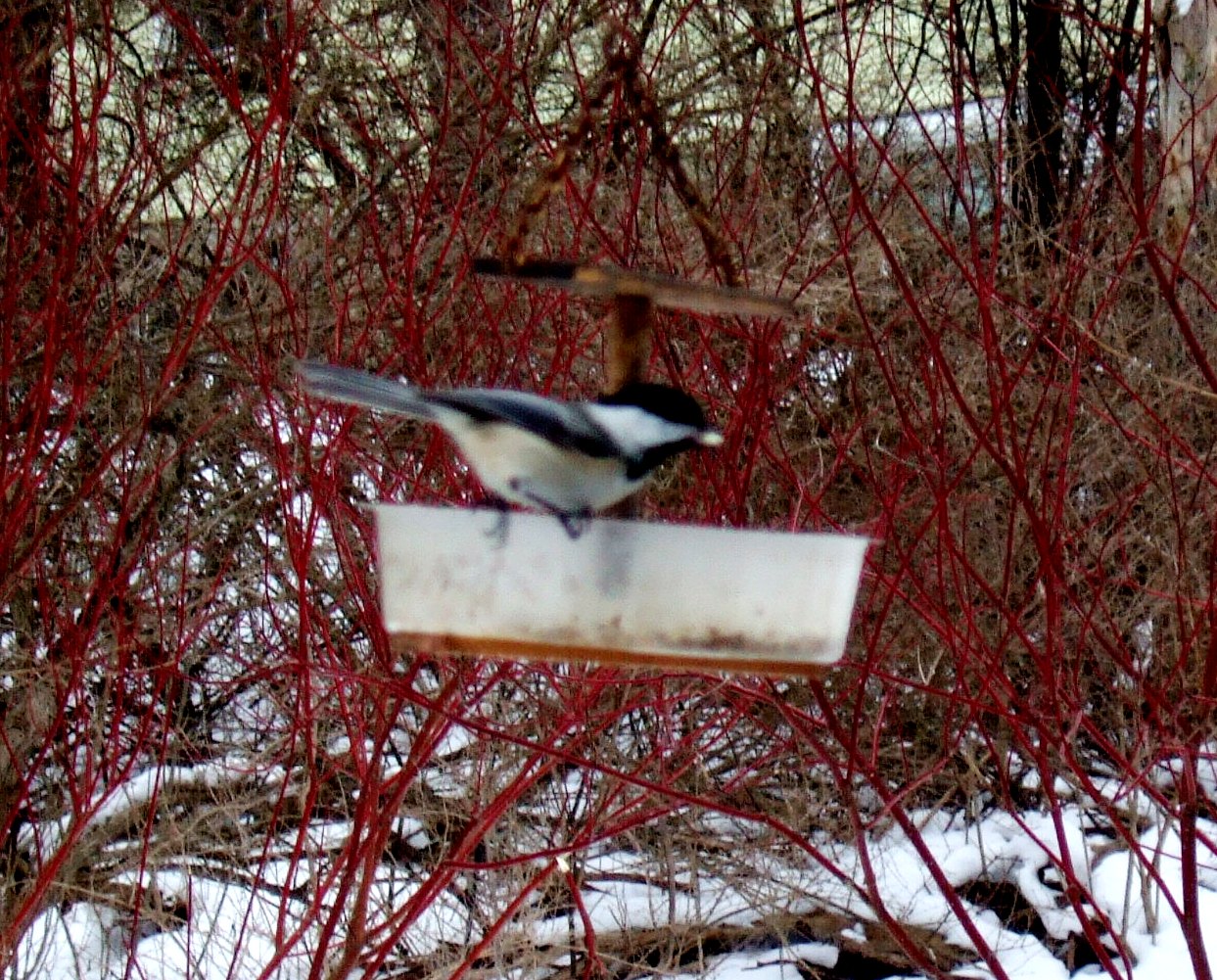
Chickadee feeder 2012-06-25 005One spring morning five years ago, as I was watching chickadees flit around our backyard feeder, it occurred to me that those nimble little birds might appreciate having a trapeze on which to perch. When my son was a child I built him a trapeze, and he enjoyed it. Perhaps the chickadees would as well.

Construction was simple. Rummaging in the garage, I found a remnant of 3/4” flat screen molding. From this I cut two six-inch pieces for the top and bottom bars. These I connected with a central, four-inch dowel. Using wire-cloth staples, I fastened two three-inch lengths of cuckoo-clock chain to the ends of the top bar, joining them at the middle with a handsome brass S-hook. My trapeze thus completed, I hung it from a branch of our pin oak tree. Ready for occupancy, it swung invitingly in the wind. (more…)

Read Full Post »

Pruitt Taylor Vince(Rub Squeers in Nobody's Fool)

Pruitt Taylor Vince

If you have a good memory for movies, you may remember Nobody’s Fool (1994). Set in a declining town in upstate New York and based loosely on Richard Russo’s comedic novel, Nobody’s Fool stars Paul Newman as Donald “Sully” Sullivan, a feckless, sixty-year-old handyman who, in Russo’s words, has “led a life of studied unpreparedness.“ Although he is blessed with humane instincts and a generous heart, Sully’s devil-may-care attitude and his boyish penchant for mischief have too often sabotaged his better nature.

Sully’s sidekick and fellow bungler of odd jobs is a garbage collector named Rub Squeers, who plays a role in Sully’s adventures comparable to that of Sancho Panza in Don Quixote’s. Rub is just over five feet tall. His large head sits “like a medicine ball precariously balanced on his thick shoulders.” For most of his life Rub has seldom paid attention to much of anything. He finds attentiveness “hateful and exhausting,” and he considers inattention “normal human behavior.”

What Rub does do is wish, habitually and frequently. During a lull, when he and Sully are out of work, Rub wishes that “we’d just start up again like before.” Later, when they do find work, Rub wishes “we were all through with this job and sitting in The Horse eating a big ole cheeseburger.”* Wherever Rub might be, he wishes he were elsewhere. (more…)

Read Full Post »

124. Cooked carrots

800px-Sliced_carrotsBeing retired now, I cook most of the meals in our home. And of late I have become a connoisseur of my wife’s responses, spoken and unspoken, to what I put on our table.

Let us say that tonight’s menu is Rotini with Lemon-Asparagus Sauce, a side of cooked carrots, and a Martha’s Vineyard salad. After a few bites, Robin may comment on what she has just eaten, or she may not. If she is silent for very long, I begin to get curious. “How do you like it?” I venture to inquire. (more…)

Read Full Post »

Dennis O' DriscollPhoto by Kim Haughton

Dennis O’ Driscoll
Photo by Kim Haughton

“He gave the art a good name,” remarked the Nobel laureate Seamus Heaney of the Irish poet Dennis O ’Driscoll, who died suddenly on Christmas Eve at the age of fifty-eight. Dennis was the author of nine collections of graceful, civilized verse and one of the most respected voices in contemporary Irish letters. I am saddened by his early death, as are many of his fellow writers, Irish and American, who remember him as a true gentleman and a generous friend. (more…)

Read Full Post »

122. Unwelcome sounds

Pile driverAs I sit at my desk this morning, I am listening unwillingly to the rhythmic, reverberant, and unrelenting blows of a pile driver on cold steel.  Wham! (Pause). Wham! (Pause). Wham! The crashes continue for another twenty minutes, as they have for the past few weeks. Charitably regarded, this disturbance of the peace represents the embodied spirit of Progress. Alfred University is building a new recreation center, a half block away from our home. But for many of us who live or work nearby, the noise has been the aural equivalent of a chronic, throbbing toothache. It has been an unwelcome sound.

In this it is far from alone. Most of us, I suspect, have our lists of unwelcome sounds, and more often than not, those sounds are beyond our power to abate, much less eliminate. Under such conditions, a scriptural reminder might be helpful: “And we exhort you, brethren . . . be patient with them all” ( 1 Thessalonians 5:14).  But help may also be found in Buddhist teachings, which offer three distinct practices for dealing with unwanted feelings and sensations. (more…)

Read Full Post »

2012-03-11 002 2012-03-11 012Dr. Friederike Boissevain is a German oncologist and seasoned Zen practitioner. By her own admission, her meditative practice is imperfect—or “crooked,” as she describes it. Rather than remain focused and fully aware of the present moment, she finds herself wandering off into the “land of dreams and worries.” But, crooked though it be, her practice has supported her daily work with the sick and the dying. “The most important thing I ever did,” she reflects, “was to sit down once.” That act set “something in motion that cannot be stopped. This is not because of trust in something but because of experience. . . The snow of dharma covers everything, whether we see it or not.” (more…)

Read Full Post »

« Newer Posts - Older Posts »