Feeds:
Posts
Comments

Posts Tagged ‘thich nhat hanh’

In the summer of the year 2000, I had the good fortune to be spending the month of June in Ireland, where I was teaching Irish literature to American students at Trinity College, Dublin. One sunny afternoon, as I was walking down Nassau Street in central Dublin, I stopped to browse at a sidewalk bookstall.

Enclosed in wooden trays were dozens of used books, including hefty, well-worn volumes on Irish history, culture, literature, and topography; slim, tattered collections by obscure Irish poets; dated anthologies of Irish drama, short stories, and essays; and biographies of such luminaries as Michael Davitt, Michael Collins, and Éamon de Valera. Finding many books of interest but none I cared to buy, I was about to leave, when another book caught my eye. Lo and behold, it was a book of my own: my verse novella, Midcentury, which my Irish publisher, Salmon Poetry, had released three years earlier.

Midcentury is a book-length, blank-verse meditation, narrated by a middle-aged American lexicographer living alone in Ireland in the nineteen-forties. Down on his luck and overly fond of Irish whiskey, he is seeking solace in the Irish landscape and Ireland’s wartime neutrality. His dominant themes, interwoven through six, interrelated sections in the manner of a string quartet, include impermanence, dispossession, forgiveness, the roots of language, Ireland’s tragic history, and his own spiritual deracination and renewal.

I began the  the first section, “The Word from Dublin, 1944,” while in residence at Yaddo, the writers’ retreat in Saratoga Springs, New York. The remaining sections were written in multiple venues over the next three years. I completed the book in 1995 while staying at the Tyrone Guthrie Centre (Annaghmakerrig), the Irish writers’ retreat in Co. Monaghan. Before I had even begun this project, I might add, months of historical research into mid-twentieth-century Irish history and culture had laid its foundation. And there it was, my magnum opus, for sale on a Dublin sidewalk for less than a pint of Guinness.

“All conditioned things,” the Buddha is reported to have said, “are of the nature of vanishing.” Where books are concerned, those conditions include the vagaries of publishing, marketing, aesthetic fashion, critical opinion, and time itself, which can be cruel to unprotected ink and paper. With obvious exceptions, most authors should not be surprised to see their books vanish or be forgotten in due time—and often sooner rather than later. (With Midcentury I’ve had better luck: according to WorldCat, the worldwide library database, the book is currently in 89 libraries, here and abroad). No matter how many hours went into the making of a book, it can disappear quickly and with scarcely a trace, taking with it whatever ephemeral acclaim it might have accrued. In his poem “Provide, Provide!” Robert Frost puts the matter succinctly: “No memory of having starred / Atones for later disregard.”

What I am speaking of, of course, is the reality of impermanence, which the Zen teacher Norman Fischer has called the “cornerstone of Buddhist teachings and practice.” For Frost, the remedy was to “make the whole stock exchange your own,” which might increase the chances of having interested parties at one’s bedside as the end draws near. “Better to go down dignified,” he advised, “With boughten friendship at your side / Than none at all.” From the perspective of Zen teachings, however, the issue is neither so materialistically defined nor so easily resolved. Nor is impermanence something we can deal with later. It is immanent, if not always apparent, in things as they appear to us in the here and now. And, as Fischer puts it, “to understand impermanence at the deepest level, and to merge with it fully, is the whole of the Buddhist path.” Mindfulness, the central practice of Zen meditation, is “not a way to cope with or overcome impermanence. It is the way to fully appreciate and live it.”

That is more easily said than done. A lifetime of Western conditioning militates against it. But having practiced Zen for more than three decades, I can report that eventually one can get the hang of living within, rather than outside, the reality of impermanence. And should that happen, you may find yourself experiencing an unexpected lightness of being. As the Vietnamese master Thich Nhat Hanh often noted, we suffer not because things are impermanent but because we expect them to be permanent when they are not. Truly releasing that expectation can lift a self-inflicted burden, offer a fresh way of seeing, and open a gate to the next new experience. And for Zen practitioners who are also creative artists, living in alignment with impermanence rather than habitually resisting it can both facilitate the process of artistic creation and make it far more enjoyable. “Long live impermanence!” Thich Nhat Hanh, a poet and the author of more than a hundred books, delighted in saying, with only the gentlest irony in his tone.


Norman Fischer, When You Greet Me I Bow (Shambhala, 2022), 99, 102.

Photo: “At the Bookstall,” by garryknight (Creative Commons)


Read Full Post »

Tea master“Receive a guest,” advised the Zen master Soyen Shaku (1860-1919), “with the same attitude you have when alone. When alone, maintain the same attitude you have in receiving guests.”

Zen masters’ pronouncements are often enigmatic, but this one is particularly baffling. For one thing, it seems to blur, if not collapse, the distinction between social and private conduct. What we do and say when hosting a guest may be very different from our speech and behavior when no one is in earshot and no one is watching. And rather than liberate our minds, as Zen teachings purport to do, Shaku Roshi’s admonition seems unduly restrictive. When we are alone and things go awry, the words we choose to express our frustrations may be impermissible in public discourse. And conversely, the constraints we impose upon ourselves when entertaining guests may be irrelevant to the ways we dress, speak, and act when home alone.

Yet if Shaku Roshi’s advice may be puzzling to a Western sensibility, it becomes more intelligible if understood in the context of traditional Japanese culture in general and the formal tea ceremony in particular. In that venerable ritual, traditionally conducted in a tea hut, both host and guest have prescribed roles to play. The host must assemble and arrange such essentials as a Zen slogan for the hanging scroll in the alcove, seasonal flowers, and sweets to accompany the tea. And his or her physical movements throughout the ceremony must be orchestrated down to the last detail. Little wonder that tea masters train for many years to perfect their exacting art.

On the other side of the host-guest equation, guests are expected to observe the conventional protocols. Before entering the tea hut, they cleanse their mouths in water from a stone basin. Entering, they pass through a low door, requiring even the most self-important guest to assume a posture of humility.  Once inside, guests are to bow when appropriate, to assume a kneeling posture as they prepare to be served, and to express appreciation for the beauty of the tea bowls. Together, these ritualized interactions, performed within the muted setting of the tearoom, generate an atmosphere consistent with the four principles governing the formal tea ceremony: Respect, Purity, Harmony, and Tranquility.

Such an atmosphere is as rare as it is desirable, and the conditions by which it is created may well be unique to its place and occasion. But the attitudes underlying the Way of Tea, derived primarily from the Zen tradition, may be cultivated anywhere and at any time, whether one is sitting alone in zazen (seated meditation), or hosting a public event, or having a few friends over for dinner and conversation.

Chief among those attitudes is the practice of continuous attention, which encompasses both the one-pointed attention of zazen and what is sometimes called “soft eyes”: the panoramic vision required of quarterbacks, equestrians, and soldiers on reconnaissance. Just as the tea master meticulously attends to the processes of brewing and serving tea, committed Zen practitioners strive to remain mindful throughout the day, whether they are sitting in zazen, chopping vegetables, or raking leaves. And whether they are alone or in company is largely irrelevant. Although the objects of attention will differ, the quality of attention will remain the same.

Second, Zen practitioners are encouraged to remain open to whatever is presently occurring, within and without. “Include everything,” a traditional Zen slogan, encapsulates this aspect of the practice. Contrary to popular belief, Zen is not a practice of splendid isolation. Nor is it a practice of detachment. Rather, practitioners endeavor to welcome the whole of their experience but to do so with an attitude of non-attachment. Thoughts, sensations, and feelings are allowed to arrive, endure, and dissipate on their own. Practitioners may arrive at important insights, which they can act upon at a later time. But while engaged in zazen, they aspire to a state of stillness, silence, and non-judgmental awareness. “Everything” may indeed be included, but it is not to be judged, reacted to, or pursued.

Third and last, Zen practice fosters an attitude of non-separation. “We are here,” wrote the Venerable Thich Nhat Hanh, “to awaken from the illusion of separateness.” Rather than view the self as separate and apart from other people, groups, and cultures, Zen teachings urge awareness of the web of interconnectedness that unites the individual with the larger human family. In similar fashion, practitioners are encouraged to treat the natural world with reverence and respect, rather than as a resource to be ruthlessly exploited.

As twenty-first century Westerners, we live in a culture far removed from medieval Japan. But in a time when sustained attention, openness, and awareness of interdependence are often in short supply, there is much to be learned from the custom of serving and receiving tea in an atmosphere of tranquility and respect. And whatever the historical and cultural distance, there is much to be said for treating both ourselves and others as honored guests.

Read Full Post »

STORM WINDOWS IMAGE

If you are of a certain age, you may remember storm windows. Not the aluminum or vinyl variety, which came along later, but heavy wooden storm windows. Every fall my father, in the company of other homeowners, spent the better part of a Saturday putting up our clunky wooden storm windows. Every spring, he took them down. When I grew old and strong enough, he allowed me to help him.

In his poem “Storm Windows,” the American poet Howard Nemerov (1920-1991) recalls a rainy autumn day when he was walking down the sidewalk and caught sight of storm windows lying in a yard:

            People are putting up storm windows now,

            Or were, this morning, until a heavy rain

            Drove them inside. So, coming home at noon,

            I saw storm windows lying on the ground,

            Frame-full of rain . . .

Taking a closer look, Nemerov notes “the crushed grass” visible through the water and the windowpane.  Appearing to “stream away in lines,” the flattened grass resembles “seaweed on the tide” or “blades of wheat leaning under the wind.”

  At this point, the poem takes an unexpected turn. Until now a literal description enhanced by visual similes, it becomes a vehicle for introspection:

            The ripple and splash of rain on the blurred glass

            Seemed that it briefly said, as I walked by,

            Something I should have liked to say to you,

            Something . . .

Employing an ellipsis to mimic a pause in his thought, Nemerov depicts a mind venturing inward—or, as the 13th-century Zen master Eihei Dogen put it, “turning the light inward.” And what that light illuminates is not only thoughts in the process of articulation but also unrealized feelings, brought to the surface by the sight of “dry grass bent under the pane / Brimful of bouncing water.” Seen through the rippling, splashing water and the water-blurred glass, the trapped grass becomes the visible counterpart—what T.S. Eliot called an “objective correlative”—of the poet’s inchoate thoughts and yet-to-be-spoken feelings. And in their convergence, the water, glass, and grass reflect “this lonely afternoon of memories / And missed desires,” even as “the wintry rain / Runs on the standing windows and away.” The physical drama being enacted before him, in other words, becomes a mirror of Nemerov’s heart and mind. It reflects not only the rising, duration, and passing of impermanent mental phenomena but a more enduring emotional state: a prevailing loneliness infused with regret, presumably over something left unsaid and a road not taken.

“Storm Windows” appeared in Nemerov’s 1958 collection of poems, Mirrors and Windows. And here as elsewhere in his collection, the relationship of the perceived external world and the perceiver’s inner life is depicted as fluid and reciprocal. Just as the outer world reflects the mind, so the mind mirrors the external world. In “A Clock with No Hands,” for example, the narrator encounters a clock with Roman numerals and no hands. Rather than treat the clock as a prompt for inner reflection, Nemerov continues to examine it objectively, as might a scientist or physician, noting in his closing lines that behind that vandalized face, the clock’s mechanism “hides in its coiled continuing / A venomous tense past tense.”

To portray the world as a mirror of the human mind, or vice versa, is nothing new. In literary theory the former is known as the “pathetic fallacy”; the latter can be traced to the earliest Buddhist sutras, where the enlightened mind is likened to a limpid pool of water. In alignment with that tradition, the 18th-century Rinzai master Torei Enji, after years of study, concluded that the Japanese word kami, which means “god,” derived from a root meaning “mirror.” Elaborating on Torei’s conclusion, Yamada Mumon Roshi, a 20th-century master, offers this observation:

Before a mirror, rich and poor, powerful and insignificant, men and women, old and young are all perfectly equal . . .  A mind that is pure and undefiled, free of contrivances of any kind, impartial and selfless as a mirror—that is the meaning of kami.*

 Concentrated, calmed, and refined by years of zazen, this god-like, mirror-like mind reflects the world as it is, without the ego’s interference or habitual distortions. Like an unruffled lake, it shows us the true nature of the things of this world, including our inner worlds of memory and desire, even as it reveals the nature of awareness itself. When this revelation occurs, as Thich Nhat Hanh liked to say, an orange becomes an orange. The ordinary objects in our everyday lives become real and fully present, and so do we. 


Howard Nemerov was Poet Laureate of the United States from 1988-1990. To listen to his reading of “Storm Windows,” and to read the full text of the poem, visit www.poetryfoundation.org/poems/42695/storm-windows.

* Yamada Mumon Roshi, Hakuin’s Song of Zazen, translated by Norman Waddell (Shambhala, 2024), 63.

Read Full Post »

North StarLast month, an Alfred State College student, who was working on a project concerning “spiritual life in the Alfred area,” contacted me to request an interview. Although I am hardly an authority on such matters, I agreed to speak with him. His questions, submitted in advance, struck me as serious and provocative. Foremost among them was the question, “Why do you think it is important for students to explore spirituality while in college?”

However well formulated, that question contains a debatable premise and an ambiguous abstraction. As it happens, I would concur with the underlying assumption: that exploring “spirituality” while in college is important. But I would note, first, that the abstract concept “spirituality” may or may not be linked to organized religion. Non-competitive swimming, for example, can be experienced as a meditative activity. Likewise cooking, writing, drawing, gardening, and other human pursuits. Second, I would suggest that “exploring spirituality” will be of limited value if it only involves adopting a set of beliefs but doesn’t integrate a regular practice into the practitioner’s daily round. With those qualifications in mind, I reinterpreted the question as, “What might be the benefits of exploring a spiritual practice during a student’s college years?” To that re-framed question, I offered three responses.

A Refuge

During my years of teaching at Alfred University, I was often aware of the pressures, emotional and intellectual, to which conscientious students were being regularly subjected. Most obvious were the academic pressures, especially on those whose scholarships were based on maintaining a high grade-point average. Many of those same students were working part-time jobs; most were juggling academic demands with social obligations and extra-curricular activities. Beyond that, all were navigating a path toward a promising but uncertain future. Along the way, they were responding to the multiple and sometimes conflicting expectations of their parents, their peers, their professors, and their fluid personal relationships. Little wonder that many suffered from chronic anxiety.

From all such pressures, a spiritual practice can provide a welcome refuge. In times of crisis, it can afford solace and support. And even on ordinary days, it can provide a young person with a “home from home,” as the Irish say, and a way of reconnecting with his or her inner life. Beyond personal restoration, a daily practice can also introduce the practitioner to the silence, the stillness, and the mystery at the heart of being. And over time, it can acquaint the dedicated practitioner with what the Zen priest Norman Fischer has called “that which is beyond [ourselves] and holds [us] in its embrace.”

A Path to Maturity

It is sometimes assumed that as we grow older, we become more mature. Comforting though it is, that assumption is not always borne out by experience. In most spiritual traditions, including Zen, it is understood that the qualities of a mature person do not magically manifest of their own accord. They must be cultivated. Among the most salient of those qualities are the strength to face difficult and sometimes painful realities; the courage to accept responsibility for one’s words, deeds, and even thoughts; the realism to acknowledge one’s personal, physical, and temperamental limitations; the empathy to temper egocentric desires with regard for other people’s feelings and needs; and the discipline to restrain hedonistic impulses in the service of the common good. These and other qualities of a mature person can be developed through regular, systematic spiritual practice. Attaining full maturity—becoming fully human—is a continuing challenge at any stage of life. To undertake a spiritual practice during one’s undergraduate years not only nourishes the practitioner’s evolving maturity. It can also provide a sound basis for future development.

A North Star

It is fair to say that American college students come from a wide variety of moral backgrounds. Their ethical training may have been narrow, strict, and rigid, on the one hand, or vague, lax, and virtually non-existent, on the other. A daily spiritual practice, if conducted in a spirit of openness and flexibility, can provide a moral compass somewhere between those extremes. Zen master Thich Nhat Hanh placed great importance on the ethical framework of Zen practice, which he often likened to a North Star. Rather than view the “precepts,” as they are called in Zen, as an inflexible code of conduct or a set of moral absolutes, he saw them as an ethical destination. By keeping the precepts firmly in mind as we speak, act, and make crucial decisions, we can stay on course toward that distant destination.

All the great spiritual traditions rest on moral foundations. By studying, absorbing, and thoughtfully interpreting those foundations, students can learn to respond to each new situation in a manner consistent with both the particulars of that situation and their deepest moral intentions. That, alone, is reason enough to “explore spirituality” during one’s college years, when life-decisions are being made, and untried graduates are poised to enter the wider world.

_______

Norman Fischer, Taking Our Places: The Buddhist Path to Truly Growing Up (Harper/SanFrancisco, 2003), 121.

Image: Polaris, by steviep87 CC

Read Full Post »

TNH bell

Years ago at a literary conference, I lent a book to a Japanese friend. A few days later, as the conference was ending, she returned the book, holding it with both hands and presenting it to me as if it were an offering. Silent, direct, and present-minded, her gesture filled the space between us. And though she was not a Zen practitioner, so far as I know, her action epitomized the practice of Zen.

In the early years of my formal Zen training, I learned to do everything—or almost everything—with two hands. No one taught me to do this. Rather I learned it through observing longtime Zen practitioners. Observation, of course, is one thing and performance another. And for a Westerner like me, the practice of using both hands to return a book or to hold and strike a bell, however conventional in East Asian cultures, felt foreign and unnatural.

(more…)

Read Full Post »


Hermit Thrush JulioM

When thoughts form an endless procession

            I vow with all beings

to notice the spaces between them

and give the thrushes a chance.

Robert Aitken, Zen Vows for Daily Life

The lines above describe a familiar experience. “Non-stop thinking,” Thich Nhat Hanh called it. Given the pace and volume of our thoughts, how are we to “notice the spaces between them”? How are we to stop—or at least put on pause—our non-stop thinking?

In his book The Path of Aliveness, the Zen teacher Christian Dillo identifies two dimensions of the human mind. The first he calls “content of mind,” by which he means the perceptions, memories, images, and other mental phenomena that traverse our consciousness. The other is the “field of mind,” by which he means our awareness of those mental phenomena. The mind’s contents, he notes, are by nature reactive. Entertaining a memory, a thought, a future scenario, we tend to react to it, whether with desire, aversion, or indifference. By contrast, the “field of mind” is non-reactive. Ever-present and immovable, even when we are agitated, it merely observes what is occurring. When we are having a thought, it knows we are having a thought. And when our thought reflects our uncertainty or fear, our joy or sorrow or elation, it knows that as well.

To “notice the spaces between” our thoughts is to take a break from conceptual thinking and open a portal to the field of mind. Unfortunately, that portal can close, and usually does, almost as soon as it opens. Robert Aitken Roshi (1917-2012) was an American Zen master, with decades of meditative experience. That he would frame the noticing of spaces between thoughts as an aspiration rather than a fruit of the practice is very telling. The endless procession of thoughts of which he speaks is the means by which we discriminate between self and other, fact and fantasy, truth and propaganda. It is the faculty with which we analyze and navigate the world. However much we may wish to disengage from “ordinary mind,” as it is called in Zen, and to rest in open awareness, we are unlikely to do so without making a conscious effort.

One way to do that is to stop whatever we are doing and take three conscious breaths. Almost any available sight or sound can serve as a prompt: a red light at an intersection, the call of a mourning dove, the wail of the village siren. Having stopped in our tracks, we can then give full attention to our breathing, noticing such subtleties as the difference in length between breaths, the coolness of the inhalation and the warmth of the exhalation, the tactile experience of tension and release. Thich Nhat Hanh, who taught this technique at his retreats, recommended it as both as a stratagem for reducing stress and a practice for fostering peace within and around us. Based on the Sutra on the Full Awareness of Breathing, a foundational Zen text, this classic method can also provide us access, however brief, to the “field of mind.”

For those who might wish to prolong that access, other, more advanced methods are available. In his book The World Could Be Otherwise, the Zen priest Zoketsu Norman Fischer Roshi offers these instructions:

Sit down and pay attention to body and breath. Become aware of thoughts, images, memories, whatever arises in your mind. Now become aware of the awareness itself that is the container or background for the content of your mind. Little by little (using your exhale to ease your way into it), shift your attention from the foreground (thoughts, etc.) to the background (awareness itself). Feel the awareness itself as boundless. Feel its infinite generosity.

As both Dillo and Fischer acknowledge, the shift of attention to which these instructions refer requires practice. It will not be accomplished in a single sitting. But in my experience, such a shift is not only possible but practicable in a variety of settings, including walking meditation. And in two important ways, its benefits can reward the commitment involved.

First, by shifting our attention from the “foreground” to the “background” of our minds, we allow ourselves the space and time to reflect on whatever is arising. We train ourselves to respond, appropriately and wisely, rather than impulsively react. And second, by releasing us from the grip of our thoughts, we open ourselves to those sensorial impressions that “non-stop thinking” impedes. Paradoxically, by learning to migrate from the foreground to the background of our minds, we engender greater intimacy between ourselves and our environs. We give the thrushes a chance to be heard and ourselves the freedom to listen.

___

Robert Aitken, Zen Vows for Daily Life (Wisdom, 2018).

Christian Dillo, The Path of Aliveness (Shambhala, 2022).

Norman Fischer, The World Could Be Otherwise (Shambhala, 2019), 50.

Photo: Hermit Thrush, by JulioM

Read Full Post »

TomisenSensujiKyusu_A01

One morning a few weeks ago, my new kyusu arrived at my door. A kyusu is a Japanese teapot with a hollow side handle and an interior mesh filter. Handcrafted in the Tokoname tradition, this particular kyusu is dark brown and evokes a quiet, earthy atmosphere. Concentric circles in the lid and body impart a simple, classical feeling. To prepare this new tool for use, I filled it with boiling water, emptied it, and left it in the dish drainer to dry. By nightfall, it had taken its place on the counter among my small collection of kyusus, looking pristine and ready for service.

That look was not to last. The following afternoon, as I was reading in my study and my wife was working in the kitchen, I heard a crash, followed by a few words of Yiddish and the improbable prediction, “He’s going to kill me!” As it happened, as Robin was innocently opening the cupboard above the counter to fetch a box of McVitie’s Digestive Biscuits, a jar of cream of tartar came tumbling out. As if guided by radar, this little missile landed squarely on my new kyusu, breaking its hollow handle into several pieces. With a seasoned ceramist’s expertise, Robin repaired the handle, leaving barely visible lines where the fractures had occurred. No matter: having traveled safely all the way from Japan and spending less than forty-eight hours in our home, this exquisite object was already broken. (more…)

Read Full Post »

Chicken image ps

Once a week, I stop in at Stearns Poultry Farm in Alfred, New York to buy a dozen eggs. On the wall above the egg cooler, looking worse for the wear, is a poster depicting a rooster standing on a country road. Over his head, a thought-balloon reads, “I dream of a world where chickens can cross the road without having their motives questioned.”

That riff on a well-known conundrum seldom fails to make me smile. And on certain days, it reminds me of a slogan from the lojong system of Tibetan Buddhist meditation. Based on a 12th-century text (The Root Text of the Seven Points of Training the Mind), this system consists of fifty-nine numbered “slogans,’ i.e., themes for daily living, all of them designed to generate resilience and compassion. With the guidance of a teacher, practitioners memorize a particular slogan, reflect on its meaning, and allow it to percolate into their conscious awareness during the course of the day. In this way, they train their minds and modify their outlooks and conduct accordingly.

            The slogan evoked by the poster is number 26:

Don’t figure others out.

In his book Training in Compassion: Zen Teachings on the Practice of Lojong, Zen priest Zoketsu Norman Fischer Roshi discusses this slogan in the context of interpersonal relationships. In Fischer’s view, human relationships are inherently prone to conflict. And the human impulse, however well-intentioned, to figure others out is often a source of discord. By becoming aware of that impulse, and by observing its often harmful effects, we can learn to refrain from engaging in the reflexive pondering of others’ motives. Or, failing that, we can learn to approach that self-appointed task with greater discernment and humility.

As Fischer observes, “[E]ven a cursory investigation . . . shows us that we barely understand ourselves. . . . If it’s hard to fathom ourselves, how could we seriously believe we can figure out someone else?” All of our motives, it might be argued, are ulterior, insofar as they are hidden even from us. Yet on we go, attributing feelings, thoughts, and motives to our spouses, friends, and even public figures, as if we could read their minds. As Fischer notes, “[W]e assume the intentions of others based on our understanding of their outward acts. And we are usually wrong.”

Depending on the situation, the human costs of attributing—or misattributing—motives can be slight or great, trivial or momentous. It’s fair to say that no one relishes being told, even by a well-meaning friend or relative, what he or she is feeling, wanting, thinking, or intending. “I’m really sorry,” I once said to a person whose feelings I had hurt. “No, you’re not,” she shot back. “You’re just feeling guilty.” That rebuke only widened our emotional divide. “I can imagine what you’re feeling,” sympathetic friends sometimes say to the recently bereaved, inadvertently deepening their sense of separateness and isolation. As one grieving husband, still reeling from the sudden loss of his wife, lamented, “How could they know what I’m feeling, when I don’t even know myself?”

As Fischer acknowledges, “There are times when it may be a good idea to try to imagine what someone else is feeling, thinking, needing or wanting.” “Don’t figure others out” is a motto, not an absolute. Rather than treat the slogan as a rigid rule, to be followed in every situation, it might better be understood as a cautionary mantra: a reminder, in Fischer’s words, that “we don’t really know what is in another’s heart and . . . whatever we imagine is probably incorrect.” “What heart can know itself?” asks the poet Anthony Hecht, in his poem “Upon the Death of George Santayana.” To that rhetorical question we might add: “What heart can know another’s?”

Yet, if we are not to “figure others out,” what, in times of conflict or crisis, are we to do? “In the end,” Fischer suggests, “probably the best thing we could do . . . for anyone . . . is to let them alone, profoundly alone, in the recognition that they are so much more than we could ever understand.” By doing so, he adds, we are “recognizing their full human dignity.”

Perhaps so.  But leaving others alone when they are fearful or distraught can be tantamount to abandonment—or be felt as such. To Fischer’s advice, and to the lojong slogan generally, I would add these complementary words by Zen master Thich Nhat Hanh, which I keep not far from my meditation cushion: “The most precious gift we can offer others is our presence. When mindfulness embraces those we love, they will bloom like flowers.” Allowing others their full human dignity by refraining from trying to figure them out, we can also be fully present for them in their time of need. The two principles are not incompatible. Held in balance, the one supporting the other, they can constitute an appropriate and compassionate response.

__________

Norman Fischer, Training in Compassion: Zen Teachings on the Practice of Lojong (Shambhala, 2012), 105-106.

Anthony Hecht, “Upon the Death of George Santayana,” The Hard Hours (Atheneum, 1967).

Read Full Post »

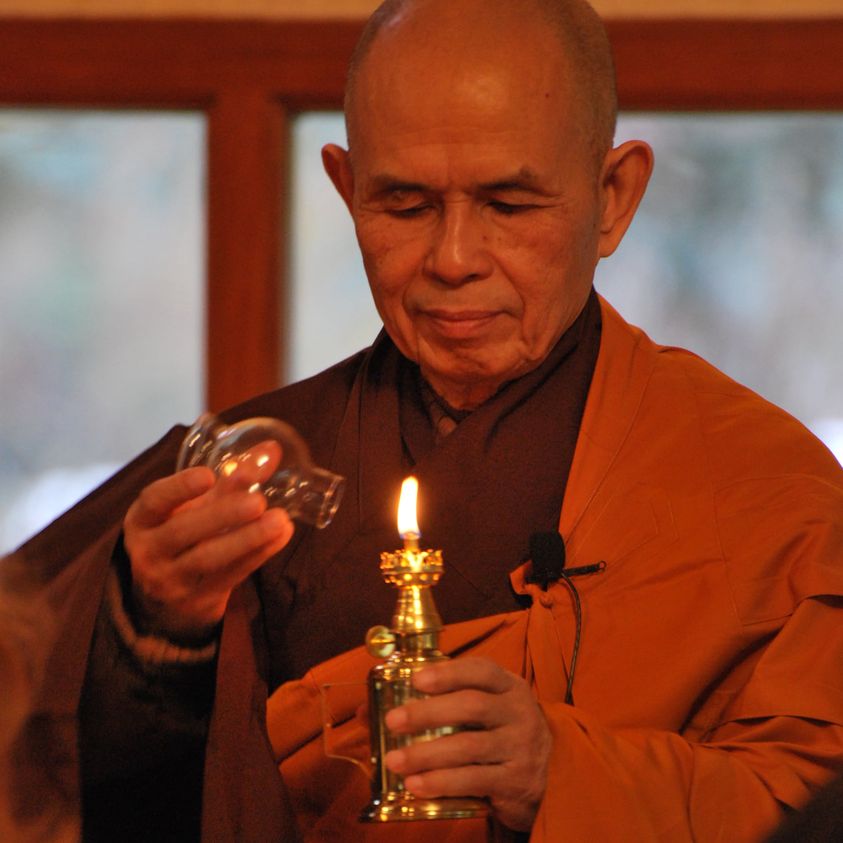
THICH NHAT HANH

Thich Nhat Hanh

1926-2022

Back in December, my wife and I sent an electronic holiday card to our family members and friends, wishing them “happiness, peace, and equanimity” in the year to come. Ever the realist, one of our friends replied, “I’ll settle for equanimity.” I suspect he was not alone.

Equanimity is a central term in the lexicon of Zen. A translation of the Sanskrit word upeksha, the word refers to a quality of mental balance and emotional stability. Not to be confused with a neutral passivity or cold indifference, equanimity might better be likened to what Hemingway called “grace under pressure”: the ability to remain calm and composed under the most trying of circumstances. Equanimity is also the faculty that enables us to take the long, even-tempered view and to remain unmoved by praise or blame, desire or aversion. Although this quality of heart and mind may be more evident in some people than in others, from the standpoint of Zen teachings, equanimity is not an ingrained trait, which some people possess and others do not. Rather, it is a capacity anyone can acquire and systematically cultivate through well-established practices.

The most fundamental of those practices is zazen, or seated meditation. Although Zen literature abounds in special instructions and nuanced techniques, zazen itself is a simple practice. In essence it consists of sitting still and paying close attention to one’s breath, body, and awareness. In this respect, Zen practitioners doing zazen resemble non-practitioners sitting quietly and enjoying their early-morning coffee, aware of their thoughts, bodies, and immediate environment.

Yet there are two crucial differences. Ideally at least, zazen is both a non-judgmental and a non-reactive practice. However pleasant or unpleasant our feelings, thoughts, and bodily sensations may be, we refrain from judging them. If the room where we are sitting is uncomfortably cold, we note that fact but refrain from passing judgment. And should an uncharitable thought cross our minds, we refrain from reacting with an inner rebuke or external action. Instead, we note our transitory thought and return to our awareness of breath and posture. By such means, zazen engenders an attitude of mindfulness and non-reactivity. Rather than judge or try to fix what we encounter, we closely observe its arising and passing.

In similar fashion, sitting still and taking the “backward step” heightens our sense of impermanence. All things change, no matter how permanent they seem. We may know this already, but when practicing zazen, that knowledge becomes concrete and unignorable. Whether what arises is an anxious thought or a disturbing image, a memory from childhood or the fragment of a song, it’s gone before we know it. The contents of our minds are in constant flux. By experiencing this directly, we are reminded time and again that even the most troubling circumstances in our lives are also subject to change. “Long live impermanence!” Zen master Thich Nhat Hanh used to say. Not only can awareness of impermanence bring relief from fear and obsessive thinking. Over time, it can also foster the qualities of dignity and equanimity, which we can carry into our daily lives.

For those who might prefer a more direct approach, there is also a practice known as “equanimity meditation,” in which the qualities of balance and peace become objects of contemplation. This practice begins with reflection on the benefits of equanimity. We are asked to consider the gift an equanimous state of mind can bestow on those with whom we come into contact. We may also reflect on its long-term benefits for ourselves. The meditation proceeds to an inner recitation of such sentences as “May I learn to see the arising and passing of all nature with balance and equanimity,” or “May I be balanced and at peace.” In some lineages, the exercise may conclude with a “transfer of merit,” in which we transfer to a person or persons of our choice whatever merit we may have accumulated by doing this practice. Though more abstract than the practices described above, this verbal exercise, repeated daily, can strengthen our sense of balance and emotional well-being.

In Zen teachings, upeksha (equanimity) is known as one of the Four Immeasurable Minds: the “boundless” states of mind that practitioners vow to cultivate. The other three are maitri (loving-kindness), karuna (compassion), and mudita (sympathetic joy). Equanimity is sometimes regarded as the most important of the four, if not their very foundation. Without equamimity, it can be difficult to practice loving-kindness or compassion or to feel joy in someone else’s happiness. For Thich Nhat Hanh, upkesha also means “inclusiveness” and “non-discrimination”: the capacity to absorb whatever vicissitudes we encounter and to treat all sentient beings with equal regard. All things considered, one could do worse than settle for equanimity.

________

Detailed instructions for equanimity meditation may be found in Jack Kornfield’s A Path with Heart (Random House, 1993). See also Thich Nhat Hanh’s discussion of upeksha and the Four Immeasurable Minds in The Heart of the Buddha’s Teaching (Harmony, 1999).

Read Full Post »

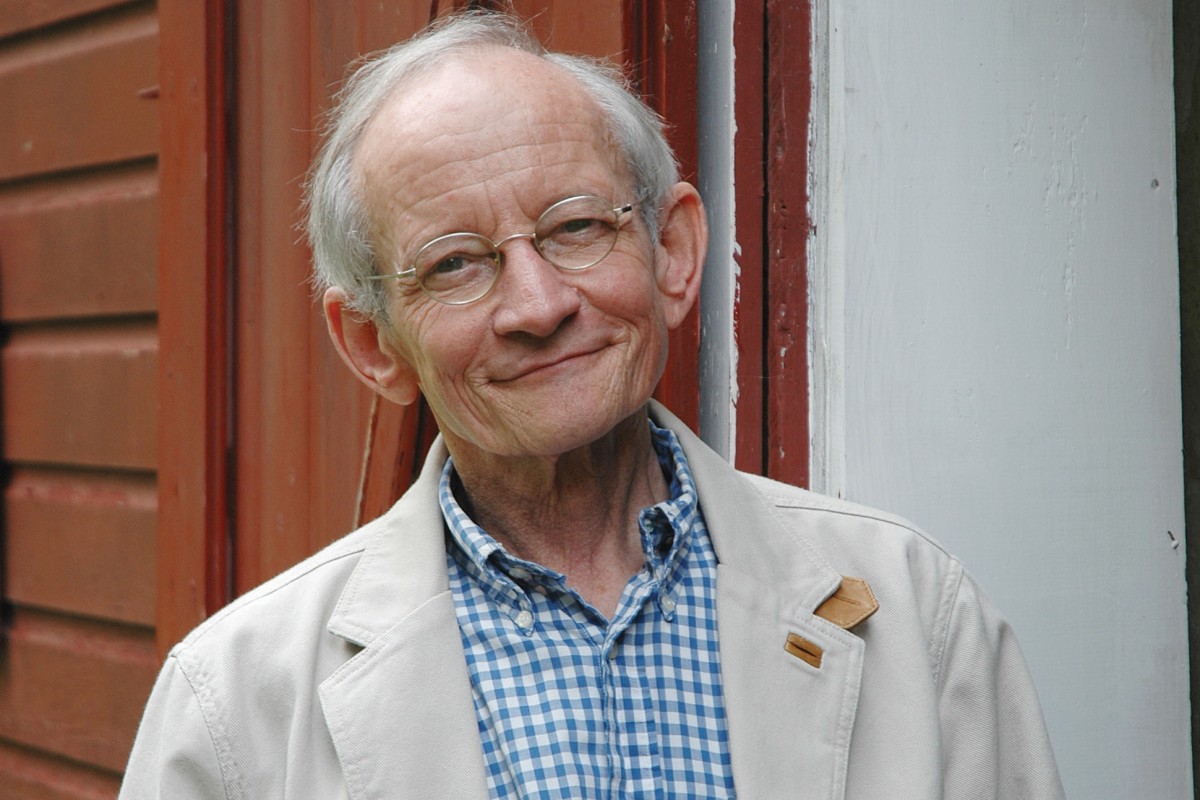
Ted Kooser

Ted Kooser

______

In Zen practice,” writes the Zen teacher Sobun Katherine Thanas, “we give attention to the details of our lives.” By paying close, sustained attention to the most ordinary details in our daily round, we train ourselves to abide in the present moment. Rather than sacrifice our present experience to a past that is already gone, a future that has not yet come, or abstract thoughts that may or may not reflect reality, we attend to the details of the matter at hand: the level of green tea in our measuring spoon, the temperature and volume of water to be added, the specific brewing time for that particular tea. By so doing, we fully engage in relative, historical time, even as we touch the timeless, absolute dimension of our experience.

No one understands this paradox more fully or articulates it with greater skill than the Midwestern poet Ted Kooser (b. 1939), who won the Pulitzer Prize for Poetry for his book Delights & Shadows in 2005 and served as US Poet Laureate from 2004-2006. Kooser is not a Zen practitioner, so far as I know, but by attending to the details of quotidian life, no matter how mundane, he returns the reader, time and again, to the immediacy of the present moment. And in their acute awareness of impermanence and interdependence, as revealed by such common or discarded objects as curtain rods, enameled pans, and Depression glass, his poems often embody the essence, if not the customary forms and rituals, of Zen practice.

A vivid example may be seen in the title poem of Kooser’s collection Splitting an Order (2014). In this gentle poem, set in a diner, the narrator observes an old man cutting his cold sandwich into two equal parts. It pleases the narrator to watch him

                                  keeping his shaky hands steady

by placing his forearms firm on the edge of the table

and using both hands, the left to hold the sandwich in place,

and the right to cut it surely, corner to corner,

observing his progress through glasses that moments before

he wiped with his napkin, and then to see him lift half

onto the extra plate that he asked the server to bring,

and then to wait, offering the plate to his wife

while she slowly unrolls her napkin and places her spoon,

her knife, and her fork in their proper places,

then smooths the starched white napkin over her knees

and meets his eyes and holds out both old hands to him.

A more ordinary situation it would be difficult to imagine: an elderly married couple having lunch in a diner. Yet Kooser endows this everyday situation with the glow of heightened attention, both on the part of the husband and wife and on that of the observant narrator.

The couple are splitting a plain roast-beef sandwich, perhaps to economize or because neither needs to eat a whole one. To accomplish this division, the husband must steady his shaky hands, a challenge he readily overcomes. By dividing the sandwich “surely” and diagonally, he ensures that the resulting portions will be exactly equal. Meanwhile, his wife carefully unrolls the napkin enclosing her knife, fork, and spoon. These, too, become objects of meticulous attention.

Even as the husband and wife are taking their time and paying attention to the details of their humble repast, the narrator is doing the same. His unswerving observation, recorded in a single complex but graceful sentence, not only mirrors that of his subjects toward the actions they are performing. It also establishes a tone of caring, even for common, unexceptional things, and implicitly bestows moral and aesthetic value on a scene that might otherwise have been dismissed as banal. The true significance of the scene becomes apparent in the poem’s closing lines, where the husband’s offering his wife her half of their sandwich completes his act of fairness, solicitude, and kindness. She in turn exhibits an attitude of openness and gratitude.

Shizen ichimi, an old Zen saying reminds us: “Poetry and Zen are one.” Although the former depends on fresh language, the latter on silent contemplation, both rely on wholehearted attention to concrete, particular detail. By stopping and looking deeply, both reveal the hidden dimension of human experience, the currents of interdependence and impermanence that underlie the most commonplace of human interactions. And, though they do so in very different ways, both, in the words of the poet Patrick Kavanagh, “snatch out of time the passionate transitory.”

_____________

Sobun Katherine Thanas, The Truth of This Life: Essays on Learning to Love This World (Shambhala, 2018), 69.

Ted Kooser, Splitting an Order (Copper Canyon, 2014), 9.

Patrick Kavanagh, “The Hospital,” Collected Poems (Norton, 1964), 153.

Photo: Ted Kooser

Read Full Post »

Older Posts »