Feeds:
Posts
Comments

Archive for the ‘1’ Category


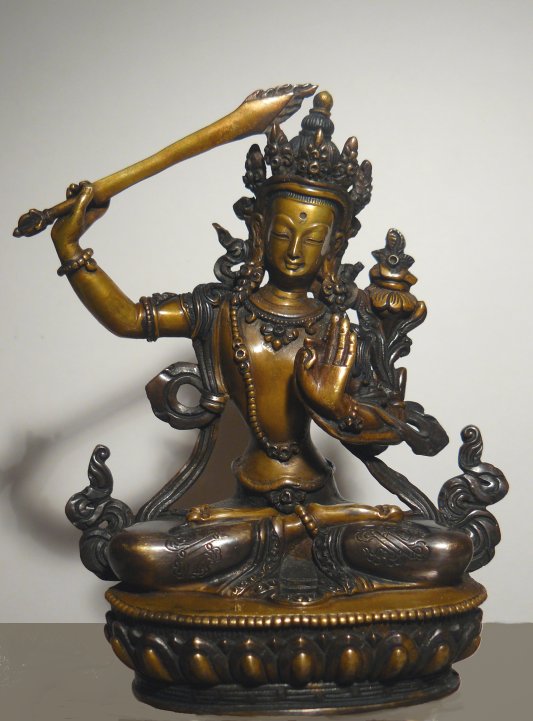
Manjusri

Manjusri

One afternoon many years ago, when my son and I were playing chess at our dining-room table, our conversation turned to a woman I’d recently met.

“She seems honest,” I cautiously observed.

“I would have said ‘straightforward,’ Dad,” Alexander replied, taking my rook with his knight. Although he was only thirteen at the time, he was even then a stickler for definitions.

As it happened, however, father and son were both close to the mark. The word straightforward is a relative newcomer to the English language. The first usage cited by the Oxford English Dictionary dates from 1806. Originally, the meaning of straightforward was primarily descriptive. The word meant “directly in front of or onwards; in direct order.” But by the end of the nineteenth century, straightforward had acquired a moral aura, as in the Rev. Griffith John’s characterization of one Mr. Wei as a “plain, honest, straightforward-looking man” (1875). If not quite synonyms, honest and straightforward had come to occupy the same moral universe. (more…)
Read Full Post »

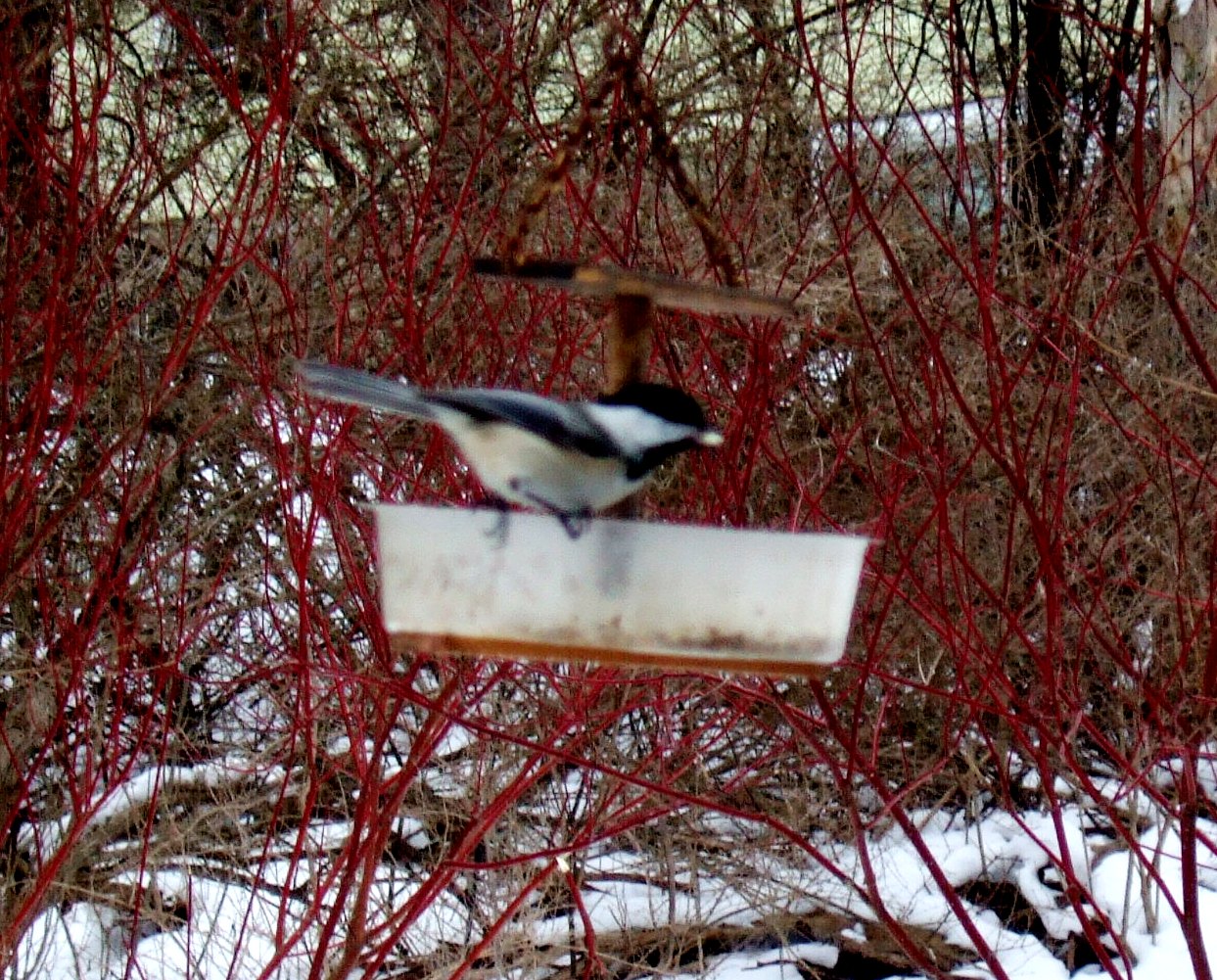
Chickadee feeder 2012-06-25 005One spring morning five years ago, as I was watching chickadees flit around our backyard feeder, it occurred to me that those nimble little birds might appreciate having a trapeze on which to perch. When my son was a child I built him a trapeze, and he enjoyed it. Perhaps the chickadees would as well.

Construction was simple. Rummaging in the garage, I found a remnant of 3/4” flat screen molding. From this I cut two six-inch pieces for the top and bottom bars. These I connected with a central, four-inch dowel. Using wire-cloth staples, I fastened two three-inch lengths of cuckoo-clock chain to the ends of the top bar, joining them at the middle with a handsome brass S-hook. My trapeze thus completed, I hung it from a branch of our pin oak tree. Ready for occupancy, it swung invitingly in the wind. (more…)

Read Full Post »

2012-03-11 002 2012-03-11 012Dr. Friederike Boissevain is a German oncologist and seasoned Zen practitioner. By her own admission, her meditative practice is imperfect—or “crooked,” as she describes it. Rather than remain focused and fully aware of the present moment, she finds herself wandering off into the “land of dreams and worries.” But, crooked though it be, her practice has supported her daily work with the sick and the dying. “The most important thing I ever did,” she reflects, “was to sit down once.” That act set “something in motion that cannot be stopped. This is not because of trust in something but because of experience. . . The snow of dharma covers everything, whether we see it or not.” (more…)

Read Full Post »

During the last few days of October, when Hurricane Sandy was threatening Western New York, state and local officials advised us as to the important documents we should take with us in the event of an evacuation: deeds, home-insurance policies, birth certificates, passports, and the like. In preparation, we should assemble those documents and place them in a waterproof envelope.

Sound advice, to be sure. But as I read that official list, I thought of a less than official item I would add to it: the file of documents I have kept for years under my father’s well-worn Bible. Contained in that file are notes, letters, and cards from friends and family, including letters from my deceased mother; birthday cards from my wife; holiday cards from my daughter-in-law; and a variety of notes from my son, some of them dating from his early childhood. Unlike the policies and passports, those documents are irreplaceable. And all were written by hand, which makes them all the more valuable.

That value, I might point out, is more than sentimental. It is historical and spiritual. The novelist Philip Hensher, author of The Missing Ink (Macmillan, 2012), has argued, with ample corroboration, that “we are at a moment when handwriting seems to be about to vanish from our lives,”* having been supplanted by the printed—and now the digital—word. If Hensher is right, we would do well to cherish whatever handwritten documents remain extant, irrespective of their author or content.  But even if we believe that handwriting, having survived for 5000 years, will always be with us, the act of writing by hand is worthy of renewed attention, if not of veneration. For in the handwritten word, it might be said, the authentic human self is concretely embodied. And the handwritten note or letter, however rough or polished, affords a depth of intimacy between writer and reader that print can only approximate. Little wonder that the world’s great spiritual traditions, Zen included, have accorded the handwritten word—or character—a place of honor, whether the handwritten text be the Torah, the Quran, the Heart Sutra, or the Book of Kells. (more…)

Read Full Post »

Chalmette National Cemetery, USCT Tree

One evening last week, as I was reading Khaled Hosseini’s novel The Kite Runner, I paused at the end of a paragraph. That paragraph, I realized, had just given me exceptional pleasure. An aesthetic pleasure, to be sure, but no less keen for that.

Here is the paragraph, which depicts a winter morning in Kabul:

Here is what I do on the first day of snowfall every year: I step out of the house early in the morning, still in my pajamas, hugging my arms against the chill. I find the driveway, my father’s car, the walls, the trees, the rooftops, and the hills buried under a foot of snow. I smile. The sky is seamless and blue, the snow so white my eyes burn. I shovel a handful of the fresh snow into my mouth, listen to the muffled stillness broken only by the cawing of crows. I walk down the front steps, barefoot, and call for Hassan to come out and see.*

There are many reasons why a reader might relish this paragraph. My own enjoyment stemmed, in a general way, from the clarity, directness, and freshness of Hosseini’s prose. More specifically, it derived from Hosseini’s sensuous, evocative imagery, his deft handling of cadence, and his construction of an intimate narrative voice: that of a grown man tenderly recalling his childhood. Experiencing all those qualities and more, I experienced the complex pleasure they provided.

Yet, had I not paused, I might never have realized what I was experiencing. Almost certainly, I was thinking as I read, but thinking is not the same as realizing the experience one is having, an experience that includes but is not limited to thought. Understandably, much of our educational effort focuses on teaching students how to think, critically and conceptually. Far more rare, however, is systematic training in how to realize what one is experiencing. And toward that end, meditative practice can play an important, complementary role, not only in education but also in our everyday lives. (more…)

Read Full Post »

“Where did this bread come from?” asked a guest at our dinner table. “It’s delicious.” To that question, there is a very short answer. But there is also a longer answer that goes to the heart of Buddhist meditative practice.

The short answer is that the Deli-Style Rye we were enjoying came from Sisters Kneading Dough, a home bakery in Almond, New York. Every Friday afternoon, the sisters Beth and Jayne arrive at Quest Farm with their trays of bread and muffins, still warm from the oven. On that particular Friday, my wife, Robin, and I also arrived, and we came home with the Deli-Style Rye, along with a loaf of Robin’s favorite, Cinnamon Swirl. That, in short, is where the bread on our table came from.

The longer answer is that the bread came from sources too numerous to mention. Deli-Style Rye is made from organic bread flour (wheat and barley), whole wheat flour, water, whole rye flour, caraway seeds, honey, yeast, and canola oil. And each of these ingredients has a history of its own. Without the work of the bees and their keepers, there would have been no honey. Without sunlight, water, earth, and the labors of the farmers, distributors, truckers, and the rest, there would have been no flour, yeast, or canola oil. Without our driving to Quest Farm on a Friday afternoon, the Deli-style Rye would never have reached our home. Like anything else that we might conventionally regard as a single thing, the bread on our table was an aggregate of countless, interconnected things, without which it could not have come into being. And as its quick disappearance demonstrated, it was not really a solid object but a transitory node in the web of life, an event in a never-ending process. (more…)

Read Full Post »

In Philip Larkin’s celebrated poem “Church Going,” a secular Englishman, out for a ride on his bicycle, stops at a local parish church. After making sure that “there’s nothing going on,” he steps inside, casting a cool but observant eye on what he encounters:

             Another church: matting, seats, and stone,

            And little books; sprawlings of flowers, cut

            For Sunday, brownish now; some brass and stuff

            Up at the holy end; the small neat organ;

            And a tense, musty, unignorable silence,

            Brewed God knows how long. Hatless, I take off

            My cycle-clips in awkward reverence . . . [1]

As can be seen from these perceptions, Larkin’s narrator is ill at ease in his surroundings. They are musty and make him tense. Yet, as he will inform us later on, he was drawn to this “cross of ground” and its “unignorable” silence. And though he summons an ironic phrase (“up at the holy end”) to bolster his resistance, he attempts a gesture of respect. (more…)

Read Full Post »

110. Just say “Oh”

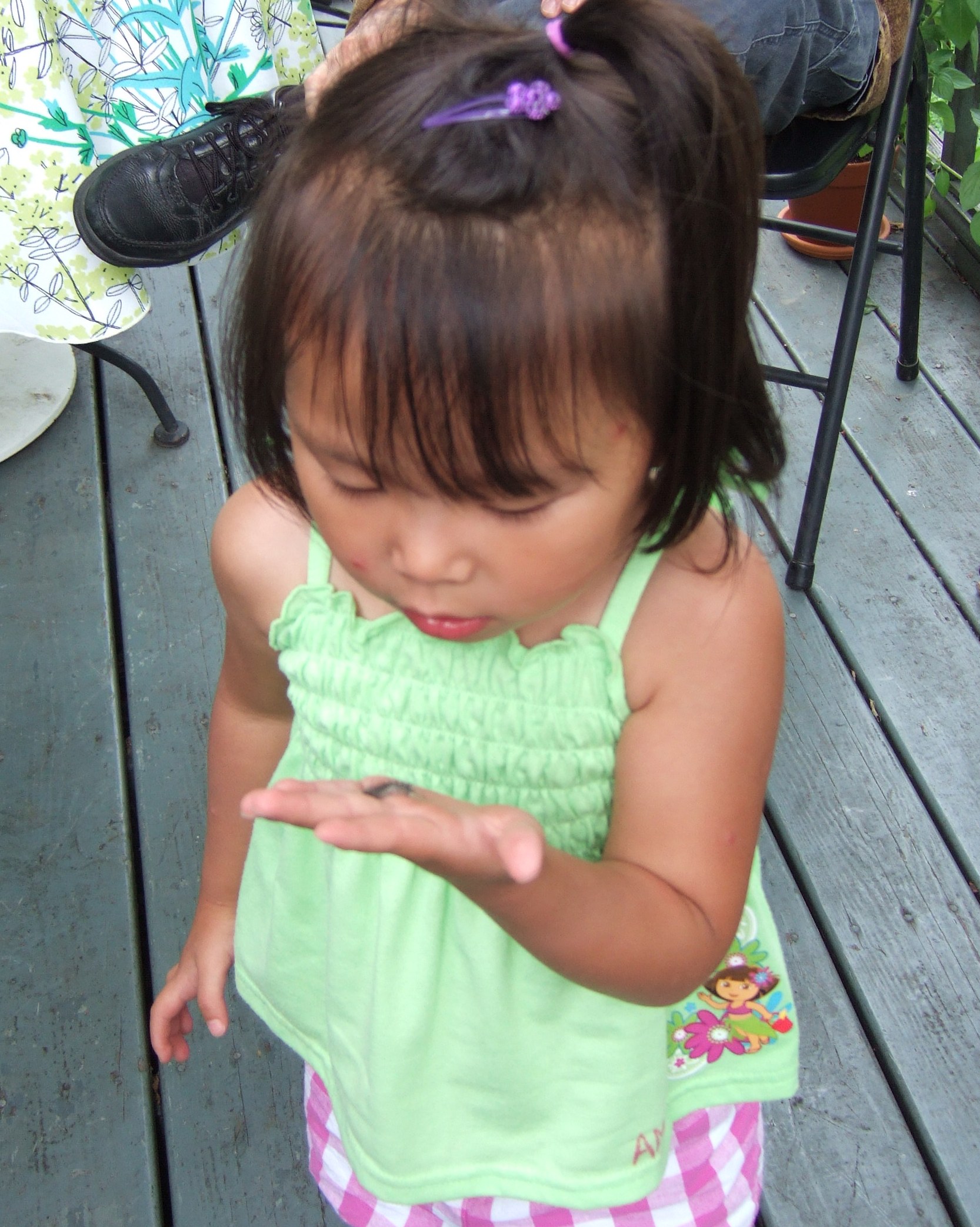
One evening last month, I took my young friend Isabel on a walk past our flower garden. Isabel is three years old. As we walked along, I named the flowers she was seeing: Wisteria. Coleus.  Viola.  Geranium. Isabel stooped to inspect the geranium, whose bright red petals had caught her eye.

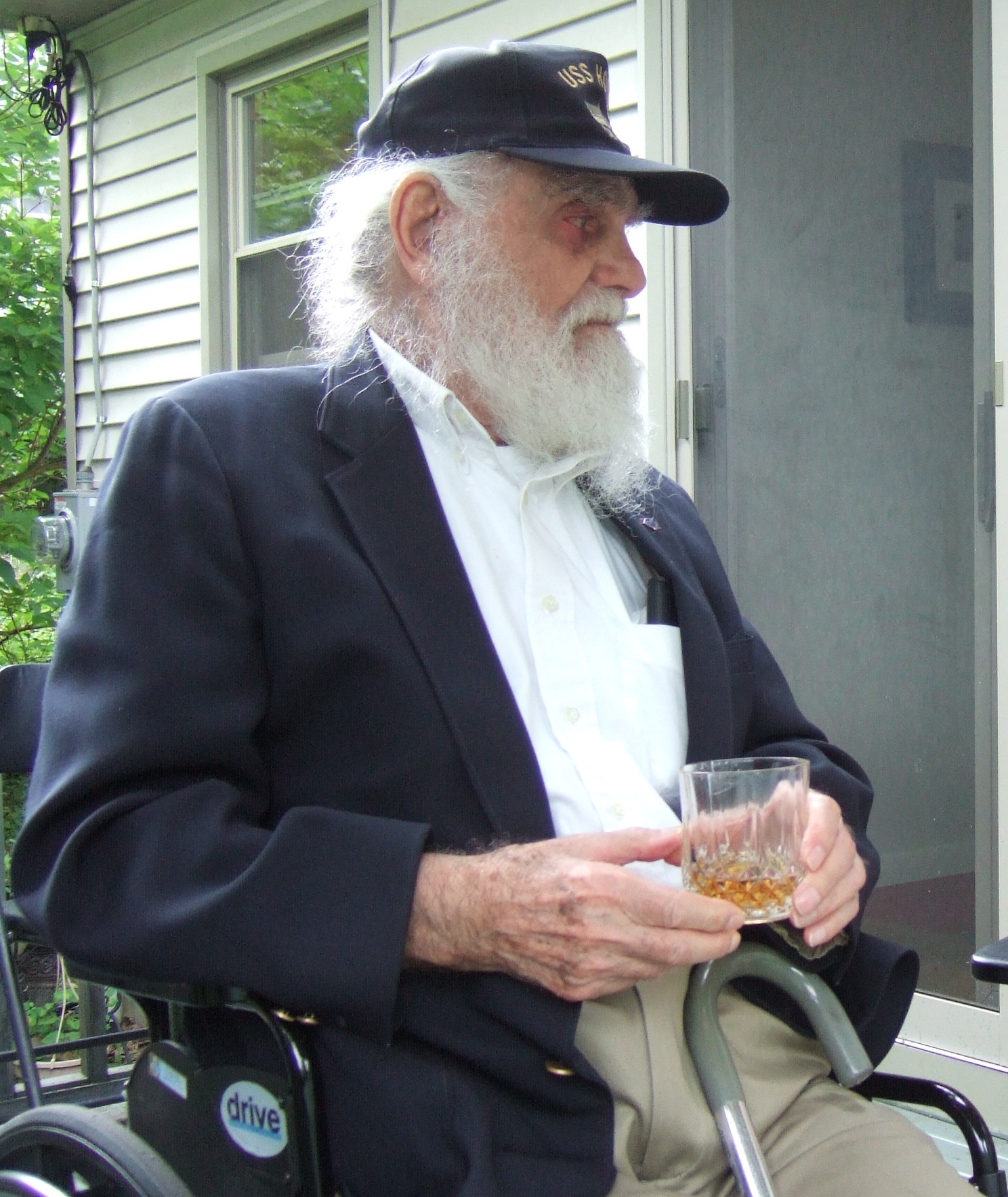
Not long afterward, Isabel and I arrived at our deck, where my father-in-law, Saul, was relaxing in his wheelchair. An 89-year-old veteran of World War Two, Saul wears a full white beard, and he is seldom seen without his blue, U.S.S. Hornet cap. “Isabel,” said my wife, Robin, “This is my dad, Mr. Caster.”

Isabel looked up at Saul quizzically, as though he might be another, somewhat larger flower. “Why are you in a wheelchair?” she asked.

“Because I only have one leg,” Saul replied.

“Oh,” said Isabel, taking a moment to absorb that information. “Very nice to meet you,” she said, extending her hand.

Isabel soon dashed off to play with a friend, but her response left a lasting impression, not least because it was so unfiltered. It evinced a capacity to meet the external world, including its unfamiliar and potentially disturbing aspects, with openness, curiosity, and an absence of comment. (more…)

Read Full Post »

Thich Nhat Hanh, 2006

In a recent talk in Dublin, the Venerable Thich Nhat Hanh spoke of the happiness available to us in our everyday lives. We have only to “release our idea of happiness,” he advised, and return to the present moment, where the conditions for happiness are already to be found.*

Thich Nhat Hanh is not alone in offering this advice, nor is he unique in viewing ideas of happiness as obstacles to the experience itself. In his book Beyond Happiness, the Zen teacher Ezra Bayda deconstructs what he calls the “myth of happiness,” which holds that “we deserve to be happy, as if it’s our birthright; that we will be happy if we get what we want; that we can’t be happy if we’re in discomfort.” For Bayda, as for Thich Nhat Hanh, our common human error lies in chasing an image of future happiness. Once we have shed that illusion, we can return “again and again to staying present with exactly what we are experiencing right now.” Rather than try to manipulate our own or others’ lives, we can “surrender to what is.”** (more…)

Read Full Post »

Toward the end of the February 22 Republican primary debate, John King asked the candidates to define themselves in a single word. “Consistent,” replied Representative Ron Paul. In the ensuing commentaries, Dr. Paul’s response met with wide approval, even by those not partial to his views. “I’ll give him that,” Jon Stewart wryly remarked.

Ron Paul’s response stood out from the others, not only because it came across as honest and accurate but also because it pointed toward his history rather than his temperament. Where the others laid claim to laudable traits of character—courage, resolution, cheerfulness—Ron Paul alluded to his public record. By so doing, he appealed to conventional wisdom, which holds that a candidate may best be judged by what he or she has said and done. “Ask me,” wrote the American poet William Stafford, “if what I have done is my life.” Under most circumstances, the answer would probably be yes. And should the next question be, “Who am I?” the standard of judgment might well be the same. The self exists in time, and a person may best be judged by examining his or her background, actions, and abiding traits of character. By such means we hire an employee or choose a doctor or pick a president. (more…)

Read Full Post »

« Newer Posts - Older Posts »