Feeds:
Posts
Comments

Archive for the ‘1’ Category

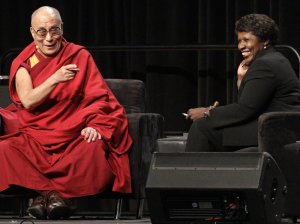
gwen-ifill-the-dalai-lama“My job as a reporter,” the late Gwen Ifill once remarked, “is not to know what I think.” Humble in spirit but incisive in content, that remark calls to mind two essential stories from the Zen tradition.

In the first, a learned university professor pays a visit to Nan-in, a renowned Zen master of the Meiji period (1868-1912), with the intention of learning more about Zen. The two men meet for tea.

Eager to impress his host, the professor holds forth at great length, demonstrating his extensive knowledge of Buddhism and expounding his personal views. Meanwhile, Nan-in pours tea into the professor’s cup. When he has filled it to the brim, he continues to pour, spilling tea all over the table.

For a time the professor ignores this distraction, but when he can bear it no longer, he exclaims, “The cup is overfull! No more will go in!”

“Like this cup,” Nan-in replies, “you are full of your opinions and speculations. How can I show you Zen unless you first empty your cup?” (more…)

Read Full Post »

Shohaku Okumura

Shohaku Okumura

“I live in America as a foreigner and need a great deal of patience,” writes Shohaku Okumura Roshi, a respected Zen scholar, priest, and teacher who lives in Bloomington, Indiana. In the United States, he explains, “the spiritual and cultural backgrounds are very different from Japan.” And actually, he adds, “any two people who live and work together will sometimes have conflicts and need to practice patience.”

Like other spiritual traditions, Zen Buddhism accords the mental factor of patience a place of honor in its hierarchy of values. By cultivating and exercising patience, we forestall unnecessary suffering. By developing patience as a quality of heart and mind, we avoid causing harm to others and ourselves. With that end in view, Zen teachings offer a wealth of insights and practices, which those willing to make the effort can incorporate into their everyday lives. Four of the most helpful might be summarized as follows. (more…)

Read Full Post »

25-10-16-adelchurch3aThe wisdom of the ages, some would contend, is lost on the young. Looking back on my own youthful follies, I’m inclined to agree. But if my thoughts and actions at the age of twenty sometimes lacked the component of wisdom, that lack cannot be blamed on my formal education. On the contrary, I was a student of English literature. I had read my Chaucer, Shakespeare and Milton.  And as it happened, on many a morning I was reminded of ancient wisdom in general and the brevity of life in particular. (more…)

Read Full Post »

sk3Although you may not be aware of it, September is National Mold Awareness Month. It is also National Pain, Campus Safety, Child Obesity, Lice, and Menopause Awareness Month. That is a lot to be aware of, and the designated objects vary widely. Common to all these constructs, however, is the term awareness and the assumption that we are agreed on what it means.

In ordinary usage awareness refers to a mental faculty compounded of thought, experience, knowledge, and attention. It is sometimes spoken of in vertical metaphors, as when others purport to “raise” our awareness. It may also be framed in horizontal figures, as when we are admonished to “broaden” our awareness, or in quantitative tropes, as when we attempt to “increase” our awareness of this or that. But whatever metaphors might be at work, the common view of awareness is that of a tool which the sovereign ego, the owner and operator of an autonomous self, can direct or otherwise control. And though awareness, in this view, may comprise functions other than thinking, it is essentially an extension of thinking, which the governing mind can train wherever it sees fit. In September we should turn our awareness to mold, pain, campus safety, childhood obesity, lice, and menopause. Having gathered information about those important subjects, we can then digest that information and take whatever action we deem appropriate. (more…)

Read Full Post »

Hand on BibleIf you have ever testified in a court of law, you have sworn an oath to tell the truth, the whole truth, and nothing but the truth. And as you may have discovered, that is a tall order. Even if we are trying our best to be honest, our best intentions may be at odds with imperfect memory, the slipperiness of language, and the inherent complexity of human affairs. “The whole truth,” if it exists at all, may be well beyond our comprehension or powers of expression.

In practicing Zen meditation, we also seek the whole truth, though our means are not primarily verbal. Rather than talk, we endeavor to realize ultimate truth through a variety of practices, one of the most essential being that of conscious breathing. Coming home to our breath, time and again, we embody the truth of our lives in general and three kinds of truth in particular. (more…)

Read Full Post »

177. Fear and belief

A_frightened_and_an_angry_face,_left_and_right_respectively._Wellcome_V0009326

“Nine out of ten people I talk with about retirement,” our family accountant remarked not long ago, “are afraid they will run out of money.” Most of his clients, he went on to explain, have sufficient resources to enjoy a secure if not affluent retirement, but that doesn’t keep them from believing otherwise or fearing future hardship.

The entangled relationship of fear and belief was one of the themes of a retreat I recently conducted at the Olean Meditation Center in Olean, New York. Around thirty people attended this retreat, whose aim was to explore how mindfulness might help us recognize, accept, and release our everyday fears. In this three-hour period we did not purport to address traumas or their aftermaths. That is the job of a qualified therapist. Nor were we attempting, in one Saturday morning, to allay such profound apprehensions as the fear of death. Rather, we had convened to examine whether, in the words of the Zen teacher Zenkei Blanche Hartman, we might “turn toward our fears with warmth and compassion”. (more…)

Read Full Post »

Comparações_planetárias“Have you been comparing?” ask Rodgers and Hart in their 1932 ballad “You Are Too Beautiful.” I suspect that most of us, if we are being honest and sufficiently self-aware, would have to answer in the affirmative.

“Comparison,” observed Mark Twain, whose vein of dark wisdom ran as deep as his humor, “is the death of joy.” Yet on we go, comparing whatever is at hand, be it brands of dental floss or newly listed homes or presidential candidates. A product of our education and social conditioning, the mental habit of comparison is as ingrained as it is necessary for survival. Regrettably, however, if left unexamined that habit can also rob us of happiness and hinder us from appreciating our present lives. (more…)

Read Full Post »

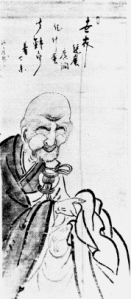
Ummon Bun'en Drawing by Hakuin Ekaku

Ummon Bun’en
Drawing by Hakuin Ekaku

Among the cryptic sayings associated with the Zen tradition, none is better known than that of Ummon Bun’en (862-949), who famously declared that “every day is a good day.” Yeah, right, the weary, seasoned mind replies. Tell that to the commuter caught in gridlock or the stressed-out parent nursing a sick child. Superficially construed, Ummon’s remark sounds both naive and culpably aloof.

Yet, if examined in the light of Zen teachings, this adage is neither foolish nor untrue. The key component of Case 6 of the Blue Cliff Record, a classic collection of Zen koans, Ummon’s pronouncement is a fiction that points to an underlying reality, a construct that discloses a deeper truth. If we wish to probe that truth, we can consult the host of commentaries Case 6 has accrued, beginning with that of Hakuin Ekaku (1686-1768), compiler of Zen koans, who called this particular koan “cold,” meaning austere and challenging to contemplate. But if we wish to explore Ummon’s saying in a warmer light, we can begin by reflecting on how we know, or think we know, the things of this world, and how we determine whether a given day is good or bad. (more…)

Read Full Post »

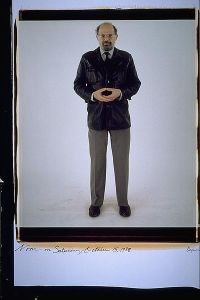
Allen Ginsberg

Allen Ginsberg, 1988

When the student is ready, the teacher will appear. So goes the Zen proverb, and for many it may be true. In my case, however, I was neither ready nor expectant. And my first guide on the path of meditation was an unlikely candidate for the position.

Allen Ginsberg visited Alfred University in October 1978.  It was a relatively tranquil time, especially when contrasted with our present era. A few weeks earlier, the Camp David Accords had been signed under the watchful eye of President Jimmy Carter. In Western New York the fall colors were at their peak. (more…)

Read Full Post »

800px-Norman_Fischer_3

Zoketsu Norman Fischer

“Why do we like being Irish?” asks the Irish poet Louis MacNeice (1907-1963) in his poem Autumn Journal (1939). In subsequent lines, he answers his own question:

Partly because

      It gives us a hold on the sentimental English

As members of a world that never was,

      Baptized with fairy water;

And partly because Ireland is small enough

     To be still thought of with a family feeling,

And because the waves are rough

     That split her from a more commercial culture;

And because one feels that here at least one can

     Do local work which is not at the world’s mercy

And that on this tiny stage with luck a man

     Might see the end of one particular action.

Because Ireland is a relatively small country, and because in MacNeice’s time families tended to stay put for as long as economic conditions allowed, Irish people could reasonably hope to see the “end”–the consequences as well as the completion–of any particular action. (more…)

Read Full Post »

« Newer Posts - Older Posts »