Feeds:
Posts
Comments

A place of peace

Gallurus OratoryEarly one morning not long ago, I found myself driving down NY Rte. 21 with no other car in sight. Lifting my hands from the steering wheel, I allowed my Camry to steer itself. Within seconds, it crept toward the center line, like a hungry cat stalking a chickadee. I repeated this experiment twice, and each time it yielded the same result. After 34,000 miles, I concluded, it may be time for an alignment.

As with our motor vehicles, so with our bodies and minds. We, too, can benefit from frequent—if not daily—realignment. Many activities and practices can serve this purpose, including Hatha yoga, the martial arts, Tai Chi, Qigong, dance, equestrian training, walking, singing in a choir, and, not least, Buddhist meditation. All promote physical, emotional, and mental alignment. And, insofar as they become daily practices, they can also foster the quality of enhanced alignment in active, everyday lives.

Within the wide spectrum of Buddhist meditative traditions, Zen is unique in placing zazen, or seated meditation, at the center of the practice. Over time, zazen fosters stability of mind, clear seeing, and deep insight into the nature of reality. No less important, it can also engender alignment with natural forces and external conditions; greater concordance between our perceptions and things as they are; and consistency between our thoughts, words, and deeds and our deepest moral values.

There are several ways of aligning the body while practicing sitting meditation, the traditional, cross-legged posture being the most familiar. For many Westerners, the most comfortable and salutary way is to sit toward the front of an armless chair, feet flat on the floor, hands resting in the lap. Contrary to common belief, it is not advisable to emulate a flagpole. Rather, the spine can be allowed to assume its native, upright curvature. Placing a wedge-shaped cushion under the buttocks can further support this aligned but natural posture.

Yamada Mumon Roshi (1900-1988) has likened the posture of zazen to a five-story pagoda. A Western equivalent might be the corbeled structures widely employed in Ireland since medieval times. In a corbeled building, the constituent stones, cut and fitted for the purpose, rest one on top of the other. Gravity supports this aligned structure; mortar is not required. The Gallarus Oratory on the Dingle Peninsula, built sometime between the eighth and twelfth centuries, is a celebrated example of this kind of structure. Resembling an upturned boat, this virtually mortarless chapel has survived centuries of harsh weather and multiple invasions, largely by virtue of its natural alignment.

Physical alignment, once firmly established, creates a foundation for its attitudinal counterpart, namely alignment of the mind with existing conditions. Beyond the force of gravity, those conditions might include the temperature of the room, the kind and degree of ambient light, the time of day or night. “When hot, be hot; when cold, be cold,” an old Zen saying, epitomizes this aspect of the practice. It also identifies an abiding challenge. Resistance to adverse conditions is as natural as breathing. When practicing zazen, however, our resistance itself becomes an object of contemplation. When we are cold, we know we are cold, and we know we don’t like it. Counterintuitively, this dual acknowledgment brings us gradually into alignment with whatever may arise, be it heat or cold or a sharp pain in a knee or shoulder.

This practice of attitudinal alignment can continue even after we leave our chairs or cushions and reenter everyday life. There we are more than likely to encounter frustrating conditions and difficult situations, ranging from a jar we can’t open to a difficult conversation we might rather have avoided. For the willing practitioner, however, such situations offer opportunities for a more subtle practice of alignment, by which I mean the alignment of our thoughts, words, and actions with our most cherished values. Often, these lie far apart. We profess to honor one way of being, but we habitually exemplify another. But, just as the qualities of physical and mental alignment can be cultivated during zazen, so the alignment of our values with our words and deeds can become a goal in our daily lives. And over time, with diligence and sincere intention, the two can be reconciled and brought into accord.

In the Japanese Zen tradition, the process of coming into alignment is known as “settling.” Its aim is a “settled mind.” Should this occur, the result can be as humbling as it is heartening. In a recent poem, I commemorate the experience:

ORATORY

As though its frame were built of corbeled stone,

This oratory made of flesh and bone

No longer needs to practice sitting still

Or hold itself erect by an act of will.

Felicitous, this finding of a place

Of lasting stability, this state of grace.

As these lines suggest, arriving at a state of alignment can feel like coming home, not only to oneself but also to a place of lasting peace. Reason enough, I would have thought, to make room for meditation in one’s daily round.


Yamada Mumon Roshi, Hakuin’s Song of Zazen (Shambhala, 2024), 182-3

Photo: The Gallarus Oratory, Dingle Peninsula, County Kerry, Ireland

Mirrors and windows

STORM WINDOWS IMAGE

If you are of a certain age, you may remember storm windows. Not the aluminum or vinyl variety, which came along later, but heavy wooden storm windows. Every fall my father, in the company of other homeowners, spent the better part of a Saturday putting up our clunky wooden storm windows. Every spring, he took them down. When I grew old and strong enough, he allowed me to help him.

In his poem “Storm Windows,” the American poet Howard Nemerov (1920-1991) recalls a rainy autumn day when he was walking down the sidewalk and caught sight of storm windows lying in a yard:

            People are putting up storm windows now,

            Or were, this morning, until a heavy rain

            Drove them inside. So, coming home at noon,

            I saw storm windows lying on the ground,

            Frame-full of rain . . .

Taking a closer look, Nemerov notes “the crushed grass” visible through the water and the windowpane.  Appearing to “stream away in lines,” the flattened grass resembles “seaweed on the tide” or “blades of wheat leaning under the wind.”

  At this point, the poem takes an unexpected turn. Until now a literal description enhanced by visual similes, it becomes a vehicle for introspection:

            The ripple and splash of rain on the blurred glass

            Seemed that it briefly said, as I walked by,

            Something I should have liked to say to you,

            Something . . .

Employing an ellipsis to mimic a pause in his thought, Nemerov depicts a mind venturing inward—or, as the 13th-century Zen master Eihei Dogen put it, “turning the light inward.” And what that light illuminates is not only thoughts in the process of articulation but also unrealized feelings, brought to the surface by the sight of “dry grass bent under the pane / Brimful of bouncing water.” Seen through the rippling, splashing water and the water-blurred glass, the trapped grass becomes the visible counterpart—what T.S. Eliot called an “objective correlative”—of the poet’s inchoate thoughts and yet-to-be-spoken feelings. And in their convergence, the water, glass, and grass reflect “this lonely afternoon of memories / And missed desires,” even as “the wintry rain / Runs on the standing windows and away.” The physical drama being enacted before him, in other words, becomes a mirror of Nemerov’s heart and mind. It reflects not only the rising, duration, and passing of impermanent mental phenomena but a more enduring emotional state: a prevailing loneliness infused with regret, presumably over something left unsaid and a road not taken.

“Storm Windows” appeared in Nemerov’s 1958 collection of poems, Mirrors and Windows. And here as elsewhere in his collection, the relationship of the perceived external world and the perceiver’s inner life is depicted as fluid and reciprocal. Just as the outer world reflects the mind, so the mind mirrors the external world. In “A Clock with No Hands,” for example, the narrator encounters a clock with Roman numerals and no hands. Rather than treat the clock as a prompt for inner reflection, Nemerov continues to examine it objectively, as might a scientist or physician, noting in his closing lines that behind that vandalized face, the clock’s mechanism “hides in its coiled continuing / A venomous tense past tense.”

To portray the world as a mirror of the human mind, or vice versa, is nothing new. In literary theory the former is known as the “pathetic fallacy”; the latter can be traced to the earliest Buddhist sutras, where the enlightened mind is likened to a limpid pool of water. In alignment with that tradition, the 18th-century Rinzai master Torei Enji, after years of study, concluded that the Japanese word kami, which means “god,” derived from a root meaning “mirror.” Elaborating on Torei’s conclusion, Yamada Mumon Roshi, a 20th-century master, offers this observation:

Before a mirror, rich and poor, powerful and insignificant, men and women, old and young are all perfectly equal . . .  A mind that is pure and undefiled, free of contrivances of any kind, impartial and selfless as a mirror—that is the meaning of kami.*

 Concentrated, calmed, and refined by years of zazen, this god-like, mirror-like mind reflects the world as it is, without the ego’s interference or habitual distortions. Like an unruffled lake, it shows us the true nature of the things of this world, including our inner worlds of memory and desire, even as it reveals the nature of awareness itself. When this revelation occurs, as Thich Nhat Hanh liked to say, an orange becomes an orange. The ordinary objects in our everyday lives become real and fully present, and so do we. 


Howard Nemerov was Poet Laureate of the United States from 1988-1990. To listen to his reading of “Storm Windows,” and to read the full text of the poem, visit www.poetryfoundation.org/poems/42695/storm-windows.

* Yamada Mumon Roshi, Hakuin’s Song of Zazen, translated by Norman Waddell (Shambhala, 2024), 63.

Finding fault

Mary_Oliver

“Do not find fault with the present moment,” advised the thirteenth-century Zen master Keizan Jokin.

That is “a mild-looking koan, huge in its ask,” notes Susan Murphy, a contemporary Australian Zen teacher and the author of A Fire Runs through All Things: Zen Koans for Facing the Climate Crisis (Shambhala, 2023). And, as anyone who follows the daily news can readily confirm, the climate crisis is but one of the adverse social, political, and natural conditions threatening life as we know it. Given those threats to our well-being and that of our descendants, Keizan’s pronouncement might seem both hopelessly out of date and culpably out of touch. Casting a cold eye on the corrupt society of his day, the first-century Roman poet Juvenal concluded that he had no choice but to write satire, the most moralistic and fault-finding of literary genres. Analogously, how can we look objectively at our present-day realities and not find fault? What other choice do we have?

One answer may be found in the poems of the American poet Mary Oliver (1935-2019), a so-called “nature poet” who was as aware as anyone of both the climate crisis and the “red-in-tooth-and-claw” dimension of nature itself. Despite this encompassing awareness—or perhaps because of it—her poems are notably free of fault-finding and abundantly rich in thoughtful exultation. An environmental realist and climate activist, Oliver was also a Christian contemplative in the lineage of the poet-priests Thomas Traherne and Gerard Manley Hopkins. Rather than disparage the fallen world, she employed her literary skills in the service of gratitude, praise, and celebration. The result was a body of work distinguished as much by its tone of reverent awareness as by its formal and spiritual freedom.

In “At the Pond,” a short narrative poem collected in her book Evidence (Beacon, 2009), Oliver recounts her daily visits to the edge of a nearby pond, where every morning she encountered a “huddle” of newly hatched geese, together with their parents. Not yet wary of human contact, the goslings “clambered up the marshy slope / and over [her] body, // peeping and staring.” Meanwhile, the grown geese looked on, “for whatever reason, // serenely.”

Acknowledging that nature “has many mysteries,” the narrator fast-forwards from the summer to the fall, by which time five of the goslings have grown “heavy of chest and / bold of wing.” Unfortunately, the sixth has fallen behind developmentally. Its undeveloped wings resemble “gauze.” Reflecting on this consequential aberration and her response to it, the narrator draws this generalized conclusion:

And this is what I think

                       everything is about:

                                   the way

                                              I was glad


            for those five and two

                       that flew away,

                                   and the way I hold in my heart the wingless one

                                              that had to stay.

As Oliver tells this compelling tale, in which she is both interested observer and wholehearted participant, her tone is one of active acceptance. She takes each of the pivotal events of her story on its own terms. In the summer, the wild goslings clambered tenderly over her receptive body. In the fall, however, a fateful convergence of stunted development and instinctual migration left the “wingless one” vulnerable and abandoned. Intuiting the likely outcome of this convergence, the narrator bows, as it were, to things as they are.

In similar fashion, the narrator acknowledges and accepts her complex emotional response. W. H. Auden famously defined poetry as the “clear expression of mixed feelings.” In this instance, Oliver’s feelings include sweetness and bitterness, joy and melancholy, gladness and sadness.  All, in their turn, are clearly articulated and forcefully expressed. And though her feelings are both mixed and conflicting, they are held within a matrix of stability and balance.

Beyond her personal feelings, Oliver also acknowledges the universal laws—what nineteenth-century natural philosophers called the “course of nature”—to which she refers in the poem’s closing lines. Both the events she records and her emotional responses are viewed as the natural manifestations of impersonal causes and conditions, over which she has virtually no control. Rather than moralize this understanding, she embodies it in the most expansive line of the poem, as if the narrator were fully exhaling. And, one line later, she completes a triple rhyme (way / away / stay) on a “high” vowel (“a”), reinforcing both the muted lyricism of the poem and its mood of bittersweet revelation.

Within this vision of the human and natural worlds and their intersection, there is little room for finding fault. Things happen as they happen and are as they are. As a result, what we as readers experience is the quiet drama of a contemplative, non-judgmental mind encountering the natural world at close quarters and endeavoring to embrace its pleasant and not-so-pleasant realities in equal measure. Whether any one of us, day after day, can follow Oliver’s example and respond to the present moment with equanimity—and without finding fault—remains an open question. It is, in truth, an ongoing challenge of meditative practice.

_______

Susan Murphy, A Fire Runs through All Things : Zen Koans for Facing the Climate Crisis (Shambhala, 2023), 142

Photo: Mary Oliver


Rhyme and relatedness

Mahon

“Rhyme distracts the conscious mind,” the poet Marvin Bell (1937-2020) once remarked. Speaking from the vantage point of a working writer, he was noting that during the process of composition, the imperative to find a rhyme jolts the writer out of logical, linear thinking and into another, more open state of mind. In this alternative mode of cognition and creation, sometimes described as “lateral thinking,” hidden connections between the things of this world, as represented by rhyming but seemingly unrelated words, are brought into conscious awareness and fully realized. Rhyming fear with dire, for example, reveals a real-world relationship as well as an acoustic connection. When a situation is dire, we are more than likely to feel fear.

Rhymes please the ear. They may also serve as mnemonic devices, as in the case of “Thirty days hath September . . .” And in mature poetry, the many varieties of rhyme—full rhyme, off rhyme, slant rhyme, internal rhyme, etc.—can serve, at once, as structural components and integral elements of meaning:

Your ashes will not stir, even on this high ground,

However the wind tugs, the headstones shake.

This plot is consecrated, for your sake,

To what lies in the future tense. You lie

Past tension now, and spring is coming round,

Igniting flowers on the peninsula.

Set on the Ards Peninsula in Northern Ireland, this is the opening sestet of “At Carrowdore Churchyard,” a formal elegy by the Irish poet Derek Mahon (1941-2020). The poem honors the memory of the poet Louis MacNeice (1903-1967), who, like Mahon, was born and reared in Northern Ireland. In Mahon’s lines, the end-rhymes add a somber music to the words. Moreover, in the case of lie and peninsula, the slant rhyme illuminates an intimate relationship between MacNeice and his native landscape. In a subsequent stanza, Mahon will amplify that connection, describing the surrounding hills as “hard / As nails, yet soft and feminine in their turn” as the seasons change. Those qualities also distinguish MacNeice’s poems, which are rich in ironic contrasts and “solving ambiguities.” Landscape and poetry rhyme, as it were, as do the poet’s sensibility and his final resting place.

Robert Frost famously observed that the test of a good rhyme was whether the reader could tell which word came first. In the verse of unpracticed poets, the rhymes are often not only painfully obvious but conspicuously forced. The reader can easily discern where idioms and phrases were wrenched to fit the rhyme. Sometimes, as in “it’s the truth, it’s actual / Everything is satisfactual,” the effect is intentionally comic. More often, however, contrived rhymes proclaim the victory of fixed form over the natural flow of the English language. What is lost is the “art that conceals art”: the mastery of form that pairs rhyming phrases without twisting them out of all recognition.

To Frost’s time-honored test I would hasten to add a second, equally important criterion: Does the rhyme merely restate a known relationship (dove / love; cottontail / bunny trail), or does it shed light on a hitherto unnoticed connection? And does the rhyme merely call attention to the poet’s “prowess,” as Frost liked to call it, or does it also disclose the relatedness of the things of this world? Rhymes that perform the latter function (e.g., abandon / return; moon / doubloon; aftershock / wedlock; snow / risorgimento) embody insights, discoveries, and fresh perspectives, visual and semantic. Beyond that, they underscore the reality of relatedness itself: the fact that no “thing’ or “self” or meaning arises solely on its own or exists in isolation.  On the contrary, within the vast network of the known universe, all are interrelated. Everything depends upon everything else.

In The Little Book of Zen Healing, the Buddhist scholar and Zen teacher Paula Arai explores Japanese rituals such as flower arranging and the traditional tea ceremony, which, she notes, “can subtly guide our awareness to the extensive matrix we all share. Ritualized tea drinking can inspire us to connect to our deeper selves and spur connecting to others in a healing manner. . . .  Experiencing our interrelatedness can wake us up to the reality that if we do not embody compassion, who will?”

Likewise, the “lateral” device of rhyme can awaken us to the relatedness of people, animals, and inanimate objects, which linear thought tends to view as separate entities. Robert Frost well understood this aspect of his art, as evidenced by this two-line poem:

THE SPAN OF LIFE

The old dog barks backward without getting up.

I can remember when he was a pup.

Up and pup connote energy and youthful vigor. Working synergistically, these paired words sharply contrast with the stress-laden image of the elderly dog. The result is a memorable, aphoristic statement about finite existence, made all the more powerful by the venerable device of rhyme.

_____

Paula Arai, The Little Book of Zen Healing (Shambhala, 2023), 88.

Photo: Derek Mahon

Stewards of the future

Past present future

“Que sera, sera,” an old song reminds us: “Whatever will be, will be. The future’s not ours to see. Que sera, sera.”

Set in the key of A major and sung with full-throated gusto by Doris Day, that tune from Alfred Hitchcock’s film The Man Who Knew Too Much (1956) rose to no. 2 on the Billboard 100 chart, and in October 1956 it made Your Hit Parade, where Giselle MacKenzie belted it out with operatic, over-the-top bravado. That such a song became popular during the Cold War era was, I suspect, more than an ironic coincidence. Fallout shelters were in vogue. Schoolchildren were being taught how to take cover under their desks in the event of a nuclear attack. Consciously or otherwise, Americans were deeply apprehensive, and with good reason. Que Sera, Sera addressed—or masked—a widespread fear of the future.

In his books and talks, the Vietnamese Zen master Thich Nhat Hanh (1926-2022) also addressed that fear. But what he offered was not a cheerful fatalism but an engaged realism grounded in Zen practice. “The best way to take care of the future,” he often advised, “is to take care of the present moment.” To my ear, at least, that pronouncement has the ring of truth. As a proposition, however, it prompts two general questions. How, exactly, does one “take care of the present moment”? And why is taking care of the present moment the best way to “take care of the future”?

For Thich Nhat Hanh, taking care of the present moment entailed two interrelated forms of meditative practice. The first, known as samatha (“calm abiding”), is essentially concentrative meditation. Practitioners assume a seated, upright posture and pay sustained attention to a particular object. Novice practitioners usually begin by focusing on their breath. They may also focus on a phrase, a meditative verse, a mantra, a visual image, or a sound. Skillfully practiced, samatha calms the body and stills the mind, while also creating a stable mental platform for a second stage of meditation.

Known in the West as Vipassana (“looking with insight”), this second stage expands the scope, depth, and long-term impact of concentrative meditation. Once a degree of stability has been established, practitioners closely observe, in real time, the bodily sensations they are experiencing and the ideational phenomena—the thoughts, images, judgments, and memories—passing through their minds. As they become more experienced in the practice, they may undertake to examine the “roots and fruits”—the emotional subtexts and probable consequences—of what they are feeling and observing, as for example the fear underlying compulsive planning. Over time, advanced practitioners of Vipassana gain insight into their mental and emotional patterns—their fixed ideas, their habits of thought and feeling, their conditioned reactions–and the effects of those patterns on their daily lives, their natural environment, and other people.

Such, in brief, is the practice of “taking care of the present moment,” a practice popularly known as “mindfulness.” But in what specific ways, we might ask, does this practice enable us to “take care” of the future?

To begin with, mindfulness practice anchors us in things as they are. A potent antidote to delusive thinking, the practice unveils the discrepancies between our ideas, attitudes, and beliefs and what is actually the case. Hidden feelings become apparent, as do fallacious views. Beyond that, the practice puts us in touch, through felt experience, with the realities of impermanence and interdependence—realities that our culture’s expectations of permanence and its ethos of individualism tend to obscure. By so doing, mindfulness practice provides a solid foundation for whatever choices and decisions we may be compelled to make in the future.

Second, daily meditative practice increases our capacity for what one tenth-century Chan master called an “appropriate response.” Truth to tell, many of us react to unexpected situations in ways more habitual than thoughtful, more compulsive than wise or compassionate. Meditative practice trains us to pause and respond rather than impulsively react, and to do so in ways appropriate to the occasion. As meditative practice deepens our inner awareness, so does it heighten our social awareness, enabling us to know what (if anything) to say, to whom to say it, and how to say it, without causing unnecessary harm—or escalating a dangerous situation. Ideally, the practice also enhances our ability to speak and act in ways that reflect our deepest moral, social, and spiritual values, whatever those may be.

“The future,” Thich Nhat Hanh remarks in his book You Are Here, “is being made of out of the present . . . We can only take care of our future by taking care of the present moment, because the future is made out of only one substance: the present.” Whatever will be, will be, but we are not without agency in the matter.  Stewards of the present moment, we are also stewards of the future.

Relinquishment

If you are by nature reflective, you may have asked yourself from time to time, “What have I accomplished?” Your notions of accomplishment might include professional, reputational, or financial attainments, or such personal accomplishments as weight loss or the completion of a home-improvement project. But from the vantage point of Zen teachings, there is another, equally important question to consider, periodically if not on a daily basis: “What have I relinquished?”

The word relinquish has fallen out of fashion. However sonorous, this Latinate verb is seldom seen in print or heard in informal conversation. Its more popular, Anglo-Saxon synonyms—leave, quit, give up, let go of—retain its core meaning but lack its weight and connotative resonance. To relinquish something, such as smoking, alcohol, or an inappropriate relationship, almost always requires a conscious decision and an act of will. And to carry out that decision requires uncompromising discipline. More often than not, the contexts in which the issue of relinquishment arises are moral, psychological, or spiritual, and in some instances they are matters of life and death. Paradoxically, the end result of relinquishment is usually some benefit to ourselves and those around us. By giving something up, we gain something of equal or greater value.

Monastic Zen exacts multiple relinquishments from its ordained disciples. Among the most prominent are the forgoing of unlimited private time, the setting aside of individual preferences in favor of communal ritual, and strict abstention from meat, intoxicants, and idle talk. Less severely but in the same spirit, contemporary Western Zen enjoins its lay-ordained practitioners to abjure the rampant materialism, the hyper-accelerated pace, and the egocentric outlook of contemporary consumer culture. Beyond these specific renunciations, the Zen tradition also encourages three general forms of relinquishment, which are to be practiced moment by moment and day by day.

First among them is the relinquishment of attachment to the past. “Do not pursue the past,” the Bhaddekaratta Sutra advises. This directive does not preclude reflection on personal experience, nor does it devalue the work of historians, archivists, and documentarians. Rather, it calls upon us to relinquish our habitual and sometimes unhealthy attachments to the past, whether the object of memory be a hurtful personal remark, the “good old days,” or an early-childhood trauma. Rather than dwell on painful incidents that no longer exist, Zen teachings invite us to look deeply into the present moment, which contains the past, and to transform remembered pain, anger, and fear with the energy of contemplative awareness.

The second relinquishment, also derived from the Bhaddekaratta Sutra, is equally challenging: “Do not lose yourself in the future.” This exhortation, however sweeping, is not meant to discourage intelligent foresight, careful planning, or visionary thinking. Rather, it encourages us to remain fully aware of where we are and what we’re doing as we imagine the future, lest we lose ourselves in daydreams and fruitless speculation. By returning, time and again, to awareness of our posture, breathing, and states of mind, we curtail the habit of living in some imagined future, where the grass is greener, and our present tribulations have disappeared. At the same time, we constrain the habit of imagining dire scenarios. “I think the sun spot on my arm,” writes the poet Linda Pastan in “The Cossacks,” “is melanoma.” Maintaining full awareness of the present moment can obviate such fears, even as it prompts us to appreciate our present lives.

Third and perhaps the most demanding, Zen practice calls upon us to relinquish “views.” Grounded in the teachings of the third-century philosopher Nargajuna, this practice trains us to release our attachments to our dualistic, rigidly held opinions, while also cultivating a capacity for clear seeing. Relinquishing attachment to views does not mean that we must never read another op-ed column or express a strong opinion. Rather, the practice counters the all-too-common tendency to cherish our opinions as though our identity and indeed our very existence depended upon our continuing to embrace them.

To expect the holders of strong opinions, ourselves included, to freely release them may be rather like ordering an untrained terrier to drop his favorite ball. He will only grip it more tightly. But to form an opinion is one thing, and to know that we are doing so is quite another. In the latter case, we remain cognizant that what we’re grasping with such tenacity is only an opinion, a thing of air and sound that we are at liberty to release, like a helium balloon, should conditions change. Like the relinquishment of fixations on the past or reflexive speculations about the future, the relinquishment of views returns us to the immediacy of the present moment, whose texture and character may be utterly at odds with our fixed ideas. Integrated with other forms of meditative practice, this enabling discipline offers a welcome release from the confines of calcified opinion. Over time, it can also open a path toward spiritual liberation.

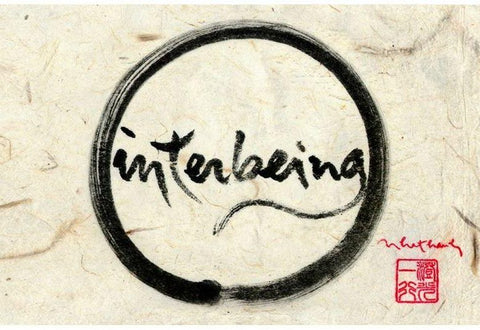
Interbeing

Interbeing_large

When the Vietnamese Zen master and peace activist Thich Nhat Hanh died last year, he left behind an invented word. Unlike those annoying neologisms that appear to have been created for the sake of novelty (e.g., metrosexual, staycation), Thich Nhat Hanh’s invention deepened our understanding of Zen teachings while also making them more accessible to the general reader. And in its way, it also advanced the cause of peace and understanding.

The word to which I refer is interbeing. Appearing often in Nhat Hanh’s writings, this resonant term points toward three aspects of everyday reality, as viewed through the lens of the Zen tradition. First, it describes the impermanent, interdependent relationship of the things of this world to each other. Second, it illuminates the intimate relationship of the self to the physical world, particularly the non-human world of animals, minerals, flora, and fauna. And third, it sheds light on our relationships with other people, past and present. In all these respects, interbeing reminds us that our encounters with the external world, with nature, and with other people have both an ordinary dimension—what Zen calls the “relative” or “historical” dimension—and one that remains hidden most of time, known in Zen as the “absolute” or “ultimate” dimension. In the timebound, relative dimension, entities exist in separation; in the timeless, absolute dimension, they exist as parts of one undivided whole.

“Fundamentally,” declares an early Zen text, “there is not a single thing.” As baffling as it is radical, this pronouncement requires some explanation. By way of illustration, I might cite the vintage Conway Stewart fountain pen with which I am writing these words. My pen is indubitably a single “thing.” I can feel its weight and admire its marbled blue barrel, its gleaming nib. Yet, as Thich Nhat Hanh would put it, my pen depends for its existence on “non-pen” elements: the resin in its barrel, the ink in its old-fashioned, lever-action bladder, the 18-carat gold in its nib. Without these and other constituents, my pen could not exist.

No less important, those constituents are neither static nor permanent. To be sure, this elegant writing instrument has lasted seventy-five years and is still functioning smoothly. Its previous owner took care of it, and I am trying to do the same. But at some point, my fountain pen will wear out. Replacement parts may or may not be available. No longer of any practical value, it will become an heirloom, an antique—or be disposed of altogether. In all these ways, my pen is both a “thing” and fundamentally not a thing, insofar as that term designates a solid, separate, and permanent object in a constellation of other such objects. Rather, my pen and its parts exist as nodes in an interdependent network of “things,” which themselves are continuously changing, even as we speak.

And what is true of inanimate objects is also true of the self. “Aware of the element earth in me,” reads one of Thich Nhat Hanh’s meditative verses, “I breathe in.” Although until recently Western culture has tended to regard the physical world in general and the natural world in particular as useful, exploitable resources, separate from and inferior to human consciousness, Zen teachings have for centuries admonished us to view the self and nature as co-equals in an intricate, reciprocal relationship. What happens to the world of mountains, rivers, trees, and streams, often as a result of our actions, also happens to us. What we do to nature, we also do to ourselves. The long-term implications of this attitude, which closely parallels that of “deep ecology,” are as evident as they are timely.

And just as we are not fundamentally separate from nature, neither are we fundamentally separate from other people. Although our prevailing cultural milieu militates against this view, preferring to regard the self as a separate, solid, and owner-operated entity, the term interbeing calls attention to the obverse side of this cultural coin. Yes, we rugged individualists may choose to live separately and apart, each of us being unique, autonomous, and responsible for our thoughts, words, and actions. But like it or not, we are also enmeshed in fluid, causal, and consequential relationships with other people, domestically and internationally, including our blood and spiritual ancestors. To imagine otherwise is to inhabit a self-centered and often destructive fantasy.

Acknowledging the dynamic nature of interbeing, Thich Nhat Hanh added a second word to his initial creation, making a verb of the original noun. We inter-are, he often said. Were this potent verb to become widespread and even prevalent in our civic discourse, how different that discourse might be. In the meantime, for those of us who would promote unity rather than division, understanding rather than hate, and peace rather than war, Thich Nhat Hanh’s contribution to our contemporary lexicon offers, at once, an expansive conceptual framework, a useful linguistic tool, and a profoundly compassionate way of seeing.

_____

See Thich Nhat Hanh, “The Insight of Interbeing”.


tetralemma-erklaert

If there is one matter upon which we the people can currently agree, it is that our society is deeply divided. Culturally, politically, and even spiritually, we are as polarized as we’ve ever been. Those who would remedy this situation, such as the Stanford Polarization and Social Change Lab (PASCL), have proposed interpersonal communication as the primary path to reconciliation. By talking honestly with each other, rather than retreating into our ideological bunkers, so the theory goes, we can correct our misperceptions and unwarranted assumptions and restore our common ground.

Perhaps so. But from the standpoint of Zen Buddhist teachings, the first step toward cultural healing may well be intra- rather than interpersonal in nature. In the Buddhist tradition, fixed ideas and strongly held opinions are known collectively as “views.” And “attachment to views,” as it is called, is seen as one of the root causes of suffering. By clinging fiercely to our views, we inflict suffering upon ourselves and everyone around us. Conversely, by loosening our attachment to our views, chiefly through meditative practice, we can relieve our personal suffering and do our part to heal our afflicted culture. In Judeo-Christian terms, we can learn once again to love our neighbors.

As a practical means of accomplishing this purpose, contemporary Zen teachers sometimes invoke an ancient method known as the tetralemma, or the Fourfold Understanding. A creation of the second-century Buddhist philosopher Nagarjuna, this method consists of four opposing “positions,” or propositions, each of them offering a distinct perspective on a common issue. Entertained in sequence, these four positions effectively cancel each other out, even as they release the practitioner from attachment to any one perspective.

By way of illustration, consider the proposition, “I am a kind person.” If you wish to apply this description to yourself, feel free to substitute your adjective of choice. (“I am a generous person”; “I am an awful person”). Having stated this opening proposition, take a few minutes to develop it as you might any other general assertion, summoning concrete examples from your experience. Include, if you so desire, others’ perceptions of your character and actions.

Now proceed to the second, opposing position, namely, “I am not a kind person.” Once again, summon concrete evidence from your experience, this time selecting incidents, situations, and actions that exemplify your fundamental lack of kindness, whether toward yourself or other people. Here again you might include the perceptions of longtime friends and acquaintances who have perceived you as less than kind.

Now move on to the third position: “I am both a kind person and not a kind person.” To support this seemingly self-contradictory proposition, recall two contrasting episodes from different times in your life, or perhaps from a single day, which together demonstrate that sometimes you have been kind and sometimes you have not. You might also include episodes in which kind, well-intended actions resulted in harmful outcomes. For example, you might have shown leniency in disciplining a son or daughter, only to discover that you have supported anti-social and even violent behavior.

Now move on to the fourth position: “I am neither a kind person nor an unkind person.” Just as you made the case for regarding yourself as kind or not kind, or both, now make the case for rejecting those categories altogether. View them as constructs, useful when mounting arguments perhaps but inadequate and inaccurate as descriptions of reality. At the same time, note whether the impulses you are feeling in the present moment are kind or unkind, or both—or something else entirely. And feel, if you can, the sense of release from abstract conceptual thinking.

The practice of the Fourfold Understanding, as illustrated by the foregoing example, can be applied to any proposition or set of assumptions, whether the context be moral, political, or spiritual. For those entrusted with making important decisions, this four-part method has sometimes proved helpful, insofar as it has enabled the decision-maker to weigh multiple points of view before arriving at a conclusion. For my own part, I have found the tetralemma liberating as well as illuminating, both as a meditative practice and as a way of thinking through complex problems. And, rather than weaken my long-standing moral, aesthetic, and political convictions, as once I feared it might do, I have found its effect quite the opposite. Over time, the practice has allowed me to see those convictions in a clearer and more nuanced light, even as it has revealed their provisional nature. Whether the Fourfold Understanding, if widely practiced, might also contribute to the curing of our social ills or the reunification of our divided culture remains an open question. But in the true spirit of the tetralemma, I offer that assertion here as an opening proposition.


For contemporary discussions of the tetralemma, see Christian Dillo’s The Path of Aliveness (Shambhala, 2022), pp. 190-194, and Tim Burkett’s Enlightenment is an Accident (Shambhala, 2023), pp. 142-146.


For the duration

thumbnail_Recruitment posterEarlier this year, our family doctor departed for pastures new. Like many other members of the Alfred, New York community, I found myself looking for a suitable replacement. Last week, I finally met with my new primary-care physician. Shortly thereafter, I remarked to my wife that this doctor might well become my caregiver “for the duration.” When she glanced at me as if I’d newly arrived from another era, I realized that I was showing my age. On further reflection, however, I also noted that this evocative expression, however dated, sorts well with three of the main tenets of Zen Buddhism.

“For the duration” originated in England during the First World War. Volunteers enlisted in the “New Army” for two years, three years, or “for the duration of the war.” Those who did so were known as “duration men” and were sometimes looked down upon by career soldiers. By 1917, “for the duration,” the abbreviated form of the original phrase, had passed into the common language. By 1920, it had begun to appear in the newspapers, as in the headline “Interned for the Duration” (The Shields Daily News, January, 1920). Almost from the start, the phrase carried negative connotations. Cognate with “endure,” its operative word echoed Samuel Johnson’s characterization of human life as a “state in which much is to be endured and little to be enjoyed.” And as the phrase gained ground in peacetime usage, it sometimes took on an ironic tone, as when a married man or woman spoke of being “in it for the duration.”

Zen teachings do not explicitly refer to “the duration,” but the stark realism conjured by the term has much in common with that of the Zen tradition. In his new book Enlightenment is an Accident (Shambhala, 2023), Zen teacher and author Tim Burkett speaks of “surrendering to what is,” reprising a familiar theme in Zen literature. Elsewhere, he defines Zen practice as being “about accepting reality as it is”—a reality that includes not only “birds and the sky and thestars . . . but also the backwaters and the swamps.” With this acceptance of reality comes an acknowledgement of limitations as well as possibilities, as when the Zen priest Zoketsu Norman Fischer, referring to a temporary illness, speaks of “living within [his] condition.”

“Your cup is already broken,” an old Zen saying reminds us, pointing to a second tenet of Zen practice, namely the recognition of the impermanence of all conditioned things. In classical Buddhist teachings, anicca, or the law of impermanence, is one of the three “marks of existence.” To speak of something lasting “for the duration” is implicitly to acknowledge its temporary nature. However painful or felicitous present conditions may be, they will eventually change, to be replaced by other conditions. Implicit in this reminder is the admonition to take the long view and cultivate a patient attitude. Less oracular in tone than such phrases as “This, too, will pass,” “for the duration” quietly asserts that even the most unhappy circumstances are, like the best of times, subject to change.

“All my teaching,” the Buddha is reported to have said, “is about suffering and the end of suffering.” Although that suffering may be mild or extreme, depending on circumstances, it is not solely an individual matter. Suffering is a part of the human condition. In this respect, “for the duration” calls to mind a third tenet of Zen teaching: that of radical interdependence, known in Buddhism as “dependent origination.” Whatever our individual preferences, we are all in the same boat. We are in this together, whether “this” be the now-receding pandemic or the ever-rising incidence of mass shootings in our culture. Though neither as specific nor as fatalistic as the French phrase “C’est la guerre” (“It’s the war”), “for the duration” acknowledges shared external conditions over which most of us have little or no control. Whether we elect to deny, resist, or accept those conditions, “for the duration” bows to their continuing existence, even as it elevates our personal suffering to a collective level.

Zen teachers speak often of the Great Matter, by which they mean the transience of life and the certainty of death. At the end of the day in Zen monasteries around the world, monastics and lay practitioners chant these resonant lines:

Life and death are of supreme importance –
Time passes swiftly and opportunity is lost.
Let us strive to awaken—awaken.
Take heed. Do not squander your life.

Intoned in a darkened zendo at the close of a long day, this chant may or may not be welcome. “Did you really need to remind us?” we might silently inquire, having spent the previous twelve hours engaged in mindful work and intensive meditation. But, welcome or not, the Night Chant enjoins us once again to honor and appreciate, for the duration, each fleeting moment of our finite existence: what the poet Mary Oliver memorably called our “one wild and precious life.”

FOX

Not long after I retired from college teaching, at least a half dozen friends and acquaintances, meeting me on the street or in the supermarket, asked me whether I was keeping busy. My practiced answer: “Busier than ever,” which seemed to settle the matter. Common to both the question and the answer was the unstated assumption that keeping busy is a good thing. Busyness is a virtue.

Which quite often it is. Busy people get things done. Whether those things are worth doing is an open question. But if nothing else, keeping busy structures time and keeps the blues away. And for those who might be tempted to wander off the paths of righteousness, keeping busy can be an effective deterrent. I learned this lesson at the age of ten, when I went around our neighborhood peddling plaster-of-Paris crucifixes I had crafted and painted all by myself. “Good for you, young man” said one elderly lady, as she reached in her purse for her wallet. “Satan finds some evil for idle hands to do.”

Taking issue with this conventional wisdom, one classical Zen teaching offers a contrasting perspective. In Case 21 of The Book of Equanimity, a foundational collection of Zen koans, a monk named Yunyan is earnestly sweeping the ground, giving this mundane task his wholehearted attention. Observing him hard at work, his brother and fellow monk Daowu challenges him by remarking, “Too busy!” To which Yunyan replies, “Brother, you should know there is one who is not busy.”

Like most Zen koans, this riddling anecdote admits of multiple interpretations. One of the most illuminating is that of Sobun Katherine Thanas (1927-2012), a renowned Zen teacher in the Soto lineage. “The one who is not busy,” she explains, refers to a “quality of mind” that may be described in three ways. It is the “awake mind,” the “not-knowing mind,” and “the mind of readiness.” Together these terms define the “one who is not busy.”

Of the three “minds” to which Thanas refers, the “awake mind” is probably the most familiar to meditative practitioners. The awakened mind is present for the present moment. At once alert and relaxed, concentrated and calm, it is neither lost in the past nor preoccupied with the future. It is focused intently on what is at hand. Beyond that, the deeply awakened mind has taken what Eihei Dogen (1200-1253), founder of the Soto Zen tradition, called “the backward step.” It has shifted its general orientation from the changing conditions of the present moment to immovable awareness: from the successive acts of attention that create the contents of mind to the broader field of mind itself, which embraces those multiple acts of attention. This broadened perspective is roughly analogous to a shift on a TV screen from the play-by-play action of an NFL game, narrated by an attentive sportscaster, to the view from the Goodyear blimp hovering above the field. In this analogy, the sportscaster is our cognitive consciousness making sense of what it sees. The blimp (or its pilot) is the “one who is not busy.”

“The mind of not-knowing,” Thanas’s second term, refers to another dimension of this all-encompassing view. The mind of not-knowing is open to whatever occurs. Free of cognitive filters and tolerant of uncertainty, it meets the expected and unexpected alike on their own terms. Unburdened by prejudicial attitudes, fixed ideas, and self-fulfilling prophecies, the mind of not-knowing (also known as “beginner’s mind”) respects the unprecedented, unrepeatable nature of each new circumstance. Adapting to changing conditions, physical and emotional, the mind of not-knowing is nimble and courageous enough to engage them at close range. The Zen adage “not-knowing is the most intimate” epitomizes this aspect of “the one who is not busy.”

Last and most important for the conduct of everyday life is the “mind of readiness,” which includes and implements the qualities just discussed. Capable of both the immediate and broader view, continuously aware of both the contents and the field of mind, the mind of readiness is unhindered by ego-centered frameworks and limiting preconceptions. Also known as “the mind that alights nowhere,” it is ready to respond, flexibly and effectively, to whatever may arise. Shunryu Suzuki Roshi likened the mind of readiness to a frog sitting at the edge of a pond, calm and relaxed but poised at any moment to throw out its tongue and catch a fly. For my own part, I would liken the mind of readiness to the red fox who showed up one morning in our backyard. Sitting quietly on his haunches, as if he had nothing else to do or nowhere else to go, he was ready for whatever threat or prey might come his way. Beautiful in his own right, this visitor from the natural world was also a befitting emblem of the “one who is not busy.”

_______

Katherine Thanas, The Truth of This Life: Zen Teachings on Loving the World as It Is (Shambhala, 2018), 35.

Photo by Ben Howard