Feeds:
Posts
Comments

121. Snow

2012-03-11 002 2012-03-11 012Dr. Friederike Boissevain is a German oncologist and seasoned Zen practitioner. By her own admission, her meditative practice is imperfect—or “crooked,” as she describes it. Rather than remain focused and fully aware of the present moment, she finds herself wandering off into the “land of dreams and worries.” But, crooked though it be, her practice has supported her daily work with the sick and the dying. “The most important thing I ever did,” she reflects, “was to sit down once.” That act set “something in motion that cannot be stopped. This is not because of trust in something but because of experience. . . The snow of dharma covers everything, whether we see it or not.” Continue Reading »

120. Wise attention

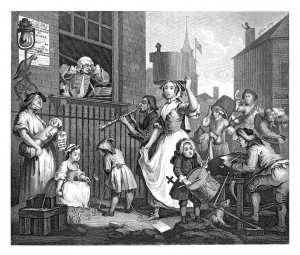
William Hogarth, The Enraged Musician

William Hogarth, The Enraged Musician

According to a recent report on the NBC Nightly News, American police have been running stop signs and causing serious accidents, so distracted have they become by the computers in their cars. To address the problem, the Fort Wayne, Indiana police department has installed devices that freeze the computer’s keys whenever the patrol car’s speed exceeds fifteen miles per hour.

This situation may be uniquely ironic, but the underlying problem is hardly peculiar to the police. On the contrary, in the age of the Internet and ubiquitous mobile devices, distraction has become endemic. With so many objects summoning our attention, where shall we direct it? On what objects should we place our minds? Continue Reading »

During the last few days of October, when Hurricane Sandy was threatening Western New York, state and local officials advised us as to the important documents we should take with us in the event of an evacuation: deeds, home-insurance policies, birth certificates, passports, and the like. In preparation, we should assemble those documents and place them in a waterproof envelope.

Sound advice, to be sure. But as I read that official list, I thought of a less than official item I would add to it: the file of documents I have kept for years under my father’s well-worn Bible. Contained in that file are notes, letters, and cards from friends and family, including letters from my deceased mother; birthday cards from my wife; holiday cards from my daughter-in-law; and a variety of notes from my son, some of them dating from his early childhood. Unlike the policies and passports, those documents are irreplaceable. And all were written by hand, which makes them all the more valuable.

That value, I might point out, is more than sentimental. It is historical and spiritual. The novelist Philip Hensher, author of The Missing Ink (Macmillan, 2012), has argued, with ample corroboration, that “we are at a moment when handwriting seems to be about to vanish from our lives,”* having been supplanted by the printed—and now the digital—word. If Hensher is right, we would do well to cherish whatever handwritten documents remain extant, irrespective of their author or content.  But even if we believe that handwriting, having survived for 5000 years, will always be with us, the act of writing by hand is worthy of renewed attention, if not of veneration. For in the handwritten word, it might be said, the authentic human self is concretely embodied. And the handwritten note or letter, however rough or polished, affords a depth of intimacy between writer and reader that print can only approximate. Little wonder that the world’s great spiritual traditions, Zen included, have accorded the handwritten word—or character—a place of honor, whether the handwritten text be the Torah, the Quran, the Heart Sutra, or the Book of Kells. Continue Reading »

118. Realizing

Chalmette National Cemetery, USCT Tree

One evening last week, as I was reading Khaled Hosseini’s novel The Kite Runner, I paused at the end of a paragraph. That paragraph, I realized, had just given me exceptional pleasure. An aesthetic pleasure, to be sure, but no less keen for that.

Here is the paragraph, which depicts a winter morning in Kabul:

Here is what I do on the first day of snowfall every year: I step out of the house early in the morning, still in my pajamas, hugging my arms against the chill. I find the driveway, my father’s car, the walls, the trees, the rooftops, and the hills buried under a foot of snow. I smile. The sky is seamless and blue, the snow so white my eyes burn. I shovel a handful of the fresh snow into my mouth, listen to the muffled stillness broken only by the cawing of crows. I walk down the front steps, barefoot, and call for Hassan to come out and see.*

There are many reasons why a reader might relish this paragraph. My own enjoyment stemmed, in a general way, from the clarity, directness, and freshness of Hosseini’s prose. More specifically, it derived from Hosseini’s sensuous, evocative imagery, his deft handling of cadence, and his construction of an intimate narrative voice: that of a grown man tenderly recalling his childhood. Experiencing all those qualities and more, I experienced the complex pleasure they provided.

Yet, had I not paused, I might never have realized what I was experiencing. Almost certainly, I was thinking as I read, but thinking is not the same as realizing the experience one is having, an experience that includes but is not limited to thought. Understandably, much of our educational effort focuses on teaching students how to think, critically and conceptually. Far more rare, however, is systematic training in how to realize what one is experiencing. And toward that end, meditative practice can play an important, complementary role, not only in education but also in our everyday lives. Continue Reading »

Melody Babbitt lives on Main Street in Pueblo, Colorado, a city of 106,595 once described as the “Pittsburgh of the West” but now enduring hard times. One of several Pueblo residents profiled on the PBS program Need to Know (October 5, 2012), Melody is an outreach specialist for the state of Colorado. She helps disabled Americans find work. Melody earns $40,000 a year and carries health insurance, but after three required abdominal surgeries that her insurance didn’t cover, she found herself deeply in debt and filed for bankruptcy. Now she needs a fourth operation and doesn’t have the money. “I’m procrastinating and postponing the surgery,” she tells journalist John Larson, the program’s narrator, as she sweeps her front porch. “I will eventually. But I can’t right now. I just can’t afford it.”

Melody Babbitt’s plight is compelling, but no less compelling is the image we are left with: that of an American woman in her late forties, telling her story of hardship while sweeping her front porch. In the midst of financial constraints so severe that she won’t allow herself to go to the movies, she is sweeping her porch. Faced with economic conditions she had no reason to expect and is virtually powerless to control, she is taking care of her home. By extension, it might be said, she is also taking care of her life.

That is an abiding purpose for most of us, I suspect, and it is also a central purpose of Zen meditation. People often come to Zen practice because their minds are unsettled and their lives are in disarray. After a few months—or even weeks—of daily practice, many find that their minds are becoming calmer and clearer, and that order is returning to their lives. And should they continue beyond that point, setting aside at least ten minutes a day for meditation, they may also find that the practice which helped them regain their balance is also helping them sustain it. For in three distinct ways, Zen practice can help us take care of our lives. Continue Reading »

During my years of teaching at Alfred University, I often found myself holding a piece of paper known as a Drop/Add Form. With this form in hand, students petitioned their advisors and professors to permit them to drop a burdensome course or add a desirable one or otherwise navigate the academic system. In this way students learned to make judicious choices and take responsibility for their decisions. Meanwhile, we professors learned to use a ballpoint rather than felt-tip pen when signing a multi-carboned form.

So far as I know, Drop/Add Forms are peculiar to academic life. They are not to be found in any other line of work. But the need those forms answer and the process they represent transcend the boundaries of academia. Dropping-and-adding, it might be said, is the heartbeat of everyday life, whether the item being dropped or added is tangible or intangible, conceptual or concrete. Sometimes, as in the case of mandatory retirement, the dropping of a habitual activity is not a matter of choice. Likewise, the adding of an activity or device or medication to one’s daily round may be prescribed rather than freely chosen. But often the choice to drop or add may be more voluntary than one supposes, particularly if what is being dropped or added is a personal habit. And meditative awareness can play an integral role in that process, whether the habit be one of thought, feeling, speech, or behavior. Continue Reading »

“Where did this bread come from?” asked a guest at our dinner table. “It’s delicious.” To that question, there is a very short answer. But there is also a longer answer that goes to the heart of Buddhist meditative practice.

The short answer is that the Deli-Style Rye we were enjoying came from Sisters Kneading Dough, a home bakery in Almond, New York. Every Friday afternoon, the sisters Beth and Jayne arrive at Quest Farm with their trays of bread and muffins, still warm from the oven. On that particular Friday, my wife, Robin, and I also arrived, and we came home with the Deli-Style Rye, along with a loaf of Robin’s favorite, Cinnamon Swirl. That, in short, is where the bread on our table came from.

The longer answer is that the bread came from sources too numerous to mention. Deli-Style Rye is made from organic bread flour (wheat and barley), whole wheat flour, water, whole rye flour, caraway seeds, honey, yeast, and canola oil. And each of these ingredients has a history of its own. Without the work of the bees and their keepers, there would have been no honey. Without sunlight, water, earth, and the labors of the farmers, distributors, truckers, and the rest, there would have been no flour, yeast, or canola oil. Without our driving to Quest Farm on a Friday afternoon, the Deli-style Rye would never have reached our home. Like anything else that we might conventionally regard as a single thing, the bread on our table was an aggregate of countless, interconnected things, without which it could not have come into being. And as its quick disappearance demonstrated, it was not really a solid object but a transitory node in the web of life, an event in a never-ending process. Continue Reading »

In a poem entitled “The Little Duck,” the American philosopher Donald C. Babcock (1886-1986) depicts a duck riding the Atlantic “a hundred feet beyond the surf”:

This is some sort of duck, and he cuddles in the swells.
He isn’t cold, and he is thinking things over.
There is a big heaving in the Atlantic,
And he is part of it.
He looks a bit like a mandarin, or the Lord Buddha meditating under the Bo tree,
But he has hardly enough above the eyes to be a philosopher.
He has poise, however, which is what philosophers must have.

Closely observing his subject, Babcock notes that the duck “can rest while the Atlantic heaves, because he rests in the Atlantic.” And though the duck “probably doesn’t know how large the ocean is,” he “realizes it, and he “sits down in it.” He “reposes in the immediate as if it were infinity—which it is.” [1] Continue Reading »

113. True Equanimity

One morning earlier this summer, I found myself standing atop an unstable blue object known as a BOSU Ball. Invented by David Weck in 1999, the BOSU Balance Trainer is an inflatable rubber hemisphere attached to a rigid platform. The central component of a “mindful approach to exercise,”[1] the BOSU Ball is designed to improve the body’s  sense of balance while strengthening its stabilizing muscles. I was standing on the BOSU Ball because I’d been having knee pain, and our family doctor had recommended physical therapy. In turn, the affable but exacting physical therapist with whom I was working had prescribed the BOSU Ball. “Don’t fall off,” he cheerfully warned, having just assigned me thirty squats. Miraculously, I managed to comply.

In a manner analogous to that of the BOSU Ball, Zen practice also aims to strengthen our sense of balance, physical and emotional. In Zen teachings, the capacity to maintain one’s equilibrium, especially under stressful, uncertain, and unstable conditions, is known as equanimity, a translation of the Sanskrit word upeksha. The traditional posture of sitting meditation—knees down, back erect, head balanced on the spine—supports the cultivation of upeksha, as does the practice of walking meditation, which trains the practitioner to walk with dignity and steady awareness. But these forms and practices, however essential to Zen discipline, are but the outward expressions of an inner poise. And at the heart of that inner poise is a balanced, inclusive way of experiencing the world. Continue Reading »

Of what may we be certain? In the vast cosmos, as in our circumscribed private lives, what is predictable and what is not? Between the expected and the unexpected, where does the balance lie?

Some fifty years ago, in an essay entitled “The Unexpected Universe,” the distinguished anthropologist Loren Eiseley (1907-1977) eloquently addressed those questions. Recalling a remark by the nineteenth-century German scientist Heinrich Hertz, who believed that “knowledge of nature” would enable us to predict future events and arrange our present affairs accordingly, Eiseley contrasted Hertz’s confident outlook with that of a previous era:

Hertz’s remark seems to offer surcease from uncertainty, power contained, the universe understood, the future apprehended before its emergence. The previous Elizabethan age, by contrast, had often attached to its legal documents a humble obeisance to life’s uncertainties expressed in the phrase “by the mutability of fortune and favor.” The men of Shakespeare’s century may have known less of science, but they knew only too well what unexpected overthrow was implied in the frown of a monarch or a breath of the plague. [1]

Among the many resonant phrases in this passage, one in particular stands out. In speaking of a “humble obeisance to life’s uncertainties,” Eiseley evokes the courtly manners of Elizabethan England. Beyond that, he invokes an outlook as foreign to our own time as Shakespeare’s diction is to contemporary English. Continue Reading »