Feeds:
Posts
Comments

Archive for the ‘1’ Category

“Death is certain,” Zen teachings remind us, “but the time of death is uncertain.” What truth could be more evident, one might say, what reality more apparent. Yet that truth and that reality are difficult to accept, even under the most auspicious conditions. And should we learn that our own death is imminent, the difficulty increases a hundredfold.

So it was with Carol Ruth Burdick (1928-2008), my friend of forty years, who learned on the evening of Friday, February 29, 2008 that she had advanced pancreatic cancer. Known to her community as “CB,” Carol was seventy-nine years old. Surgery, as she saw it, was out of the question, as was chemotherapy. The plain fact was that she was going to die, and soon. Rather than share that fact with friends or family, she spent the night facing it alone.

Knowing nothing of her diagnosis, I called CB early the next morning to inquire after her health and to suggest that we meet for conversation, as we often did on Saturday mornings. When she told me her bad news, I  expressed my sympathy, but I didn’t know what to say. “What’s the prognosis?” I asked.

“About six weeks,” she replied.

A few hours later, CB and I sat at her dining-room table, looking out of her big picture window at her frozen pond. Her mood seemed preternaturally calm. “How are you feeling?” I asked. In response, she reported that during the night she had made a list of the ten “positive aspects” of her impending death. “You know how I hate positive thinking,” she declared—and then went on to read her list.

First, she would not be a burden to her grown children. Second, she would not suffer the humiliation of senile dementia. Third, she would not become destitute. Fourth, she would not have to endure a second knee replacement. Fifth, she would no longer need to worry about her internal pains, for now she knew their cause. Her list continued, each item detailing another benefit of her death—silver linings, if you like, in the darkest of clouds.

Exactly six weeks later, on another Saturday morning, CB passed away. Since then, I’ve often thought of her list. What prompted her to compose it, I’ve wondered, and what purpose did it serve?

To some, CB’s list might seem an elaborate form of denial, a rationalist’s defense against an implacable force. Perhaps it was, but I would prefer to see it as an expression of her literary sensibility and her practical outlook. CB was a published writer of poems and essays, articles and memoirs. It was natural that she would turn to language and literary form to articulate her situation. And CB was also an unsparing realist, who cast a cold eye on human folly and romantic self-deception. Void of such notions as a happy afterlife or a lasting legacy, her list acknowledged the concrete changes her death would bring, both for herself and her loved ones. It was not a wish list but a sober appraisal, reflective of both her stern Protestant upbringing and her literary education.

Yet CB’s list was more than a realist’s analysis. It was also, in its way, an affirmation of the wholeness of life. Positive/negative; good/bad; fortunate/unfortunate: by their very nature, such dualities divide the stream of being into artificial halves, favoring one over the other and falsifying the whole. Perhaps that’s why CB disliked “positive thinking,” which not only “accentuates the positive,” as the old show tune advises us to do, but also isolates half of our experience at the expense of the other. And perhaps that’s also why CB fashioned her list, which redressed the balance of darkness and light, sadness and happiness in her present experience. For her family and friends as well as herself, her list afforded honest consolation. Beyond that, it affirmed the unity of life and death, creation and destruction, even in the midst of loss. Sober though it was, her list was a hymn to life and death, a lapsed Protestant’s L’Chaim.

______________________

Carol Burdick was Adjunct Professor of English at Alfred University and the author of Haps & Mishaps: Sketches from a Rural Life (Whitlock Publishing, 2008). For more information, see http://www.whitlockpublishing.com/local.htm.


Read Full Post »

Like forms in the natural world, musical forms have their own, distinct identities. A ballad is one thing, a sonata another. In his review of the Cowley Carol Book (1902), a collection of traditional Christmas carols, the British musicologist Sir William Henry Hadow (1859-1937) explores the differences between two such forms: the carol and the hymn. Although Sir Henry’s discussion has nothing overtly to do with Zen, it brings to mind an important component of Zen practice.

As Sir Henry explains, a carol is the “folk-song of religious music; its essential character is simple, human, direct; it sings its message of joy and welcome, of peace and goodwill, and remembers, while it sings, the sanctity of motherhood and the gentleness of little children.” Carols are by nature democratic. They appeal to emotions that are “the common heritage of mankind,” and they aim at “no display of learning, no pageantry of ceremonial.” They are “the service of poor men in their working garb,” and they bring “tidings which all may hear and understand.” In keeping with their humble origins, the melodies of carols are “simple and flowing” and “easy to remember.” Their native place is the “open air,” where a “few rude voices” are singing “under the frosty stars.”

By contrast, hymns are most at home in churches and cathedrals. They are an instrument of worship, and they have an authorized place in the Sunday service. In their solemnity and grandeur, hymns represent the “majesty and erudition of the Church.” Marked by “intricacy of contrapuntal device,” “ingenuity of modulation,” and “colored or perfumed harmony,” hymns by the likes of William Byrd sort well with the “fretted aisles and blazoned windows” of the great English cathedrals.  Unlike the carol, which evokes a beautiful “beggar-maiden” in peasant rags,  the hymn wears “a sumptuous habit of jewels and brocade.” It is an integral part of Anglican liturgy, and it carries the weight of ecclesiastical authority.*

Zen has no exact equivalent of the hymn or carol. Western “bare-bones” Zen, as practiced by Toni Packer, Joan Tollifson, and others, dispenses with liturgy altogether; and even the liturgy of formal Zen, with its wood-blocks, bows, and bells, is a plain austere affair, at least when contrasted with Sunday morning at York Minster or Evensong at King’s College, Cambridge.

Yet formal Zen does make use of chants, which combine the most prominent features of hymns and carols. Like the hymn, such chants as Atta Dipa (“You are the Light”), the Heart Sutra, and the Four Great Vows embody the authority of a venerable tradition. Chanted in Pali or Sino-Japanese, they evoke a strangeness comparable to that of an Anglican Mass. At the same time, most Zen chants are, in musical terms, rudimentary. The Heart Sutra is chanted in a rhythmic monotone, and Atta Dipa consists of two notes at an interval of a fourth (do-fa). However strange their idiom or formidable their authority, they can be learned and chanted by anyone.

Unlike its counterpart in Christian liturgy, Zen chanting is not a form of worship. Its functions are, first, to loosen the diaphragm in preparation for seated meditation, and second, to unify the body, breath, and mind in the act of chanting. As John Daido Loori Roshi has noted, Zen chanting grounds the practitioner in the here-and-now. No less important, it serves to cultivate wholesome states of mind, particularly those of respect and gratitude. In Daido Roshi’s words, Zen chanting has “little to do with the volume of your voice. It has all to do with the state of your mind.”*

Nowhere are these purposes more evident than in Tei Dai Denpo, or lineage chanting, in which Zen practitioners intone the names of their ancestral teachers. Shido Bunan Zenji. Dokyo Etan Zenji. Hakuin Ekaku Zenji. . .  Echoing in the zendo, this ancient chant evokes a mood of profound communal gratitude. Traversing the centuries, it conjures an unbroken lineage of practice, thought, and feeling, extending from the fifth century B.C. E. to the present day. An amalgam, if you like, of hymn and carol, it also honors the teachers in ourselves.

_____________________________________

*Sir Henry Hadow, “Carol Singing,” Times Literary Supplement, January 2, 1903.

*John Daido Loori Roshi,  Bringing the Sacred to Life : The Daily Practice of Zen Ritual (Shambhala, 2008),  65-66.

Read Full Post »

54. Dappled things

“Glory be to God,” wrote the poet-priest Gerard Manley Hopkins, “for dappled things. / For skies of couple-color as a brinded cow.”

An archaic form of “brindled,”“brinded” means “streaked” or “having patches of a darker hue.” Couple-colored skies are at once dark and light.  Other dappled things, as seen by Hopkins, include “finches’ wings,” “rose-moles all in stipple upon trout that swim,” and “all trades, their gear and tackle and trim.” All are parts of the interdependent body of reality, and all are included in Hopkins’s vision of “pied beauty.” (1)

Zen teachings, ancient and modern, accord with Hopkins’s vision. The Heart Sutra declares that in sunyata, the absolute dimension, “nothing is defiled, nothing is pure.” “Defiled” and “pure” are dualistic concepts, projected by the human mind upon undifferentiated reality. Seng-ts’an’s Faith-Mind Sutra elaborates  the point, cautioning the reader against the delusions attendant to dualistic thinking. “It is due to our grasping and rejecting,” writes Seng-ts’an, “that we do not know the true nature of things.” Attached to our preferences, our liking and disliking, we “remain in a dualistic state.” However, if we can free ourselves of our attachment to “refined” and “vulgar” and other comparative concepts, we can see “the ten thousand things” just as they are. We can recognize that they are “of a single essence,” and we can “walk in harmony with the nature of things, [our] own fundamental nature,” freely and undisturbed. (2)

The non-dualistic outlook articulated by Seng-ts’an may also be found in the literature of Zen, particularly its poetry. The wandering poet Matsuo Basho (1644-1694), best known for his idyllic haiku, “The old pond– / frog jumps in / sound of water,” describes, in a less decorous haiku, “a fishy smell– / perch  guts / in the water weeds.” In yet another, he records the experience of “fleas, lice, / a horse peeing / near [his] pillow.”(3) And Gary Snyder (b.1930), a Zen practitioner and committed environmentalist, describes an “eight-petaled yellow ‘Shell’” sign and a “blue-and-white ‘Mobil’ with a big red ‘O’ // growing in the asphalt riparian zone / by the soft roar of the flow / of Interstate 5.” (4) Whatever his political views, Snyder does not condemn these emblems of corporate America. On the contrary, in Snyder’s vision, as in Hopkins’s and Basho’s, pleasant and unpleasant, refined and ugly phenomena are parts of the great, indivisible body of reality. All are worthy of regard.

So, too, are the brindled skies of our inner lives, where the “ten thousand sorrows”  consort with the “ten thousand joys.” Should we venture to look inward, we might well discover the counterparts of fish guts and horse piss, fleas and lice in our psyches. And if we are meditative practitioners, we might also discover traces of what the Tibetan master Trungpa Rinpoche called “spiritual materialism,” by which he meant pride in spiritual achievement. Unlike Vipassana (“insight”) meditation, Zen practice does not encourage inspection of the emotional subtexts of our thoughts, such as might occur in psychoanalysis, but it does encourage an open, non-judgmental awareness of the motley images that cross our minds. And ultimately, the aim of the practice is not only awareness of changing thoughts and images but also contact with “original mind,” the timeless ground of being, from which those thoughts and images have sprung.

March, it might be said, is the month of dappled things. Patches of snow coexist with patches of grass, gray slush with crocuses and snowdrops. Looking out on that piebald landscape, we can wish impatiently for April and an end to winter. Or, as Hopkins did, we can appreciate the streaks of darkness and light, while also intuiting the underlying whole. Before our eyes is the changing relative world, where things are, in Hopkins’s phrase, “swift, slow; sweet, sour; adazzle, dim.” Beyond our eyes is absolute reality, the beginningless ground of being, whose beauty, in Hopkins’s words, is “past change.”

_____________________________________________________________________

(1) Gerard Manley Hopkins, “Pied Beauty.” See http://www.bartleby.com/122/13.html.

(2) Seng-ts’an, “Verses on the Faith-Mind,” tr. Richard B. Clarke.  See http://www.mendosa.com/way.html.

(3) The Essential Haiku, ed. Robert Hass (Ecco 1994), 35, 39

(4) Gary Snyder, “In the Santa Clarita Valley,” Danger on Peaks (Shoemaker and Hoard 2004), 67.

Read Full Post »

Since its arrival in the West, the practice of Zen has taken a rich variety of forms, ranging from the most traditional to the most iconoclastic. At one end of the spectrum there is formal Zen, with its incense, bows, and chants. At the other, there is “bare-bones” Zen, void of liturgy, hierarchy, or lineage.

Yet for all their differences, the varieties of Western Zen share a common practice, namely that of radical questioning. As Roshi Philip Kapleau, author of The Three Pillars of Zen, once put it, “the ultimate aim of Zen training is full awakening,” and “to awaken, what is most essential is a questioning mind growing out of a fundamental perplexity, or ‘ball of doubt’.”* That view is echoed by Zoketsu Norman Fischer, a contemporary Soto Zen priest, who defines the “core” of Zen as the “active, powerful, fundamental, relentless, deep and uniquely human act of questioning.”** Hearing these definitive statements, we might ask what “questioning,” as practiced in Zen, is and is not, and how it might be enlisted in everyday life.

To begin with, Zen inquiry is not the questioning born of fear. Any thoughtful person who has gone through a divorce, the foreclosure of a home, or the loss of a job knows the experience of questioning what to do next, whom to blame, and how to survive a traumatic loss. Such questioning is necessary and sometimes productive, but it is not the questioning of Zen.

Second, Zen questioning is not the same as rigorous philosophical inquiry. To be sure, Zen teachings engage metaphysical issues, most prominently the “Great Matter of life and death.” And insofar as they emphasize personal responsibility and freedom of choice, Zen teachings share common ground with existentialist thought. But unlike professional philosophy, Zen eschews definitions, abstract categories, and other components of systematic inquiry. Its way is more immediate, intuitive, personal, and concrete.

And third, Zen questioning is not psychoanalysis. While doing seated meditation, Zen practitioners keep their eyes open. The aim is awareness—full awareness—of whatever is happening in the present moment. If a memory of a deceased parent or an estranged sibling should manifest itself, it may be noted as something to look into at a later time, perhaps with the aid of a therapist. But the aim of the practice is to be mindful of whatever is happening, not to analyze or pursue the images that arise.

Toward that end, Zen questioning focuses less on specific thoughts or feelings than on the conditions that have caused them to arise. Thich Nhat Hanh, the Vietnamese Zen master, urges us to ask the question, “What am I doing?” as a way of awakening awareness of our states of mind. Barry Briggs, a teacher in the Korean Zen tradition, asks himself periodically, “How is it, just now?” By asking such questions, we can become fully aware of the concrete circumstances in which our abstract thoughts are occurring. And we can discern whether the thought we’re having, the remark we’re about to make, or the action we’re about to take is habitual or fresh, reflexive or wisely responsive.

Beyond these practical modes of self-interrogation, Zen questioning is also a process of radical, unmediated inquiry. “Who hears the sound?” asked the fourteenth-century Zen master Bassui Tokusho. It is a question to be asked, over and again, in a spirit of not-knowing, until the truth of the self is revealed with incontrovertible clarity. “What is this?” Bassui also asked, demanding a fearless, unrelenting inquiry into the nature of reality. Norman Fischer has likened such questioning to a torch, which burns away “all the dross and scum of desire and confusion that covers ordinary activities.”

Zen questioning is hard—harder, said Shunryu Suzuki, than giving up smoking. But its aim is a life no longer governed by fear, anger, habit, or forgetfulness, and it is well worth the effort.

______________________________________________________

*Roshi Philip Kapleau, Zen: Merging of East and West (Anchor 1979), 132.

**Zoketsu Norman Fischer, “On Questioning,”  Mountains are Mountains and Rivers are Rivers, ed. Ilana Rabinowitz (Hyperion 1999), 17.

Read Full Post »

According to the fifth-century Indian sage Bodhidharma, one of the founders of the Zen tradition, Zen is a mode of inquiry “not dependent on words and letters.” It is a practice of direct seeing, based on direct experience. Language in general and conceptual language in particular can come between our minds and the realities of this world. We can mistake the word moon for the moon itself.

Yet, as Zen master Thich Nhat Hanh, author of more than sixty books, affirms, “Writing is a practice of looking deeply.”* Through the act of writing, as through the practice of meditation, we can become intimate with our lives. We can stop and look deeply into what is occurring, and as the poet Eavan Boland once put it, we can fully “experience our experience.”  In these ways, as in many others, the parallel practices of meditative inquiry and meditative writing share a common purpose. And in the works of the greatest contemplative writers—Thomas Merton, Rainer Maria Rilke, Elizabeth Bishop, Matsuo Basho, to name a few—the two practices are so closely allied as to be one and the same.

That is certainly true of the Irish Nobel laureate Seamus Heaney (b. 1939), whose poems and essays bear the marks of a meditative temperament. And in his poem “Personal Helicon,” he offers an illuminating metaphor for the process of “looking deeply,” even as his poem enacts that process.

The title of Heaney’s poem alludes to Mount Helicon, the sanctuary of the Muses in Greek mythology. By association, it also alludes to the Hippocrene spring, the legendary source of poetic inspiration, which was situated on Mount Helicon. Yet at first glance the poem appears to be a fond sketch of childhood, set in rural County Derry and centering on the poet’s early fascination with wells. “They could not keep me from wells,” Heaney declares in his opening stanza. “I loved the dark drop, the trapped sky, the smells / Of waterweed, fungus and dank moss.” In subsequent stanzas, he recalls particular wells in the Northern Irish countryside, including one “so deep you saw no reflection in it,” and a shallow well in a ditch, which “fructified like any aquarium.”

In his closing stanzas, however, Heaney turns from fond reminiscence to mature reflection on his life’s work:


Others had echoes, gave back your own call

With a clean new music in it. And one

Was scaresome, for there, out of ferns and tall

Foxgloves, a rat slapped across my reflection.


Now, to pry into roots, to finger slime,

To stare, big-eyed Narcissus, into some spring

Is beneath all adult dignity. I rhyme

To see myself, to set the darkness echoing.


In the first of these stanzas, Heaney acknowledges both the childhood pleasure of hearing echoes in a well and the not-so-pleasant experience of seeing a rat in the water. Understood figuratively, the image of the rat suggests foul and frightening aspects of the self and the world, revealed by the process of looking deeply. And in the closing stanza, he likens that process to the act of writing, which allows him both to see himself and to evoke what he has elsewhere called “the mysterious otherness of the world.” Like the child’s voice echoing in a well, the mature poet’s rhymes conjure the dark unknown. They create a state of mind known to literary analysts as “negative capability” and to Zen practitioners as “Don’t-know mind” or the mind of “not-knowing.”  Abiding with confidence and courage in that state, the poet and meditative practitioner are open to infinite possibilities.

Not everyone can write a poem with the depth and precision of “Personal Helicon.” But anyone with pen and paper can enlist the act of writing as a tool of meditative inquiry. As the American poet William Stafford once remarked, writing is “one of the great free human activities,” which anyone can pursue, whether as a literary vocation or as a vehicle for “looking deeply.” Please try it for yourself.

____________________________________

*Thich Nhat Hanh, The Heart of the Buddha’s Teaching (Parallax 1998), 83.

Seamus Heaney’s reading of “Personal Helicon” may be heard at:

http://www.ibiblio.org/ipa/poems/heaney/personal_helicon.php

Read Full Post »

51. Dropping into awareness

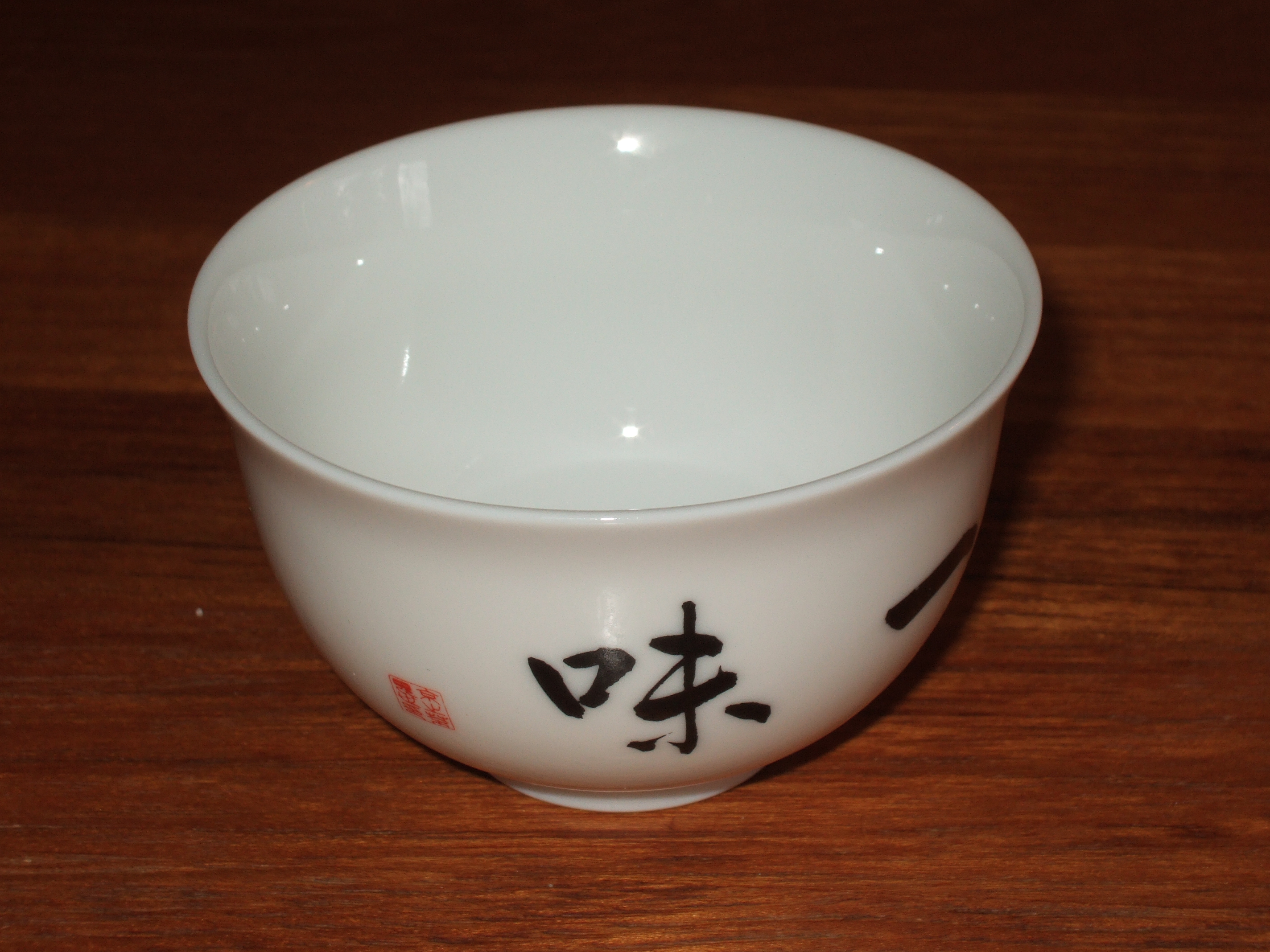
As I pick up my teacup on this cold winter morning, I’m remembering the story of the Zen student who asked Shunryu Suzuki, author of Zen Mind, Beginner’s Mind, why the Japanese make their teacups so thin. Being so delicate, the cups are easily broken.

“It’s not that they’re too delicate,” Suzuki Roshi replied, “but that you don’t know how to handle them. You must adjust yourself to the environment, and not vice versa.”

Suzuki’s Roshi’s point is well taken. We must adjust to our surroundings.  However, if you are living in Western New York in the month of January, you may be feeling a little resistance to Suzuki’s wisdom. It is not so difficult to adjust to one’s environment when, as now, a lean female cardinal is coming and going from our feeder, her orange beak and tan feathers catching the early-morning light. But it is not so easy when your driveway is filled with snow, the sidewalks are icy, and you’re already sick of scarves and parkas. Here in Alfred, New York, we know how to handle such conditions, but that doesn’t mean we like them.

Yet the significance of the student’s question and Suzuki’s response transcends the question of adjustment. What the story vividly illustrates is the way in which preconceptions—in this instance, that teacups should be sturdy and equipped with handles—influence and often govern our perceptions. And it also exemplifies the resistance that many of us bring to the unknown, whether the new or foreign object be a Japanese teacup or an all-electric car.

For a more immediate example, please pause and consider any preconceptions that you might have brought to the reading of this column. Perhaps you expected something other than what you’ve encountered—a discussion of meditative methods, for instance, or an explanation of satori. Or, conversely, perhaps what you have so far read accords with your expectations, and you are more or less satisfied. In the first instance, you might choose to read something else; in the second, you might choose to read on.

There is, however, another option, which is to examine your expectations and your present response in the light of awareness. Looking closely into both, you can discern your assumptions, your fixed ideas, and the judgments they’ve engendered. And you can become aware of those mental processes, even as they are arising, continuing, and passing away.

In The Four Foundations of Mindfulness, a core text for Zen students, awareness of this kind is called “mindfulness of the mind in the mind.” That somewhat cumbersome phrase refers to awareness of mental phenomena in the very moment when they are occurring. Such awareness is not the same as discursive thinking. Rather, it is a kind of effortless seeing, its object in this case being the thoughts that cross our minds. In contrast to fear, worry, and resistance, open awareness liberates the mind, both by illuminating our mental processes and by revealing the empty, or ephemeral, nature of mental events.

Such awareness cannot be awakened by an act of will. There is no switch to turn it on. However, it can be cultivated through the practices of sitting and walking meditation. And when it occurs, it can be felt in the mind as a spacious receptivity and in the body as a subtle shift of orientation—a shift from the confines of the head to the expansiveness of  the hara, the body’s center of gravity, situated in the lower abdomen. Viewed from the standpoint of the hara, even the most destructive thought loses much of its power.

Shinge Roko Sherry Chayat Roshi, Abbot of the Zen Center of Syracuse, has likened this felt shift from thinking to awareness to an expectant mother’s experience of her baby “dropping” into the pelvis shortly before birth. In this instance, however, the baby is the mind itself, as it settles into awareness, fully cognizant of whatever is occurring. In that silent, open space, habitual thoughts and self-protective judgments can be recognized for what they are and nothing more. And even a traditional Japanese teacup, however breakable or difficult to handle, can be appreciated as something useful, beautiful, and new.

Read Full Post »

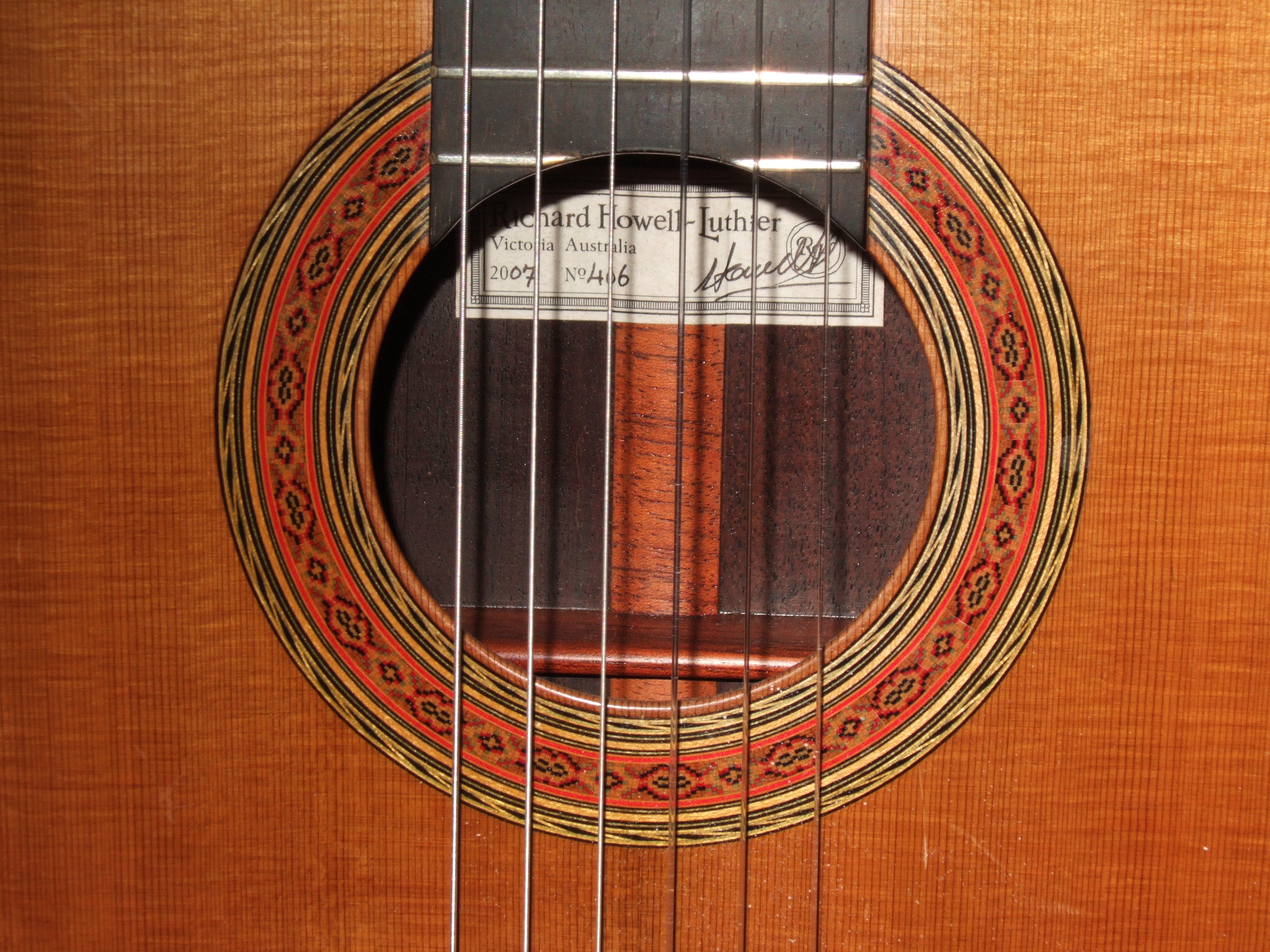
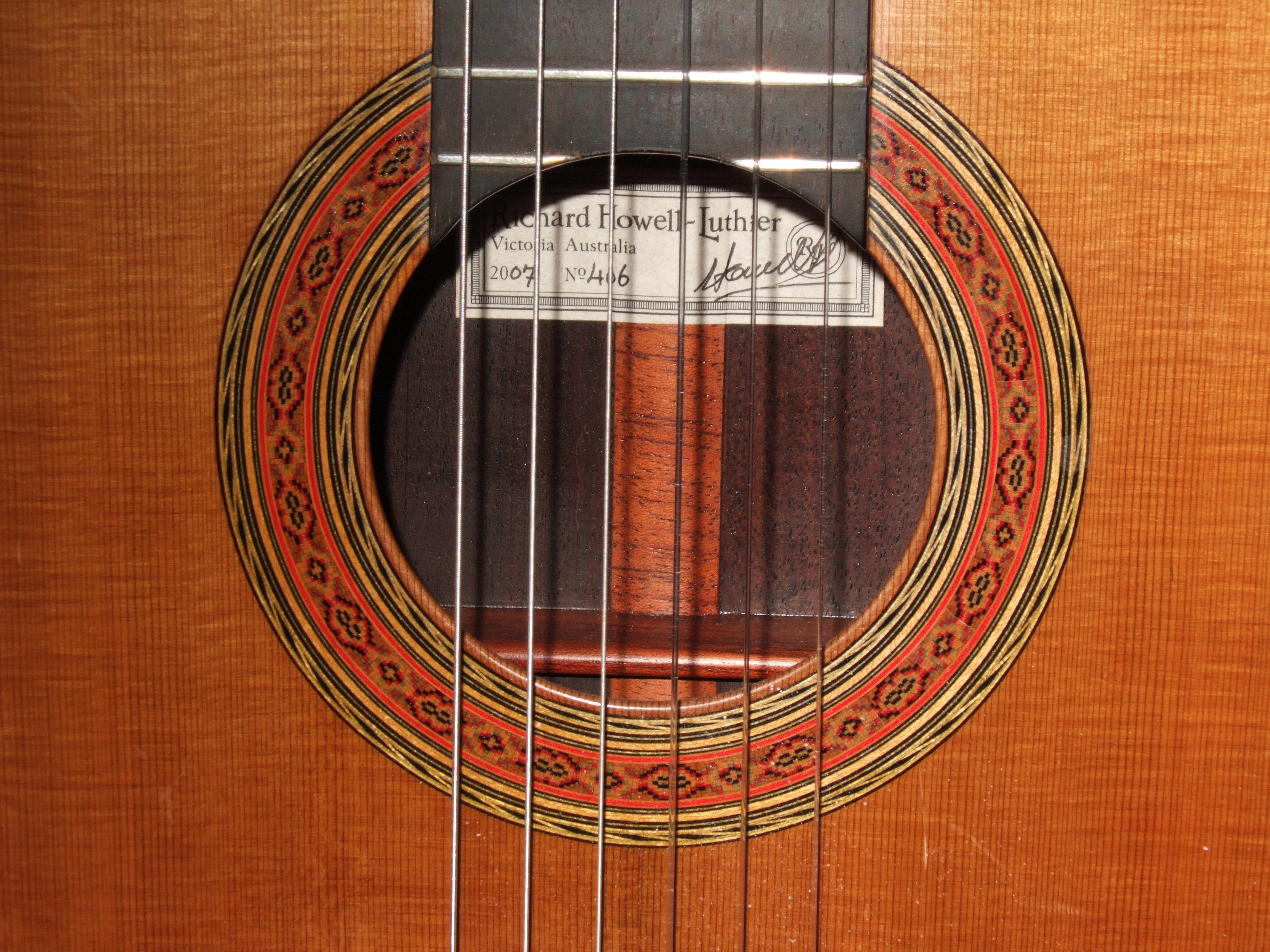
Richard Howell guitar 2007

If you enjoy listening to the classical guitar, you may be familiar with the Prelude from J.S. Bach’s Prelude, Fugue and Allegro (BMV 998), one of the most beautiful pieces in the standard repertoire. Composed for lute or harpsichord in the so-called “broken style” (style brise) of the French Baroque, the Prelude consists largely of arpeggiated chords. Played evenly and deliberately, the successive notes create an impression of wholeness, as though the chords’ original order had been restored.

Twenty-five years ago, I performed the Prelude in a master class at an international guitar festival in Toronto. The class was conducted by David Russell, then a rising star and now a concert artist of the highest distinction. Seated before me were some fifty guitarists and guitar teachers from around the world. To perform in such a setting was both exhilarating and daunting, not least because my audience had intimate knowledge of the piece I was playing. Interpretive felicities would not go unnoticed, but neither would mistakes.

Despite the stressful circumstances, I turned in a creditable performance. When I had finished, and the polite applause had died down, David Russell offered his critique.

To begin with, my tone had been inconsistent. I needed to work on that. Moreover, I had played the piece rather metrically, almost metronomically. I could allow myself and the music greater freedom. And most important, I had come down too hard at the ends of phrases. To avoid that unfortunate tendency, I might regard the last notes of phrases not as points of emphasis but as points of destination. “Think of them as arrivals,” David suggested.

Given the character of the Prelude, David Russell’s suggestion, however astute, was difficult to put into practice. Composed in 12/8 meter, the Prelude is marked by unceasing forward movement. With the exception of one long pause near the end, the score contains no moments of repose, no half notes, whole notes, or fermatas. If there are to be points of rest—points of arrival—the performer must consciously put them in. Or rather, the performer must be sensitive to natural, if reclusive, moments of repose.

In twenty-five years of playing the Prelude, I have never forgotten the principle articulated by David Russell. And over the years, I have seen how that principle may be applied in situations well beyond the bounds of musical interpretation, namely the practice of meditation and the conduct of everyday life.

With respect to meditation, Zen master Thich Nhat Hanh recommends that as we sit in stillness, we silently recite the verses, “I have arrived / I am home / In the here / And in the now,” letting these phrases accompany our inhalations and exhalations. More simply, we can inwardly recite the words “Arrive / home” and “Here / now” while breathing in and out. In that way, we counter the pressure, so prevalent in our culture, to be always on the move, always en route to somewhere else.

This practice is both pleasant and nourishing, and over time it can become an integral part of the daily round. Even the most hectic day contains moments of potential repose, in which we can cultivate a sense of arrival. And as with musical performance, we can honor those points of rest without losing our general momentum. By doing so, we may discover a hidden but inherent order, a rhythm akin to natural breathing. And we may also discover that even under the most anxious circumstances, it is possible to stop and collect ourselves before making our next move. Indeed, it is essential to do so, lest the life we’ve been given become little more than a shapeless, graceless succession of sixteenth-notes, played without meaning at breakneck speed.

____________________________

Per-Olov Kindgren’s rendition of the Prelude may be heard at http://www.youtube.com/watch?v=JDhv2f2mweE, Jan Depreter’s  at http://www.youtube.com/watch?v=LMXpCyS0We4 , and Julian Bream’s at http://www.youtube.com/watch?v=Fdi54PBPYC8.  David Russell plays the Prelude, Fugue, and Allegro on David Russell Plays Bach (Telarc 2003).

Read Full Post »

If you are near-sighted, as I am, you may have found that you can sometimes see nearby objects more clearly by taking off your glasses. Or, to put it another way, in the absence of your glasses, the inherent closeness of those objects becomes more apparent. What was supposed to enhance your vision was actually imposing a veil between yourself and the coffee cup in front of you.

One of the aims of Zen practice is to recognize such veils and, if possible, to remove them. According to Zen teachings, direct experience of the world—or what the Zen-trained teacher Toni Packer calls “fresh seeing”—is the one reliable basis for knowledge, understanding, and whatever wisdom we might acquire. Books and teachers may guide us, confirm what we have seen, or place our perceptions in an enabling context. But we must see things for ourselves. In Zen practice we cultivate direct seeing and a sense of intimacy, both with ourselves and with the world around us. Whatever stands in the way is to be set aside, or subjected to scrutiny, or cut asunder.

Of the conditions conducive to direct seeing, none is more important than the silence of meditation. “Only when I am quiet for a long time / and do not speak,” writes the poet Jane Hirshfield, “do the objects of my life draw near.” Elaborating her theme, she imagines that the proximate objects in her life, among them scissors and spoons and a blue mug, are deliberately keeping their distance from her. Even her towels, “for all their intimate knowledge,” are hesitant to come close. They are kept away by speech and thought, which separate self and other, the ego-centered mind and the things of this world. Only in those rare, egoless moments when she glimpses “for even an instant the actual instant” do the objects of her life draw near. At such moments, she fancifully suggests, each object emits a “sigh of happiness,” knowing that she has joined “their circle of simple, passionate thusness,” void of habitual, me-centered thought and the separation it imposes. (1)

Such intimacy is indeed a source of happiness. Conversely, a sense of separation can engender a deep and chronic suffering. In her essay “Touching Fear” Toni Packer addresses that reality:

“I’m never free of fear,” some people say, implying that there should be a state of mind and body that is free of fear. How can we possibly be free from fear when we live in the conditioned mode of the me-story most of the time? We’re deeply programmed to believe in this separate me by inaccurate language and by growing up in a world of other mes, all of whom think of and experience themselves as separate entities. . . . With separation inevitably goes fear and pain. (2)

Elsewhere, Packer quotes a questioner who asked, “Why does this me-ness, this self-centered feeling, arise when we realize that it causes such a painful sense of separation? How did it ever start in the first place?” Packer admits that she doesn’t know, but she also suggests that “all of us can watch me-ness as it is arising from moment to moment. We can find out about it if we are really deeply interested and curious.” (3)

Perhaps we can. And perhaps over time we can also discover ways to release ourselves from the me-centered tyranny of dualistic thinking, which places images and concepts between ourselves and the objects in our lives. By sitting still and not speaking, if only for the space of an hour, we can permit those objects to draw near, and we can rejoin what the poet Mary Oliver has called the “family of things.”(4) By taking off our conceptual glasses, we can see the world afresh, and see our place within it.

_____________

(1) Jane Hirshfield, Only When I Am Quiet and Do Not Speak,” Given Sugar, Given Salt (HarperCollins 2001), 23.

(2) Toni Packer, The Wonder of Presence (Shambhala 2002), 59

(3) Packer, 82

(4) Mary Oliver, “”Wild Geese,” Dream Work (Atlantic Monthly Press 1986), 14.

Read Full Post »

In our culture, new is usually considered better. And where so-called home improvements are concerned, that is often the case, especially if the new item is a high-efficiency furnace or a forty-year roof or an energy-saving kitchen appliance. But sometimes the situation is more complex than that, the effect more problematic.

Recently we installed new vinyl windows in our home. In contrast to the fifty-year-old relics they replaced, the new windows bring a soft, expansive light into our darker rooms. Gone are the small panes and splintered mullions. Gone, too, are the uncaulked cracks and loose-fitting frames that let out heat. Our house feels tighter now, and our carbon footprint will almost certainly be smaller.

Yet with this welcome change has come an unexpected loss. Clean and efficient though they are, our new windows lack a quality that was palpably present in the decrepit pine windows they replaced. In American parlance that quality is sometimes called “character,” and it is said to reside in such objects as weathered deck chairs, antique tools, and Willie Nelson’s battered guitar. Our rattling old windows, such as they were, had character; our new vinyl windows, whatever their environmental virtues, do not.

In Japanese culture, the quality I’m describing is known as sabi, and it has an integral connection to the practice of Zen. Often linked with wabi, which connotes simplicity and a life free of materialistic striving, sabi once meant “loneliness” or “solitude.” In modern usage, it means the quality of being old, worn, and faded—and all the more beautiful for the wear and tear. The architect Tadao Ando defines the quality in this way:

Sabi by itself means “the bloom of time.” It connotes natural progression—tarnish, hoariness, rust—the extinguished gloss of that which once sparkled. It’s the understanding that beauty is fleeting. .  . Sabi things carry the burden of their years with dignity and grace: the chilly mottled surface of an oxidized silver bowl, the yielding gray of weathered wood, the elegant withering of a bereft autumn bough.*

Noting that sabi “transcends the Japanese,” Ando finds it in “an old car left in a field to rust, as it transforms from an eyesore into a part of the landscape.” This, he suggests, might be considered “America’s contribution to the evolution of sabi.”

Beyond the aspect of age, the word sabi also connotes imperfection. Rooted historically in the tea ceremony, the aesthetic of sabi developed in the sixteenth century as an indigenous reaction to the expensive teaware imported from China. In contrast to the brilliant colors and ostentatious perfection of Chinese wares and utensils, the tea masters Murata Shuko, Takeno Jo-o, and especially Sen no Rikyu (1522-1591) introduced such rough, imperfect objects as stoneware buckets and tea bowls produced by local craftsmen. In subsequent centuries, the aesthetic thus established extended to a general appreciation of imperfect objects, whether the object be a bamboo screen or a leaky vase. As the feudal baron Lord Fumai (1751-1819), himself the owner of a leaky vase, explained, “The furyu [sabi] of this  bamboo vase consists in the very fact of this leakage.”**

Yet if the objects that embody sabi are imperfect, it is not because they were poorly made. Nor is their imperfection a sign of neglect. On the contrary, as Tadao Ando remarks, “wabi-sabi is never messy or slovenly,” and an unmade bed or a room cluttered with junk is not an expression of sabi. Objects that possess sabi do so because they are visibly in the process of breaking down and reverting to the state of nature. Their imperfection is a mark of their impermanence. To contemplate sabi is to be reminded of the emptiness from which all things come and to which they will return. It is also to be reminded of the dynamic web of life, in which energies are constantly being exchanged, and new forms are coming into being.

The aesthetic of sabi and the practice of Zen are branches of a single cultural tree, and they have much in common. In both, a heightened awareness of impermanence draws us closer to the evanescent beauty of the present moment.  In both, the pathos of things going in and out of existence mingles with a sense of infinite possibility. And in both, the realization that all things are transitory prompts us to value and care for our lives.

_______________

*Tadao Ando, “What is Wabi-Sabi?”   http://nobleharbor.com/tea/chado/WhatIsWabi-Sabi.htm

**Daisetz T. Suzuki, Zen and Japanese Culture ( Princeton 1970), p. 326.

See also Leonard Koren, Wabi-Sabi for Artists, Designers, Poets, & Philosophers (Berkeley: Stone Bridge Press, 1994).

Read Full Post »

2009_1114ABHVISIT20070004

Patience, we are told, is a virtue. As a child growing up in eastern Iowa, I heard that bromide more than once. However, as an adolescent I learned about patience not from listening to Methodist sermons or elders’ proverbs but by spending time with an exceptionally patient man.

His name was Sven Jorgensen, and he was the co-owner of Eble and Jorgensen Office Supply, where I worked after school, on weekends, and in the summers. Unlike Fred Eble, a former Navy Seabee and a tense, frenetic striver, Sven exuded steadiness and calm. Wiry, high-strung Fred dealt with the public and could often be found in the front of the store, filling out orders or talking on the phone. Thick-set, sedentary Sven worked quietly at his table in the back room, cleaning and repairing typewriters. Nearby was a photo of Sven and his dog Walt in a flat-bottomed fishing boat. Like his owner, Walt looked stable and relaxed.

To everyone in town, Sven Jorgensen was known as Speed. Speed Jorgensen. He acquired that name at the age of fourteen, when he barreled down a steep hill on his bike, rode into a pile of frozen leaves, and flew over the handlebars. He hadn’t realized that the leaves were frozen. Ever after, all physical evidence to the contrary, Sven would be known as Speed. It was a lifelong joke, played by the world on a slow-moving Swede.

At Eble and Jorgensen’s I sometimes waited on customers, made deliveries, or stocked shelves, but much of the time I worked in the back room, where dirty or broken typewriters waited to be restored. With his big Swedish hands Speed would carry them, one by one, to his table, where he put them in a deep tray half-filled with solvent. There he would clean their typebars with a solvent-soaked toothbrush, adjust their springs, replace broken or tarnished keys. When he was finished, even the most abused machine would function smoothly and look as good as new.

Much of the time, Speed worked silently, as did I, but sometimes we chatted as we worked. Or rather, I talked and Speed listened, offering advice when advice was sorely needed. Once, when I had manged to deliver rubber cement rather than duplicating fluid to an office, nearly precipitating a crisis, Speed sharply admonished me to be more attentive. On another occasion, when I was enumerating my father’s faults, Speed remarked, without looking up, that my father was a very nice man. And once, when I repeated a mean-spirited joke I’d heard at school, he told me in so many words that my joke was not very funny. I would not repeat it again.

In his unchosen role as friend and mentor, Speed taught partly by precept but mostly by example. What he exemplified was not only patience but also the virtue of slowing down, even when typewriters needed to be cleaned or supplies delivered. Working slowly but productively at his table, or pausing in his work to offer kind advice, he provided vivid proof that life could be lived at a slower pace, allowing time to look more deeply and act more wisely.

The pace at which Sven Jorgensen lived and worked is also the pace of meditation. “Do you have the patience to wait,” asks Lao-Tzu in the Tao Te Ching, “till your mud settles and the water is clear? / Can you remain unmoving / till the right action arises by itself?” And in his book Meditation as Contemplative Inquiry, the physicist Arthur Zajonc observes that “hurrying is antithetical to the required tempo of meditation”. Elaborating that point, he notes that “the tempo of meditation is the same as that of artistic attention; it is the rhythm of poetry. Speed hides all subtlety; and reality is subtle.” *

Which of us isn’t in a hurry? Although my son once referred to me as his slow-moving dad, I too can get in a rush, lose all patience, and miss the subtleties of experience. If I need a retardant, I can find it in the image of Lao-Tzu, writing immortal poetry in his mountain retreat. Or, closer to home, I can call back the memory of Speed Jorgensen at his table, patiently scrubbing an ink-filled “o,” or winding a cloth ribbon on a spool, or calmly wiping a well-worn platen.

___________

* Arthur Zajonc, Meditation as Contemplative Inquiry (Lindisfarne, 2009), 98.

Read Full Post »

« Newer Posts - Older Posts »