Feeds:
Posts
Comments

Archive for the ‘1’ Category

Let us imagine that it’s a Friday afternoon, and you are driving on the New York State Thruway. You are in the passing lane, going seventy-five miles per hour. The car on your right is not slowing down, and the SUV behind you is fast approaching. You can see its emblazoned grill in your rearview mirror. You do not want to increase your speed, but the driver behind you is leaving you no choice.

As the SUV draws closer, you feel your heart rate increasing, your anger arising. You can’t see the driver in your mirror, but you can well imagine him: an aggressive, insensitive lout, with no concern for anyone but himself. As you reluctantly speed up and move over, an epithet comes to mind, and you let it slip from your lips. It is not a nice word, but it gives you satisfaction.

Moments later, the SUV passes on your left, and you see that the driver is not a lout at all but a petite, professional-looking woman in her thirties, who is keeping her eyes on the road, apparently unaware of your distress. And a few minutes later, after she and her SUV have long since disappeared, you realize that your anger, too, has disappeared and your clarity of mind is slowly returning. It is as if a veil, through which you were viewing the world, has gradually been lifted. (more…)

Read Full Post »


“Can there be fresh speaking and fresh listening right now,” asks the Zen-trained teacher Toni Packer, “undisturbed by what is known?”*

Packer’s question would be pertinent in any season, but it is especially so in the present season, when the usual holiday tunes are in the air, and what we are hearing is so well-known as to seem banal. Like it or not, here comes The Little Drummer Boy again—he and his drum. Given the familiarity of the old songs, is “fresh listening” possible? And if so, how shall we go about it? (more…)

Read Full Post »

Cloisters of Lisbon Cathedral

“There is this cave / In the air behind my body / That nobody is going to touch: / A cloister, a silence / Closing around a blossom of fire.”* So wrote the American poet James Wright (1927-1980) in his poem “The Jewel.” Wright’s images are enigmatic, in the way dreams are, but their import is clear. They evoke a place in the self that is silent, luminous, and inviolate. (more…)

Read Full Post »

Autumn in Kyoto, Japan

In his essay “Reading Oneself,” the writer and teacher Sven Birkerts describes the experience of encountering a long-forgotten page of his own prose. As Birkerts tells the story, he agreed to read the book manuscript of a student whom he had taught many years before. When his former student arrived at their meeting, she brought both her manuscript and Birkerts’ written evaluation of her work, which she had saved from her days in his course. Typed on the Selectric II he was using at the time, Birkerts’ prose seemed foreign to its author:

And suddenly there’s this feeling, I’ve had it before—more and more in recent years. I am reading something I’ve written and I not only don’t recognize the sentences—they’ve gone from me—I also don’t quite map to the mind that produced them. It’s very much like catching your shopwindow reflection for a split second before you realize it’s you. Almost always, the shock is negative. I look like that? With these sentences it’s the opposite. My eyes catch sight of what my hand did. Reading, I actually admire the images, the figures of speech, the confidence of the rhythm. Not the rhythm I would write in now. But I feel it as distinct.

For Birkerts this encounter with his younger self was comparable to contemplating an old photograph. “The looking,” he observes, “is mainly about taking in the differences.”* (more…)

Read Full Post »

58. The sword of attention

Many years ago, when my son was still in diapers and I was a new and inexperienced father, I spoke with a visiting poet about the challenges of fatherhood. Among them was the challenge of pushing a diaper pin through several layers of cloth without sticking it into my son.

Gray-haired and world-weary, the poet was himself the father of four grown children. “With our firstborn,” he reflected, “I used to worry about that. But by the time the fourth one came along, I just pushed the pin in and hoped for the best.”

I suspect that the poet was exaggerating, or tailoring his reflection for comic effect. But his remark has proved memorable, perhaps because it illustrates the degree to which second, third, and fourth experiences differ from the first. The first time around, we may be fully attentive, whether out of fear or wonder or concern. By the fourth, we may be indifferent or complacent. What once was fresh has become old hat.

To restore our initial wonder is a central aim of Zen practice. What Shunryu Suzuki Roshi famously called beginner’s mind is no other than the capacity to experience the world freely and openly, without prior judgments or self-centered agendas. In Zen Mind, Beginner’s Mind, he puts it this way:

Our “original mind” includes everything within itself. It is always rich and sufficient within itself. You should not lose your self-sufficient state of mind. This does not mean a closed mind, but actually an empty and a ready mind. If your mind is empty, it is ready for anything; it is open to everything. In the beginner’s mind there are many possibilities; in the expert’s mind there are few.*

Meeting the world with “original mind,” we bring a receptive awareness to whatever we encounter, holding our memories and preconceptions in abeyance. Original mind, Suzuki goes on to say, is the mind of boundless compassion. To return to original mind is to open ourselves not only to our immediate surroundings but also to the interdependent, ever-changing web of life.

But how is one to do that? By what means are we to meet the fourth—or five hundredth—experience of a repeated action with “original mind”?

In her book Everyday Zen, Charlotte Joko Beck offers this advice:

A zendo is not a place for bliss and relaxation, but a furnace room for the combustion of our egoistic delusions. What tools do we need to use? Only one. We’ve all heard of it, yet we use it very seldom. It’s called attention.

Attention is the cutting, burning sword, and our practice is to use that sword as much as we can. None of us is very willing to use it; but when we do—even for a few minutes—some cutting and burning takes place. All practice aims to increase our ability to be attentive, not just in zazen but in every moment of our life. **

What the burning sword cuts through, Beck subsequently explains, is delusive conceptual thought. By paying close and continuous attention, we come to realize that “the conceptual process is a fantasy; and the more we grasp this the more our ability to pay attention to reality increases.”

Egoistic delusions are many, but few are more pervasive or potentially harmful than the illusion of sufficient expertise: of already knowing it all, or all that is relevant to the occasion. Whether the activity be pinning a diaper or chopping an onion, managing a portfolio or diagnosing an illness, the “expert’s mind” may well be closed to possibilities. It  may also misperceive the facts, jump to conclusions, or ignore conflicting evidence.  Cutting through the self-centered concept of expertise, the sword of attention clears a path to the unknown, unprecedented reality before us. Burning away conceptions and misconceptions, prejudices and expectations, it enables us to encounter the present moment on its own terms rather than impose our own. “Don’t-Know Mind,” the Korean master Seung Sahn liked to call it. “Only don’t know!” Difficult to cultivate and even more difficult to maintain, it is essential to the practice of Zen.

_______________

*Shunryu Suzuki Roshi, Zen Mind, Beginner’s Mind (Weatherhill, 1970), 21.

**Charlotte Joko Beck, Everyday Zen (HarperCollins, 1989), 32.

In the photo above, the glass artist Randi Solin is adding molten glass to the blow pipe. The glass is heated to a temperature of 2,120 degrees Fahrenheit. This image is being used with the kind permission of Michaela at http://www.thegardenerseden.com/?p=5763. Visit Solinglass at http://www.solinglass.com/

Read Full Post »

“Ah, she was a terror for the flowers,” an Irish widower once remarked of his late wife. “She had no gift for leaving things alone.”

Few of us Westerners do, including those of us who practice Zen meditation. “Zazen,” writes the Soto master Kosho Uchiyama Roshi, “enables life to be life by letting it be” (1). And Shunryu Suzuki Roshi, author of Zen Mind, Beginner’s Mind, advises us to “let things go as they go.” But how, exactly, are we to do that when practicing seated meditation? How much, if any, control should we relinquish, and when?

Nearly all the manuals agree that the Zen practitioner should sit in a stable posture, knees down and spine erect, and pay attention to the breath. But should we regulate our breathing? Should we count our breaths or simply observe the flow of air as it comes and goes? Is it really necessary to hold our hands in the “cosmic mudra,” left palm resting in the right? Should we strive to silence our inner chatter—or allow it to continue? Answers to these questions may be found,  but they vary according to the school and the teacher.

Among those who advocate stern control, Japanese Rinzai masters occupy a pre-eminent position. Rinzai Zen has been likened to a “brave general who moves a regiment without delay,” and with few exceptions Rinzai teachers live up to that description. The renowned Rinzai master Omori Sogen Roshi advises the student to push the breath into the lower abdomen and “squeeze it lightly there with a scooping feeling” (2).  Katsuki Sekida, another Rinzai teacher, directs the practitioner to narrow the exhalation by “holding the diaphragm down and steadily checking the upward pushing movement of the abdominal muscles” (3). Similar admonitions regarding breath, posture, and concentration resound throughout the Rinzai literature, lending a tone of rigorous authority.

By contrast, Soto Zen takes a less severe approach, urging continuous awareness more than strict control. Soto teachers do emphasize form in general and correct posture in particular, but the intent is less to marshal the body into submission than to facilitate the open flow of breath and the cultivation of awareness. In his Opening the Hand of Thought, Uchiyama Roshi admonishes us just to “drop everything and entrust everything to the correct zazen posture” (4).  In similar fashion, he instructs us not to suppress discursive thoughts but merely to let go of “all the accidental things that rise in our minds.” Firm but gentle, Uchiyama’s instructions typify Soto teachings, which have been likened to a “farmer taking care of a rice field, one stalk after another, patiently.”

At the least directive end of the spectrum, the non-traditional teacher Toni Packer advocates “fresh seeing” but no particular control of breath or posture. In her essay “A Few Tips for Sitting,” she offers this advice:

No need to be rigid about proper posture. The back lifts itself up spontaneously as the mind inquires, opens up, and empties out. It is intimately related to our varying states of mind. In experiencing pain, sorrow, anger, fear, or greed, the body manifests each mood in its own ways.  In openness and clarity the body feels like no-body (5).

Like those poets who view literary form as an “extension” (or revelation) of content, Packer views proper posture not as a form to be externally imposed but as an expression of an open, inquiring state of mind.

To the newcomer, the rich variety of methods that marks Western Zen can be more bewildering than encouraging. Whom should you trust, and what method should you follow? As a general rule, the unaffiliated novice would do well to choose a method and stay with it long enough to determine whether the prescribed forms of control promote or detract from the development of awareness. For my own part, I often begin a sitting with the Rinzai practice of susokkan, or counting of out-breaths. Later on in the sitting, I practice zuisokukan, or following the breath, focusing on the lower abdomen. Toward the end, I settle into shikantaza, or “just sitting,” which is sometimes called the “method of no method.” Although this sequence will not suit everyone, I have found it a skillful means for gradually relinquishing control. At the outset of the sitting I am, as it were, making something happen. By the end, I am learning, in the manner of the Taoist master Chuang Tzu, to “gaze at the world but leave the world alone.”

______________________________________

(1) Kosho Uchiyama, Opening the Hand of Thought (Wisdom, 2004), 102

(2) Omori Sogen, An Introduction to Zen Training (Tuttle, 2001), 42

(3) Katsuki Sekida, Zen Training (Weatherhill, 1985), 56.

(4) Opening the Hand of Thought, 48.

(5) Toni Packer, The Wonder of Presence (Shambhala, 2002), 17.

“Gaze at the world but leave the world alone” is the Irish poet Derek Mahon’s paraphrase of Chuang  Tzu’s admonition:

We have lost our equilibrium, he said;

gaze at the world but leave the world alone.

Do nothing; do nothing and everything will be done.

–Derek Mahon, The Yellow Book (Wake Forest University Press, 1998), 50

Read Full Post »

“Death is certain,” Zen teachings remind us, “but the time of death is uncertain.” What truth could be more evident, one might say, what reality more apparent. Yet that truth and that reality are difficult to accept, even under the most auspicious conditions. And should we learn that our own death is imminent, the difficulty increases a hundredfold.

So it was with Carol Ruth Burdick (1928-2008), my friend of forty years, who learned on the evening of Friday, February 29, 2008 that she had advanced pancreatic cancer. Known to her community as “CB,” Carol was seventy-nine years old. Surgery, as she saw it, was out of the question, as was chemotherapy. The plain fact was that she was going to die, and soon. Rather than share that fact with friends or family, she spent the night facing it alone.

Knowing nothing of her diagnosis, I called CB early the next morning to inquire after her health and to suggest that we meet for conversation, as we often did on Saturday mornings. When she told me her bad news, I  expressed my sympathy, but I didn’t know what to say. “What’s the prognosis?” I asked.

“About six weeks,” she replied.

A few hours later, CB and I sat at her dining-room table, looking out of her big picture window at her frozen pond. Her mood seemed preternaturally calm. “How are you feeling?” I asked. In response, she reported that during the night she had made a list of the ten “positive aspects” of her impending death. “You know how I hate positive thinking,” she declared—and then went on to read her list.

First, she would not be a burden to her grown children. Second, she would not suffer the humiliation of senile dementia. Third, she would not become destitute. Fourth, she would not have to endure a second knee replacement. Fifth, she would no longer need to worry about her internal pains, for now she knew their cause. Her list continued, each item detailing another benefit of her death—silver linings, if you like, in the darkest of clouds.

Exactly six weeks later, on another Saturday morning, CB passed away. Since then, I’ve often thought of her list. What prompted her to compose it, I’ve wondered, and what purpose did it serve?

To some, CB’s list might seem an elaborate form of denial, a rationalist’s defense against an implacable force. Perhaps it was, but I would prefer to see it as an expression of her literary sensibility and her practical outlook. CB was a published writer of poems and essays, articles and memoirs. It was natural that she would turn to language and literary form to articulate her situation. And CB was also an unsparing realist, who cast a cold eye on human folly and romantic self-deception. Void of such notions as a happy afterlife or a lasting legacy, her list acknowledged the concrete changes her death would bring, both for herself and her loved ones. It was not a wish list but a sober appraisal, reflective of both her stern Protestant upbringing and her literary education.

Yet CB’s list was more than a realist’s analysis. It was also, in its way, an affirmation of the wholeness of life. Positive/negative; good/bad; fortunate/unfortunate: by their very nature, such dualities divide the stream of being into artificial halves, favoring one over the other and falsifying the whole. Perhaps that’s why CB disliked “positive thinking,” which not only “accentuates the positive,” as the old show tune advises us to do, but also isolates half of our experience at the expense of the other. And perhaps that’s also why CB fashioned her list, which redressed the balance of darkness and light, sadness and happiness in her present experience. For her family and friends as well as herself, her list afforded honest consolation. Beyond that, it affirmed the unity of life and death, creation and destruction, even in the midst of loss. Sober though it was, her list was a hymn to life and death, a lapsed Protestant’s L’Chaim.

______________________

Carol Burdick was Adjunct Professor of English at Alfred University and the author of Haps & Mishaps: Sketches from a Rural Life (Whitlock Publishing, 2008). For more information, see http://www.whitlockpublishing.com/local.htm.

Read Full Post »

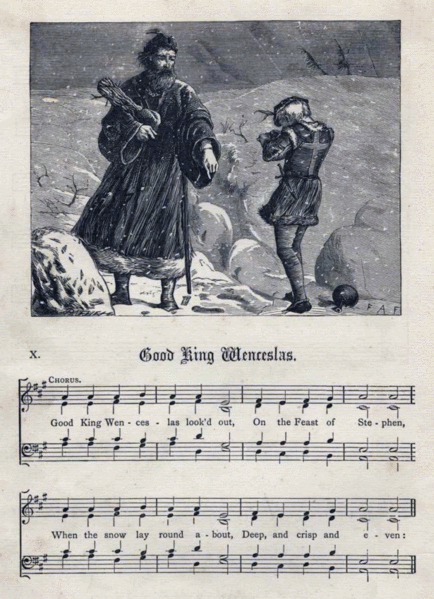
Like forms in the natural world, musical forms have their own, distinct identities. A ballad is one thing, a sonata another. In his review of the Cowley Carol Book (1902), a collection of traditional Christmas carols, the British musicologist Sir William Henry Hadow (1859-1937) explores the differences between two such forms: the carol and the hymn. Although Sir Henry’s discussion has nothing overtly to do with Zen, it brings to mind an important component of Zen practice.

As Sir Henry explains, a carol is the “folk-song of religious music; its essential character is simple, human, direct; it sings its message of joy and welcome, of peace and goodwill, and remembers, while it sings, the sanctity of motherhood and the gentleness of little children.” Carols are by nature democratic. They appeal to emotions that are “the common heritage of mankind,” and they aim at “no display of learning, no pageantry of ceremonial.” They are “the service of poor men in their working garb,” and they bring “tidings which all may hear and understand.” In keeping with their humble origins, the melodies of carols are “simple and flowing” and “easy to remember.” Their native place is the “open air,” where a “few rude voices” are singing “under the frosty stars.”

By contrast, hymns are most at home in churches and cathedrals. They are an instrument of worship, and they have an authorized place in the Sunday service. In their solemnity and grandeur, hymns represent the “majesty and erudition of the Church.” Marked by “intricacy of contrapuntal device,” “ingenuity of modulation,” and “colored or perfumed harmony,” hymns by the likes of William Byrd sort well with the “fretted aisles and blazoned windows” of the great English cathedrals.  Unlike the carol, which evokes a beautiful “beggar-maiden” in peasant rags,  the hymn wears “a sumptuous habit of jewels and brocade.” It is an integral part of Anglican liturgy, and it carries the weight of ecclesiastical authority.*

Zen has no exact equivalent of the hymn or carol. Western “bare-bones” Zen, as practiced by Toni Packer, Joan Tollifson, and others, dispenses with liturgy altogether; and even the liturgy of formal Zen, with its wood-blocks, bows, and bells, is a plain austere affair, at least when contrasted with Sunday morning at York Minster or Evensong at King’s College, Cambridge.

Yet formal Zen does make use of chants, which combine the most prominent features of hymns and carols. Like the hymn, such chants as Atta Dipa (“You are the Light”), the Heart Sutra, and the Four Great Vows embody the authority of a venerable tradition. Chanted in Pali or Sino-Japanese, they evoke a strangeness comparable to that of an Anglican Mass. At the same time, most Zen chants are, in musical terms, rudimentary. The Heart Sutra is chanted in a rhythmic monotone, and Atta Dipa consists of two notes at an interval of a fourth (do-fa). However strange their idiom or formidable their authority, they can be learned and chanted by anyone.

Unlike its counterpart in Christian liturgy, Zen chanting is not a form of worship. Its functions are, first, to loosen the diaphragm in preparation for seated meditation, and second, to unify the body, breath, and mind in the act of chanting. As John Daido Loori Roshi has noted, Zen chanting grounds the practitioner in the here-and-now. No less important, it serves to cultivate wholesome states of mind, particularly those of respect and gratitude. In Daido Roshi’s words, Zen chanting has “little to do with the volume of your voice. It has all to do with the state of your mind.”*

Nowhere are these purposes more evident than in Tei Dai Denpo, or lineage chanting, in which Zen practitioners intone the names of their ancestral teachers. Shido Bunan Zenji. Dokyo Etan Zenji. Hakuin Ekaku Zenji. . .  Echoing in the zendo, this ancient chant evokes a mood of profound communal gratitude. Traversing the centuries, it conjures an unbroken lineage of practice, thought, and feeling, extending from the fifth century B.C. E. to the present day. An amalgam, if you like, of hymn and carol, it also honors the teachers in ourselves.

_____________________________________

*Sir Henry Hadow, “Carol Singing,” Times Literary Supplement, January 2, 1903.

*John Daido Loori Roshi,  Bringing the Sacred to Life : The Daily Practice of Zen Ritual (Shambhala, 2008),  65-66.

Read Full Post »

54. Dappled things

“Glory be to God,” wrote the poet-priest Gerard Manley Hopkins, “for dappled things. / For skies of couple-color as a brinded cow.”

An archaic form of “brindled,”“brinded” means “streaked” or “having patches of a darker hue.” Couple-colored skies are at once dark and light.  Other dappled things, as seen by Hopkins, include “finches’ wings,” “rose-moles all in stipple upon trout that swim,” and “all trades, their gear and tackle and trim.” All are parts of the interdependent body of reality, and all are included in Hopkins’s vision of “pied beauty.” (1)

Zen teachings, ancient and modern, accord with Hopkins’s vision. The Heart Sutra declares that in sunyata, the absolute dimension, “nothing is defiled, nothing is pure.” “Defiled” and “pure” are dualistic concepts, projected by the human mind upon undifferentiated reality. Seng-ts’an’s Faith-Mind Sutra elaborates  the point, cautioning the reader against the delusions attendant to dualistic thinking. “It is due to our grasping and rejecting,” writes Seng-ts’an, “that we do not know the true nature of things.” Attached to our preferences, our liking and disliking, we “remain in a dualistic state.” However, if we can free ourselves of our attachment to “refined” and “vulgar” and other comparative concepts, we can see “the ten thousand things” just as they are. We can recognize that they are “of a single essence,” and we can “walk in harmony with the nature of things, [our] own fundamental nature,” freely and undisturbed. (2)

The non-dualistic outlook articulated by Seng-ts’an may also be found in the literature of Zen, particularly its poetry. The wandering poet Matsuo Basho (1644-1694), best known for his idyllic haiku, “The old pond– / frog jumps in / sound of water,” describes, in a less decorous haiku, “a fishy smell– / perch  guts / in the water weeds.” In yet another, he records the experience of “fleas, lice, / a horse peeing / near [his] pillow.”(3) And Gary Snyder (b.1930), a Zen practitioner and committed environmentalist, describes an “eight-petaled yellow ‘Shell’” sign and a “blue-and-white ‘Mobil’ with a big red ‘O’ // growing in the asphalt riparian zone / by the soft roar of the flow / of Interstate 5.” (4) Whatever his political views, Snyder does not condemn these emblems of corporate America. On the contrary, in Snyder’s vision, as in Hopkins’s and Basho’s, pleasant and unpleasant, refined and ugly phenomena are parts of the great, indivisible body of reality. All are worthy of regard.

So, too, are the brindled skies of our inner lives, where the “ten thousand sorrows”  consort with the “ten thousand joys.” Should we venture to look inward, we might well discover the counterparts of fish guts and horse piss, fleas and lice in our psyches. And if we are meditative practitioners, we might also discover traces of what the Tibetan master Trungpa Rinpoche called “spiritual materialism,” by which he meant pride in spiritual achievement. Unlike Vipassana (“insight”) meditation, Zen practice does not encourage inspection of the emotional subtexts of our thoughts, such as might occur in psychoanalysis, but it does encourage an open, non-judgmental awareness of the motley images that cross our minds. And ultimately, the aim of the practice is not only awareness of changing thoughts and images but also contact with “original mind,” the timeless ground of being, from which those thoughts and images have sprung.

March, it might be said, is the month of dappled things. Patches of snow coexist with patches of grass, gray slush with crocuses and snowdrops. Looking out on that piebald landscape, we can wish impatiently for April and an end to winter. Or, as Hopkins did, we can appreciate the streaks of darkness and light, while also intuiting the underlying whole. Before our eyes is the changing relative world, where things are, in Hopkins’s phrase, “swift, slow; sweet, sour; adazzle, dim.” Beyond our eyes is absolute reality, the beginningless ground of being, whose beauty, in Hopkins’s words, is “past change.”

_____________________________________________________________________

(1) Gerard Manley Hopkins, “Pied Beauty.” See http://www.bartleby.com/122/13.html.

(2) Seng-ts’an, “Verses on the Faith-Mind,” tr. Richard B. Clarke.  See http://www.mendosa.com/way.html.

(3) The Essential Haiku, ed. Robert Hass (Ecco 1994), 35, 39

(4) Gary Snyder, “In the Santa Clarita Valley,” Danger on Peaks (Shoemaker and Hoard 2004), 67.

Read Full Post »

Since its arrival in the West, the practice of Zen has taken a rich variety of forms, ranging from the most traditional to the most iconoclastic. At one end of the spectrum there is formal Zen, with its incense, bows, and chants. At the other, there is “bare-bones” Zen, void of liturgy, hierarchy, or lineage.

Yet for all their differences, the varieties of Western Zen share a common practice, namely that of radical questioning. As Roshi Philip Kapleau, author of The Three Pillars of Zen, once put it, “the ultimate aim of Zen training is full awakening,” and “to awaken, what is most essential is a questioning mind growing out of a fundamental perplexity, or ‘ball of doubt’.”* That view is echoed by Zoketsu Norman Fischer, a contemporary Soto Zen priest, who defines the “core” of Zen as the “active, powerful, fundamental, relentless, deep and uniquely human act of questioning.”** Hearing these definitive statements, we might ask what “questioning,” as practiced in Zen, is and is not, and how it might be enlisted in everyday life.

To begin with, Zen inquiry is not the questioning born of fear. Any thoughtful person who has gone through a divorce, the foreclosure of a home, or the loss of a job knows the experience of questioning what to do next, whom to blame, and how to survive a traumatic loss. Such questioning is necessary and sometimes productive, but it is not the questioning of Zen.

Second, Zen questioning is not the same as rigorous philosophical inquiry. To be sure, Zen teachings engage metaphysical issues, most prominently the “Great Matter of life and death.” And insofar as they emphasize personal responsibility and freedom of choice, Zen teachings share common ground with existentialist thought. But unlike professional philosophy, Zen eschews definitions, abstract categories, and other components of systematic inquiry. Its way is more immediate, intuitive, personal, and concrete.

And third, Zen questioning is not psychoanalysis. While doing seated meditation, Zen practitioners keep their eyes open. The aim is awareness—full awareness—of whatever is happening in the present moment. If a memory of a deceased parent or an estranged sibling should manifest itself, it may be noted as something to look into at a later time, perhaps with the aid of a therapist. But the aim of the practice is to be mindful of whatever is happening, not to analyze or pursue the images that arise.

Toward that end, Zen questioning focuses less on specific thoughts or feelings than on the conditions that have caused them to arise. Thich Nhat Hanh, the Vietnamese Zen master, urges us to ask the question, “What am I doing?” as a way of awakening awareness of our states of mind. Barry Briggs, a teacher in the Korean Zen tradition, asks himself periodically, “How is it, just now?” By asking such questions, we can become fully aware of the concrete circumstances in which our abstract thoughts are occurring. And we can discern whether the thought we’re having, the remark we’re about to make, or the action we’re about to take is habitual or fresh, reflexive or wisely responsive.

Beyond these practical modes of self-interrogation, Zen questioning is also a process of radical, unmediated inquiry. “Who hears the sound?” asked the fourteenth-century Zen master Bassui Tokusho. It is a question to be asked, over and again, in a spirit of not-knowing, until the truth of the self is revealed with incontrovertible clarity. “What is this?” Bassui also asked, demanding a fearless, unrelenting inquiry into the nature of reality. Norman Fischer has likened such questioning to a torch, which burns away “all the dross and scum of desire and confusion that covers ordinary activities.”

Zen questioning is hard—harder, said Shunryu Suzuki, than giving up smoking. But its aim is a life no longer governed by fear, anger, habit, or forgetfulness, and it is well worth the effort.

______________________________________________________

*Roshi Philip Kapleau, Zen: Merging of East and West (Anchor 1979), 132.

**Zoketsu Norman Fischer, “On Questioning,”  Mountains are Mountains and Rivers are Rivers, ed. Ilana Rabinowitz (Hyperion 1999), 17.

Read Full Post »

« Newer Posts - Older Posts »