
Feeds:
Posts
Comments

Posts Tagged ‘Susan Moon’

Bonnard Tree Alley“We rarely contact this simple moment,” wrote the Zen-trained teacher Toni Packer (1927-2013). “So used to constant input and excitement, we lack fine-tuning into all the subtleties of this instant, the ability to register a quiet aliveness without the stirring of expectation.”

In this otherwise straightforward reflection on the place of meditative practice—or “contemplative inquiry,” as Packer preferred to call it—in contemporary Western culture, the word aliveness may give us pause. What, exactly, is “aliveness,” and what has it to do with meditation, a practice conventionally associated with quietude and calm?

In his book The Path of Aliveness: A Contemporary Zen Approach to Awakening Body and Mind, the Zen teacher Christian Dillo employs two striking metaphors to characterize his primary subject. “Aliveness,” he asserts, “is the buzz that can be felt from head to toe,” the “buzz of basic aliveness.” It is “the feeling of the body being filled with a liquid continuously releasing champagne bubbles.” More prosaically, he defines aliveness as “the always-present background”—what elsewhere he calls the “field of mind”—to any and all sensations,” the “here now through which everything appears.” In Dillo’s view, to become consciously aware of the aliveness of one’s body and mind, and to cultivate that awareness, is a central objective of meditative practice.

In his book Taking Our Places: The Buddhist Path to Truly Growing Up, Zoketsu Norman Fischer Roshi offers a perspective congruent with Dillo’s, but he places emphasis less on cultivating the quality of aliveness than on appreciating its abiding presence in our bodies and minds. In his discussion of zazen, or seated meditation, Fischer notes that in Japan this practice “is called ‘just sitting’—in other words, simply being present with the fact of being alive, breathing, in the body. It is such a simple thing, yet so profound, to appreciate directly that we are living, breathing bodies. Mostly we take this for granted and occupy ourselves with what seem like more significant concerns. But, in fact, there is nothing more significant than being our bodies.” Through the daily practice of zazen, we can become more cognizant and far more appreciative of our breathing, physical presence. And as our practice matures, this fundamental recognition can lead to a deeper awakening, as we come to see that “we are not atomized individuals separate from and opposed to the world.” By becoming acutely aware of our living bodies, we also become aware of “that which is larger than [ourselves], which holds [us] in its embrace.”

Yet another view of aliveness animates the Zen teacher Susan Moon’s collection of essays Alive Until You’re Dead: Notes on the Home Stretch. In her essay “Knowing How to Be Satisfied,” Moon recounts the harrowing experience she had while riding on the BART (Bay Area Rapid Transit) from Berkeley to the San Francisco airport. Upon reaching her destination, Moon discovered that her carry-on bag, which contained her IDs, credit cards, cash, address book, appointment calendar, and teaching notes, had been stolen. Shocked and disoriented, she felt “stripped of everything.” Barred from boarding her flight without an ID, but still in possession of her round-trip train ticket, Moon took the BART back to Berkeley. And on the way home, she had a startling revelation. Whatever else had been taken from her, she suddenly realized, she still had her life, her body, her family, and her friends. “I touched my own knees in amazement,” she recalls. “I wanted to jump up and down in the train, shouting, `I’m alive! I’m alive!’ The theft was a strange kind of gift. I lost some objects, yes, and I gained a sense of gratitude for my life that is still with me. I often forget how amazing it is to be alive, but if I concentrate, I can open a drawer in my mind and find the memory of that BART train ride: I’m alive! I’m alive!” By periodically reliving that pivotal experience, Moon can also rekindle her sense of aliveness, restoring it to its rightful place in her hierarchy of values.

It bears noting that in Toni Packer’s formulation, it is not only the “constant input and excitement” of contemporary life that prevent us from registering our “quiet aliveness.” It is also the “stirring of expectation,” with its attendant speculation, anxiety, and sometimes dire scenarios. But, as Fischer reminds us, the daily discipline of seated meditation, in which we contact “this simple moment” in all its plenitude, can prompt us to appreciate our living, breathing bodies and to recognize once again the precious gift that we’ve been given.  And over time, this renewed awareness can awaken our infinite gratitude.  

______

Christian Dillo, The Path of Aliveness (Shambhala, 2022), 54, 122, 218.

Norman Fischer, Taking Our Places  (Harper, 2003), 119.

Susan Moon, Alive Until You’re Dead (Shambhala, 2022), 122.

Image: Pierre Bonnard, L’allee d’arbres. (The Tree Alley)


Read Full Post »

grandmother-1_custom-9fc121820404197bbae50a16e9363940e4a7e6a3-s800-c85

One night at the dinner table I posed three questions to our granddaughter, who has now entered fourth grade.

“What is something,” I asked, “that children are interested in but grown-ups are not?”

“Pokemon,” she replied, not skipping a beat.

“What is something that grown-ups are interested in but children are not?”

“Economics,” she replied, a knowing look in her eyes.

“And what is something that both children and grown-ups are interested in?

“Food!” she answered.

Perhaps it was time to eat.

The subject of food—and of late, food insecurity—is indeed of universal interest. Its importance transcends nations and cultures as well as generations. In Zen teachings, food is regarded as one of the four essential gifts for which we should be grateful, the other three being clothing, medicine, and shelter. Yet, though food is fundamental to our existence, regardless of who we are or where we live, it’s fair to say that there are as many customs, strictures, and prohibitions regarding the preparation and consumption of food as there are societies, ethnicities, and varieties of religious experience.

Zen is no exception, though in Western Zen, especially among lay practitioners, there are few hard and fast rules. According to the “Five Contemplations” chanted before meals in Zen monasteries, we are to consume “only those foods which nourish us and prevent illness.” (Fritos are out of the question). Moreover, we are to “eat mindfully, so as to be worthy” to receive our food. By so doing, we will “realize the path of understanding and love.” If you spend time in a Western Zen center, as in its Asian counterpart, you are more than likely to be served—and often to assist in the preparation—of vegetarian meals. But what, exactly, you will eat is on the whole of less consequence than the attitude to be cultivated in preparing and consuming it.

If you would like a taste, as it were, of that attitude, I would recommend exploring the many Zen-inflected cookbooks currently available to the Western reader. A good place to start would be Edward Espe Brown’s Tassajara Bread Book (1974), the bread-making bible of the “whole-earth” movement, and his memoir No Recipe: Cooking as Spiritual Practice (Sounds True, 2018). In the latter book, Brown, a celebrated chef as well as a Zen priest, embraces an intuitive, improvisatory approach to the art of cooking. Also of interest is 3 Bowls: Recipes from an American Zen Buddhist Monastery (Harvest, 2000), by Seppo Edward Farrey and Nancy O’Hara, which offers innovative, hybrid recipes not found elsewhere. My own well-thumbed favorite is A Taste of Heaven and Earth (Morrow, 1993) by Bettina Vitell. Like Farrey, Vitell is a former tenzo (head cook) at Dai Bosatsu Zendo. Emphasizing the sensory dimension of cooking and eating, her wide-ranging book integrates perspectives from the Zen tradition with simple but delicious vegetarian recipes.

Underlying all of these modern examples, however, is Eihei Dogen’s thirteenth-century classic Instructions for the Zen Cook (1237), in which the founder of the Soto Zen tradition articulates the basic principles of Zen cooking. Foremost among them is an attitude of wholeheartedness—or, in today’s parlance, of being “all in,” however menial the task at hand. Concomitant to this is the principle of equality: we are to treat the lowliest turnip with the same respect as we would the most exotic rice. Most striking, at least to the modern Western reader accustomed to hastily prepared food, is Dogen’s explanation of robai-shin, commonly translated as “parental mind.” Cultivating robai-shin, we train ourselves to treat both the food we are preparing and the utensils we are using as if they were our children, affording them infinite care.

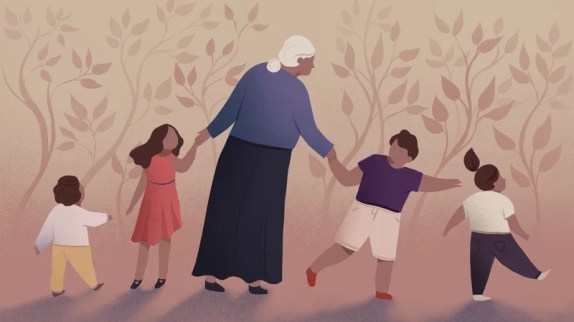
Robai-shin is sometimes translated as “grandmother mind.” And in her book Alive Until You’re Dead (Shambhala, 2022), the Zen teacher Susan Moon, herself a devoted grandmother, opts for this alternative translation. “Grandmother mind” deepens the concept of parental mind to include the qualities of warmth, empathy, wisdom, and compassionate understanding, tempered by grandmotherly sternness when required.

This attitude need not be limited to cooking. Nor is it the exclusive province of literal grandmothers. In the true spirt of Zen, Moon widens the concept to encompass anyone engaged in the interactions of everyday life. “If a young male monk can develop grandmother mind,” she writes, “then a person of any age, gender, and social status can develop it. You don’t have to be a grandmother to give your coat to someone shivering in the cold. A particular nod of recognition is due to all the grandfathers who are devoted to their grandchildren. Grandmother mind is simply a figure of speech. Even grandfathers can have grandmother mind.” Moreover, she notes in her conclusion, “Since we will become ancestors after we die, whether we like it or not, we might as well practice now by loving the beings we meet with grandmother mind, even if we aren’t grandmothers and even if they aren’t children.”

_______

Susan Moon, Alive Until You’re Dead: Notes on the Home Stretch (Shambhala, 2022), 57, 62.

Illustration by Nicole Xu.

 \

Read Full Post »

(more…)

Read Full Post »

800px-Norman_Fischer_3

Zoketsu Norman Fischer

“Why do we like being Irish?” asks the Irish poet Louis MacNeice (1907-1963) in his poem Autumn Journal (1939). In subsequent lines, he answers his own question:

Partly because

      It gives us a hold on the sentimental English

As members of a world that never was,

      Baptized with fairy water;

And partly because Ireland is small enough

     To be still thought of with a family feeling,

And because the waves are rough

     That split her from a more commercial culture;

And because one feels that here at least one can

     Do local work which is not at the world’s mercy

And that on this tiny stage with luck a man

     Might see the end of one particular action.

Because Ireland is a relatively small country, and because in MacNeice’s time families tended to stay put for as long as economic conditions allowed, Irish people could reasonably hope to see the “end”–the consequences as well as the completion–of any particular action. (more…)

Read Full Post »