Feeds:
Posts
Comments

Posts Tagged ‘ichigo ichie’

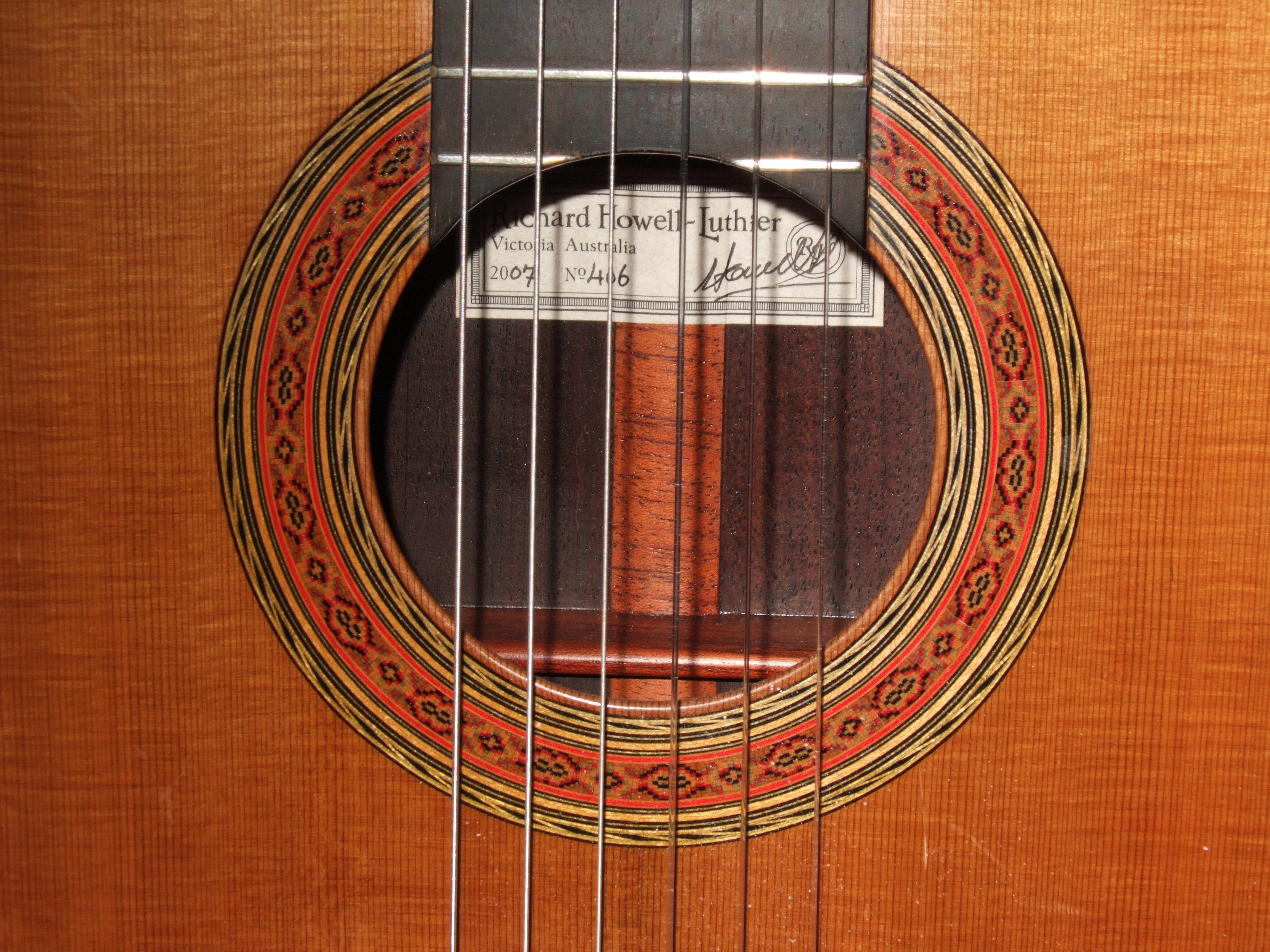
Richard Howell guitar 2007

If you enjoy listening to the classical guitar, you may be familiar with the Prelude from J.S. Bach’s Prelude, Fugue and Allegro (BMV 998), one of the most beautiful pieces in the standard repertoire. Composed for lute or harpsichord in the so-called “broken style” (style brise) of the French Baroque, the Prelude consists largely of arpeggiated chords. Played evenly and deliberately, the successive notes create an impression of wholeness, as though the chords’ original order had been restored.

Twenty-five years ago, I performed the Prelude in a master class at an international guitar festival in Toronto. The class was conducted by David Russell, then a rising star and now a concert artist of the highest distinction. Seated before me were some fifty guitarists and guitar teachers from around the world. To perform in such a setting was both exhilarating and daunting, not least because my audience had intimate knowledge of the piece I was playing. Interpretive felicities would not go unnoticed, but neither would mistakes.

Despite the stressful circumstances, I turned in a creditable performance. When I had finished, and the polite applause had died down, David Russell offered his critique.

To begin with, my tone had been inconsistent. I needed to work on that. Moreover, I had played the piece rather metrically, almost metronomically. I could allow myself and the music greater freedom. And most important, I had come down too hard at the ends of phrases. To avoid that unfortunate tendency, I might regard the last notes of phrases not as points of emphasis but as points of destination. “Think of them as arrivals,” David suggested.

Given the character of the Prelude, David Russell’s suggestion, however astute, was difficult to put into practice. Composed in 12/8 meter, the Prelude is marked by unceasing forward movement. With the exception of one long pause near the end, the score contains no moments of repose, no half notes, whole notes, or fermatas. If there are to be points of rest—points of arrival—the performer must consciously put them in. Or rather, the performer must be sensitive to natural, if reclusive, moments of repose.

In twenty-five years of playing the Prelude, I have never forgotten the principle articulated by David Russell. And over the years, I have seen how that principle may be applied in situations well beyond the bounds of musical interpretation, namely the practice of meditation and the conduct of everyday life.

With respect to meditation, Zen master Thich Nhat Hanh recommends that as we sit in stillness, we silently recite the verses, “I have arrived / I am home / In the here / And in the now,” letting these phrases accompany our inhalations and exhalations. More simply, we can inwardly recite the words “Arrive / home” and “Here / now” while breathing in and out. In that way, we counter the pressure, so prevalent in our culture, to be always on the move, always en route to somewhere else.

This practice is both pleasant and nourishing, and over time it can become an integral part of the daily round. Even the most hectic day contains moments of potential repose, in which we can cultivate a sense of arrival. And as with musical performance, we can honor those points of rest without losing our general momentum. By doing so, we may discover a hidden but inherent order, a rhythm akin to natural breathing. And we may also discover that even under the most anxious circumstances, it is possible to stop and collect ourselves before making our next move. Indeed, it is essential to do so, lest the life we’ve been given become little more than a shapeless, graceless succession of sixteenth-notes, played without meaning at breakneck speed.

____________________________

Per-Olov Kindgren’s rendition of the Prelude may be heard at http://www.youtube.com/watch?v=JDhv2f2mweE, Jan Depreter’s  at http://www.youtube.com/watch?v=LMXpCyS0We4 , and Julian Bream’s at http://www.youtube.com/watch?v=Fdi54PBPYC8.  David Russell plays the Prelude, Fugue, and Allegro on David Russell Plays Bach (Telarc 2003).

Read Full Post »

If you are near-sighted, as I am, you may have found that you can sometimes see nearby objects more clearly by taking off your glasses. Or, to put it another way, in the absence of your glasses, the inherent closeness of those objects becomes more apparent. What was supposed to enhance your vision was actually imposing a veil between yourself and the coffee cup in front of you.

One of the aims of Zen practice is to recognize such veils and, if possible, to remove them. According to Zen teachings, direct experience of the world—or what the Zen-trained teacher Toni Packer calls “fresh seeing”—is the one reliable basis for knowledge, understanding, and whatever wisdom we might acquire. Books and teachers may guide us, confirm what we have seen, or place our perceptions in an enabling context. But we must see things for ourselves. In Zen practice we cultivate direct seeing and a sense of intimacy, both with ourselves and with the world around us. Whatever stands in the way is to be set aside, or subjected to scrutiny, or cut asunder.

Of the conditions conducive to direct seeing, none is more important than the silence of meditation. “Only when I am quiet for a long time / and do not speak,” writes the poet Jane Hirshfield, “do the objects of my life draw near.” Elaborating her theme, she imagines that the proximate objects in her life, among them scissors and spoons and a blue mug, are deliberately keeping their distance from her. Even her towels, “for all their intimate knowledge,” are hesitant to come close. They are kept away by speech and thought, which separate self and other, the ego-centered mind and the things of this world. Only in those rare, egoless moments when she glimpses “for even an instant the actual instant” do the objects of her life draw near. At such moments, she fancifully suggests, each object emits a “sigh of happiness,” knowing that she has joined “their circle of simple, passionate thusness,” void of habitual, me-centered thought and the separation it imposes. (1)

Such intimacy is indeed a source of happiness. Conversely, a sense of separation can engender a deep and chronic suffering. In her essay “Touching Fear” Toni Packer addresses that reality:

“I’m never free of fear,” some people say, implying that there should be a state of mind and body that is free of fear. How can we possibly be free from fear when we live in the conditioned mode of the me-story most of the time? We’re deeply programmed to believe in this separate me by inaccurate language and by growing up in a world of other mes, all of whom think of and experience themselves as separate entities. . . . With separation inevitably goes fear and pain. (2)

Elsewhere, Packer quotes a questioner who asked, “Why does this me-ness, this self-centered feeling, arise when we realize that it causes such a painful sense of separation? How did it ever start in the first place?” Packer admits that she doesn’t know, but she also suggests that “all of us can watch me-ness as it is arising from moment to moment. We can find out about it if we are really deeply interested and curious.” (3)

Perhaps we can. And perhaps over time we can also discover ways to release ourselves from the me-centered tyranny of dualistic thinking, which places images and concepts between ourselves and the objects in our lives. By sitting still and not speaking, if only for the space of an hour, we can permit those objects to draw near, and we can rejoin what the poet Mary Oliver has called the “family of things.”(4) By taking off our conceptual glasses, we can see the world afresh, and see our place within it.

_____________

(1) Jane Hirshfield, Only When I Am Quiet and Do Not Speak,” Given Sugar, Given Salt (HarperCollins 2001), 23.

(2) Toni Packer, The Wonder of Presence (Shambhala 2002), 59

(3) Packer, 82

(4) Mary Oliver, “”Wild Geese,” Dream Work (Atlantic Monthly Press 1986), 14.

Read Full Post »

In our culture, new is usually considered better. And where so-called home improvements are concerned, that is often the case, especially if the new item is a high-efficiency furnace or a forty-year roof or an energy-saving kitchen appliance. But sometimes the situation is more complex than that, the effect more problematic.

Recently we installed new vinyl windows in our home. In contrast to the fifty-year-old relics they replaced, the new windows bring a soft, expansive light into our darker rooms. Gone are the small panes and splintered mullions. Gone, too, are the uncaulked cracks and loose-fitting frames that let out heat. Our house feels tighter now, and our carbon footprint will almost certainly be smaller.

Yet with this welcome change has come an unexpected loss. Clean and efficient though they are, our new windows lack a quality that was palpably present in the decrepit pine windows they replaced. In American parlance that quality is sometimes called “character,” and it is said to reside in such objects as weathered deck chairs, antique tools, and Willie Nelson’s battered guitar. Our rattling old windows, such as they were, had character; our new vinyl windows, whatever their environmental virtues, do not.

In Japanese culture, the quality I’m describing is known as sabi, and it has an integral connection to the practice of Zen. Often linked with wabi, which connotes simplicity and a life free of materialistic striving, sabi once meant “loneliness” or “solitude.” In modern usage, it means the quality of being old, worn, and faded—and all the more beautiful for the wear and tear. The architect Tadao Ando defines the quality in this way:

Sabi by itself means “the bloom of time.” It connotes natural progression—tarnish, hoariness, rust—the extinguished gloss of that which once sparkled. It’s the understanding that beauty is fleeting. .  . Sabi things carry the burden of their years with dignity and grace: the chilly mottled surface of an oxidized silver bowl, the yielding gray of weathered wood, the elegant withering of a bereft autumn bough.*

Noting that sabi “transcends the Japanese,” Ando finds it in “an old car left in a field to rust, as it transforms from an eyesore into a part of the landscape.” This, he suggests, might be considered “America’s contribution to the evolution of sabi.”

Beyond the aspect of age, the word sabi also connotes imperfection. Rooted historically in the tea ceremony, the aesthetic of sabi developed in the sixteenth century as an indigenous reaction to the expensive teaware imported from China. In contrast to the brilliant colors and ostentatious perfection of Chinese wares and utensils, the tea masters Murata Shuko, Takeno Jo-o, and especially Sen no Rikyu (1522-1591) introduced such rough, imperfect objects as stoneware buckets and tea bowls produced by local craftsmen. In subsequent centuries, the aesthetic thus established extended to a general appreciation of imperfect objects, whether the object be a bamboo screen or a leaky vase. As the feudal baron Lord Fumai (1751-1819), himself the owner of a leaky vase, explained, “The furyu [sabi] of this  bamboo vase consists in the very fact of this leakage.”**

Yet if the objects that embody sabi are imperfect, it is not because they were poorly made. Nor is their imperfection a sign of neglect. On the contrary, as Tadao Ando remarks, “wabi-sabi is never messy or slovenly,” and an unmade bed or a room cluttered with junk is not an expression of sabi. Objects that possess sabi do so because they are visibly in the process of breaking down and reverting to the state of nature. Their imperfection is a mark of their impermanence. To contemplate sabi is to be reminded of the emptiness from which all things come and to which they will return. It is also to be reminded of the dynamic web of life, in which energies are constantly being exchanged, and new forms are coming into being.

The aesthetic of sabi and the practice of Zen are branches of a single cultural tree, and they have much in common. In both, a heightened awareness of impermanence draws us closer to the evanescent beauty of the present moment.  In both, the pathos of things going in and out of existence mingles with a sense of infinite possibility. And in both, the realization that all things are transitory prompts us to value and care for our lives.

_______________

*Tadao Ando, “What is Wabi-Sabi?”   http://nobleharbor.com/tea/chado/WhatIsWabi-Sabi.htm

**Daisetz T. Suzuki, Zen and Japanese Culture ( Princeton 1970), p. 326.

See also Leonard Koren, Wabi-Sabi for Artists, Designers, Poets, & Philosophers (Berkeley: Stone Bridge Press, 1994).

Read Full Post »

2009_1114ABHVISIT20070004

Patience, we are told, is a virtue. As a child growing up in eastern Iowa, I heard that bromide more than once. However, as an adolescent I learned about patience not from listening to Methodist sermons or elders’ proverbs but by spending time with an exceptionally patient man.

His name was Sven Jorgensen, and he was the co-owner of Eble and Jorgensen Office Supply, where I worked after school, on weekends, and in the summers. Unlike Fred Eble, a former Navy Seabee and a tense, frenetic striver, Sven exuded steadiness and calm. Wiry, high-strung Fred dealt with the public and could often be found in the front of the store, filling out orders or talking on the phone. Thick-set, sedentary Sven worked quietly at his table in the back room, cleaning and repairing typewriters. Nearby was a photo of Sven and his dog Walt in a flat-bottomed fishing boat. Like his owner, Walt looked stable and relaxed.

To everyone in town, Sven Jorgensen was known as Speed. Speed Jorgensen. He acquired that name at the age of fourteen, when he barreled down a steep hill on his bike, rode into a pile of frozen leaves, and flew over the handlebars. He hadn’t realized that the leaves were frozen. Ever after, all physical evidence to the contrary, Sven would be known as Speed. It was a lifelong joke, played by the world on a slow-moving Swede.

At Eble and Jorgensen’s I sometimes waited on customers, made deliveries, or stocked shelves, but much of the time I worked in the back room, where dirty or broken typewriters waited to be restored. With his big Swedish hands Speed would carry them, one by one, to his table, where he put them in a deep tray half-filled with solvent. There he would clean their typebars with a solvent-soaked toothbrush, adjust their springs, replace broken or tarnished keys. When he was finished, even the most abused machine would function smoothly and look as good as new.

Much of the time, Speed worked silently, as did I, but sometimes we chatted as we worked. Or rather, I talked and Speed listened, offering advice when advice was sorely needed. Once, when I had manged to deliver rubber cement rather than duplicating fluid to an office, nearly precipitating a crisis, Speed sharply admonished me to be more attentive. On another occasion, when I was enumerating my father’s faults, Speed remarked, without looking up, that my father was a very nice man. And once, when I repeated a mean-spirited joke I’d heard at school, he told me in so many words that my joke was not very funny. I would not repeat it again.

In his unchosen role as friend and mentor, Speed taught partly by precept but mostly by example. What he exemplified was not only patience but also the virtue of slowing down, even when typewriters needed to be cleaned or supplies delivered. Working slowly but productively at his table, or pausing in his work to offer kind advice, he provided vivid proof that life could be lived at a slower pace, allowing time to look more deeply and act more wisely.

The pace at which Sven Jorgensen lived and worked is also the pace of meditation. “Do you have the patience to wait,” asks Lao-Tzu in the Tao Te Ching, “till your mud settles and the water is clear? / Can you remain unmoving / till the right action arises by itself?” And in his book Meditation as Contemplative Inquiry, the physicist Arthur Zajonc observes that “hurrying is antithetical to the required tempo of meditation”. Elaborating that point, he notes that “the tempo of meditation is the same as that of artistic attention; it is the rhythm of poetry. Speed hides all subtlety; and reality is subtle.” *

Which of us isn’t in a hurry? Although my son once referred to me as his slow-moving dad, I too can get in a rush, lose all patience, and miss the subtleties of experience. If I need a retardant, I can find it in the image of Lao-Tzu, writing immortal poetry in his mountain retreat. Or, closer to home, I can call back the memory of Speed Jorgensen at his table, patiently scrubbing an ink-filled “o,” or winding a cloth ribbon on a spool, or calmly wiping a well-worn platen.

___________

* Arthur Zajonc, Meditation as Contemplative Inquiry (Lindisfarne, 2009), 98.

Read Full Post »

46. Chazen ichimi

2009_1031ABHVISIT20070017

Hohryu Kyusu

For at least eight centuries the practice of Zen has been closely linked to the consumption of green tea. In 1191 the Zen monk Eisai returned to Kyoto from his studies in China, bringing a bag of tea seeds, which he planted in the temple garden. In 1211 he wrote Kissa Yojoki (The Book of Tea), Japan’s first tea book, extolling the healthfulness of green tea. Ever since, Zen practitioners have used green tea to nurture their bodies, soothe their minds, and keep themselves awake during their long hours of sitting. “Chazen ichimi,” declared the sixteenth-century tea master Sen Sotan:  “Zen and the taste of tea are one and the same”.*

Over the past two decades, health-conscious Americans have also brought green tea into their daily lives, but where taste is concerned, the reviews have been decidedly mixed.  “Would you drink green tea,” a skeptical friend once asked, “if you didn’t know it was good for you?” And another, whose taste in beverages runs to single-malt Scotch and a good Merlot, reported that he tried green tea and it tasted like pasteboard. If that is the taste of Zen, so much the worse for Zen.

If you too have tried green tea and found it not to your liking, that may be the end of the matter. However, if you already drink green tea but would like to enjoy it more, you can do so by making a small investment in equipment and by following a few time-honored instructions. With patience, care, and a little practice, you might find yourself enjoying a delicious, authentic cup of Japanese green tea.

First of all, you will need fresh tea. What is available in the supermarket or even in specialty tea shops is often anything but fresh. It may have been languishing in a tea bag or bin for a very long time. I order tea directly from Hibiki-an (www.hibiki-an.com), a  family-owned firm in Kyoto, and it arrives in a few days, sealed in a foil-lined bag. When I open the bag, the aroma of the unbrewed tea is itself enticing.

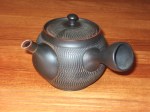
Second, you will need a kyusu, an earthenware teapot designed expressly for brewing green tea. For the price of a coffeemaker you can buy a kyusu online, and it’s well worth the expense. The distinguishing features of the kyusu include its hollow side handle and its interior mesh filter, which covers the opening of the spout. In contrast to the familiar infuser, the latter feature allows the tea leaves to open and to float freely in the water, releasing their flavor.

Third, you will need the softest, purest water you can find. Hibiki-an recommends Evian, Rocky Mountain, and other bottled waters. Here in Western New York, I use Chemung Spring Water, and it has proved equal to the task.

Fourth, you will need to pay attention to the temperature and the brewing time. On most mornings I drink a refreshing Sencha tea, which is brewed at 176 degrees Fahrenheit for sixty to eighty seconds. Other teas require other temperatures and brewing times. At first, you will need to use a thermometer and to watch the time very carefully. Later on, you can dispense with the thermometer, and you can adjust the prescribed time to suit your taste.

To prepare two cups of Sencha tea, you will need a kyusu and three small teacups. To brew the tea, please follow these instructions:

–Boil the water, let it cool for a minute, and pour it into the kyusu.  When the water has cooled for another minute, pour it into two of the three cups. Drain any remaining water from the kyusu.

–Next, pour the water back and forth among the three cups. This process heats the cups and further cools the water. It also allows the water to oxygenate, which improves the flavor of the tea.

–Check the temperature. When it is around 176 degrees, add a tablespoon of loose Sencha tea to the heated kyusu and pour in just enough water to cover the leaves. Replace the lid, and wait for twenty seconds, letting the leaves absorb the water. Then add the rest of the water, and brew for a minute or slightly longer.

–Now pour the tea alternately into two of the cups, and offer one to your guest. Lifting your own cup with both hands, take time to inhale the aroma of the tea. Contemplate its provenance, its impermanence, and its beneficial influence on your mind and body. Then drink it slowly, with full attention, and enjoy the taste of Zen.

_____________________________________

*For further information, see Barry Briggs’ weblog  Go Drink Tea at http://www.godrinktea.com/. See also D.T. Suzuki, Zen and Japanese Culture (Princeton, 1993), pp. 269-314; Soshitsu Sen, Tea Life, Tea Mind (Weatherhill, 1979); and Kakuzo Okakura, The Book of Tea (Stone Bridge Press, 2007).

Read Full Post »

Garden Buddha, by Robin Caster

Garden Buddha, by Robin Caster

If you have lived in America for the past two decades you have almost certainly been enjoined to take care. Among contemporary American expressions, that benign valediction ranks with Have a nice day in frequency of use, and it is often used in much the same way. What we are supposed to take care of is left unspecified, but that is beside the point. Take care of everything, the phrase might well be saying, until we meet again.

Zen teachings also admonish us to take care. In her book Mindfully Green, the environmentalist Stephanie Kaza provides a vivid example:

In Zen kitchens, students are trained in what is called “knife practice,” that is,  how to take care of knives properly. First, this means noticing the properties of  the knife while you are using it—its weight, its sharp edge, the way it feels in the  hand, how it cuts. Then, when you’re done with the knife, it means washing and drying it immediately and putting it back in the chopping block to keep the knife safe. Doing this practice faithfully changes your relationship with knives. You are practicing caretaking as an investment in the well-being of things. This is the opposite of consuming things until they are gone. *

As here described, “knife practice” exemplifies conservation and ecological awareness. Taking care of our kitchen knives, we also take care of the planet Earth.

Knife practice is but one instance of samu, or work practice, which is as integral to Zen as sitting meditation. In Zen centers and monasteries, residents and guests alike devote at least an hour a day to caretaking: to scrubbing steps, cleaning bathrooms, chopping vegetables, and other mundane chores. As a practical matter, these daily labors keep the zendo clean and running smoothly. Beyond that, they train Zen students to “lower the mast of the ego,” respect the humblest pot or pail, and concentrate on one thing at a time. Performed in silence and with full awareness, work practice prompts the practitioner to examine conventional notions of low and high, menial and exalted labor. And as an embodiment of an ethic, it extends beyond the zendo into domestic life, where the same principle may be applied to the care of a house or garden, bicycle or car.

The ethical principle of “taking care” also extends beyond the care of material objects. Broadly interpreted, it includes the care of one’s body, mind, and heart, moment by moment, through the practice of meditation. Zen master Thich Nhat Hanh puts it this way:

To meditate means to go home to yourself. Then you know how to take care of the things that are happening inside you, and you know how to take care of the things that are happening around you. All meditation exercises are aimed at bringing you back to your true home, to yourself. Without restoring your peace and calm and helping the world restore peace and calm, you cannot go very far in the practice.**

In keeping with this admonition, Thich Nhat Hanh directs us to bring awareness to the parts of our bodies, moving systematically from the eyes to the lungs to the heart, and so on. In another exercise, we bring awareness to our sensations, noting whether they are pleasant, unpleasant, or neutral. And in another, we attend to our states of mind, including those of anxiety and anger. If we are experiencing the latter, we are urged to take care of it, as a parent might care for a crying child. Rather than vent or suppress our anger, we bring a gentle attention to its presence. By so doing, we allow its energies to disperse or to change into something more constructive.

The wisdom of Zen is not confined to arcane koans or ancient Chinese stories or the cryptic sayings of the masters. It also resides in everyday life—or, in this case, in the commonest of American expressions. So may I suggest that when you hear that expression, you regard it not as an empty cliché but as wise and timely advice. Let it remind you to take care.

___________________________

*Stephanie Kaza, Mindfully Green: A Personal and Spiritual Guide to Whole Earth Thinking (Shambhala 2008), 135.

**Thich Nhat Hanh, “This Is the Buddha’s Love,” an interview with Melvin McLeod, Shambhala Sun (2008), http://www.shambhalasun.com/index.php?option=content&task=view&id=2882.

Read Full Post »

Since the death of Walter Cronkite in July, much has been written about the late anchorman’s moral authority. According to a Roper poll taken in 1974, Walter Cronkite was “the most trusted man in America”. When he gravely intoned his signature line, we believed him. However shocking or sad the reality just reported, that’s the way it was. The CBS Evening News with Walter Cronkite had opened a window on things as they were.

Zen practice also aims to put the practitioner in touch with reality, as it is in this very moment. And every Zen center or monastery has, as it were, its own Walter Cronkite. Whether he or she is called Abbot, Sensei, Roshi, or simply “head teacher,” the person in this position embodies the inherited wisdom and the venerable authority of the Zen tradition. If the person is a “lineage holder,” which is to say, has received “Dharma transmission” from an earlier teacher, the weight of authority is even greater. It is, in most instances, unquestioned, and one of the core requirements of a prospective Zen student is to believe in the teacher. If a Zen student is unable to do that, the student is well-advised to find another teacher.

Yet if the structure of the traditional zendo is authoritarian, the practice itself is quite the opposite. It is radically egalitarian. From the start, Zen students are enjoined to rely on direct experience: to trust their senses, not the words of any teacher. Every morning, students in Rinzai Zen training chant the verses “Atta dipa / Viharata / Atta sirana / Ananna sirana,” which roughly translate as “You are the Light / Rely on yourself / Rely on nothing but yourself”. This is followed by “Dhamma dipa / Dhamma sirana / Ananna sirana,” which translates as “Rely on the Dharma / Rely on nothing but  the Dharma”. Although the word Dharma has multiple meanings, in this context it is best understood as “reality,” or “the laws of reality,” most prominently those of  impermanence and interdependence. It is left to us to perceive those laws—and to realize ourselves within our immediate surroundings. As one ancient Chinese master told his student, “I can’t  wear clothes for you. I can’t eat for you. . . I can’t carry your body around and live your life for you”. We must do these things—and know we doing them—ourselves.

How, then, is the near-absolute authority of the Zen teacher to be reconciled with the imperative to trust direct experience and rely on ourselves? And to the extent that we embrace a particular Zen lineage, to what extent are we free to question its authority? To speak for ourselves?

For Toni Packer, who left the Rochester Zen Center to establish the Springwater Center for Meditative Inquiry, the resolution lay in dropping the liturgy, forms, and hierarchies of traditional Japanese Zen, leaving only the sitting, listening, and questioning. For traditionalists, however, the resolution lies not in discarding hierarchical structures but in clearly defining the teacher’s role. Often that role is likened to a mirror, which reflects the present state of the student’s mind and heart.

In my own experience, the most helpful teachers have been those who have urged their students to look honestly into their lives, moment by moment, and to act in accordance with what they see. Rather than answer abstract questions with absolute authority, such teachers return their students, time and again, to the concrete, reliable practice of zazen: to a direct and continuous contact with reality, just as it is. Only then can the student realize the richness and depth of present experience. Only then can he or she say, with any real authority,  “That’s the way it is”.

Read Full Post »

For many people, summer is the season for travel. And for those who practice a contemplative discipline, travel can be a catalyst for spiritual growth. The seventeenth-century poet Basho, master of haiku and author of The Narrow Road to the Deep North, believed that “nothing is worth noting that is not seen with fresh eyes”. His extensive travels freshened and enlarged his vision. Thomas Merton had similar experiences in Asia, as recorded in his Asian Journal.

Yet for those whose primary discipline is Zen meditation, travel can also present a formidable challenge. Insofar as the practice of Zen requires us to sit still, and travel requires us to be on the move, Zen and travel appear to be at odds. How might the one support the other? How might the practice of Zen be integrated with the experience of travel?

To begin with, the practice of meditation can alleviate the anxiety of travel. One of my friends told me the story of being in an international airport on a day when many flights had been canceled. People were berating ticket agents, yelling into their cell phones, and experiencing general misery. Then, as it happened, the Vietnamese Zen master Thich Nhat Hanh arrived in his brown robes, accompanied by the monks and nuns of Plum Village. Silent, gentle, and slow-moving, their presence transformed their environment. People quieted down.

Not everyone, of course, can be so fortunate as to have a troupe of Zen monastics on hand to relieve the fear of travel. But meditative practice, as taught by Thich Nhat Hanh, can calm the fearful mind. As he explains in his book by that title, we can lessen our anxieties not by drugging them with Valium or Johnnie Walker but by honestly acknowledging them and bringing a kind attention to their presence. “Breathing in, I am aware of my anxiety. / Breathing out, I bring kind attention to my anxiety.” Over time, this simple practice can help to diminish the anxiety of travel.

So can the practice of sitting still, even when surrounded by incessant movement. Meditation is often described as a way of “stopping” and “coming home”. By sitting still and following our breathing, we return to the stability of immovable awareness. We restore our equanimity. To be sure, it can be awkward to stop when everyone else is moving or to sit perfectly still in a public place. But we can find ways to sit still without calling attention to ourselves. And more often than not, passers-by are too preoccupied with their own affairs to care whether we are moving or sitting still.

Beyond the maintenance of personal balance, Zen practice can also deepen the experience of travel.  In an earlier column I described the exercise of asking “What is this?” and regarding the things of this world as if we were seeing them for the first time.* When traveling, we really are seeing things for the first time—and quite possibly the last. By asking “What is this?” we become present for whatever we are seeing, be it a glacier in Alaska or a cathedral in Madrid. And the places we see, in turn, become present for us. Later on, we can learn their names and study their histories. But by asking “What is this?” we open ourselves to our immediate experience.

Eihei Dogen, founder of the Soto school of Zen, cautioned against unnecessary travel. “It is futile to travel,” he advised, “to dusty countries, thus forsaking your own seat”. But Dogen was hardly one to talk, being himself a traveler who sojourned in dusty China and brought the practice of Chan back to Japan. And for the resourceful practitioner, travel can become a form of “skillful means,” complementary to sitting meditation and consistent with its purpose.

May your travels be safe and your flights on time.

___________________________________

* Column 34, “What is This?”

Read Full Post »

If you have looked closely at advertising copy, you may have noticed how often the word perfect appears in printed ads, whether the product be an appliance, an item for the garden, or a vacation rental. For only $18.97 you can own Black and Decker’s 2-Slice Toaster with Electronic Shade Control, which will provide you with “perfect toast and bagels every time”. If you would like to spruce up your lawn, Patch Perfect Grass Seed  will ensure “perfect even coverage every time”. If travel is on your horizon, Summer House on Winter Bay, a rental property on Prince Edward Island, offers “the perfect choice for your golfing group, family reunion, or destination wedding”. And if you would like to enhance your experience of Zen meditation, you can buy a Mountain Timer from Zen Mountain Monastery at a cost of $145.00, plus shipping and handling. Designed to free you from glancing at a clock, the Mountain Timer is the “perfect complement to the stillness of meditation.”

As these examples suggest, the word perfect (together with ideal, its first cousin) has become a buzzword in the advertising business, if not a mantra.  Presumably, the word has become prominent because it has proven to be effective. What does its prominence tell us about its targeted clientele, namely ourselves?

The most obvious answer is that advertising appeals to our desires, and we would like the objects of those desires to be perfect, or as close to perfect as possible. Why settle for burnt toast or mediocre bagels? Why put up with a spotty lawn or a less-than-perfect vacation spot? And why use a stick of incense (the traditional method for timing a sitting) when you can have the perfect complement of a Mountain Timer? Fueling our fantasies, the word perfect feeds and creates our appetites and longings.

At a more covert level, the word also sends the message that our present lives—and by extension, our present selves—are woefully imperfect. By buying the perfect toaster we will help to remedy that remediable situation. By becoming smart, informed consumers, we will fill the vacancies in our daily round. By investing in a perfect future, we will relieve our present suffering.

As can be seen in the ad for the Mountain Timer, American Zen has not been impervious to Western consumer culture. On the contrary, meditation has often been sold as a form of stress reduction or promoted as a mode of self-improvement. But the primary aim of Zen practice is not to reduce stress or to place new heads, as one of the teachings puts it, on top of our present ones. Rather, it is to cultivate a clear and stable awareness of what is going on, within and without, and to free ourselves from our negative conditioning. And if one persists in the practice, what one is likely to see, clearly and unequivocally, is the connection between our conditioned images of perfection and the suffering we inflict on others and ourselves.

“My love, she speaks like silence,” Bob Dylan sang in 1965, “without ideals or violence.” In the same song (“Love Minus Zero / No Limit”), he contrasted his lover’s serene self-containment with the dissatisfaction of “bankers’ nieces” who “seek perfection / expecting all the gifts that wise men bring”. Over the past four decades, we have witnessed the horrific violence that misguided idealism can loose upon the world. And in the past year we have seen the economic ruin that unbridled greed can foster. Looking inward, can we also see how unexamined notions of perfection lead us to destroy our happiness, impose unrealistic expectations on ourselves and others, and devalue our present lives? Can we learn to live more wisely?

Read Full Post »

In New York State you can own a Personalized License Plate, better known as a vanity plate, for $ 43.00. To retain your plate you will need to pay an annual fee of $ 25.50. Depending on your viewpoint, that is a lot or not much to pay for the privilege of having your name—or that of your trade, your passion, or your favorite sport—emblazoned on your car.

As I was driving on the New York State Thruway the other day, I came upon the ultimate vanity plate. Pulling into a rest stop, I noticed the out-of-state license plate on a sporty silver car. In bold black letters, it proclaimed its owner’s first concern:

ME

On either side of these letters were several inches of white space, which gave further prominence to this one, all-important word.

It’s common to hear the word “me” in conversation, but it was striking to find that word isolated on a license plate. I was reminded of a poem by my one-time mentor, the Maine poet Philip Booth (1925-2007). Entitled “Marches,” the poem is an exploration of seasonal change and human mortality.

In the first four stanzas the narrator reflects on the advent of spring, imagines the young “wading the surf, getting wasted, pretending / they cannot die,” and envisions “thousands of death-needles” being passed, leaving “hundreds of / children. . . born with systems in no way immune”. In the last two stanzas, he reflects on  the imminence of death in everyday life, especially life on the highway:

And millions of the rest of us, self-righteous

in the perfect democracy of backcountry roads, freeways,

and interstates, pass each other at life-span speeds;

or close, in opposing lanes, at a hundred-and-thirty,


trusting implicitly in simple self-interest, missing

each other, time after time, only by fragments of seconds,

as we move our lives, or dyings, another round toward

what March may be like in maybe the year 2000.*

Yes, the roads are dangerous, these lines acknowledge, but no one wants to die, and we can depend on each other’s self-interest to keep us alive.

This vision of interdependence is common in Western culture. In sociological terms, it is often called Western individualism; in economic terms, the free-market economy. In America this view has prevailed for at least two hundred years, though of late its economic version has not been faring so well. But there is another vision of interdependence, which the Vietnamese Zen master Thich Nhat Hanh describes in this way:

In our ordinary discriminatory world, we see a teapot as a single, independent object. But when we look deeply enough into the teapot, we will see that it contains many phenomena—earth, water, fire, air, space, and time—and we will realize that in fact the entire universe has come together to make this teapot. That is the interdependent nature of the teapot. A flower is made up of many non-flower elements, such as clouds, soil, and sunshine. Without clouds and earth, there could be no flower. This is interbeing. The one is the result of the all. What makes the all possible is the one.**

In this vision of interdependence, everything depends on everything else. All are interconnected parts of the great, indivisible body of reality, in which energies are constantly being exchanged, and what we normally call “things” are being transformed, moment by moment. To describe that reality, Thich Nhat Hanh has coined the word “interbeing.”

In Japanese Zen, the reality of “interbeing” is epitomized by the Japanese word “mu,” which literally means “no” but in Zen usage has no extractable content. Rather, it is a way of pointing toward things as they are at any given moment—impermanent, void of intrinsic selves, and utterly dependent upon each other. In contrast to “me,” “mu” evokes a fundamental mutuality and engenders a spirit of compassion. Were I to see it on a license plate, I would feel safer on the road.

_________________________________

*Philip Booth, Selves (Viking 1990), 56

**Thich Nhat Hanh, Transformation at the Base: Fifty Verses on the Nature of Consciousness (Parallax Press 2001), 77

Read Full Post »

« Newer Posts - Older Posts »