Feeds:
Posts
Comments

Posts Tagged ‘ichigo ichie’

“Calm the heart’s dark waters,” advised the third-century Chinese poet Lu Chi. “Collect from deep thoughts the proper names for things.”

I was reminded of Lu Chi’s admonition the other day, when I came upon a poem by the Irish poet Pearse Hutchinson (b. 1927). Entitled “She Fell Asleep in the Sun,” the poem concerns the children of unwed mothers.  Embedding Irish-Gaelic phrases within his English text, Hutchinson presents two, very different ways of describing such children. In so doing, he also presents two contrasting perspectives on human frailty.

“She fell asleep in the sun,” explains the narrator of the poem, is an Irish way of saying that a young woman got pregnant unintentionally. “That’s what they used to say,” the narrator recalls, “in South Fermanagh / of a girl who gave birth / unwed.” Shifting the scene to County Kerry, the narrator invokes a phrase used in that part of the country: “leanbh on ngrein: / a child from the sun.” As a third example, he describes another “child from the sun”: a “little lad running round a farmyard” in North Tipperary. Watching the child, his “granda” remarks that the boy is “garsuinin beag mishtake.” That phrase may be translated as “the little lad’s a mistake” or “the lad’s a little mistake.”

Taken together, the Irish phrases in Hutchinson’s poem express an attitude of realism, acceptance, and forgiveness. In subsequent stanzas, the narrator praises that attitude—and wonders whether it can survive in modern times:

A lyrical ancient kindness

that could with Christ accord.

Can it outlive technolatry?

or churches?


Not to mention that long, leadranach,

latinate, legal, ugly

twelve-letter name not

worthy to be called a name,

that murderous obscenity—to call


any child ever born

that excuse for a name

could quench the sun for ever.*

Pairing a narrow morality, as preached in certain churches, with the worship of technology, these lines inquire whether the Christ-like kindness of the older culture can endure in twentieth-century Ireland. Embodied in the phrases of an endangered language, that kindness seems itself endangered, a mode of feeling that may soon be leaving the world.

Among the forces eroding that mode of feeling, Hutchinson cites a  “legal, ugly, / twelve-letter name.”  As the reader may readily infer, that unspoken, Latinate name is illegitimate. In contrast to the vivid, concrete Irish phrases, the abstract English word conveys a tedious (leadranach), judgmental attitude toward the mother’s “mistake” and the child who must bear the consequences of her actions. Rather than welcome the child into the human family, the English word defines him as an outcast, murdering his spirit and quenching the life-giving sun.

Of the two perspectives in his poem, Hutchinson clearly favors the first. Adopting that perspective, we might empathize with the plight of mother and child. We might look into the conditions that brought her son into being and try to imagine the life ahead of him. And we might also admit that at times we have done foolish, irresponsible things ourselves. Adopting the second perspective, however, we might observe that the child is indeed illegitimate, as judged by accepted norms, and that to call him a child from the sun is to soften a social reality, poeticize a legal fact, and implicitly condone unwed motherhood. In passing we might note that calling a child a “mistake” may be only a little less damaging than calling him illegitimate.

One of the virtues of meditative practice, Zen included, is that it allows us the space and freedom to examine our responses to human frailty, whether judgmental or compassionate or somewhere in between, before taking action or saying a word. In contemporary American culture, the judgmental response has become reflexive, even in putatively “spiritual” circles. But a compassionate response is also possible, and the mind of compassion is often more penetrating than that of moral judgment, which tends to distance us from the conditions of human suffering. And should we deign to look deeply into the heart’s dark waters, we may discover that in our own ways we too are children from the sun.

_______________

*Pearse Hutchinson, “She Fell Asleep in the Sun,” An Anthology of Modern Irish Poetry, ed. Wes Davis (Harvard University Press, 2010), 183-4.

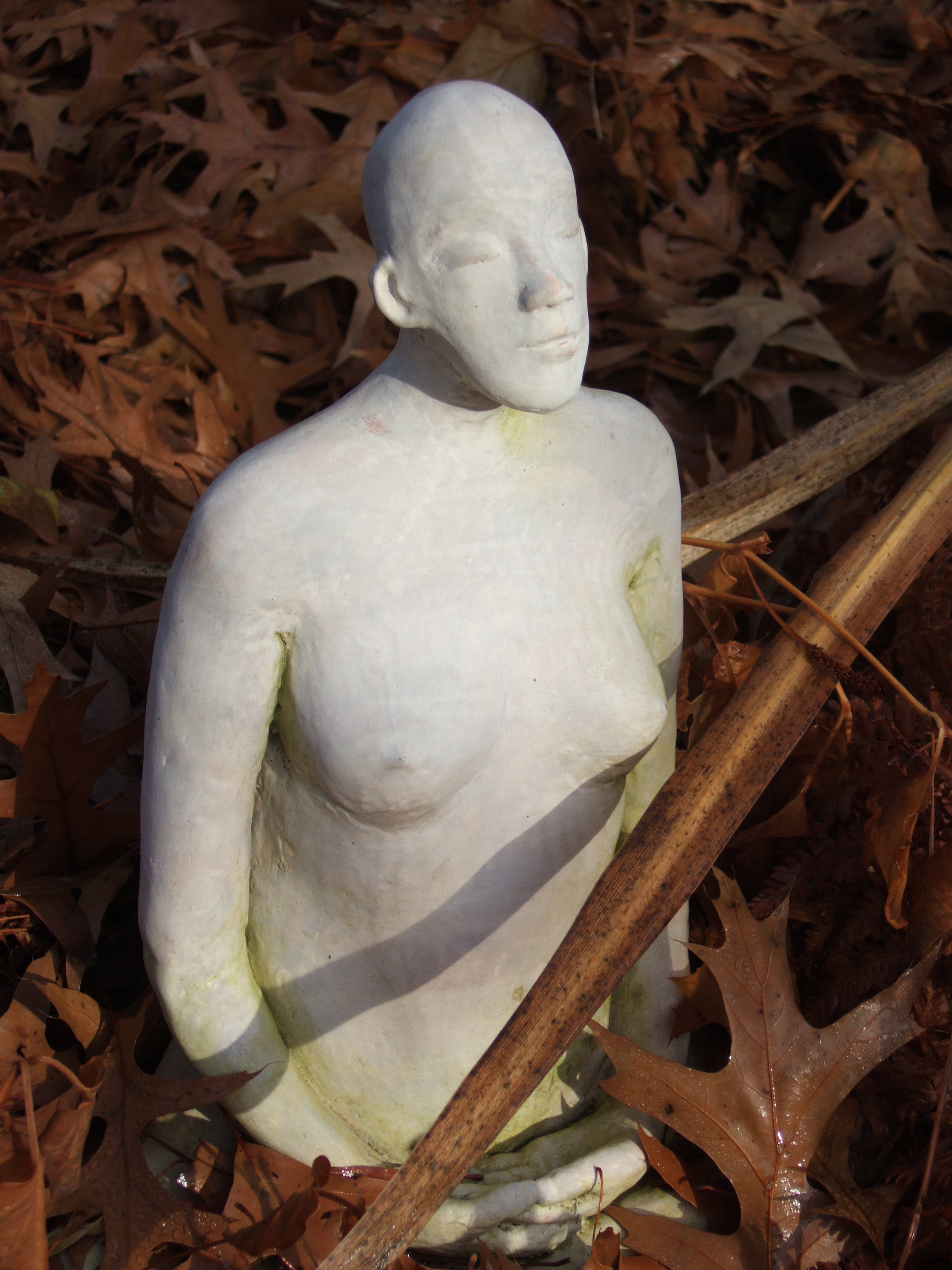
Garden sculpture by Robin Caster Howard.
Read Full Post »

One afternoon last summer, I did what many people seem to do: I stepped out of a hotel elevator and took a wrong turn. Realizing that I was headed toward a potted plant rather than my room,  I did a discreet about-face, maintaining my dignity as best I could. What were you thinking?I asked myself. Assuming that I was thinking at all, my thoughts had not been in accord with reality.

To point the thinking mind in the direction of reality is an abiding aim of Zen meditation. In Zen teachings, such thought is called “Right Thinking,” “right” meaning “in accordance with things as they are.” To help us cultivate Right Thinking, Zen master Thich Nhat Hanh has devised four practices, which can be employed whenever we have a decision to make or a problem to solve. Taken singly, these practices help to align our thinking with reality. Taken together, they provide a guide to wise and harmonious living.*

The first practice is to ask ourselves, “Are you sure?”  As Thich Nhat Hanh has often observed, many of our perceptions are erroneous, and erroneous perceptions cause suffering. To take but one example, the recent Pew Forum survey of religious knowledge found that more than a quarter of Americans thought that the Golden Rule was one of the Ten Commandments. While that misperception is unlikely to cause much suffering, it well illustrates the disparity between belief and fact, a disparity that seems to be growing larger every day, as misinformation proliferates and is distributed at lightning speed. Thich Nhat Hanh recommends that we write “Are you sure?” on a large piece of paper and hang it where we will see it often. Perhaps it would make a good screen saver as well.

The second practice is to ask ourselves, “What am I doing?” Although the answer might seem obvious—“I am feeding the birds”; “I am reading a column on Zen meditation”—this question counters the habit of rushing into the future. It returns us to the present moment. For example, if you are up on a ladder cleaning out your gutters but thinking about something else, asking this question can bring your wandering mind back to the task at hand. That is important for your safety as well as your presence of mind. Asking “What am I doing?” can also reveal the extent to which our thoughts are conditioned—if not created—by whatever we are doing. Having that awareness, we may be less inclined to believe our passing thoughts or lose ourselves in speculation.

The third practice is to say, “Hello, habit energy.” By “habit energies” Thich Nhat Hanh means our “ingrained thoughts,” our habitual patterns of thinking and behaving. “Our way of acting depends on our way of thinking,” he observes, “and our way of thinking depends on our habit energies.” To become aware of those energies is often to diminish their power. And by addressing our habits directly, we accept and befriend them, rather than feel guilty about having them. Over time, this practice can keep us from applying tired, habitual ways of thinking to fresh situations. Insofar as we can recognize the habitual components in our thinking, we can respond with wisdom rather than react with reflexive judgment.

The fourth practice is bodhicitta, which translates as “the mind of love.” In Thich Nhat Hanh’s words, the mind of love is the “deep wish to cultivate understanding in ourselves in order to bring happiness to many beings.” By making bodhicitta the basis of our thinking, we guide ourselves toward compassionate speech and action. This practice may well be the most important of the four, but in my experience it is also the one most likely to be forgotten when conflict arises. How easy it is to think poorly of someone who has insulted us. How hard it is to cultivate the mind of love when subjected to calumny or manifest injustice. Yet not to do so is to cloud one’s thinking and to foster speech and actions that one may later regret. Like the other practices, bodhicitta affords us protection as well as guidance, steering us away from actions that will do harm to ourselves and others.

As Thich Nhat Hanh makes clear, the practice of Right Thinking is not a substitute for meditation. The practice is merely a “map,” and when we have arrived at our destination, “we need to put down the map and enter the reality fully.” That is sound advice, especially for the practice of Zen, which regards conceptual thinking, however wise or foolish, as a barrier to the direct experience of reality. But the map provided by Thich Nhat Hanh can prepare us for meditation, and it can assist us in implementing meditative insight. Like a patient friend, it can help us find our way.

_______________

*Thich Nhat Hanh, The Heart of the Buddha’s Teaching (Parallax, 1998), 55-58.

Read Full Post »

If you have looked hard at a single object, you may have found that an image of the object lingers even after you’ve looked away.

Such is my experience every morning, when I drink green tea from a small porcelain cup. Looking down, I see the cup’s white rim, which forms a perfect circle. Looking up, I see that same circle, now in black, projected against the bamboo rug.  In its main features the image resembles the enso, or Zen circle–a symbol of enlightenment and absolute reality.

Not all images are so benign, nor is their duration so brief. The poet Ezra Pound famously defined the image as “an intellectual and emotional complex in an instant of time.” And if that image is laden with emotional content, it may be virtually ineradicable. In her poem “Quai d’ Orleans,” Elizabeth Bishop observes barges on the river Seine, comparing their wakes to giant oak leaves, which extinguish themselves on the sides of the quay. Deepening her analogy, Bishop contrasts the disappearance of the wakes with the endurance of human memories, especially memories of loss. “If what we see could forget us half as easily,” she reflects, “as it does itself—but for life we’ll not be rid / of the leaves’ fossils.”*

Zen meditation is essentially a process of stopping and looking. Amidst the multiple distractions of everyday life, the images in our psyches may well escape notice, but when we sit still, follow our breathing, and have a look at our interior lives, those images often return with a vengeance, bearing their cargo of memories and associations. How, if at all, should we respond to them? What, if anything, should we do?

Perhaps the most reflexive response is to pursue the image: to dwell in the past. Encountering the image of a barge, for example, I might recall the scenes of my childhood, when I sat for hours on the banks of the Mississippi River, watching the barges pass. Pushed by powerful “towboats,” those massive platforms transported steel, coal, and other freight north toward Lock and Dam 13. Viewed from a distance, the barges appeared to be moving slowly, as they rounded the bend and gradually disappeared. But in fact they were moving at a rapid, dangerous clip, and boaters were well advised to stay out of their way. Remembering their bulk and speed, I recall that one of my schoolmates, a third grader named Michael Stone, drowned one night beneath a barge. A few days earlier, I had wrestled with him on the playground.

Such memories haunt us, and it is tempting to pursue them. But to do so is not the way of Zen meditation, whose aim is situate our minds and hearts, vividly and continuously, in the reality of the present moment. The Bhaddekaratta Sutta (Sutra on the Better Way of Living Alone), a guiding text for Zen practitioners, states this aim directly:

Do not pursue the past.

Do not lose yourself in the future.

The past no longer is.

The future has not yet come.

Looking deeply at life as it is

in the very here and now,

the practitioner dwells

in stability and freedom.

The sutra goes on to explain what is meant by “pursuing the past”:

When someone thinks about the way his body was in the past, the way his feelings were in the past, the way his perceptions were in the past, the way his mental factors were in the past, the way his consciousness was in the past; when he thinks about these things and his mind is burdened by and attached to these things which belong to the past, then that person is pursuing the past.

By contrast, when a person thinks about those same things but his mind is neither “enslaved by nor attached” to them, then that person is not “pursuing the past.”**

To think about the past without being enslaved by it is a formidable challenge, but there are ways of meeting that challenge. Jack Kornfield, a clinical psychologist and renowned Vipassana teacher, advises us to heal the wounds in our psyches by bringing meditative awareness—“that which knows”—to our painful memories. Similarly, Zen master Thich Nhat Hanh urges us to review the past and “observe it deeply” while “standing firmly in the present.” In that way our destructive memories can be transformed into something constructive. In either case, the method is first to ground ourselves in the present, and second, to cultivate a generous, clear awareness, in which images from the past, however troubling or enticing, arrive and last for a while but do not become objects of obsessive thought. Like barges observed from a river bank, they interest but do not overwhelm us.

___________________

* Elizabeth Bishop, “Quai d’ Orleans,” The Complete Poems: 1927-1979 (Farrar, Straus and Giroux,1984), 28.

**Thich Nhat Hanh, Our Appointment with Life: Discourse on Living Happily in the Present Moment (Parallax, 1990), 6.

Enso (Zen circle) by Shinge Roko Sherry Chayat Roshi.

Read Full Post »

Sheila Pepe at Alfred University

This is the season when students go back to school. Here in Alfred, New York, the college students have already returned, and the yellow buses will soon be rolling again. There is a youthful freshness in the air.

Zen students also go back to school, but that action occurs with each new sitting, each fresh encounter with things as they are. Shunryu Suzuki Roshi describes the process in this way:

Once in a while you should stop all your activities and make your screen white. That is zazen. That is the foundation of our everyday life and our meditation practice. Without this kind of foundation your practice will not work. All the instructions you receive are about how to have a clean white screen, even though it is never pure white because of various attachments and previous stains.*

The clean white screen to which Suzuki Roshi refers is a mind without prejudice or expectations, judgments or rigid notions. In the Zen practice of shikantaza, or “just sitting,” the mind of the practitioner becomes the mental counterpart of a clean new notebook—or what, in grade school, we used to call our tablets. Open and unmarked, such a mind is ready to receive whatever comes its way.

Yet, as Suzuki observes, the screen is not pure white. Attachments and stains prevent our minds from being immaculate or entirely open. Prominent among those attachments is our fear of the unknown and our expectation, conscious or otherwise, that whatever we encounter should fit our preconceptions. And prominent among the stains is our previous knowledge, which ought to help us interpret experience but often has the opposite effect.

Commenting on what Zen calls “the barrier built of knowledge,” Zen master Thich Nhat Hanh distinguishes between mere knowledge and true understanding:

Old knowledge is the obstacle to new understanding. . . . Like those who are awakened, great scientists have undergone great internal changes. If they are able to achieve profound realization, it is because their powers of observation, concentration, and awareness are deeply developed.

Understanding is not an accumulation of knowledge. To the contrary, it is the result of the struggle to become free of knowledge. Understanding shatters old knowledge to make room for the new that accords better with reality. When Copernicus discovered that the Earth goes around the sun, most of the astronomical knowledge of the time had to be discarded, including the ideas of above and below. Today, physics is struggling valiantly to free itself from the ideas of identity and cause/effect that underlie classical science. Science, like the Tao (Way), urges us to get rid of all preconceived notions. **

Whether the preconceived notion is that of the pre-Copernican universe or the assumption of cause and effect, conventional wisdom quickly grows obsolete, and it can bar the way to a deeper understanding. Elsewhere, Thich Nhat Hanh defines that understanding as “direct and immediate perception,” “an intuition rather than the culmination of reasoning.”

To cultivate direct, intuitive perception is the real work of the Zen practitioner. That work may be aided by the acquisition of conceptual knowledge, including intimate knowledge of Zen teachings and traditions. But unless that knowledge is integrated with direct experience, it can indeed become a positive hindrance. For the work of the Zen practitioner is to enter this present moment, becoming fully and sometimes fiercely aware of whatever is occurring. And as Roko Shinge Roshi has observed, to enter the present moment we “have to let go of everything extraneous—what we think regarding this moment, what we add to it, or try to take away from it.” Practicing Zen is not a process of acquisition, nor is its aim the mastery of a body of knowledge. On the contrary, it is in large part a process of unlearning, of becoming aware of our layers of conditioning rather than adding another layer.

To those of us who grew up in the competitive world of Western education, such a practice runs against the grain, and it may seem formidably foreign. But insofar as the aim of Zen practice is to help us navigate a complex, rapidly changing world, it shares common cause with our universities, colleges, and schools. And insofar as the practice engenders, as it often does, a passion for inquiry and a heightened sense of discovery, its spirit is congruent with that of Western education. In each new moment, we are going back to school.

_____________

*Shunryu Suzuki, Not Always So (HarperCollins, 2002), 51-52.

**Thich Nhat Hanh, The Sun My Heart (Parallax, 1988), 50-51.

In the photo above, visiting artist Sheila Pepe teaches a class in Foundations at the School of Art and Design in the New York State of College of Ceramics at Alfred University. Photo by Robin Caster Howard.

Read Full Post »

64. Closing the gap

At one of the climactic moments in Shakespeare’s tragedy King Lear, the aged king experiences a pivotal awakening. Divested of his kingdom and his power, his regal robes and loyal retinue, he finds himself on a barren heath amidst a ferocious storm. Reduced to rags himself, he sees the suffering of the indigent as never before. In a passionate soliloquy he expresses his realization:

Poor naked wretches, whereso’er you are,

That bide the pelting of this pitiless storm,

How shall your houseless heads and unfed sides,

Your looped and windowed raggedness, defend you

From  seasons such as these? O, I have ta’en

Too little care of this! Take physic, pomp;

Expose thyself to feel what wretches feel,

That thou mayst shake the superflux to them

And show the heavens more just.

— III, 4

Forty-five years ago, I memorized those lines, and in four ensuing decades they have often surfaced in my awareness. Their staying power has something to do with their formal beauty, their muscular syntax and resonant pentameters. What makes this soliloquy memorable, however, is not only its forceful rhetoric but also the motive behind it: that of a fallen king, who has realized at long last that he must dissolve the barriers between himself and the suffering of others. He must take “physic” (medicine) to cure the illness of pomposity, the sickness of class prejudice. He must close the gap between himself and others’ suffering.

That is also a motive of Zen practice, whose ultimate aims are the relief of suffering and the cultivation of compassionate wisdom. From the vantage point of Zen teachings, the notion of a separate self is an illusion, whether that self be a king or a homeless serf. And that illusion causes suffering, both to the king and the serf: the subject and object in a mutual relationship. For the reality is that we are all enmeshed in what Martin Luther King, Jr. called an “inescapable network of mutuality, tied into a single garment of destiny.” To deny that reality is to live in a self-centered dream—and to widen the gap between self and other.

But how, in practice, is one to close that gap? Short of becoming destitute and desperate ourselves, how are we to awaken, fully and compassionately, to others’ suffering?

For the Zen practitioner, the best medicine is meditation, which not only steadies the mind but also affords access to our internal suffering and its causes. To attend to others’ suffering, Zen teachings tell us, we must first attend to our own. This directive is not a prescription for self-pity or an invitation to wallow in our woes. Rather, it is an admonition to become aware of the elements in our psyches and our culture that engender suffering—the craving, fear, and anger; the impulse to violence; the mindless consumption; the habitual patterns of reactivity. Only when we have gained insight into these forces and, if possible, transformed them into something more constructive, will we be in a position to pay full attention to others’ distress, much less help to relieve it. As Thich Nhat Hanh sternly puts it, “we have to dissolve all prejudices, barriers, and walls and empty ourselves in order to listen and look deeply before we utter even one word.”* If we can manage that daunting task, we will be in a far better position to act for the benefit of others.

What we will do will depend on the circumstances. It might be humanitarian action, but it might also be the act of stopping and listening, wholeheartedly and without preconceptions, to those with whom we engage in everyday life. Thich Nhat Hanh calls this practice “deep listening,” by which he means unprejudiced, non-judgmental attention to another person’s suffering. “Deep listening and loving speech,” he writes, “are wonderful instruments to help us arrive at the kind of understanding we all need as a basis for appropriate action. You listen deeply for only one purpose—to allow the other person to empty his or her heart. This is already an act of relieving suffering.”**

By such means, any one of us might close the gap—and show the heavens more just.

____________________________

*Thich Nhat Hanh, Living Buddha, Living Christ (Riverhead, 1995), 101

**Thich Nhat Hanh, Creating True Peace (Free Press, 2003), 88.

To view a performance of King Lear, Act III, with J. Stephen Crosby in the leading role, see http://vimeo.com/6011143.

Read Full Post »

Early one morning, a friend of mine ventured to compliment his wife, who was sitting upright in bed.  “You look lovely today,” he noted.

“Only today?” she replied.

My friend might learn two lessons from this experience. The first is ably expressed by a character in one of the Irish writer Claire Keegan’s stories. “Many’s the man,” he reflects, “lost much just because he missed a perfect opportunity to say nothing.”*

The second lesson is that the English language is inherently dualistic. “Today” in this instance is an adverb, indicating when an action occurred. Today is not yesterday and not tomorrow. By implication, if not by overt statement, my friend excluded those other possibilities.

Applying this principle to the word “holiness,” Thich Nhat Hanh offers this observation:

Holiness is only the word “holiness.” And when we say the word “holiness,” we eliminate everything that isn’t holy, like the ordinary. If there is no ordinary, how can there be holiness?  Therefore any words, even words like “holiness,” “beautiful,” and “Buddha,” eliminate part of the true nature of the thing in describing it. . . . When we say a name out loud, it is as if we are slashing a knife into reality and cutting it into small pieces. **

In Zen teachings, the act of slashing reality into small pieces is called discrimination, and the mind that performs this act is the discriminating mind, which distinguishes self from other and this from that. Employing dualistic language to that end, the discriminating mind might say that someone is an “acquaintance” rather than a “friend,” implying that the same person cannot be both.  Or, to view it the other way round, by employing language in the first place, the mind is led to discriminate, since language itself discriminates, eliminating part of what it purports to describe. To say that someone is an acquaintance is to think, or to lead oneself to think, that he or she is not a friend.

Dualistic language also generates opinion. The language may be minimal, as when women express their opinion of “men” simply by saying the word. Or it may be elaborate, as when Oscar Wilde observes that “all women become like their mothers. That’s their tragedy. No man does. That’s his.” But whether the expression be simple or complex, direct or ironic,  personal opinion and dualistic language are of a piece, each serving to reinforce the other.

The American poet Jane Hirshfield, a longtime Zen practitioner, acknowledges as much in her poem “To Opinion,” in which she addresses Opinion as though it were a sentient being. Positing that a capacity to have opinions is what defines the human, she notes that “a mosquito’s estimation of her meal, however subtle, / is not an opinion.” She also recognizes that to think about Opinion is to have one. It is to “step into” something (“your arms? a thicket? a pitfall?”) Most poignantly, when she senses Opinion “rising strongly” in her, she feels herself “grow separate / and more lonely.” Opinions divide people, not only from others but from the wholeness of their own experience. And language—the poet’s medium—is both the source and the instrument of Opinion.

What, then, is one to do? Hirshfield recalls a line from the Japanese poet Myoe—Bright, bright, bright, bright, the moon—as if to suggest that by simply repeating a word we might honor the presence of an object, rather than slash its reality into pieces. And in her closing lines, she offers an instance of her own, as she recalls a few brief minutes when Opinion “released her,” and “[o]cean ocean ocean was the sound the sand / made of the moonlit waves / breaking on it.” Rather than generate an opinion, or divide self from other, the act of repeating a mimetic name drew her closer to the natural world.***

By such means, the dualistic character of language may sometimes be transcended. The self’s isolation may be overcome. But should those means fail, there is another option, which is to listen rather than speak: to say nothing rather than something. In one of his many reflections on language and silence, the Trappist monk Thomas Merton entertains that possibility:

No writing on the solitary, meditative dimensions of life can say anything that has not already been said better by the wind in the pine trees. These pages seek nothing more than to echo the silence and peace that is “heard” when the rain wanders freely among the hills and forests. But what can the wind say where there is no hearer? There is then a deeper silence: the silence in which the Hearer is No-Hearer. That deeper silence must be heard before one can speak truly of solitude.****

Eloquent though they are, these sentences evoke the wisdom of saying nothing.

________________________

*Claire Keegan, “Foster,” The New Yorker, February 15, 2010.

**Thich Nhat Hanh, Nothing to Do, Nowhere to Go ( Parallax, 2007), 122.

***Jane Hirshfield, After (HarperCollins, 2006), 41.

****Thomas Merton, Echoing Silence, ed. Robert Inchausti (New Seeds, 2007), 55.

Read Full Post »

On Thursday, May 6, 2010, the Dow-Jones Industrial Average dropped nearly a thousand points in less than an hour. By the end of the day, the Dow had bounced back up to record a net loss of 348 points. On that same day, British voters went to the polls, and the next morning we learned that Britain had created its first “hung parliament” since the 1970s, exposing America’s closest ally to new uncertainties.

Observing these changes and others like them, I’m reminded of the word rely, whose root meaning is “to bind” or “to fasten”—a root it shares with the word religion. Whether the context be financial, religious, or personal, on what if anything should we fasten our trust? On what should we rely?

“Some have relied on what they knew,” writes Robert Frost in “Provide, Provide,” a poem about old age, “Others on simply being true. / What worked for them might work for you.” Perhaps it might, but the realist Frost, who knows that “[t]oo many fall from great and good  / For you to doubt the likelihood,” is not convinced. “Make the whole stock exchange your own!” he urges the chastened reader. And in his closing stanza he offers this advice:

Better to go down dignified

With boughten friendship at your side

Than none at all.  Provide, provide!

In New England dialect, “boughten” means “purchased.” If you have indeed provided for a wealthy retirement, you can bribe your greedy friends to surround your deathbed. Better them than no one.

At about the same time as Frost was writing “Provide, Provide,” the Japanese poet Miyazawa Kenji composed these lines:

In the world of these phenomena

where everything is unreliable,

where you cannot count on anything,

the unreliable attributes

help form such a beautiful raindrop

and dye a warped spindle tree

like a gorgeous fabric

from rouge to the color of moonlight.*

Like Frost, Miyazawa recognizes the unreliability of the world. Unlike Frost, however, he views the “unreliable attributes” of the natural world as the basis of natural beauty. Undependable though they are, those shifting conditions create the beauty of the raindrop and the gorgeous, changing colors of the spindle tree.

The Diamond-Cutter Sutra, a core text for Zen practitioners, offers yet another perspective.  In one of the most celebrated passages of that sutra, the listener who would become a Bodhisattva (an enlightened being) is admonished to develop “a pure, lucid mind that doesn’t depend upon sight, sound, touch, flavor, smell, or any thought that arises in it.” He or she should cultivate a “mind that alights nowhere.” According to legend, the peasant boy Hui-Neng, who would later become the Sixth Ancestor of the Zen tradition, experienced awakening upon hearing monks recite that passage in the marketplace.

But what does it mean to develop “a mind that alights nowhere”? The Buddhist scholar Mu Soeng understands the original phrase to mean “a mind that is free from any kind of clinging.”** It binds to nothing. However, Zen master Thich Nhat Hanh, using a different translation, interprets the passage to mean “that mind that is not caught up in anything.”*** Such a mind does not get caught up in the objects of the five senses because all such objects are “conditioned and constantly changing.” They are unstable and not to be relied upon.

What, then, are we to rely upon? As Thich Nhat Hanh points out, there are many stable things upon which to depend—the earth and the air, for example. But the most stable is “to abide in the non-abiding,” which is to say, to return through the practice of meditation to absolute reality, the ground of being, from which all conditioned phenomena, including the fluctuations of the stock market and the changing colors of the spindle tree, are constantly arising. Like the wave that rises from the water, only to return, the uncertain, fearful mind can return to immovable awareness, finding a place to rest and a source on which to rely.

____________________________

*Miyazawa Kenji, “Past Desire,” Selections, ed. Hiroaki Sato (University of California Press, 2007), 100.

**Mu Soeng, ed., The Diamond Sutra (Wisdom, 2000), 110.

***Thich Nhat Hanh, The Diamond that Cuts through Illusion (Parallax, 1992), 78.

Read Full Post »

“Ah, she was a terror for the flowers,” an Irish widower once remarked of his late wife. “She had no gift for leaving things alone.”

Few of us Westerners do, including those of us who practice Zen meditation. “Zazen,” writes the Soto master Kosho Uchiyama Roshi, “enables life to be life by letting it be” (1). And Shunryu Suzuki Roshi, author of Zen Mind, Beginner’s Mind, advises us to “let things go as they go.” But how, exactly, are we to do that when practicing seated meditation? How much, if any, control should we relinquish, and when?

Nearly all the manuals agree that the Zen practitioner should sit in a stable posture, knees down and spine erect, and pay attention to the breath. But should we regulate our breathing? Should we count our breaths or simply observe the flow of air as it comes and goes? Is it really necessary to hold our hands in the “cosmic mudra,” left palm resting in the right? Should we strive to silence our inner chatter—or allow it to continue? Answers to these questions may be found,  but they vary according to the school and the teacher.

Among those who advocate stern control, Japanese Rinzai masters occupy a pre-eminent position. Rinzai Zen has been likened to a “brave general who moves a regiment without delay,” and with few exceptions Rinzai teachers live up to that description. The renowned Rinzai master Omori Sogen Roshi advises the student to push the breath into the lower abdomen and “squeeze it lightly there with a scooping feeling” (2).  Katsuki Sekida, another Rinzai teacher, directs the practitioner to narrow the exhalation by “holding the diaphragm down and steadily checking the upward pushing movement of the abdominal muscles” (3). Similar admonitions regarding breath, posture, and concentration resound throughout the Rinzai literature, lending a tone of rigorous authority.

By contrast, Soto Zen takes a less severe approach, urging continuous awareness more than strict control. Soto teachers do emphasize form in general and correct posture in particular, but the intent is less to marshal the body into submission than to facilitate the open flow of breath and the cultivation of awareness. In his Opening the Hand of Thought, Uchiyama Roshi admonishes us just to “drop everything and entrust everything to the correct zazen posture” (4).  In similar fashion, he instructs us not to suppress discursive thoughts but merely to let go of “all the accidental things that rise in our minds.” Firm but gentle, Uchiyama’s instructions typify Soto teachings, which have been likened to a “farmer taking care of a rice field, one stalk after another, patiently.”

At the least directive end of the spectrum, the non-traditional teacher Toni Packer advocates “fresh seeing” but no particular control of breath or posture. In her essay “A Few Tips for Sitting,” she offers this advice:

No need to be rigid about proper posture. The back lifts itself up spontaneously as the mind inquires, opens up, and empties out. It is intimately related to our varying states of mind. In experiencing pain, sorrow, anger, fear, or greed, the body manifests each mood in its own ways.  In openness and clarity the body feels like no-body (5).

Like those poets who view literary form as an “extension” (or revelation) of content, Packer views proper posture not as a form to be externally imposed but as an expression of an open, inquiring state of mind.

To the newcomer, the rich variety of methods that marks Western Zen can be more bewildering than encouraging. Whom should you trust, and what method should you follow? As a general rule, the unaffiliated novice would do well to choose a method and stay with it long enough to determine whether the prescribed forms of control promote or detract from the development of awareness. For my own part, I often begin a sitting with the Rinzai practice of susokkan, or counting of out-breaths. Later on in the sitting, I practice zuisokukan, or following the breath, focusing on the lower abdomen. Toward the end, I settle into shikantaza, or “just sitting,” which is sometimes called the “method of no method.” Although this sequence will not suit everyone, I have found it a skillful means for gradually relinquishing control. At the outset of the sitting I am, as it were, making something happen. By the end, I am learning, in the manner of the Taoist master Chuang Tzu, to “gaze at the world but leave the world alone.”

______________________________________

(1) Kosho Uchiyama, Opening the Hand of Thought (Wisdom, 2004), 102

(2) Omori Sogen, An Introduction to Zen Training (Tuttle, 2001), 42

(3) Katsuki Sekida, Zen Training (Weatherhill, 1985), 56.

(4) Opening the Hand of Thought, 48.

(5) Toni Packer, The Wonder of Presence (Shambhala, 2002), 17.

“Gaze at the world but leave the world alone” is the Irish poet Derek Mahon’s paraphrase of Chuang  Tzu’s admonition:

We have lost our equilibrium, he said;

gaze at the world but leave the world alone.

Do nothing; do nothing and everything will be done.

–Derek Mahon, The Yellow Book (Wake Forest University Press, 1998), 50

Read Full Post »

Like forms in the natural world, musical forms have their own, distinct identities. A ballad is one thing, a sonata another. In his review of the Cowley Carol Book (1902), a collection of traditional Christmas carols, the British musicologist Sir William Henry Hadow (1859-1937) explores the differences between two such forms: the carol and the hymn. Although Sir Henry’s discussion has nothing overtly to do with Zen, it brings to mind an important component of Zen practice.

As Sir Henry explains, a carol is the “folk-song of religious music; its essential character is simple, human, direct; it sings its message of joy and welcome, of peace and goodwill, and remembers, while it sings, the sanctity of motherhood and the gentleness of little children.” Carols are by nature democratic. They appeal to emotions that are “the common heritage of mankind,” and they aim at “no display of learning, no pageantry of ceremonial.” They are “the service of poor men in their working garb,” and they bring “tidings which all may hear and understand.” In keeping with their humble origins, the melodies of carols are “simple and flowing” and “easy to remember.” Their native place is the “open air,” where a “few rude voices” are singing “under the frosty stars.”

By contrast, hymns are most at home in churches and cathedrals. They are an instrument of worship, and they have an authorized place in the Sunday service. In their solemnity and grandeur, hymns represent the “majesty and erudition of the Church.” Marked by “intricacy of contrapuntal device,” “ingenuity of modulation,” and “colored or perfumed harmony,” hymns by the likes of William Byrd sort well with the “fretted aisles and blazoned windows” of the great English cathedrals.  Unlike the carol, which evokes a beautiful “beggar-maiden” in peasant rags,  the hymn wears “a sumptuous habit of jewels and brocade.” It is an integral part of Anglican liturgy, and it carries the weight of ecclesiastical authority.*

Zen has no exact equivalent of the hymn or carol. Western “bare-bones” Zen, as practiced by Toni Packer, Joan Tollifson, and others, dispenses with liturgy altogether; and even the liturgy of formal Zen, with its wood-blocks, bows, and bells, is a plain austere affair, at least when contrasted with Sunday morning at York Minster or Evensong at King’s College, Cambridge.

Yet formal Zen does make use of chants, which combine the most prominent features of hymns and carols. Like the hymn, such chants as Atta Dipa (“You are the Light”), the Heart Sutra, and the Four Great Vows embody the authority of a venerable tradition. Chanted in Pali or Sino-Japanese, they evoke a strangeness comparable to that of an Anglican Mass. At the same time, most Zen chants are, in musical terms, rudimentary. The Heart Sutra is chanted in a rhythmic monotone, and Atta Dipa consists of two notes at an interval of a fourth (do-fa). However strange their idiom or formidable their authority, they can be learned and chanted by anyone.

Unlike its counterpart in Christian liturgy, Zen chanting is not a form of worship. Its functions are, first, to loosen the diaphragm in preparation for seated meditation, and second, to unify the body, breath, and mind in the act of chanting. As John Daido Loori Roshi has noted, Zen chanting grounds the practitioner in the here-and-now. No less important, it serves to cultivate wholesome states of mind, particularly those of respect and gratitude. In Daido Roshi’s words, Zen chanting has “little to do with the volume of your voice. It has all to do with the state of your mind.”*

Nowhere are these purposes more evident than in Tei Dai Denpo, or lineage chanting, in which Zen practitioners intone the names of their ancestral teachers. Shido Bunan Zenji. Dokyo Etan Zenji. Hakuin Ekaku Zenji. . .  Echoing in the zendo, this ancient chant evokes a mood of profound communal gratitude. Traversing the centuries, it conjures an unbroken lineage of practice, thought, and feeling, extending from the fifth century B.C. E. to the present day. An amalgam, if you like, of hymn and carol, it also honors the teachers in ourselves.

_____________________________________

*Sir Henry Hadow, “Carol Singing,” Times Literary Supplement, January 2, 1903.

*John Daido Loori Roshi,  Bringing the Sacred to Life : The Daily Practice of Zen Ritual (Shambhala, 2008),  65-66.

Read Full Post »

Since its arrival in the West, the practice of Zen has taken a rich variety of forms, ranging from the most traditional to the most iconoclastic. At one end of the spectrum there is formal Zen, with its incense, bows, and chants. At the other, there is “bare-bones” Zen, void of liturgy, hierarchy, or lineage.

Yet for all their differences, the varieties of Western Zen share a common practice, namely that of radical questioning. As Roshi Philip Kapleau, author of The Three Pillars of Zen, once put it, “the ultimate aim of Zen training is full awakening,” and “to awaken, what is most essential is a questioning mind growing out of a fundamental perplexity, or ‘ball of doubt’.”* That view is echoed by Zoketsu Norman Fischer, a contemporary Soto Zen priest, who defines the “core” of Zen as the “active, powerful, fundamental, relentless, deep and uniquely human act of questioning.”** Hearing these definitive statements, we might ask what “questioning,” as practiced in Zen, is and is not, and how it might be enlisted in everyday life.

To begin with, Zen inquiry is not the questioning born of fear. Any thoughtful person who has gone through a divorce, the foreclosure of a home, or the loss of a job knows the experience of questioning what to do next, whom to blame, and how to survive a traumatic loss. Such questioning is necessary and sometimes productive, but it is not the questioning of Zen.

Second, Zen questioning is not the same as rigorous philosophical inquiry. To be sure, Zen teachings engage metaphysical issues, most prominently the “Great Matter of life and death.” And insofar as they emphasize personal responsibility and freedom of choice, Zen teachings share common ground with existentialist thought. But unlike professional philosophy, Zen eschews definitions, abstract categories, and other components of systematic inquiry. Its way is more immediate, intuitive, personal, and concrete.

And third, Zen questioning is not psychoanalysis. While doing seated meditation, Zen practitioners keep their eyes open. The aim is awareness—full awareness—of whatever is happening in the present moment. If a memory of a deceased parent or an estranged sibling should manifest itself, it may be noted as something to look into at a later time, perhaps with the aid of a therapist. But the aim of the practice is to be mindful of whatever is happening, not to analyze or pursue the images that arise.

Toward that end, Zen questioning focuses less on specific thoughts or feelings than on the conditions that have caused them to arise. Thich Nhat Hanh, the Vietnamese Zen master, urges us to ask the question, “What am I doing?” as a way of awakening awareness of our states of mind. Barry Briggs, a teacher in the Korean Zen tradition, asks himself periodically, “How is it, just now?” By asking such questions, we can become fully aware of the concrete circumstances in which our abstract thoughts are occurring. And we can discern whether the thought we’re having, the remark we’re about to make, or the action we’re about to take is habitual or fresh, reflexive or wisely responsive.

Beyond these practical modes of self-interrogation, Zen questioning is also a process of radical, unmediated inquiry. “Who hears the sound?” asked the fourteenth-century Zen master Bassui Tokusho. It is a question to be asked, over and again, in a spirit of not-knowing, until the truth of the self is revealed with incontrovertible clarity. “What is this?” Bassui also asked, demanding a fearless, unrelenting inquiry into the nature of reality. Norman Fischer has likened such questioning to a torch, which burns away “all the dross and scum of desire and confusion that covers ordinary activities.”

Zen questioning is hard—harder, said Shunryu Suzuki, than giving up smoking. But its aim is a life no longer governed by fear, anger, habit, or forgetfulness, and it is well worth the effort.

______________________________________________________

*Roshi Philip Kapleau, Zen: Merging of East and West (Anchor 1979), 132.

**Zoketsu Norman Fischer, “On Questioning,”  Mountains are Mountains and Rivers are Rivers, ed. Ilana Rabinowitz (Hyperion 1999), 17.

Read Full Post »

« Newer Posts - Older Posts »