Feeds:
Posts
Comments

Posts Tagged ‘ichigo ichie’

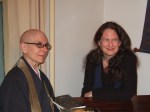
Roko Shinge Roshi and Jane Hirshfield

Roko Shinge Roshi and Jane Hirshfield

A few years ago, the American poet Jane Hirshfield was invited to define Zen practice in seven words. As a young woman Hirshfield spent eight years in full-time Zen training, three of them in a Zen monastery. “That experience,” she has said, “and its continuing life in my life underlie everything I have done since.”* How might Hirshfield’s deep, experiential understanding of Zen, which she views as a path parallel to that of poetry, be articulated in seven words?

To appreciate the daunting nature of Hirshfield’s task, even for a writer of her abilities, please take a minute to try it yourself. Choose something you know well and have known for a long time. Then try to define your subject in seven words. An anonymous Roman writer, who chose the brevity of life as his or her subject, wrote the motto ut hora sic vita, which became, in English, “As an hour, so is this life”. That was a feat of rhetoric as well as a distillation of insight. And it illustrates, not incidentally, that in comparison with Latin, English is a rather wordy language. To say anything of substance in seven English words is itself a worthy challenge.

For the writer who would define Zen, three additional obstacles present themselves. Considered singly, they demonstrate the limitations of any proposed definition. Taken together, they illustrate the paradoxical nature of Zen practice.

To begin with, the tradition known collectively as Zen has changed dramatically over the centuries. Zen is thought to have originated in the sixth century CE, when the Indian monk Bodhidharma, the First Ancestor of Zen, brought the practice of dhyana, or meditation, to China. There it mingled with Confucian and Taoist elements and became known as Chan,  the Chinese word for dhyana. When Chan arrived in Japan four centuries later, it became Zen, the Japanese word for Chan, and it acquired a distinctively Japanese character. In its subsequent migrations through Asia and, more recently, Europe and North America, Zen has continued to adapt to its changing cultural contexts. How can a practice so fluid and protean be defined in seven words?

A second obstacle lies in the interdependent relationship of Zen to other fields of human endeavor. In its rites and rituals, formal Zen resembles a religious order, though it’s also been called the “religion before religions”. As a rigorous physical discipline, requiring one-pointed concentration, it has something in common with the martial arts. As a form of inquiry that aims to relieve human suffering, it shares common cause with psychology, particularly cognitive therapy. And as an aesthetic, embodying principles of harmony, simplicity, and directness, it has influenced artistic pursuits as diverse as architecture, painting, tea-drinking, and landscape gardening. How can a practice so interconnected with others be isolated in a simple definition?

And last, though Zen can be readily identified by a noun, it is not really an entity. It is not a solid thing. Rather, it is an activity—a continuing practice of mindfulness. As Eido Shimano Roshi reminds us, “Zazen is both something one does – sitting cross-legged, with proper posture and correct breathing – and something one essentially is. To emphasize one aspect at the expense of the other is to misunderstand this subtle and profound practice.”** But whether one emphasizes does or is, both are verbs; both point toward an evolving practice, not a static form. How can a definition, which assumes some degree of stability, be applied to a practice that is inherently vibrant, unpredictable, and ever-changing?

Jane Hirshfield found her own way. “Zen pretty much comes down to three things,” she wrote. “Everything changes; everything is connected; pay attention”.

_________

*Atlantic Unbound, September, 1997.

**Eido Tai Shimano Roshi, “What is Zen,” http://www.amacord.com/taste/essays/zen.html.

Read Full Post »

In his memoir “Something to Write Home About” the poet Seamus Heaney recalls an experience from his rural childhood in Northern Ireland. Near his parents’ farm in Co. Derry, there was a ford in the River Moyola. A trail of stepping stones led from one bank to the other. Venturing into the river, “from one stepping stone to the next,” he felt a sense of security, mixed with a sense of daring:

Suddenly you were on your own. You were giddy and rooted to the spot at one and the same time. Your body stood stock still, like a milestone or a boundary mark, but your head would be light and swimming from the rush of the river at your feet and the big stately movement of the clouds in the sky above your head.*

Looking back at this experience, Heaney sees it as a metaphor for the capacity of human beings “to be attracted at one and the same time to the security of what is intimately known and the challenges and entrancements of what is beyond us”. For the poet Heaney, the experience is also a metaphor for a good poem, which “allows you to have your feet on the ground and your head in the air simultaneously.”

Seamus Heaney is not a Zen practitioner, though his poems often have a contemplative character. But his experience of standing “stock still” in the middle of a river, with the current flowing past him and the clouds moving above his head, has something in common with the practice of Zen meditation.

In practicing zazen, or seated meditation, we assume a posture that resembles a pyramid. Using the meditation cushion as a wedge, we keep our knees on the mat below, forming a triangle with our sitting bones. Leaning forward, then straightening up, we allow the spine to assume its natural curvature, erect but resilient. Exhaling fully in this position, we let our weight and our awareness drop into the lower abdomen. As we settle into stillness, we feel aligned and firmly grounded. To heighten our awareness of our stable posture, Thich Nhat Hanh suggests we silently recite the verses, “Breathing in, I see myself as a mountain. / Breathing out, I feel solid”.

Yet if the posture of meditation engenders feelings of solidity, it also fosters openness to experience. Because we are sitting still, we become more sensitive to movement within and around us, be it the flow of breath or the buzz of a fly at the window. Because our posture promotes relaxed alertness, we can observe the thoughts that cross our minds, as though they were clouds in the sky. And because we are resting in awareness, we can recognize those mental habits—those recurrent memories, fantasies, and expectations—that leave little room for anything more productive. Merely by bringing awareness to that mental traffic, we may cause it to diminish, clearing a space for creative thought.

In December, 1995, Seamus Heaney traveled to Stockholm to receive the Nobel Prize for Literature. In “Crediting Poetry,” his Nobel Lecture, he reflected on his “journey into the wideness of language, a journey where each point of arrival—whether in one’s poetry or one’s life—turned out to be a stepping stone rather than a destination”. For the meditative practitioner, whose aim is the deepening of awareness, wisdom, and compassion, the journey may be very different, but the underlying pattern is much the same. Successive acts of attention, made possible by the practitioner’s stable base, open the ego-centered self to a more expansive reality, be it the wideness of language or the ocean of human suffering. On the long path toward compassionate understanding, each moment fully realized becomes a stepping stone, each step a fresh arrival.

__________________________________________

*Seamus Heaney, Finders Keepers (Faber, 2002), 48. For the full text of “Crediting Poetry” see http://nobelprize.org/nobel_prizes/literature/laureates/1995/heaney-lecture.html

Read Full Post »

If you have been reading this column for a while, you may remember Imre, the rambunctious three-year-old whom I taught to sit still. As his reward, he received a matchbox car.*

Imre is now four, and he recently learned the word forsythia. At the time, we were examining the forsythia bush in our front yard. Its buds were green and about to turn yellow. “Can you say forsythia?” I asked.

Imre could not. So I broke the word into syllables, giving special emphasis to the second, which is difficult to pronounce. For-SITH-ee-uh. Imre practiced the word several times and finally got it—more or less. He seemed pleased with his achievement, though his newly acquired word could not compete with the word stinky, which he relished saying, over and over.

The forsythia plant is named after William Forsyth (1737-1804), a Scottish botanist and a founding member of the Royal Horticultural Society. Had it been named after William’s great-grandson, Joseph Forsyth Johnson (1840-1906), the famous gardener and landscape architect, it would been much easier for Imre to pronounce.  But perhaps it deserves the more difficult name, being as it is a foreign import.

The forsythia is a genus in the olive family, with eleven species, all but one of them native to eastern Asia. Forsythia is an integral component of Chinese medicine and is sometimes used in Chinese cooking. In Korea, a stringed instrument called the ajaeng is played with a stick of forsythia wood. The stick is scraped across the strings, producing a deep and raspy sound.

Given its exotic origins, the forsythia might be regarded in Western New York as a prized plant, worthy of infinite care. As it happens, it is more often viewed as a common shrub, whose chief function is to announce, in bright yellow hues, the end of another winter. By some, the forsythia is seen as a nuisance, requiring frequent pruning if it is not to become a monster. To a four-year-old child, a forsythia bush is something new and even exciting. But is it possible for conditioned adults like ourselves to see it afresh?

According to one school of Zen thinking, the name itself presents an obstacle. In a four-line poem fundamental to the Zen tradition, the First Zen Ancestor,  Bodhidharma, describes Zen as a practice of “direct seeing, not dependent on words and letters”. Following Bodhidharma’s lead, Zen teachers sometimes view language with suspicion and regard words as impediments to fresh seeing. The word forsythia is one thing, the shrub another. Proud of knowing the name, we may fail to see the object at all.

That point is well taken, but  knowing the name of a plant or tree can sometimes help us to notice it.  And beyond that, the name can provide access to its “suchness”—its unique and transient presence.

If  you would like to experience this for yourself, sit in a comfortable, upright position, following your breathing. Choose an object in your surroundings, and while looking at that object, contemplate its name. Repeat the word slowly, listening to its consonants and vowels. As you continue to intone the name, notice how its meaning gradually dissolves, leaving a succession of syllables or merely a gauze of sound. At that point, ask the question “What is this?” Let the question resonate in silence. Then ask it again, and yet again, and see where it leads you.

First propounded by the fourteenth-century Zen master Bassui Tokushō, the question “What is this?” is sometimes followed, in Zen practice, with the statement “I don’t know.” Practiced with diligence, Bassui’s koan can reveal the limitations of our knowledge and our language. It can remove our mental cataracts and restore our sense of wonder. And it can refresh a world “sicklied o’er,” as Hamlet put it, “with the pale cast of thought”.

———————————————————————-

See #   8     Sitting without goals

Read Full Post »

In the Rinzai Zen tradition, the first interview between student and teacher is an auspicious formal occasion. The required attire includes not only a robe but also the white booties known as tabi, which cover the feet and ankles. Tabi are fastened with hooks and eyes located on the inside of the ankle.  For Westerners they are difficult to manage, even on the best of days.

On the morning of my own first interview with Jiro Osho Fernando Afable at Dai Bosatsu Zendo, a formal Rinzai monastery, I forgot all about my tabi. They were nestled like sleeping rabbits in the sleeves of my robe. As I prepared to leave for my interview, a senior monk noticed my oversight. He gestured sternly toward my feet, and I took his point.

Unfortunately, there are no chairs in a Japanese zendo. Rather than hunker on a cushion, I stood on one foot, then the other, as I struggled to put on my tabi. At one point, I hopped; at another, I nearly fell over. It must have taken me three minutes to marshal my partially hooked tabi into a semblance of order.  Meanwhile, the senior monk was summoning every bit of his Zen discipline to keep a straight face. I suspect that he told the story to his fellow monks later on.

Embarrassing though it was, my awkwardness was not unusual. Ceremonial forms abound in Japanese Zen, and to the uninitiated Westerner they often feel as alien as they are compelling. From the relatively simple protocol known as jukai, in which a lay practitioner “receives the precepts,” to the high theater of shitsugo, in which a seasoned priest receives the title of roshi, public ceremonies acknowledge the practitioner’s deepening insight. And even on ordinary days, when nothing special is being recognized, celebrated, or commemorated, a sense of ceremony permeates the zendo. It can be seen in the bows and heard in the bells. It can be smelled in the incense. For the Western lay practitioner, this pervasive atmosphere of ceremony presents a challenge to the skeptical mind as well as the reluctant body. How much Asian ceremony should be included in a Western lay practice? How much is essential?

In addressing those questions, it is important to remember that Asian ceremonial forms, as used in Zen, exist primarily to support the practice of mindfulness. Pressing the palms together and bowing to one’s teacher, for example, is a way of expressing gratitude and respect. But it is also a way of knowing that one is expressing gratitude and respect and a way of cultivating those states of mind. For those prepared to embrace them, the bows, chants, prostrations, and other elements of traditional Zen can become as integral to the practice as awareness of breath and posture.

For those who are not, however, there is another way of integrating a sense of ceremony into one’s daily life. It is well described by Brother Joseph Keenan (1932-1999), who taught religion at La Salle University and was also a master of the Japanese tea ceremony:

The making of a bed, the folding of laundry, walking down stairs, driving a car to work — instead of racing through these actions with the mind-set of simply getting them done, savor them as present moments which contain hidden riches, and do them in the most beautiful way. Do them not from egotistical motives of self-fulfillment, but rather as gifts to the world that express to those you meet that you really want to present the best to them. In this approach to life even in today’s world . . . the niggling details of the daily grind can become moments of joy, moments filled with sweet nectar to be savored rather than tension-filled tasks. With this sort of attention to mundane actions, you can open yourself and others to a greater awareness of what is around you in the here and now.*

Although Brother Keenan is speaking of the tea ceremony, his description applies equally to a committed lay practice. In such a practice, each mundane task becomes an occasion for ceremonial regard. Each is an end in itself, not a means to a practical end. Each is an act of giving.

_________________________________________________

* Brother Joseph Keenan, “Tea for All Nations: The Japanese Tea Ceremony”

http://web.archive.org/web/20080528100807/www.teahyakka.com/keenanlayout.html

See also http://www.phillytea.org/about.html

Read Full Post »

When my son, Alexander, was a child we often took walks around the village of Alfred on Sunday mornings. We had no agenda, other than to spend some time together and to explore our surroundings.

Being closer to the ground, Alexander sometimes noticed things that I overlooked. On one April morning, he spotted two crumpled plastic cups near Seidlin Hall. They reeked of stale beer. “Who put those there?” he asked.

“Thoughtless people,” I replied.

A few weeks later, Alexander noticed some crushed soda cans in the Kanakadea Creek. “It must have been the Thoughtless People,” he concluded. In his imagination, I surmised, the Thoughtless People had become a band of feckless nincompoops, who roved the streets of Alfred, New York, dropping refuse wherever they went.

Perhaps he was not far wrong. But in retrospect, I wonder whether my response to his question, however fatherly, was all that wise. At best, it was incomplete.

If there are Thoughtless People, there must also be Thoughtful People. The one implies the other. In my eagerness to teach a moral lesson, I had created a moral duality, from which my six-year-old son had fashioned an image of his own. In the technical language of philosophy, he had reified an abstraction. On the one side were the Thoughtless People, on the other the Thoughtful People. People who know better. People like ourselves.

Twelve years earlier, Joni Mitchell had done something similar in her song “Big Yellow Taxi.” In that 1970 song Joni complained that an unspecified “they” had “paved paradise / and put in a parking lot”. In a subsequent verse she admonished farmers to “put away that D.D.T.” before it destroyed “the birds and the bees.” On the one side of her moral polarity stood avaricious developers and pesticide-wielding farmers; on the other, the trees, birds, and bees—and virtuous enviromentalists like herself.

To be sure, such polarities serve a practical purpose. Certain people, and certain aggregates of people, tend to be greedy, thoughtless, and destructive. For the sake of ethical clarity, if not also for the common good, it is sometimes necessary to call a spade a spade: to identify such people and such groups, using the familiar language of dualistic thought.

The danger lies in reifying our abstractions, which is to say, in mistaking our moral categories for reality. And one of the benefits of meditation, regularly practiced, is to reveal to us that in the flux of undifferentiated reality, prior to the imposition of moral concepts, there are no Thoughtless or Thoughtful People. There are only actions, our own and others’—actions that have an impact on the web of life.

In his book Coming to Our Senses, Jon Kabat-Zinn puts it this way:

In any given moment, we are either practicing mindfulness or, de facto, we are practicing mindlessness. When framed in this way, we might want to take more responsibility for how we meet the world, inwardly and outwardly in any and every moment—especially given that there just aren’t any “in-between” moments in our lives.*

Viewing the past in this perspective, we can recognize and regret our thoughtless and destructive actions without being held forever in their thrall.  But by the same token, we can no longer take refuge in images of ourselves as Thoughtful—or Mindful—People. At any future moment, our words and deeds may be thoughtful or thoughtless, mindful or mindless. And much will depend on the difference.

________________________

*Jon Kabat-Zinn, Coming to Our Senses (Hyperion, 2005), 71.

Read Full Post »

The Burren is a limestone plateau in County Clare, Ireland. Occupying more than a hundred square miles, it is one of the quietest places on earth, and its gray expanse has often been likened to a lunar landscape. Yet it also hosts more than six hundred varieties of flowering plants, which thrive in reflected light.

Here is a poem set in the Burren. Its author is Michael Longley, one of Ireland’s finest poets and a lifelong resident of Belfast:

AT POLL SALACH

Easter Sunday, 1998

While I was looking for Easter snow on the hills

You showed me, like a concentration of violets

Or a fragment from some future unimagined sky

A single spring gentian shivering at our feet.

Poll Salach (pronounced pole sol-ock) means “dirty pool” in the Irish language. Poll Salach is situated in the northwest region of the Burren, where the limestone pavement runs into the sea. Despite its name, it is an austere and beautiful site.

The narrator of this poem is walking at Poll Salach, and with a little help from an unnamed companion, he discovers a spring gentian (Gentian verna), a solitary flower. Its five petals are a bright blue, and to the poet the flower resembles a “concentration of violets.” At its center is a pure white throat. According to Irish folklore, to pick a spring gentian is to precipitate an early death. To bring one indoors will cause your house to be struck by lightning.

It is significant that the narrator of this poem was looking for one thing—Easter snow—and discovered another. As the Zen teacher Toni Packer has remarked, most of the time we are looking for something, but we can also cultivate pure looking, or looking for its own sake. In that way we open ourselves to what is present in the here and now.

Something of that kind happens to the narrator of “Poll Salach,” though he is also thinking of the future. For him, the blue of the gentian conjures a “future unimagined sky,” which is to say, a future that has yet to be envisioned, much less determined.

Michael Longley wrote “At Poll Salach” on Easter Sunday, 1998, two days after the Good Friday Agreement was signed in Belfast. The Good Friday Agreement signaled an end to the sectarian violence in Northern Ireland, which had claimed more than 3,000 lives. In the ensuing decade, paramilitaries on both sides of the conflict have relinquished fighting and put their faith in peace and reconciliation.

Last month that truce was threatened, when dissidents from the Irish Republican Army killed two unarmed British soldiers and a member of the Police Service of Northern Ireland, which is now composed of Catholics as well as Protestants. This time, however, the leaders of the once-warring sides united in condemning the atrocities and renewing their commitment to peace.

It remains to be seen whether that peace will hold. Edna Longley, Michael’s wife and a prominent literary critic, has described the “shivering” gentian in her husband’s poem as a “tentative floral image,” which indeed it is. But it is also an image of hope, as potent in its way as the lilies of Easter Sunday.

_____________________________________________________

“At Poll Salach” appears in Michael Longley’s collection The Weather in Japan (Wake Forest University Press, 2000). It is reprinted here by permission of Wake Forest University Press (http://www.wfu.edu/wfupress/index.php).

Read Full Post »

“The present contains the past,” writes the Vietnamese Zen master Thich Nhat Hanh. “The materials of the past which make up the present become clear when they express themselves in the present.”

A few months ago, I was reminded of Thich Nhat Hanh’s words, as I sat in the main room of Flint’s Auto Center in Almond, waiting for a new battery to be installed in my wife’s car.

All around me, the present made its presence felt. As I surveyed the room, I noticed the tall stacks of virgin tires, the bright green batteries on the racks, the factory-fresh fan belts hanging near the ceiling. The phone rang, and someone left a message. Moments later, a hurried young man came in, asking if his car could be inspected that very day. Over the next quarter of an hour, three more customers arrived.

Yet amidst these signs of a thriving business, the past was also expressing itself. High on a shelf lay a vintage copper washboard and a stash of antique toys—a model airplane, a red bus, a metal chicken. On the shelf below stood well-worn cans bearing their famous names: Boraxo, Prince Albert, Gilley’s Beer. Not far away were a Ranger fire extinguisher, a Woodman Bee Smoker, and one of John Flint’s family heirlooms: a manual, cast-iron meat grinder, with which many a sandwich was prepared.

Beyond these evocative relics, what caught and held my attention were the gas-pump signs on the far wall. Esso. White Star. Sky Chief. Fire Chief. Sinclair Dino. Some readers of this column may know that Fire Chief referred to Texaco Fire Chief, a gasoline with an octane high enough to be used in fire engines. A popular radio show of the thirties featured Ed Wynn, the Texaco Fire Chief. “Sinclair Dino” referred to the company’s hugely successful logo, a benign brontosaurus. As part of its imaginative promotion, Sinclair put out, in 1935, a dinosaur stamp album that could be filled only with Dino stamps issued at Sinclair stations. That the gas-guzzling cars of ensuing decades might themselves become dinosaurs was not on anyone’s mind.

“The car used to be greatly admired and desired,” remarks John Casesa, a leading automotive analyst, “but now some people see it as something that is not good for us, like tobacco. . . . The sound of a gas engine, the V8—those are going to be increasingly rare commodities. Maybe we’re going to have to give up that seven-tenths of a second from zero to sixty.”

Maybe so. But as Thich Nhat Hanh often says, the present is made up of the past, and we can learn from contemplating the materials of a bygone era. “If we observe these materials deeply,” he suggests, “we can arrive at a new understanding of them. That is called ‘looking again at something old in order to learn something new’.”*

If you would like to reflect on America’s long romance with the car and the culture of the open road, while also having your car or truck reliably serviced, you need look no further than Flint’s Auto Center in Almond, New York. And while you’re there, don’t overlook the rows of original license plates that line the walls or the roadsign that reads New Mexico, Route 66. Spanning the 2,448 miles from Chicago to Los Angeles and celebrated in Bobby Troup’s famous song, Route 66 was the trail of choice for migrants, dreamers, the Dust Bowl poor, and all those headed west. Some called it the Main Street of America. John Steinbeck called it the Mother Road.

___________________________________________________________________

*Thich Nhat Hanh, Our Appointment with Life (Parallax, 1990), 33.

The full text of John Casesa’s remarks may be found at http://www.onearth.org/article/motown-blues. Flint’s Auto Center is located at 63 Main Street in Almond, New York.


Read Full Post »


As I look out our kitchen window, the most prominent presence in my field of vision is the fifty-year-old pin oak tree in our backyard. Embedded in its trunk, halfway up, is a red metal hook, which the bark has nearly concealed. Running up and down from the hook is a long, deep crack.

Twenty years ago, I screwed that six-inch bike hook into the trunk. At the time, I owned no clothes dryer, and it occurred to me that I might run a clothesline between the house and the tree. My notion was innocent enough, and, by today’s ecological standards, admirably green. What did not occur to me is that I might injure the tree.

As injuries go, the one I inflicted is less than catastrophic. Over the past two decades, the oak tree has thrived, and now it towers above our house, providing shade in the summer and a year-round habitat for birds and other creatures. It is, in fact, in vigorous health, as shown by the volume of acorns it dumps on our deck, the piles of leaves it deposits in our gutters.

Yet that red hook remains, as does the ugly scar it caused. And together they illustrate the principle of cause and effect, which in Zen teachings is known as karma. In popular culture, that word carries mystical associations, conjuring a chain of causation that extends well beyond the boundaries of this life. But the root meaning of “karma” is simply “action,” and, as used in Zen, it usually means just that. This is because that is. Our words and deeds have consequences. In the words of Zen master Thich Nhat Hanh, what we say and do creates “our continuation, whether we want it to be so or not”.

To those of a reflective disposition, that is hardly news. Live long enough, and you will observe the long-term effects of even the most casual compliment, insult, reassurance, or rebuke. And that is to say nothing of our major actions, personal, social, and political—actions whose effects may ramify for generations. But in Zen teachings, as in the law, it is not only words and deeds that matter. So do the thoughts that gave rise to the words and deeds.

“Mind,” we are told in the first verse of the Dhammapada, a fundamental text in the Zen tradition, “is the forerunner of action. / All deeds are led by mind, created by mind. / If one speaks or acts with a corrupt mind, suffering will follow, / As the cart follows the hoof of the ox.” Conversely, if one “speaks or acts with a serene mind/ Happiness will follow, / As surely as one’s shadow.”*

Taken seriously, these lines have serious implications. We are responsible, they imply, for our thoughts and states of mind as well as our words and deeds. And we are also responsible for cultivating a “serene” mind, which is to say, a mind that looks deeply, sees clearly, and causes as little harm as possible.

As I look out our kitchen window in the early mornings, I am sometimes reminded of those admonitions.

March 12, 2009

———-

* The Dhammapada, tr. Ven. Ananda Maitreya (Parallax Press 1995), 1.


Read Full Post »

In November, 1972, I accompanied Dan and Lillyan Rhodes to the University of Rochester to hear a reading by the poet Gary Snyder. A native of Fort Dodge, Iowa, Daniel Rhodes was an internationally known potter, sculptor, and professor of ceramic art at the New York State College of Ceramics at Alfred University. He was also a longtime friend of Gary Snyder.

Of the poems I heard that evening, one in particular made a lasting impression:

PINE TREE TOPS

In the blue night

frost haze, the sky glows

with the moon

pine tree tops

bend snow-blue, fade

into sky, frost, starlight,

the creak of boots.

Rabbit tracks, deer tracks,

what do we know.*

As he read the last line of his poem, Snyder stressed the word “we.” What can we presume to know, he seemed to be asking, in the presence of the natural world’s nocturnal beauty? His tone was one of awe, tempered by disdain for human presumption.

Gary Snyder’s poem owes something to Ezra Pound, one of Snyder’s poetic mentors, who admonished us to “pull down [our] vanity”  and to “learn of the green world what can be [our] place.” Snyder’s lines also reflect his practical experience as logger and forest ranger, his empathic study of indigenous cultures, and his lifelong practice of Zen meditation.

In one well-known story from the lore of Zen, a monk sets out on a pilgrimage in his straw hat, robe, and sandals. Along the way he encounters a Zen master, who asks him where he’s going. “Around on pilgrimage,” the monk replies.

“What is the purpose of pilgrimage?”asks the master.

“I don’t know,” the monk confesses.

“Not knowing is the most intimate,” replies the master.

That story is conventionally interpreted as an illustration of “beginner’s mind.” By not presuming to know where he is going, the monk is opening himself to whatever he encounters. Void of expectations and preconceptions, he can meet the world directly.

That interpretation is plausible enough, but Gudo Nishijima, a contemporary Zen master, has a different take on the story. In Nishijima’s view, the monk’s response acknowledges the limitations of his perceptions. To be sure, we usually know our immediate destinations. In relative terms, we know where we are going. In ultimate terms, however, we really have no idea where we’re headed. By admitting as much, the monk remains in touch with ultimate reality, even as he lives in the relative world.

Thirty-six years ago, as I listened to Gary Snyder read “Pine Tree Tops,” I did not know that Dan Rhodes would retire and leave Alfred the next year—or that he would die of a heart attack in Nevada in 1989, at the age of seventy-eight. Nor did I know that Gary Snyder, Beat poet and author of  rugged lyric verse, would become an icon of the environmental movement, or that his progressive views on ecology, derived from the ancient principle of ahimsa (“non-harming”), would become moral imperatives in the early 21st century.

Gary Snyder is a man of wide erudition, with a deep respect for the natural and social sciences. In offering the teaching of not-knowing, he is not sanctioning an aggressive ignorance. Rather, he is urging an attitude of humility and reverence, lest we do further harm. Resonant at the time, his lines are even more urgent now.

____________________________

*Gary Snyder, Turtle Island (New Directions, 1974). To hear Gary Snyder read “Pine Tree Tops,”  go to http://cdn3.libsyn.com/bubba/Gary_Snyder_Spiritual_Spice_14.mp3?nvb=20091124134834&nva=200911251.


Read Full Post »

“Snow was general all over Ireland,” writes James Joyce at the end of his short story “The Dead.” In this celebrated story Gabriel Conroy, a middle-aged Dubliner, comes to terms with his own mortality. As often in Western literature, snow is a metaphor for death.

Today, what is general all over America—and indeed the world—is fear, whether its object be joblessness, a terrorist attack, or the more familiar specters of aging, sickness, and death. What have Zen teachings to say about fear? And what has Zen practice to offer?

One person who has confronted fear in general and the fear of death in particular is Joan Halifax Roshi, founder and Abbot of the Upaya Zen Center in Santa Fe, New Mexico. Trained as an anthropologist, Roshi Joan turned to Zen practice after the death of her grandmother. For the past four decades she has devoted her life to teaching Zen and caring for the dying.

In her new book, Being with Dying (Shambhala, 2008), Halifax presents the fruit of her life’s work. Observing that the fear of death causes many of us to avoid, ignore, or otherwise deny the “only certainty of our lives,” she reminds us that “to deny death is to deny life.” And to embrace death can be the ultimate form of liberation:

The sooner we can embrace death, the more time we have to live completely, and to live in reality. Our acceptance of death influences not only the experience of dying but also the experience of living; life and death lie along the same continuum. One cannot—as so many of us try to do—lead life fully and struggle to keep the inevitable at bay.

But how, exactly, are we to embrace death? To address our fear?

Halifax offer a wealth of “skillful means,” including zazen, walking meditation, reflection on one’s priorities, and the contemplation of nine perspectives on living and dying (“The human life span is ever-decreasing; each breath brings us closer to death”). But of her many strategems, two in particular stand out, the first of them a practical method, the second a matter of attitude.

Halifax calls her method “strong back, soft front.” By this she means the posture of meditation, in which we first straighten, then relax, our backs, feeling the strength and stability of an upright spine. Having established that stability, we soften the front of our bodies, opening our lungs to the air and our minds to things as they are. We bring our presence, strengthened but softened, to whatever suffering we encounter.

Simple though it sounds, this practice can bring immediate calm. And over time, it can engender a profound shift of attitude :

To meet suffering and bear witness to it without collapsing or withdrawing into alienation, first we must stabilize the mind and make friends with it. Next, we open the mind to life—the whole of life, within and around us, seeing it clearly and unconditionally from that stable inner base. And then we fearlessly open our hearts to the world, welcoming it inside no matter how wretched or full of pain it might be. I’ve come to call this the “threefold transparency”—us being transparent to ourselves, the world’s being transparent to us, and us being transparent to the world.

As Halifax readily acknowledges, this practice is anything but quick or easy. But with the necessary effort come eventual liberation and the capacity to be of genuine help to others. “It may take effort,” she observes, “to return our mind to practice. And it usually takes effort to bring energy and commitment to everything we do. Effort at its very core means letting go of fear.”

At a time when fear is as general as Joyce’s snow, such a perspective is as worthy as it is rare.

Read Full Post »

« Newer Posts - Older Posts »