
Not long after I retired from college teaching, at least a half dozen friends and acquaintances, meeting me on the street or in the supermarket, asked me whether I was keeping busy. My practiced answer: “Busier than ever,” which seemed to settle the matter. Common to both the question and the answer was the unstated assumption that keeping busy is a good thing. Busyness is a virtue.
Which quite often it is. Busy people get things done. Whether those things are worth doing is an open question. But if nothing else, keeping busy structures time and keeps the blues away. And for those who might be tempted to wander off the paths of righteousness, keeping busy can be an effective deterrent. I learned this lesson at the age of ten, when I went around our neighborhood peddling plaster-of-Paris crucifixes I had crafted and painted all by myself. “Good for you, young man” said one elderly lady, as she reached in her purse for her wallet. “Satan finds some evil for idle hands to do.”
Taking issue with this conventional wisdom, one classical Zen teaching offers a contrasting perspective. In Case 21 of The Book of Equanimity, a foundational collection of Zen koans, a monk named Yunyan is earnestly sweeping the ground, giving this mundane task his wholehearted attention. Observing him hard at work, his brother and fellow monk Daowu challenges him by remarking, “Too busy!” To which Yunyan replies, “Brother, you should know there is one who is not busy.”
Like most Zen koans, this riddling anecdote admits of multiple interpretations. One of the most illuminating is that of Sobun Katherine Thanas (1927-2012), a renowned Zen teacher in the Soto lineage. “The one who is not busy,” she explains, refers to a “quality of mind” that may be described in three ways. It is the “awake mind,” the “not-knowing mind,” and “the mind of readiness.” Together these terms define the “one who is not busy.”
Of the three “minds” to which Thanas refers, the “awake mind” is probably the most familiar to meditative practitioners. The awakened mind is present for the present moment. At once alert and relaxed, concentrated and calm, it is neither lost in the past nor preoccupied with the future. It is focused intently on what is at hand. Beyond that, the deeply awakened mind has taken what Eihei Dogen (1200-1253), founder of the Soto Zen tradition, called “the backward step.” It has shifted its general orientation from the changing conditions of the present moment to immovable awareness: from the successive acts of attention that create the contents of mind to the broader field of mind itself, which embraces those multiple acts of attention. This broadened perspective is roughly analogous to a shift on a TV screen from the play-by-play action of an NFL game, narrated by an attentive sportscaster, to the view from the Goodyear blimp hovering above the field. In this analogy, the sportscaster is our cognitive consciousness making sense of what it sees. The blimp (or its pilot) is the “one who is not busy.”
“The mind of not-knowing,” Thanas’s second term, refers to another dimension of this all-encompassing view. The mind of not-knowing is open to whatever occurs. Free of cognitive filters and tolerant of uncertainty, it meets the expected and unexpected alike on their own terms. Unburdened by prejudicial attitudes, fixed ideas, and self-fulfilling prophecies, the mind of not-knowing (also known as “beginner’s mind”) respects the unprecedented, unrepeatable nature of each new circumstance. Adapting to changing conditions, physical and emotional, the mind of not-knowing is nimble and courageous enough to engage them at close range. The Zen adage “not-knowing is the most intimate” epitomizes this aspect of “the one who is not busy.”
Last and most important for the conduct of everyday life is the “mind of readiness,” which includes and implements the qualities just discussed. Capable of both the immediate and broader view, continuously aware of both the contents and the field of mind, the mind of readiness is unhindered by ego-centered frameworks and limiting preconceptions. Also known as “the mind that alights nowhere,” it is ready to respond, flexibly and effectively, to whatever may arise. Shunryu Suzuki Roshi likened the mind of readiness to a frog sitting at the edge of a pond, calm and relaxed but poised at any moment to throw out its tongue and catch a fly. For my own part, I would liken the mind of readiness to the red fox who showed up one morning in our backyard. Sitting quietly on his haunches, as if he had nothing else to do or nowhere else to go, he was ready for whatever threat or prey might come his way. Beautiful in his own right, this visitor from the natural world was also a befitting emblem of the “one who is not busy.”
_______
Katherine Thanas, The Truth of This Life: Zen Teachings on Loving the World as It Is (Shambhala, 2018), 35.
Photo by Ben Howard

 Last month, an Alfred State College student, who was working on a project concerning “spiritual life in the Alfred area,” contacted me to request an interview. Although I am hardly an authority on such matters, I agreed to speak with him. His questions, submitted in advance, struck me as serious and provocative. Foremost among them was the question, “Why do you think it is important for students to explore spirituality while in college?”
 “We rarely contact this simple moment,” wrote the Zen-trained teacher Toni Packer (1927-2013). “So used to constant input and excitement, we lack fine-tuning into all the subtleties of this instant, the ability to register a quiet aliveness without the stirring of expectation.”

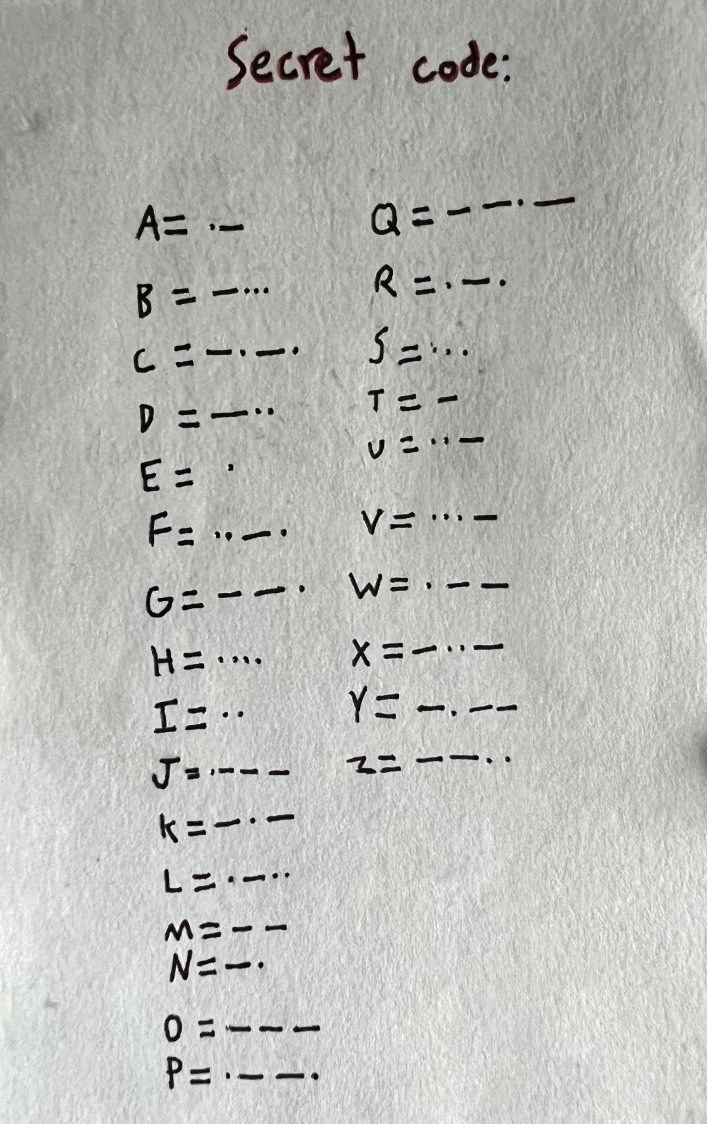 During her recent visit, our nine-year-old granddaughter learned to send Morse code. Having found the code in her activity book, she printed it out in her own, precise hand on a 4 x 6” notecard. As it happens, I learned Morse code myself when I was not much older than Allegra is now. Tapping a pencil on our dining-room table, I taught her how to translate the printed dots and dashes of the code into rhythmic patterns of sound. By the end of her stay, she was able to send “I love you, Dad” to her father. And to her grandfather (who was still in his pajamas), “Have a nice shower, Grandpa.”
 One Time, One Meeting