Feeds:
Posts
Comments

42. Taking care

Garden Buddha, by Robin Caster

Garden Buddha, by Robin Caster

If you have lived in America for the past two decades you have almost certainly been enjoined to take care. Among contemporary American expressions, that benign valediction ranks with Have a nice day in frequency of use, and it is often used in much the same way. What we are supposed to take care of is left unspecified, but that is beside the point. Take care of everything, the phrase might well be saying, until we meet again.

Zen teachings also admonish us to take care. In her book Mindfully Green, the environmentalist Stephanie Kaza provides a vivid example:

In Zen kitchens, students are trained in what is called “knife practice,” that is,  how to take care of knives properly. First, this means noticing the properties of  the knife while you are using it—its weight, its sharp edge, the way it feels in the  hand, how it cuts. Then, when you’re done with the knife, it means washing and drying it immediately and putting it back in the chopping block to keep the knife safe. Doing this practice faithfully changes your relationship with knives. You are practicing caretaking as an investment in the well-being of things. This is the opposite of consuming things until they are gone. *

As here described, “knife practice” exemplifies conservation and ecological awareness. Taking care of our kitchen knives, we also take care of the planet Earth.

Knife practice is but one instance of samu, or work practice, which is as integral to Zen as sitting meditation. In Zen centers and monasteries, residents and guests alike devote at least an hour a day to caretaking: to scrubbing steps, cleaning bathrooms, chopping vegetables, and other mundane chores. As a practical matter, these daily labors keep the zendo clean and running smoothly. Beyond that, they train Zen students to “lower the mast of the ego,” respect the humblest pot or pail, and concentrate on one thing at a time. Performed in silence and with full awareness, work practice prompts the practitioner to examine conventional notions of low and high, menial and exalted labor. And as an embodiment of an ethic, it extends beyond the zendo into domestic life, where the same principle may be applied to the care of a house or garden, bicycle or car.

The ethical principle of “taking care” also extends beyond the care of material objects. Broadly interpreted, it includes the care of one’s body, mind, and heart, moment by moment, through the practice of meditation. Zen master Thich Nhat Hanh puts it this way:

To meditate means to go home to yourself. Then you know how to take care of the things that are happening inside you, and you know how to take care of the things that are happening around you. All meditation exercises are aimed at bringing you back to your true home, to yourself. Without restoring your peace and calm and helping the world restore peace and calm, you cannot go very far in the practice.**

In keeping with this admonition, Thich Nhat Hanh directs us to bring awareness to the parts of our bodies, moving systematically from the eyes to the lungs to the heart, and so on. In another exercise, we bring awareness to our sensations, noting whether they are pleasant, unpleasant, or neutral. And in another, we attend to our states of mind, including those of anxiety and anger. If we are experiencing the latter, we are urged to take care of it, as a parent might care for a crying child. Rather than vent or suppress our anger, we bring a gentle attention to its presence. By so doing, we allow its energies to disperse or to change into something more constructive.

The wisdom of Zen is not confined to arcane koans or ancient Chinese stories or the cryptic sayings of the masters. It also resides in everyday life—or, in this case, in the commonest of American expressions. So may I suggest that when you hear that expression, you regard it not as an empty cliché but as wise and timely advice. Let it remind you to take care.

___________________________

*Stephanie Kaza, Mindfully Green: A Personal and Spiritual Guide to Whole Earth Thinking (Shambhala 2008), 135.

**Thich Nhat Hanh, “This Is the Buddha’s Love,” an interview with Melvin McLeod, Shambhala Sun (2008), http://www.shambhalasun.com/index.php?option=content&task=view&id=2882.

41. The way it is

Since the death of Walter Cronkite in July, much has been written about the late anchorman’s moral authority. According to a Roper poll taken in 1974, Walter Cronkite was “the most trusted man in America”. When he gravely intoned his signature line, we believed him. However shocking or sad the reality just reported, that’s the way it was. The CBS Evening News with Walter Cronkite had opened a window on things as they were.

Zen practice also aims to put the practitioner in touch with reality, as it is in this very moment. And every Zen center or monastery has, as it were, its own Walter Cronkite. Whether he or she is called Abbot, Sensei, Roshi, or simply “head teacher,” the person in this position embodies the inherited wisdom and the venerable authority of the Zen tradition. If the person is a “lineage holder,” which is to say, has received “Dharma transmission” from an earlier teacher, the weight of authority is even greater. It is, in most instances, unquestioned, and one of the core requirements of a prospective Zen student is to believe in the teacher. If a Zen student is unable to do that, the student is well-advised to find another teacher.

Yet if the structure of the traditional zendo is authoritarian, the practice itself is quite the opposite. It is radically egalitarian. From the start, Zen students are enjoined to rely on direct experience: to trust their senses, not the words of any teacher. Every morning, students in Rinzai Zen training chant the verses “Atta dipa / Viharata / Atta sirana / Ananna sirana,” which roughly translate as “You are the Light / Rely on yourself / Rely on nothing but yourself”. This is followed by “Dhamma dipa / Dhamma sirana / Ananna sirana,” which translates as “Rely on the Dharma / Rely on nothing but  the Dharma”. Although the word Dharma has multiple meanings, in this context it is best understood as “reality,” or “the laws of reality,” most prominently those of  impermanence and interdependence. It is left to us to perceive those laws—and to realize ourselves within our immediate surroundings. As one ancient Chinese master told his student, “I can’t  wear clothes for you. I can’t eat for you. . . I can’t carry your body around and live your life for you”. We must do these things—and know we doing them—ourselves.

How, then, is the near-absolute authority of the Zen teacher to be reconciled with the imperative to trust direct experience and rely on ourselves? And to the extent that we embrace a particular Zen lineage, to what extent are we free to question its authority? To speak for ourselves?

For Toni Packer, who left the Rochester Zen Center to establish the Springwater Center for Meditative Inquiry, the resolution lay in dropping the liturgy, forms, and hierarchies of traditional Japanese Zen, leaving only the sitting, listening, and questioning. For traditionalists, however, the resolution lies not in discarding hierarchical structures but in clearly defining the teacher’s role. Often that role is likened to a mirror, which reflects the present state of the student’s mind and heart.

In my own experience, the most helpful teachers have been those who have urged their students to look honestly into their lives, moment by moment, and to act in accordance with what they see. Rather than answer abstract questions with absolute authority, such teachers return their students, time and again, to the concrete, reliable practice of zazen: to a direct and continuous contact with reality, just as it is. Only then can the student realize the richness and depth of present experience. Only then can he or she say, with any real authority,  “That’s the way it is”.

40. Resting

“During our sitting meditation,” writes Zen master Thich Nhat Hanh in “Resting in the River,” “we can allow ourselves to rest like a pebble. We can allow ourselves to sink naturally without effort to the position of sitting, the position of resting. Resting is a very important practice; we have to learn the art of resting.” 1

In A Conservationist Manifesto, 2 his new collection of essays on environmental issues, Scott Russell Sanders offers an evocative variation on this theme. Drawing on both his personal experience and his extensive knowledge of the Judeo-Christian tradition, Sanders likens meditative practice to the observance of the Sabbath. In both, he notes, we rest from our labors. In both, we “grant rest to all those beings . . . whose labor serves us.”

The word Sabbath, Sanders reminds us, comes from a Hebrew root meaning “to rest.” And in an essay entitled “Wilderness as a Sabbath for the Land,” he examines the nuances of the word, drawing on relevant passages from the books of Exodus, Deuteronomy, and Leviticus. According to those sources,  the Sabbath is, as Sanders puts it, a time to “lay down our tools, cease our labors, and set aside our plans, so that we may enjoy the sweetness of being without doing.” But it is also a time to reenact the liberation of the Hebrew people “for the benefit of everyone and everything under their control.” For the Earth and the laborer alike, the Sabbath is a restorative, affording “medicine for soil and spirit, a healing balm.”

Turning to the New Testament, Sanders recalls the stories of Jesus offending the Pharisees by healing on the Sabbath. As Sanders sees it, “Jesus interpreted the Sabbath as a day for the breaking of fetters,” and “instead of dwelling on what was forbidden, he dwelt on what was required—the relief of suffering, the restoring of health.” When he proclaimed that “the Sabbath was made for humankind, and not humankind for the Sabbath,” he was “recalling the spirit of freedom and jubilee implicit in the gift of the Sabbath.” For the Sabbath, in this interpretation, is not only a day of rest, in which we are restored to a state of wholeness. It is also a day “for deliverance . . . from whatever entraps us.”

In “Stillness,” a closely related essay, Sanders directly links the keeping of the Sabbath with the practice of meditation. Recounting the experience of sitting peacefully in a hut in the woods, he describes his sense of intimacy with the natural world:

I wish to bear in mind all the creatures that breathe, which is why I’ve chosen to make my retreat here within the embrace of meadow and woods. The panorama I see through the windows is hardly wilderness, and yet every blade of grass, every grasshopper, every sparrow and twig courses with a wild energy. The same energy pours through me. Although my body grows calm from sitting still, I rock slightly with the slow pulse of my heart. My ears fill with the pulse of crickets and cicadas proclaiming their desires. My breath and the clouds ride the same wind.3

As he reflects on this experience, Sanders is reminded of the Sabbath and the injunction that every fiftieth year, the earth be granted a “solemn rest.” And he suggests that “whatever our religious views, we might do well to recover the idea of the Sabbath, not only because we could use a solemn day of rest once a week but also because Earth could use a respite from our demands.”

To be sure, the practice of meditation is not only one of rest and healing. It is also one of dynamic inquiry. But by invoking the idea of the Sabbath, Sanders provides an illuminating paradigm for meditative practice. What begins in solitude conduces to an awareness of the earth’s manifold inhabitants.  What begins in rest conduces to liberation.

________________________________________________

1 Thich Nhat Hanh, “Resting in the River” http://www.pathandfruit.com/Books2/Thich_Nhat_Hanh_Resting_in_the_River.htm

2 Scott Russell Sanders, A Conservationist Manifesto (Indiana University Press 2009).

3 Sanders, p. 199

39. Travels

For many people, summer is the season for travel. And for those who practice a contemplative discipline, travel can be a catalyst for spiritual growth. The seventeenth-century poet Basho, master of haiku and author of The Narrow Road to the Deep North, believed that “nothing is worth noting that is not seen with fresh eyes”. His extensive travels freshened and enlarged his vision. Thomas Merton had similar experiences in Asia, as recorded in his Asian Journal.

Yet for those whose primary discipline is Zen meditation, travel can also present a formidable challenge. Insofar as the practice of Zen requires us to sit still, and travel requires us to be on the move, Zen and travel appear to be at odds. How might the one support the other? How might the practice of Zen be integrated with the experience of travel?

To begin with, the practice of meditation can alleviate the anxiety of travel. One of my friends told me the story of being in an international airport on a day when many flights had been canceled. People were berating ticket agents, yelling into their cell phones, and experiencing general misery. Then, as it happened, the Vietnamese Zen master Thich Nhat Hanh arrived in his brown robes, accompanied by the monks and nuns of Plum Village. Silent, gentle, and slow-moving, their presence transformed their environment. People quieted down.

Not everyone, of course, can be so fortunate as to have a troupe of Zen monastics on hand to relieve the fear of travel. But meditative practice, as taught by Thich Nhat Hanh, can calm the fearful mind. As he explains in his book by that title, we can lessen our anxieties not by drugging them with Valium or Johnnie Walker but by honestly acknowledging them and bringing a kind attention to their presence. “Breathing in, I am aware of my anxiety. / Breathing out, I bring kind attention to my anxiety.” Over time, this simple practice can help to diminish the anxiety of travel.

So can the practice of sitting still, even when surrounded by incessant movement. Meditation is often described as a way of “stopping” and “coming home”. By sitting still and following our breathing, we return to the stability of immovable awareness. We restore our equanimity. To be sure, it can be awkward to stop when everyone else is moving or to sit perfectly still in a public place. But we can find ways to sit still without calling attention to ourselves. And more often than not, passers-by are too preoccupied with their own affairs to care whether we are moving or sitting still.

Beyond the maintenance of personal balance, Zen practice can also deepen the experience of travel.  In an earlier column I described the exercise of asking “What is this?” and regarding the things of this world as if we were seeing them for the first time.* When traveling, we really are seeing things for the first time—and quite possibly the last. By asking “What is this?” we become present for whatever we are seeing, be it a glacier in Alaska or a cathedral in Madrid. And the places we see, in turn, become present for us. Later on, we can learn their names and study their histories. But by asking “What is this?” we open ourselves to our immediate experience.

Eihei Dogen, founder of the Soto school of Zen, cautioned against unnecessary travel. “It is futile to travel,” he advised, “to dusty countries, thus forsaking your own seat”. But Dogen was hardly one to talk, being himself a traveler who sojourned in dusty China and brought the practice of Chan back to Japan. And for the resourceful practitioner, travel can become a form of “skillful means,” complementary to sitting meditation and consistent with its purpose.

May your travels be safe and your flights on time.

___________________________________

* Column 34, “What is This?”

If you have looked closely at advertising copy, you may have noticed how often the word perfect appears in printed ads, whether the product be an appliance, an item for the garden, or a vacation rental. For only $18.97 you can own Black and Decker’s 2-Slice Toaster with Electronic Shade Control, which will provide you with “perfect toast and bagels every time”. If you would like to spruce up your lawn, Patch Perfect Grass Seed  will ensure “perfect even coverage every time”. If travel is on your horizon, Summer House on Winter Bay, a rental property on Prince Edward Island, offers “the perfect choice for your golfing group, family reunion, or destination wedding”. And if you would like to enhance your experience of Zen meditation, you can buy a Mountain Timer from Zen Mountain Monastery at a cost of $145.00, plus shipping and handling. Designed to free you from glancing at a clock, the Mountain Timer is the “perfect complement to the stillness of meditation.”

As these examples suggest, the word perfect (together with ideal, its first cousin) has become a buzzword in the advertising business, if not a mantra.  Presumably, the word has become prominent because it has proven to be effective. What does its prominence tell us about its targeted clientele, namely ourselves?

The most obvious answer is that advertising appeals to our desires, and we would like the objects of those desires to be perfect, or as close to perfect as possible. Why settle for burnt toast or mediocre bagels? Why put up with a spotty lawn or a less-than-perfect vacation spot? And why use a stick of incense (the traditional method for timing a sitting) when you can have the perfect complement of a Mountain Timer? Fueling our fantasies, the word perfect feeds and creates our appetites and longings.

At a more covert level, the word also sends the message that our present lives—and by extension, our present selves—are woefully imperfect. By buying the perfect toaster we will help to remedy that remediable situation. By becoming smart, informed consumers, we will fill the vacancies in our daily round. By investing in a perfect future, we will relieve our present suffering.

As can be seen in the ad for the Mountain Timer, American Zen has not been impervious to Western consumer culture. On the contrary, meditation has often been sold as a form of stress reduction or promoted as a mode of self-improvement. But the primary aim of Zen practice is not to reduce stress or to place new heads, as one of the teachings puts it, on top of our present ones. Rather, it is to cultivate a clear and stable awareness of what is going on, within and without, and to free ourselves from our negative conditioning. And if one persists in the practice, what one is likely to see, clearly and unequivocally, is the connection between our conditioned images of perfection and the suffering we inflict on others and ourselves.

“My love, she speaks like silence,” Bob Dylan sang in 1965, “without ideals or violence.” In the same song (“Love Minus Zero / No Limit”), he contrasted his lover’s serene self-containment with the dissatisfaction of “bankers’ nieces” who “seek perfection / expecting all the gifts that wise men bring”. Over the past four decades, we have witnessed the horrific violence that misguided idealism can loose upon the world. And in the past year we have seen the economic ruin that unbridled greed can foster. Looking inward, can we also see how unexamined notions of perfection lead us to destroy our happiness, impose unrealistic expectations on ourselves and others, and devalue our present lives? Can we learn to live more wisely?

37. Me and Mu

In New York State you can own a Personalized License Plate, better known as a vanity plate, for $ 43.00. To retain your plate you will need to pay an annual fee of $ 25.50. Depending on your viewpoint, that is a lot or not much to pay for the privilege of having your name—or that of your trade, your passion, or your favorite sport—emblazoned on your car.

As I was driving on the New York State Thruway the other day, I came upon the ultimate vanity plate. Pulling into a rest stop, I noticed the out-of-state license plate on a sporty silver car. In bold black letters, it proclaimed its owner’s first concern:

ME

On either side of these letters were several inches of white space, which gave further prominence to this one, all-important word.

It’s common to hear the word “me” in conversation, but it was striking to find that word isolated on a license plate. I was reminded of a poem by my one-time mentor, the Maine poet Philip Booth (1925-2007). Entitled “Marches,” the poem is an exploration of seasonal change and human mortality.

In the first four stanzas the narrator reflects on the advent of spring, imagines the young “wading the surf, getting wasted, pretending / they cannot die,” and envisions “thousands of death-needles” being passed, leaving “hundreds of / children. . . born with systems in no way immune”. In the last two stanzas, he reflects on  the imminence of death in everyday life, especially life on the highway:

And millions of the rest of us, self-righteous

in the perfect democracy of backcountry roads, freeways,

and interstates, pass each other at life-span speeds;

or close, in opposing lanes, at a hundred-and-thirty,


trusting implicitly in simple self-interest, missing

each other, time after time, only by fragments of seconds,

as we move our lives, or dyings, another round toward

what March may be like in maybe the year 2000.*

Yes, the roads are dangerous, these lines acknowledge, but no one wants to die, and we can depend on each other’s self-interest to keep us alive.

This vision of interdependence is common in Western culture. In sociological terms, it is often called Western individualism; in economic terms, the free-market economy. In America this view has prevailed for at least two hundred years, though of late its economic version has not been faring so well. But there is another vision of interdependence, which the Vietnamese Zen master Thich Nhat Hanh describes in this way:

In our ordinary discriminatory world, we see a teapot as a single, independent object. But when we look deeply enough into the teapot, we will see that it contains many phenomena—earth, water, fire, air, space, and time—and we will realize that in fact the entire universe has come together to make this teapot. That is the interdependent nature of the teapot. A flower is made up of many non-flower elements, such as clouds, soil, and sunshine. Without clouds and earth, there could be no flower. This is interbeing. The one is the result of the all. What makes the all possible is the one.**

In this vision of interdependence, everything depends on everything else. All are interconnected parts of the great, indivisible body of reality, in which energies are constantly being exchanged, and what we normally call “things” are being transformed, moment by moment. To describe that reality, Thich Nhat Hanh has coined the word “interbeing.”

In Japanese Zen, the reality of “interbeing” is epitomized by the Japanese word “mu,” which literally means “no” but in Zen usage has no extractable content. Rather, it is a way of pointing toward things as they are at any given moment—impermanent, void of intrinsic selves, and utterly dependent upon each other. In contrast to “me,” “mu” evokes a fundamental mutuality and engenders a spirit of compassion. Were I to see it on a license plate, I would feel safer on the road.

_________________________________

*Philip Booth, Selves (Viking 1990), 56

**Thich Nhat Hanh, Transformation at the Base: Fifty Verses on the Nature of Consciousness (Parallax Press 2001), 77

36. Seven words

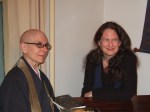
Roko Shinge Roshi and Jane Hirshfield

Roko Shinge Roshi and Jane Hirshfield

A few years ago, the American poet Jane Hirshfield was invited to define Zen practice in seven words. As a young woman Hirshfield spent eight years in full-time Zen training, three of them in a Zen monastery. “That experience,” she has said, “and its continuing life in my life underlie everything I have done since.”* How might Hirshfield’s deep, experiential understanding of Zen, which she views as a path parallel to that of poetry, be articulated in seven words?

To appreciate the daunting nature of Hirshfield’s task, even for a writer of her abilities, please take a minute to try it yourself. Choose something you know well and have known for a long time. Then try to define your subject in seven words. An anonymous Roman writer, who chose the brevity of life as his or her subject, wrote the motto ut hora sic vita, which became, in English, “As an hour, so is this life”. That was a feat of rhetoric as well as a distillation of insight. And it illustrates, not incidentally, that in comparison with Latin, English is a rather wordy language. To say anything of substance in seven English words is itself a worthy challenge.

For the writer who would define Zen, three additional obstacles present themselves. Considered singly, they demonstrate the limitations of any proposed definition. Taken together, they illustrate the paradoxical nature of Zen practice.

To begin with, the tradition known collectively as Zen has changed dramatically over the centuries. Zen is thought to have originated in the sixth century CE, when the Indian monk Bodhidharma, the First Ancestor of Zen, brought the practice of dhyana, or meditation, to China. There it mingled with Confucian and Taoist elements and became known as Chan,  the Chinese word for dhyana. When Chan arrived in Japan four centuries later, it became Zen, the Japanese word for Chan, and it acquired a distinctively Japanese character. In its subsequent migrations through Asia and, more recently, Europe and North America, Zen has continued to adapt to its changing cultural contexts. How can a practice so fluid and protean be defined in seven words?

A second obstacle lies in the interdependent relationship of Zen to other fields of human endeavor. In its rites and rituals, formal Zen resembles a religious order, though it’s also been called the “religion before religions”. As a rigorous physical discipline, requiring one-pointed concentration, it has something in common with the martial arts. As a form of inquiry that aims to relieve human suffering, it shares common cause with psychology, particularly cognitive therapy. And as an aesthetic, embodying principles of harmony, simplicity, and directness, it has influenced artistic pursuits as diverse as architecture, painting, tea-drinking, and landscape gardening. How can a practice so interconnected with others be isolated in a simple definition?

And last, though Zen can be readily identified by a noun, it is not really an entity. It is not a solid thing. Rather, it is an activity—a continuing practice of mindfulness. As Eido Shimano Roshi reminds us, “Zazen is both something one does – sitting cross-legged, with proper posture and correct breathing – and something one essentially is. To emphasize one aspect at the expense of the other is to misunderstand this subtle and profound practice.”** But whether one emphasizes does or is, both are verbs; both point toward an evolving practice, not a static form. How can a definition, which assumes some degree of stability, be applied to a practice that is inherently vibrant, unpredictable, and ever-changing?

Jane Hirshfield found her own way. “Zen pretty much comes down to three things,” she wrote. “Everything changes; everything is connected; pay attention”.

_________

*Atlantic Unbound, September, 1997.

**Eido Tai Shimano Roshi, “What is Zen,” http://www.amacord.com/taste/essays/zen.html.

In his memoir “Something to Write Home About” the poet Seamus Heaney recalls an experience from his rural childhood in Northern Ireland. Near his parents’ farm in Co. Derry, there was a ford in the River Moyola. A trail of stepping stones led from one bank to the other. Venturing into the river, “from one stepping stone to the next,” he felt a sense of security, mixed with a sense of daring:

Suddenly you were on your own. You were giddy and rooted to the spot at one and the same time. Your body stood stock still, like a milestone or a boundary mark, but your head would be light and swimming from the rush of the river at your feet and the big stately movement of the clouds in the sky above your head.*

Looking back at this experience, Heaney sees it as a metaphor for the capacity of human beings “to be attracted at one and the same time to the security of what is intimately known and the challenges and entrancements of what is beyond us”. For the poet Heaney, the experience is also a metaphor for a good poem, which “allows you to have your feet on the ground and your head in the air simultaneously.”

Seamus Heaney is not a Zen practitioner, though his poems often have a contemplative character. But his experience of standing “stock still” in the middle of a river, with the current flowing past him and the clouds moving above his head, has something in common with the practice of Zen meditation.

In practicing zazen, or seated meditation, we assume a posture that resembles a pyramid. Using the meditation cushion as a wedge, we keep our knees on the mat below, forming a triangle with our sitting bones. Leaning forward, then straightening up, we allow the spine to assume its natural curvature, erect but resilient. Exhaling fully in this position, we let our weight and our awareness drop into the lower abdomen. As we settle into stillness, we feel aligned and firmly grounded. To heighten our awareness of our stable posture, Thich Nhat Hanh suggests we silently recite the verses, “Breathing in, I see myself as a mountain. / Breathing out, I feel solid”.

Yet if the posture of meditation engenders feelings of solidity, it also fosters openness to experience. Because we are sitting still, we become more sensitive to movement within and around us, be it the flow of breath or the buzz of a fly at the window. Because our posture promotes relaxed alertness, we can observe the thoughts that cross our minds, as though they were clouds in the sky. And because we are resting in awareness, we can recognize those mental habits—those recurrent memories, fantasies, and expectations—that leave little room for anything more productive. Merely by bringing awareness to that mental traffic, we may cause it to diminish, clearing a space for creative thought.

In December, 1995, Seamus Heaney traveled to Stockholm to receive the Nobel Prize for Literature. In “Crediting Poetry,” his Nobel Lecture, he reflected on his “journey into the wideness of language, a journey where each point of arrival—whether in one’s poetry or one’s life—turned out to be a stepping stone rather than a destination”. For the meditative practitioner, whose aim is the deepening of awareness, wisdom, and compassion, the journey may be very different, but the underlying pattern is much the same. Successive acts of attention, made possible by the practitioner’s stable base, open the ego-centered self to a more expansive reality, be it the wideness of language or the ocean of human suffering. On the long path toward compassionate understanding, each moment fully realized becomes a stepping stone, each step a fresh arrival.

__________________________________________

*Seamus Heaney, Finders Keepers (Faber, 2002), 48. For the full text of “Crediting Poetry” see http://nobelprize.org/nobel_prizes/literature/laureates/1995/heaney-lecture.html

If you have been reading this column for a while, you may remember Imre, the rambunctious three-year-old whom I taught to sit still. As his reward, he received a matchbox car.*

Imre is now four, and he recently learned the word forsythia. At the time, we were examining the forsythia bush in our front yard. Its buds were green and about to turn yellow. “Can you say forsythia?” I asked.

Imre could not. So I broke the word into syllables, giving special emphasis to the second, which is difficult to pronounce. For-SITH-ee-uh. Imre practiced the word several times and finally got it—more or less. He seemed pleased with his achievement, though his newly acquired word could not compete with the word stinky, which he relished saying, over and over.

The forsythia plant is named after William Forsyth (1737-1804), a Scottish botanist and a founding member of the Royal Horticultural Society. Had it been named after William’s great-grandson, Joseph Forsyth Johnson (1840-1906), the famous gardener and landscape architect, it would been much easier for Imre to pronounce.  But perhaps it deserves the more difficult name, being as it is a foreign import.

The forsythia is a genus in the olive family, with eleven species, all but one of them native to eastern Asia. Forsythia is an integral component of Chinese medicine and is sometimes used in Chinese cooking. In Korea, a stringed instrument called the ajaeng is played with a stick of forsythia wood. The stick is scraped across the strings, producing a deep and raspy sound.

Given its exotic origins, the forsythia might be regarded in Western New York as a prized plant, worthy of infinite care. As it happens, it is more often viewed as a common shrub, whose chief function is to announce, in bright yellow hues, the end of another winter. By some, the forsythia is seen as a nuisance, requiring frequent pruning if it is not to become a monster. To a four-year-old child, a forsythia bush is something new and even exciting. But is it possible for conditioned adults like ourselves to see it afresh?

According to one school of Zen thinking, the name itself presents an obstacle. In a four-line poem fundamental to the Zen tradition, the First Zen Ancestor,  Bodhidharma, describes Zen as a practice of “direct seeing, not dependent on words and letters”. Following Bodhidharma’s lead, Zen teachers sometimes view language with suspicion and regard words as impediments to fresh seeing. The word forsythia is one thing, the shrub another. Proud of knowing the name, we may fail to see the object at all.

That point is well taken, but  knowing the name of a plant or tree can sometimes help us to notice it.  And beyond that, the name can provide access to its “suchness”—its unique and transient presence.

If  you would like to experience this for yourself, sit in a comfortable, upright position, following your breathing. Choose an object in your surroundings, and while looking at that object, contemplate its name. Repeat the word slowly, listening to its consonants and vowels. As you continue to intone the name, notice how its meaning gradually dissolves, leaving a succession of syllables or merely a gauze of sound. At that point, ask the question “What is this?” Let the question resonate in silence. Then ask it again, and yet again, and see where it leads you.

First propounded by the fourteenth-century Zen master Bassui Tokushō, the question “What is this?” is sometimes followed, in Zen practice, with the statement “I don’t know.” Practiced with diligence, Bassui’s koan can reveal the limitations of our knowledge and our language. It can remove our mental cataracts and restore our sense of wonder. And it can refresh a world “sicklied o’er,” as Hamlet put it, “with the pale cast of thought”.

———————————————————————-

See #   8     Sitting without goals

In the Rinzai Zen tradition, the first interview between student and teacher is an auspicious formal occasion. The required attire includes not only a robe but also the white booties known as tabi, which cover the feet and ankles. Tabi are fastened with hooks and eyes located on the inside of the ankle.  For Westerners they are difficult to manage, even on the best of days.

On the morning of my own first interview with Jiro Osho Fernando Afable at Dai Bosatsu Zendo, a formal Rinzai monastery, I forgot all about my tabi. They were nestled like sleeping rabbits in the sleeves of my robe. As I prepared to leave for my interview, a senior monk noticed my oversight. He gestured sternly toward my feet, and I took his point.

Unfortunately, there are no chairs in a Japanese zendo. Rather than hunker on a cushion, I stood on one foot, then the other, as I struggled to put on my tabi. At one point, I hopped; at another, I nearly fell over. It must have taken me three minutes to marshal my partially hooked tabi into a semblance of order.  Meanwhile, the senior monk was summoning every bit of his Zen discipline to keep a straight face. I suspect that he told the story to his fellow monks later on.

Embarrassing though it was, my awkwardness was not unusual. Ceremonial forms abound in Japanese Zen, and to the uninitiated Westerner they often feel as alien as they are compelling. From the relatively simple protocol known as jukai, in which a lay practitioner “receives the precepts,” to the high theater of shitsugo, in which a seasoned priest receives the title of roshi, public ceremonies acknowledge the practitioner’s deepening insight. And even on ordinary days, when nothing special is being recognized, celebrated, or commemorated, a sense of ceremony permeates the zendo. It can be seen in the bows and heard in the bells. It can be smelled in the incense. For the Western lay practitioner, this pervasive atmosphere of ceremony presents a challenge to the skeptical mind as well as the reluctant body. How much Asian ceremony should be included in a Western lay practice? How much is essential?

In addressing those questions, it is important to remember that Asian ceremonial forms, as used in Zen, exist primarily to support the practice of mindfulness. Pressing the palms together and bowing to one’s teacher, for example, is a way of expressing gratitude and respect. But it is also a way of knowing that one is expressing gratitude and respect and a way of cultivating those states of mind. For those prepared to embrace them, the bows, chants, prostrations, and other elements of traditional Zen can become as integral to the practice as awareness of breath and posture.

For those who are not, however, there is another way of integrating a sense of ceremony into one’s daily life. It is well described by Brother Joseph Keenan (1932-1999), who taught religion at La Salle University and was also a master of the Japanese tea ceremony:

The making of a bed, the folding of laundry, walking down stairs, driving a car to work — instead of racing through these actions with the mind-set of simply getting them done, savor them as present moments which contain hidden riches, and do them in the most beautiful way. Do them not from egotistical motives of self-fulfillment, but rather as gifts to the world that express to those you meet that you really want to present the best to them. In this approach to life even in today’s world . . . the niggling details of the daily grind can become moments of joy, moments filled with sweet nectar to be savored rather than tension-filled tasks. With this sort of attention to mundane actions, you can open yourself and others to a greater awareness of what is around you in the here and now.*

Although Brother Keenan is speaking of the tea ceremony, his description applies equally to a committed lay practice. In such a practice, each mundane task becomes an occasion for ceremonial regard. Each is an end in itself, not a means to a practical end. Each is an act of giving.

_________________________________________________

* Brother Joseph Keenan, “Tea for All Nations: The Japanese Tea Ceremony”

http://web.archive.org/web/20080528100807/www.teahyakka.com/keenanlayout.html

See also http://www.phillytea.org/about.html