Feeds:
Posts
Comments

Posts Tagged ‘haiku’

One afternoon not long ago, as I was walking in a local gym, I watched a student shooting hoops in an unusual way. On the fingertips of his right hand, he held a basketball. In the palm of his left, he held a cell phone. After taking a single-handed shot, and before the ball had even hit the backboard, he turned his attention to his cell phone. Repeated over and over, his toggling had a rhythm of its own. But it also divided his attention, which could not have been good for his game. And, unwittingly, he was repeatedly flouting a cardinal principle of Zen practice.

In Japanese Zen, that principle is known as ichigyo zammai, which means “doing one thing at a time.” As Zen masters ancient and modern have often reminded us, by giving full attention to whatever we might be doing we not only develop our powers of concentration. We also cultivate the grounded, peaceful state of samadhi: an equanimous, non-reactive, and natural alignment with the flow of reality. “Combust yourself entirely,” a familiar Zen saying, encapsulates this root tenet of the practice.

In classical Japanese poetry, the practice of ichigyo zammai undergirds that most familiar of Japanese poetic forms, the haiku:

A solitary

crow on a bare branch—

autumn evening.

— Basho

In this miniature word-painting, the duality of subject and object dissolves in the meeting of poet and crow. Rather than utilize the crow as a metaphor or symbol, Basho amplifies the bird’s singular presence. What might have been an act of ego-centered observation becomes a moment of life-centered, selfless contemplation.

In Western poetry, which tends to regard encounters with the natural world as occasions for moral, metaphysical, or psychological reflection (“I wandered lonely as a cloud”), there is no exact equivalent of the Japanese haiku. But a parallel may be seen in a sub-genre of lyric poetry known in German as the dinggedicht and in English as the “thing-poem.” As those labels suggest, poems of this kind concentrate on a single thing. And often the poet establishes, in Martin Buber’s famous formulation, an “I-Thou” rather than an “I-It” relationship with the object at hand.

In Rainer Maria Rilke’s “The Panther,” for example, the narrator’s consciousness merges with that of a panther confined to its cage. In Elizabeth Bishop’s poem “The Fish,” the narrator’s sporting, anthrocentric frame of mind morphs into one of reverence and awe. And in the poems of such Zen-trained American poets as Gary Snyder, W.S. Merwin, and Jane Hirshfield, the narrators typically treat their objects of attention with deep respect and disinterested regard.

Such is the case in Hirshfield’s poem “A Chair in Snow,” where the narrator contemplates a snow-covered chair, focusing on the quiddity, or “whatness,” of her subject. After observing that a chair covered with snow ought to be like any other object “whited / & rounded,” she distinguishes it from all other snow-covered objects primarily by virtue of its function:

more than a bed

more than a hat or house

 a chair is shaped for just one thing


 to hold

 a soul its quick and few bendable

 hours


 perhaps a king


 not to hold snow

 not to hold flowers

For Hirshfield, there is something melancholy in this scene. “[A] chair in snow,” she notes, “is always sad.” Presumably, this sadness stems from the chair being isolated and out of place in an alien environment. But the chair’s stark displacement is also an essential component of its singularity.

As a young woman, Jane Hirshfield spent eight years in Zen training, first at the Tassajara Zen Mountain Center in California’s Ventana Wilderness and subsequently at the San Francisco Zen Center and Green Gulch Farm. In 1979 she received lay ordination in Soto Zen. Reflecting on those early, intensive experiences, Hirshfield, now in her seventies, has remarked that they have influenced her life and work ever since. In its concentration, its intimacy with its subject, and its spirit of inquiry, “A Chair in Snow” vividly confirms that claim.

Beyond that, Hirshfield’s poem represents a quality of sustained, one-pointed attention that is growing increasingly rare in our culture, where millions of people experience their smart phones as vital appendages and frequent scrolling-and-swiping as a necessary, if not obsessive, activity. As Chris Hayes, in his book The Siren’s Call (Penguin, 2025), has noted, attention has become a commodity, which the titans of social media compete to manipulate and otherwise control. And the fragmentation of attention is fast becoming the norm.

To those pernicious social trends, the daily practice of ichigyo zammai offers a potent antidote. By their very nature, the twin disciplines of doing one thing and concentrating on one object at a time settle the restless mind and calm the anxious heart. And for those young people I have observed jaywalking across busy streets, their heads bowed and their eyes fixed on their cell phones, this venerable practice might prove as life-preserving as it is timely.

To read the full text of “A Chair in Snow,” see

http://www.poetryfoundation.org/poetrymagazine/poems/56174/a-chair-in-snow.  
Read Full Post »

Falling blossoms


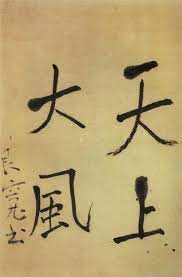
Sky Above, Great Windsdfdd

As I was walking up North Main Street in Alfred, New York a few weeks ago, I stopped to look at a row of Cleveland pear trees spanning two front yards. The trees were in full bloom. Their brilliant white blossoms caught the late-morning light.

A week later, those blossoms had fallen. Only the green leaves remained. I was reminded of a haiku by the Zen master, poet, and calligrapher Daigu Ryokan (1758-1831):

            Falling blossoms

            Blossoms in bloom are also

            falling blossoms

As Kazuaki Tanahashi, Ryokan’s biographer and translator, has noted, this haiku “presents the Zen paradox that flourishing is no different from withering.”* Flourishing and withering are two distinct phases in the life cycle of blossoming trees, but the two are one in the stream of life.

If Ryokan’s haiku embodies the paradox of non-duality, it also represents the principle of impermanence, one of the fundamental tenets of the Zen tradition. Ryokan entered a Zen temple at the age of sixteen and was ordained as a monk two years later. Through his rigorous Zen training and his intensive study of Japanese classical poetry, he was well acquainted with the truth of impermanence, a truth harshly confirmed when his father, a prominent and prosperous local official, ran afoul of the ruling shogunate and committed suicide by drowning. Yet, for all his understanding of transiency, Ryokan could still be moved by fresh evidence of that inviolable law. On one occasion, as he was walking down a path at the foot of a mountain, he came upon “an ancient cemetery filled with countless tombstones.” The names on the tombstones were obliterated, the lives of the dead long since forgotten. “Choked with tears, unable to speak,” he took his staff and returned home.

Ryokan lived alone in a thatched-roof mountainside hut, having renounced the world of money, fame, and power. A mendicant monk, he often ventured into a nearby village, where his calm presence was said to confer an atmosphere of peace on the places and people he encountered. From time to time, he invited visitors to his hut for tea or sake, but for more than twenty years, he spent the bulk of his hours in silence and solitude, tending his garden, practicing zazen, and reading and writing poetry, companioned only by the natural world:

Only two in the garden,

plum blossoms at their peak

and an old man full of years

As vivid as it is immediate, this haiku presents one of many such impressions in Ryokan’s poems. Collectively these sensuous impressions register an uncommon intimacy with the sights, sounds, and smells of his natural environment. Whether he is noting a nightingale in the brush, frogs “chanting,” “plum trees reflecting the silver moon,” hail striking bamboo, wind in the pines, or a monkey’s cries from a distant valley, Ryokan’s imagery bespeaks a cultivated openness to what the dharma teacher Gaylon Ferguson has called the “redemptive fullness” of the natural world.* In contrast to our own ubiquitous consumerism, which views fulfillment as something to be acquired from the latest consumer product, Ryokan’s poems evoke an abundance not dependent on wealth or power:

Out-breath

and in-breath

proof that the world

is inexhaustible.

Yet for all his appreciation of natural abundance, Ryokan also demonstrated a capacity for non-attachment, not only to nature but also to human preconceptions of value and importance. His most famous haiku, composed after a thief broke into his hut and stole his meager belongings, expresses that quality of heart and mind:

The thief left it behind—

the moon

at the window

Just as this haiku reflects Ryokan’s non-attachment to material possessions, his observation that “blossoms in bloom are also / falling blossoms” attests to his freedom from conventional hierarchies of value, which prize blossoms in bloom far more than their fallen counterparts. In the language of Zen,  each exists in its “suchness” and its “dharma position,” independent of human yardsticks. Practicing non-attachment, Ryokan contemplates things as they are and not as the human mind, eager to impose its rankings on whatever it encounters, would have them be.

Which is not to say that Ryokan practiced “detachment” or a cold indifference to the world of human striving and suffering. On the contrary, in one of his most piercing haiku, he voices a complaint reminiscent of many a conscientious priest, minister, rabbi, or pastor:

Oh, that my priest’s robe were wide enough

to gather up all the suffering people

in this floating world

A confession of his personal limitations, this haiku also defines Ryokan’s moral character. Little wonder that this humble hermit-poet, who spurned both the careerism of the literary world and opportunities for temporal prominence in the Zen community, is now among the most treasured poets in the Japanese Zen tradition. “When we know one Ryokan,” wrote Daisetz T. Suzuki in his Zen and Japanese Culture, “we know hundreds and thousands of Ryokans in Japanese hearts.”


* Kazuaki Tanahashi, Sky Above, Great Wind: The Life and Poetry of Zen Master Ryokan  (Shambhala, 2012), 2.

*Gaylon Ferguson, Welcoming Beginner’s Mind (Shambhala, 2024), 173.

Photo: Calligraphy by Ryokan: “Sky Above, Great Wind.”

Read Full Post »

And yet, and yet

ISSA 2

In 1973, the writer and Zen practitioner Peter Matthiessen and the field biologist George Schaller undertook an expedition to the High Himalayas in hopes of sighting the elusive snow leopard. Before departing for the Tibetan Plateau, Matthiessen consulted with his Zen teacher, Eido Shimano Roshi, at Dai Bosatsu Zendo. Drawing upon a fundamental Zen teaching, Eido Roshi advised his student to “expect nothing.” By adopting that attitude, Matthiessen would enable himself to be open and attentive to whatever he encountered. Rather than regard his expedition as a means to an end, he might treat the experience as an end in itself.

Eido Roshi’s advice may well have been sound, given Matthiessen’s slim chances of sighting so rare a creature as the snow leopard. As a guideline for living, however, “expect nothing” might best be viewed as a wise maxim to bear in mind rather than a practical motto to live by. We human beings, it’s fair to say, are hardwired not only to expect but also to hope for and fear specific outcomes. Should we attempt to banish our expectations, we are more than likely to fail. As a realistic alternative, however, we can resolve to take note of our expectations as they arise, acknowledging both their presence and their largely speculative nature. And we can endeavor to remain cognizant, moment by moment, of the ongoing tension between the time-honored wisdom of Zen and the recalcitrant realities of human nature.

Nowhere is that tension more concisely expressed than in this haiku by the Japanese poet and Buddhist priest Kobayashi Issa (1763-1828):

             tsuyu no yo wa

             tsuyu no yo nagara

             sari nagara

                        –

            The world of dew

            is only the world of dew –

            and yet, and yet

The first two lines of this haiku allude to a central tenet of the Buddhist tradition, articulated in these verses from the Diamond Sutra:

            Think in this way of all this fleeting world:

            As a star at dawn, a bubble in a stream,

            A dewdrop, a flash of lightning in a summer cloud,

            A flickering lamp, a phantom, and a dream.

Through a concentration of metaphors, these verses remind us that all conditioned things are subject to change. All are impermanent. What we may conventionally view as solid and lasting is no more permanent than morning dew. The image of a “world of dew” evokes this foundational premise of the tradition in which the poet-priest Issa was trained.

“The world of dew” also reflects a cardinal principle of Japanese art and poetry.  According to this principle, known as mono no aware, the transience of the things of this world is both a locus of their pathos and a source of their beauty, whether those transient things be cherry blossoms, bubbles in a stream, or our own brief existence on this planet. Beautiful, ephemeral things are moving and beautiful because they are transient. A visual artist as well as a poet, Issa was steeped in Japanese cultural traditions, and as his haiku demonstrates, his aesthetic was deeply aligned with the convention of mono no aware.

But Issa was also a husband and father who had experienced profound losses in his life, including the deaths of his first wife, several of his children, and, shortly before writing the present haiku, the loss of his two-and-a-half-year-old daughter to smallpox. Introducing his haiku in his travel journal The Springtime of My Life, he recounts that devastating experience:

Her mother clutched her cold body and wailed. I knew her heartbreak but also knew that tears were useless, that water under the bridge never returns, that scattered flowers are gone forever. And yet nothing I could do would cut the bonds of human love.

In popular iconography, Japanese Zen is sometimes viewed as a meditative version of samurai culture: a practice marked by “detachment” and the stoic repression of feeling. Contrary to that popular conception, authentic Buddhist practice—and the Zen-based practice of haiku—foster direct engagement with external realities, particularly the realities of impermanence and death. Rather than turn away, practitioners are admonished to make those realities objects of contemplation. At the same time, the practice also encourages continuous awareness of (and non-attachment to) one’s changing moods and feelings, however pleasant or painful they may be.

Hence the last line of Issa’s haiku. Occurring just after the “turning” characteristic of the haiku form, the repeated phrase “and yet” acknowledges the emotional dimension of his present experience: the upwelling of grief triggered by the death of a child. And though it leaves much unsaid, this repeated phrase leaves little doubt as to its meaning.

“The deepest feeling,” wrote the American poet Marianne Moore, “always shows itself in silence; / not in silence but restraint.” As silent and restrained as a poem can be, Issa’s haiku is all the more piercing for its reticence and all the more affecting for its restraint. If you would live wisely, it seems to say, expect nothing. And yet, and yet.

    —–

Image: Kobayashi Issa

Her mother clutched her body: Sam Hamill & J.P. Seaton, The Poetry of Zen (Shambhala, 2004), 172-3.

Marianne Moore,  “Silence,” in The Complete Poems of Marianne Moore (Macmillan, 1972), 91.

Read Full Post »

99788e90

Wallace Stevens 1879-1955

In his poem “Sunday Morning,” the modern American poet Wallace Stevens depicts a leisured woman enjoying her late-morning coffee in a sun-drenched room. “She dreams a little,” the narrator notes; and in her reverie she revisits moments of heightened emotional intensity:

            Passions of rain, or moods in falling snow;

            Grievings in loneliness, or unsubdued

            Elations when the forest blooms; gusty

            Emotions on wet roads on autumn nights;

            All pleasures and all pains, remembering

            The bough of summer and the winter branch.

I first read those lines as an undergraduate, some fifty years ago. They have stayed with me over the decades, partly because of their formal beauty but also because they exemplify what the English poet and philosopher Samuel Taylor Coleridge (1772-1834) viewed as a principal aim of the poetic imagination: the “balance or reconciliation of opposite or discordant qualities.” In this instance, the qualities being reconciled are the disparate emotional states associated with spring and fall, summer and winter. Passion and its absence, grief and elation, loneliness and excitement, pleasure and pain—all are held in balance in one harmonious whole. (more…)

Read Full Post »